Real Estate Investment Benefits India 2026: 7 Budget & Policy Reforms Making Land the Smartest Asset Class
If you belong to the serious capital class — long-term investors, HNIs, NRIs, policymakers, legacy wealth planners — the conversation around property in 2026 is no longer about “where prices are rising this month.” It is about structural shifts.
The real discussion is about the benefits real estate investment brings to India 2026, including policy stability, infrastructure execution, institutional capital participation, and faster regulatory timelines. In a market that has matured significantly over the last decade, intelligent investors are reading budgets, SEBI notifications, corridor announcements, and state-level reforms before reading marketing brochures.
And that is precisely where the real opportunity lies.
This is not a speculative piece. It is a policy-led, fact-based examination of the real estate investment benefits India 2026 offers — grounded in Union Budget 2026–27 allocations, regulatory adjustments affecting REIT participation, freight corridor expansion, City Economic Region planning, and tangible state-level reforms such as approval timeline reductions in Goa.
For experienced investors, 2026 is less about noise — and more about clarity.
The Big Shift: Why Policy, Not Hype are driving Real Estate in 2026
Historically, Indian real estate cycles were often sentiment-driven. A metro announcement, an airport proposal, a celebrity endorsement — and micro-markets would move.
In 2026, the capital ecosystem looks different.
Three structural changes are defining real estate investment benefits India 2026:
- Sustained infrastructure capital expenditure
- Institutionalisation of real estate through regulated structures
- Process efficiency and regulatory streamlining at the state levels
For mature investors — especially those managing generational wealth or global portfolios — these three pillars reduce what matters most: uncertainty risk.
And uncertainty, more than volatility, has historically been the highest hidden cost in land and real estate investing.
A Framework for Reading Real Estate Investment Benefits India 2026
Before diving into reforms, let us simplify the evaluation model.
When assessing real estate investment benefits India 2026, investors should examine four structural indicators:
1. Capital Allocation Direction
Where is public money flowing? Infrastructure spending tends to shape demand corridors.
Are regulators strengthening transparency, liquidity, and participation mechanisms?
3. Regional Development Planning
Is growth concentrated only in metros, or being distributed across emerging clusters?
Are approval timelines improving? Are transaction bottlenecks reducing?
Each of these dimensions has seen measurable movement in 2026.
7 Structural Reforms Shaping Real Estate Investment Benefits India 2026
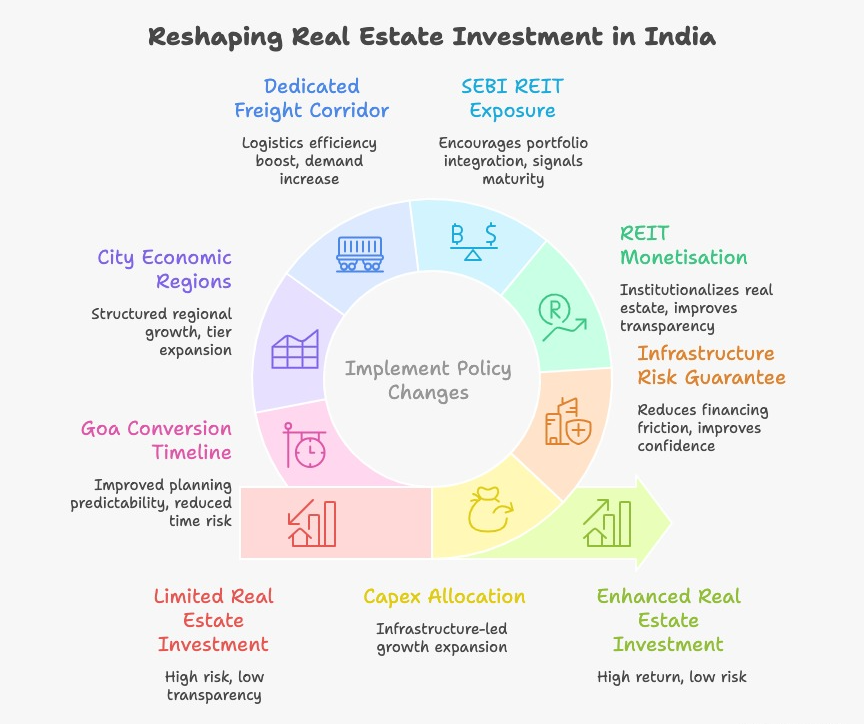
1. ₹12.2 Lakh Crore Capex Allocation: Infrastructure as the Demand Multiplier
The Union Budget 2026–27 allocated ₹12.2 lakh crore towards capital expenditure, reinforcing infrastructure-led growth as a national priority.
Official budget documents and releases confirm the continued commitment to high public capex.
Why This Matters
Infrastructure capital expenditure affects real estate in indirect but powerful ways:
- Reduces travel time between economic nodes
- Improves logistics and freight efficiency
- Expands viable commuting zones
- Enables Tier 2 and Tier 3 growth
- Strengthens industrial and warehousing ecosystems
For long-horizon investors, real estate investment benefits India 2026 are deeply connected to this capex cycle. Real estate performs sustainably where infrastructure reduces friction.
Importantly, infrastructure does not automatically raise land prices. It raises usability. And usability, over time, creates demand.
2. Infrastructure Risk Guarantee Fund: Execution Confidence Improves
One of the less headline-driven but strategically important moves referenced in budget documentation is the proposed Infrastructure Risk Guarantee Fund.
The objective: reduce financing friction and improve execution probability for infrastructure projects.
Investor Interpretation
Projects that stall damage investor confidence. Projects that execute build ecosystem credibility.
If risk-sharing mechanisms improve financing confidence, the probability of infrastructure delivery improves. That strengthens one of the core real estate investment benefits of India 2026: execution reliability.
For seasoned investors, this is not about short-term gains. It is about systemic improvement in development credibility.
3. Dedicated REIT Structures for CPSE Real Estate Monetisation
The Budget also emphasized the use of dedicated REITs for monetising CPSE real estate assets.
Why Institutionalisation Matters
Real estate markets mature when:
- Assets are structured transparently
- Cash flows are formalised
- Reporting standards improve
- Institutional participation deepens
REIT frameworks do not directly impact land prices. But they improve overall market confidence.
One of the more subtle real estate investment benefits India 2026 is that property is being integrated further into regulated capital markets, making it easier to benchmark, track, and understand.
For HNIs and NRIs balancing global allocations, this maturity matters.
4. SEBI: REIT Exposure Treated as Equity from January 1, 2026
SEBI’s move to treat mutual fund and SIF exposure to REITs as equity effective January 2026 signals further mainstreaming of real estate-backed instruments.
Why This Signals Depth
Market classification affects allocation comfort. When REIT exposure aligns with equity treatment, portfolio integration becomes more straightforward.
For investors evaluating real estate investment benefits India 2026, this development indicates:
- Growing regulatory confidence
- Better portfolio positioning flexibility
- Potential improvement in liquidity depth
Again, this does not eliminate risk. But it strengthens systemic credibility.
5. Dedicated Freight Corridor (Dankuni–Surat): Logistics Reshaping Geography
Freight infrastructure directly influences industrial and warehousing demand. The proposed Dankuni–Surat corridor is one such initiative shaping the long-term landscape.
Why Logistics Infrastructure Impacts Land
Freight corridors:
- Lower transportation costs
- Improve industrial viability
- Encourage warehousing clusters
- Create employment hubs
- Generate residential demand nearby
In many global markets, logistics expansion has quietly driven secondary city growth. India’s corridor expansion strengthens this logic.
When evaluating real estate investment benefits India 2026, experienced investors increasingly track mobility and freight networks rather than relying solely on urban headlines.
6. City Economic Regions (CERs): Structured Regional Growth
The Budget analysis by PRS India highlights support for structured City Economic Regions.
Why CERs Matter
CERs aim to:
- Distribute economic growth regionally
- Strengthen infrastructure clusters
- Reduce metro over-concentration
- Encourage new employment nodes
This supports one of the most compelling real estate investment benefits India 2026: the expansion of investable geographies beyond traditional metros.
For investors aged 35–75 managing diversified portfolios, regional growth offers entry flexibility with structural support.
7. Goa Land-Use Conversion Timeline Reduced: 60 to 45 Days
In Goa, legislative change reduced the disposal timeline for land-use conversion applications from 60 days to 45 days.
Why Time Efficiency Is Critical
Land investing carries “time risk.” The longer approvals take, the greater the holding uncertainty.
Reducing official timelines:
- Improves predictability
- Reduces capital lock-in
- Strengthens planning feasibility
For investors examining real estate investment benefits India 2026, process efficiency is as important as price.
Connecting the Dots: What Real Estate Investment Benefits India 2026 Actually Mean
When we combine:
- High infrastructure capex
- Risk mitigation mechanisms
- Institutional REIT integration
- Freight corridor expansion
- Regional planning via CERs
- Regulatory clarity improvements
- Faster state-level processing
We see a pattern.
The real story of real estate investment benefits India 2026 is about reducing systemic friction.
It is not about speculative acceleration.
It is about making the environment more predictable for serious capital.
A Calm Investor’s Playbook for 2026
If you are evaluating real estate investment benefits India 2026, consider these strategic principles:
1. Focus on Infrastructure Over Sentiment
Execution zones outperform announcement zones.
2. Prioritise Clarity
Title chain, zoning, access, compliance — fundamentals matter.
3. Think in Multi-Year Cycles
Infrastructure-led growth is gradual but durable.
4. Separate Location from Legality
Each project and micro-market requires independent verification. Policy tailwinds do not replace due diligence.
5. Respect Capital Preservation
Land can be powerful — but only when selected with discipline.
At this stage, firms that specialise in curated land evaluation and long-term positioning — including platforms such as TOTL Realty — often focus heavily on diligence and ecosystem mapping rather than short-term selling. The broader conversation in 2026 is increasingly about process integrity and strategic positioning.
Risk Management: The Mature Investor’s Edge
No discussion of real estate investment benefits India 2026 is complete without acknowledging risk.
Even in improving policy environments:
- Local implementation can vary
- Infrastructure timelines can shift
- Micro-markets can overheat
- Regulatory compliance remains critical
The most successful investors in the 35–75 demographic often share one trait: patience combined with verification.
Policy creates tailwinds. Discipline captures them.
1) What are the biggest real estate investment benefits India 2026 offers after the Union Budget 2026–27?
The biggest real estate investment benefits India 2026 offers stem from continued infrastructure capital expenditure, institutional strengthening of real estate through REIT frameworks, logistics expansion, and regional development planning. The Union Budget 2026–27 allocated ₹12.2 lakh crore toward capital expenditure, reinforcing infrastructure-led growth as a national priority. Infrastructure investment historically improves connectivity, reduces logistics costs, and supports employment generation — all of which indirectly strengthen real estate ecosystems over time.
For investors, this signals policy continuity and execution focus rather than speculative stimulus. The benefits are structural, not short-term.
2) How does higher infrastructure capex translate into real estate investment benefits India 2026?
Higher capital expenditure does not automatically increase property prices. Instead, it improves long-term usability and accessibility of regions. Roads, freight corridors, rail links, and economic clusters create employment nodes. Employment drives housing demand. Housing demand strengthens land and residential markets.
The real estate investment benefits India 2026 connected to capex are therefore indirect but durable. Investors should track actual execution and connectivity improvements rather than announcements alone.
3) What role do REIT reforms play in real estate investment benefits India 2026?
One of the more important structural real estate investment benefits India 2026 comes from institutional deepening. The government’s emphasis on REIT-based monetisation of CPSE assets and SEBI’s move to treat REIT exposure by mutual funds and SIFs as equity from January 2026 strengthen real estate’s integration into formal capital markets.
This increases transparency, benchmarking, and institutional participation — which can improve overall market confidence.
4) Are real estate investment benefits India 2026 stronger in land compared to apartments?
Land and apartments serve different investment objectives. However, during infrastructure-led cycles, land located in structurally improving corridors often benefits earlier in the development chain.
The real estate investment benefits India 2026 for land investors are closely tied to process efficiency, infrastructure proximity, and zoning clarity. Land typically requires longer holding periods and stronger due diligence, but it can capture value before built assets mature.
Investors should evaluate land based on documentation, access, regulatory compliance, and infrastructure viability.
5) How do freight corridors improve real estate investment benefits India 2026?
Freight corridors such as the proposed Dankuni–Surat Dedicated Freight Corridor influence logistics efficiency. Logistics improvements attract warehousing, industrial development, and service ecosystems. Over time, these clusters create residential demand near employment zones.
The real estate investment benefits India 2026 linked to freight expansion, are ecosystem-driven rather than speculative. Investors should monitor corridor execution and supporting infrastructure.
6) What are City Economic Regions (CERs), and why do they matter for real estate investment benefits India 2026?
City Economic Regions (CERs) are planned economic clusters designed to distribute growth beyond traditional metro centers. According to PRS Budget Analysis, CERs aim to promote coordinated regional development.
For investors, CERs strengthen real estate investment benefits India 2026 by:
- Supporting Tier 2 and Tier 3 expansion
- Reducing metro concentration risk
- Creating structured employment ecosystems
- Enhancing regional infrastructure coordination
CER-driven development tends to produce more stable long-term growth patterns.
Goa reduced the disposal timeline for land-use conversion applications from 60 days to 45 days. While actual timelines may vary depending on documentation and compliance, formal reduction improves planning clarity.
For land investors, process efficiency is one of the most tangible real estate investment benefits India 2026. Reduced official timelines lower uncertainty and improve feasibility modelling.
8) Are real estate investment benefits India 2026 relevant for NRIs and global investors?
Yes. For NRIs and globally diversified investors, real estate investment benefits India 2026 are relevant because of increasing institutionalisation, regulatory strengthening, and infrastructure continuity.
These reforms align Indian real estate more closely with global capital standards — particularly through REIT structures and policy-backed infrastructure planning. However, NRI investors must continue to verify compliance, taxation implications, and repatriation regulations independently.
9) Does improved policy eliminate risk in real estate investment benefits India 2026?
No policy eliminates risk. What the current environment does is reduce systemic friction and improve clarity.
The real estate investment benefits India 2026 narrative is about improved predictability — not guaranteed returns. Risks such as title disputes, zoning inconsistencies, infrastructure delays, and overpricing remain relevant. Mature investors treat policy as a tailwind, not a substitute for diligence.
10) What should investors verify to truly capture real estate investment benefits India 2026?
To align with real estate investment benefits India 2026, investors should verify:
- Clear title and ownership chain
- Encumbrance status
- Zoning classification
- Land-use conversion eligibility
- Access road and infrastructure connectivity
- Proximity to confirmed (not speculative) infrastructure
Policy strength enhances opportunity, but verification captures value. Experienced investors combine macro awareness with micro diligence to optimise long-term outcomes.
Why Land Is Quietly Re-Emerging in 2026
For nearly a decade, the real estate narrative in India was dominated by vertical growth — apartments, mixed-use towers, commercial IT parks, and yield-driven assets. Land remained present, but often under-discussed outside developer circles and long-term family offices.
In 2026, that conversation is subtly shifting.
The reason land is quietly re-emerging is not speculation. It is structural alignment. The macro framework behind real estate investment benefits India 2026 increasingly favors early-stage positioning in ecosystems that are expanding through infrastructure and policy clarity.
Land, unlike built assets, sits at the beginning of the value chain.
When infrastructure corridors expand, when City Economic Regions are planned, when logistics networks deepen, and when regulatory timelines improve, the first asset class to reflect those shifts is often land.
1. Infrastructure-Led Growth Rewards Early Positioning
Large capital expenditure commitments, such as the ₹12.2 lakh crore allocation in the Union Budget 2026–27, signal continuity in infrastructure expansion. Infrastructure does not create immediate resale premiums. It creates viability.
Viability turns dormant parcels into usable locations. Usable locations attract activity. Activity builds ecosystems.
For investors evaluating real estate investment benefits India 2026, this sequence matters deeply. Land positioned near confirmed infrastructure development benefits from structural demand creation before full-scale built development occurs.
This does not imply short-term windfalls. It implies patient value alignment.
2. Regional Growth Models Expand the Land Universe
City Economic Regions (CERs) represent a move toward distributed development. When growth decentralizes from one or two metropolitan anchors into structured regional clusters, new geographies enter the investment map.
For decades, land investing was heavily metro-centric. In 2026, the expansion of regional growth corridors is widening the universe.
The real estate investment benefits India 2026 thesis includes this geographical expansion. As economic activity distributes more evenly, secondary zones — particularly those supported by logistics, highways, and employment nodes — become legitimate long-term considerations.
This is especially relevant for HNIs and NRIs seeking portfolio diversification within India rather than metro concentration risk.
3. Process Efficiency Strengthens Land Confidence
Land has historically carried a perception of administrative complexity — especially regarding zoning clarity, conversion timelines, and procedural uncertainty.
When states introduce reforms that improve official timelines — such as Goa reducing land-use conversion disposal from 60 days to 45 days — the signal extends beyond the number itself. It indicates process awareness.
One of the most tangible real estate investment benefits India 2026 is not price acceleration — it is friction reduction.
For long-term capital, reduced friction means:
- More predictable planning
- Better capital allocation modelling
- Lower opportunity cost
- Improved confidence in holding periods
Land becomes more investable when time uncertainty declines.
4. Inflation, Asset Diversification & Tangibility
Global macro volatility over the last several years has reinforced a classical truth: tangible assets hold psychological and financial value in diversified portfolios.
Land, particularly in structurally growing economies, often serves as:
- A capital preservation hedge
- A generational wealth anchor
- A low-leverage asset class
- A long-duration growth instrument
For investors between 35 and 75 years of age managing intergenerational wealth, land re-emerges not as a speculative vehicle but as a strategic allocation aligned with structural development.
This is where real estate investment benefits India 2026 intersect with wealth philosophy — patience, clarity, and alignment with long-term infrastructure expansion.
5. Land Is Not Yield-Driven — It Is Position-Driven
Unlike rental apartments or REIT-linked income products, land does not generate immediate cash flow. That is precisely why it requires a different mindset.
In infrastructure-led cycles, land’s strength lies in positioning ahead of ecosystem maturity.
The difference between speculation and strategic land investing in 2026 lies in three filters:
- Verified documentation
- Confirmed infrastructure proximity
- Realistic holding horizon
When these filters are respected, the structural environment behind real estate investment benefits India 2026 increasingly supports land as a rational long-term allocation.
Land is not “trending.”
It is re-aligning with policy.
And serious capital tends to notice such shifts quietly before they become headlines.
The Real Estate Investment Benefits India 2026 Thesis
The real estate investment benefits India 2026 thesis is not built on enthusiasm. It is built on convergence.
Convergence between:
- Sustained public infrastructure capital
- Regulatory evolution and institutionalisation
- Regional economic planning
- Process efficiency reforms
- Logistics expansion
- Market structure maturity
When these elements align, they reduce systemic uncertainty — and uncertainty has historically been the highest hidden cost in Indian real estate investing.
This does not eliminate risk.
It does not guarantee returns.
It does not override due diligence.
What it does is improve clarity.
And clarity, for serious capital allocators, is invaluable.
The Mature Capital Lens
For HNIs, NRIs, policymakers, and legacy wealth managers, the environment in 2026 invites a different type of evaluation:
- Is infrastructure being executed, not just announced?
- Are market mechanisms becoming more transparent?
- Are regional growth patterns supported by policy?
- Are regulatory processes becoming more time-efficient?
If the answer to these questions trends positively, then the broader real estate investment benefits India 2026 thesis strengthens.
The conversation moves from speculation to allocation strategy.
Long-Term Positioning Over Short-Term Cycles
Historically, the investors who benefited most from structural infrastructure cycles were not those who reacted late to headlines — but those who positioned early, verified thoroughly, and held patiently.
The 2026 environment appears increasingly aligned with:
- Multi-year holding strategies
- Infrastructure-linked positioning
- Geographic diversification beyond metro saturation
- Asset classes with tangible backing
Land and premium real estate in structurally growing corridors are therefore being evaluated not for excitement — but for alignment.
The Quiet Evolution of the Indian Real Estate Environment
What makes real estate investment benefits India 2026 compelling is not a single reform. It is cumulative progress.
Over time, markets mature.
- Capital markets integrate real estate instruments.
- Public infrastructure pipelines become more consistent.
- States refine approval processes.
- Regional planning reduces over-concentration.
Each step reduces friction.
And friction reduction is one of the most powerful drivers of sustainable investment ecosystems.
A Measured Conclusion
The thesis is straightforward:
India’s real estate environment in 2026 is showing increasing structural maturity.
For disciplined investors, this means opportunity — but only when approached with:
- Verification
- Patience
- Policy awareness
- Geographic intelligence
The real estate investment benefits India 2026 framework does not reward impulsiveness. It rewards clarity.
For those exploring curated land and premium real estate opportunities aligned with infrastructure growth — particularly in regions such as Goa where process improvements and ecosystem expansion intersect — firms operating within a diligence-first framework, such as TOTL Realty, increasingly focus on structured positioning rather than speculative narratives.
The environment is evolving.
The advantage will belong to those who read it calmly, verify it thoroughly, and align capital with structure — not noise.