Infrastructure-Led Real Estate Growth India: 7 Powerful Drivers of 10X Investment Opportunities
India’s Infrastructure Supercycle Has Begun
India is not just growing—it is being rebuilt.
From high-speed expressways cutting travel time by half to metro systems transforming urban mobility and airports unlocking regional economies, the country is witnessing a once-in-a-generation infrastructure expansion. This transformation is not random; it is deeply strategic, driven by large-scale national initiatives like the National Infrastructure Pipeline (NIP) and PM GatiShakti.
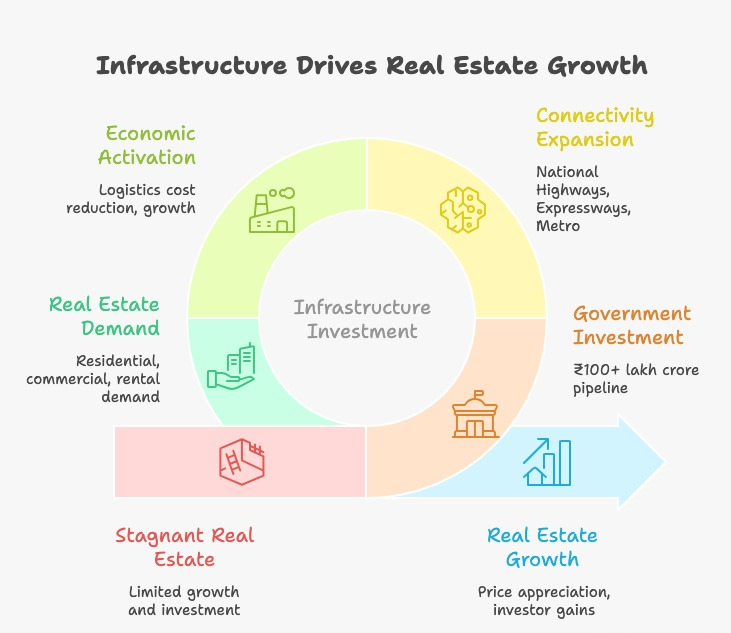
According to the Ministry of Finance (India), India’s infrastructure investment pipeline exceeds ₹100 lakh crore, covering sectors like roads, railways, urban development, and logistics. This is not just development—it is a structural shift.
And at the center of this transformation lies one of the most powerful wealth creation themes of the decade:
Infrastructure-led real estate growth India
For investors, HNIs, NRIs, policymakers, and business leaders, this is not a speculative narrative. It is a data-backed, policy-driven opportunity that is reshaping how land, cities, and economic corridors evolve.
👉 The key insight:
Real estate does not grow randomly—it grows where infrastructure flows.
Why Infrastructure Is the Biggest Driver of Real Estate Value
Every major real estate boom in India has been triggered by infrastructure.
Take Gurugram, which transformed due to NH-48 connectivity. Or Noida, which saw exponential appreciation post the Yamuna Expressway. These are not isolated success stories—they are repeatable patterns.
Infrastructure creates three critical shifts:
- Accessibility – Reduced travel time
- Economic Activity – Increased business and employment
- Demand Surge – Residential and commercial expansion
According to the World Bank, improved connectivity directly enhances land productivity and urban expansion potential.
This is why infrastructure-led real estate growth India is not just about development—it is about time compression. When a 2-hour journey becomes 45 minutes, entire regions become investable.
👉 Investor Insight:
Real estate follows infrastructure, not the other way around.
Highways & Expressways: The Backbone of Land Appreciation
India’s highway network is expanding at an unprecedented pace.
As per Press Information Bureau, the National Highway network has grown to over 1.46 lakh km, marking a significant increase over the past decade. The rise of access-controlled expressways has further accelerated connectivity.
Key corridors redefining growth:
- Delhi–Mumbai Expressway
- Purvanchal Expressway
- Bundelkhand Expressway
These corridors are not just roads—they are economic arteries.
How Highways Drive Real Estate Growth
The pattern is predictable:
Land → Logistics → Commercial → Residential
When a new expressway is announced:
- Land prices are low (early-stage opportunity)
- Industrial and warehousing demand follows
- Businesses move in
- Residential demand rises
This is where infrastructure-led real estate growth India creates its strongest multiplier effect.
👉 Investor Insight:
Early investment near interchanges and access points can unlock multi-fold appreciation over time.
Railways, Freight Corridors & RRTS: Redefining Regional Growth
While highways dominate headlines, rail infrastructure is quietly transforming regional real estate.
Projects like the Dedicated Freight Corridors (DFC) led by Dedicated Freight Corridor Corporation of India Limited are reshaping logistics efficiency across the country.
At the same time, high-speed regional systems like the Delhi–Meerut corridor by National Capital Region Transport Corporation are redefining daily commuting.
Impact on Real Estate
- Tier-2 cities are becoming extensions of metros
- Rise of satellite towns
- Increased demand for plotted developments
- Growth in commercial clusters
This is another powerful layer of infrastructure-led real estate growth India, where distance is no longer a limitation.
👉 Investor Insight:
Cities connected by high-speed rail will see faster-than-average real estate appreciation.
Metro Expansion: The Micro-Market Transformation Engine
India’s metro rail network has expanded from a handful of cities to over 25 urban centers, driven by initiatives from the Ministry of Housing and Urban Affairs.
Metro connectivity creates micro-market booms.
What Happens Around Metro Corridors?
- Property values rise within 500m–2km radius
- Rental demand increases significantly
- Commercial hubs develop around stations
- Liquidity improves
This hyperlocal transformation is a key component of infrastructure-led real estate growth India.
👉 Investor Insight:
Metro connectivity ensures:
- Faster resale
- Higher rental yield
- Strong long-term demand
Explore more:
https://mohua.gov.in/
Airports & Regional Connectivity: The Premium Growth Trigger
India currently operates over 160 airports under the expansion strategy of the Ministry of Civil Aviation (India).
Schemes like UDAN have connected previously underserved regions, unlocking tourism and business travel.
Airport-Led Real Estate Growth
Airports create:
- Hospitality demand
- Luxury residential projects
- Commercial business zones
- Second-home markets
This is especially relevant for premium investors, where location desirability meets global accessibility.
This dynamic strongly reinforces infrastructure-led real estate growth India.
👉 Investor Insight:
Properties near major or upcoming airports often command premium valuations and NRI demand.
Smart Cities & Urban Transformation: Building Future-Ready India
The Smart Cities Mission has already completed over 90% of its projects, focusing on digital infrastructure, governance, and urban efficiency.
Why Smart Cities Matter for Real Estate
- Better livability
- Improved infrastructure
- Enhanced safety
- Efficient public services
These factors attract:
- Corporates
- Skilled workforce
- Long-term tenants
This makes smart cities a key pillar of infrastructure-led real estate growth India.
👉 Investor Insight:
Smart city developments increase both asset value and tenant demand stability.
The Rise of Emerging Investment Corridors
The next wave of real estate growth is not limited to metros.
It is unfolding across:
- Peripheral NCR regions
- Coastal Maharashtra belts
- South India growth corridors
- Tier-2 and Tier-3 cities
These regions are benefiting from:
- Expressways
- Industrial corridors
- Tourism expansion
- Logistics hubs
This is where infrastructure-led real estate growth India offers its most compelling opportunities.
👉 Investor Insight:
Early-stage corridors offer the highest potential for long-term wealth creation.
Understanding the “10X Real Estate Opportunity”
The idea of 10X growth is not a promise—it is a pattern.
Stages of Growth
- Announcement phase
- Development phase
- Demand surge
- Price acceleration
Most investors enter at stage 3 or 4.
But true wealth is created in stage 1 and 2—when infrastructure is planned or under development.
This is the essence of infrastructure-led real estate growth India.
👉 Investor Insight:
Timing matters more than location.
Strategic Investment Framework for HNIs & NRIs
To capitalize on this cycle, investors must evaluate:
Key Factors
- Distance from infrastructure
- Future government plans
- Connectivity timelines
- Legal and regulatory clarity
Best Asset Classes
- Land parcels
- Plotted developments
- Commercial zones near corridors
Among all, land remains the most powerful asset in infrastructure-led real estate growth India.
👉 Investor Insight:
Land appreciates first, fastest, and most significantly in infrastructure cycles.
Risks to Understand (A Balanced Perspective)
No investment cycle is without considerations.
Key aspects include:
- Project execution timelines
- Over-speculation in certain regions
- Importance of due diligence
A strategic approach ensures that infrastructure-led real estate growth India remains a long-term wealth creation journey rather than short-term speculation.
India’s Infrastructure + Real Estate Decade
India is expected to remain one of the fastest-growing major economies, supported by:
- Urbanization
- Industrial growth
- Policy support
- Global investment inflows
Infrastructure expansion will continue to shape how cities evolve, where businesses operate, and where people live.
This reinforces the central theme:
Infrastructure-led real estate growth India will define the next decade of wealth creation.
FAQ
1. What is infrastructure-led real estate growth India, and why is it important for investors?
Infrastructure-led real estate growth India refers to the increase in property value driven by the development of highways, metros, railways, airports, and urban infrastructure. This growth is important because infrastructure directly improves connectivity, which increases demand for residential, commercial, and industrial spaces.
For investors, this means entering markets before infrastructure completion can lead to significant long-term appreciation.
2. How do highways and expressways impact real estate prices in India?
Highways and expressways are among the strongest drivers of infrastructure-led real estate growth India. They reduce travel time, connect remote areas, and attract industrial and commercial activity.
For example, expressways like Delhi–Mumbai have created entirely new investment corridors where land prices have appreciated significantly over time.
3. Why is land considered the best asset in infrastructure-led real estate growth India?
Land is often the first asset to appreciate when infrastructure is announced. In infrastructure-led real estate growth India, land near upcoming projects like highways, metro stations, or airports sees early demand from developers and investors.
Unlike built properties, land has lower entry costs and higher appreciation potential in emerging corridors.
4. How does metro connectivity influence property values in India?
Metro systems significantly boost infrastructure-led real estate growth India by improving urban mobility. Properties within 500 meters to 2 km of metro stations often see higher demand, better rental yields, and increased resale value.
Metro connectivity also attracts commercial development, further increasing property prices.
5. What role do airports play in real estate growth in India?
Airports act as catalysts in infrastructure-led real estate growth India by boosting tourism, business travel, and global connectivity. Areas near airports often see demand for luxury housing, hotels, and commercial developments.
Government initiatives like UDAN are expanding airport connectivity, unlocking new investment regions.
6. What are the best locations to invest in for infrastructure-led real estate growth India?
The best locations are emerging corridors where infrastructure is under development, not already saturated markets. These include:
- Expressway-linked regions
- Metro expansion zones
- Airport influence areas
- Industrial corridors
These regions offer maximum upside in infrastructure-led real estate growth India due to early-stage pricing.
7. How do freight corridors and RRTS impact real estate investment?
Freight corridors and rapid rail systems enhance logistics and commuting efficiency, driving infrastructure-led real estate growth India. They reduce transportation costs, improve connectivity between cities, and create new business hubs.
This leads to increased demand for residential and commercial properties in connected regions.
8. What is the timeline for real estate appreciation in infrastructure-led growth?
In infrastructure-led real estate growth India, appreciation typically follows four stages:
- Announcement
- Development
- Demand surge
- Price acceleration
Maximum gains are usually seen when investments are made during the early stages (announcement or development phase).
9. Are there risks in infrastructure-led real estate investment in India?
While infrastructure-led real estate growth India offers strong potential, investors should consider:
- Project delays
- Regulatory approvals
- Over-speculation in certain areas
Conducting due diligence and investing in verified projects is essential for long-term success.
10. Why is now the right time to invest in infrastructure-led real estate growth India?
India is currently in a high-growth infrastructure phase, supported by government policies, increased capital expenditure, and global investor interest. This makes it an ideal time to enter the market before prices peak.
Infrastructure-led real estate growth India is expected to define wealth creation over the next decade, especially in emerging corridors.
For seasoned investors, the opportunity is clear.
The question is not whether infrastructure will drive real estate.
The question is:
Are you entering before or after the growth happens?
At Totlrealty, the focus remains on identifying early-stage, infrastructure-driven opportunities—where long-term value creation is backed by data, planning, and policy alignment.
Because in this cycle, success is not about chasing growth.
It is about positioning before growth begins.
India’s infrastructure transformation is not just reshaping mobility—it is redefining real estate.
For HNIs, NRIs, and forward-looking investors, infrastructure-led real estate growth India represents one of the most powerful, data-backed, and future-ready investment themes of this decade.
The opportunity is not in what is already built.
The opportunity is in what is about to be built.