Why Land Investment in India Is Emerging as One of the Strongest Long-Term Wealth Creation Opportunities
India is entering one of the most transformative infrastructure and urban expansion cycles in its modern economic history. From massive expressway construction and airport development to industrial corridors, metro expansion, logistics hubs, smart cities, tourism infrastructure, and regional connectivity upgrades, the country is witnessing a structural transformation that is reshaping how investors view real estate.
Amid this shift, land investment in India is increasingly emerging as a strategic long-term wealth creation opportunity. Investors, HNIs, NRIs, businessmen, policymakers, and long-term wealth creators are gradually shifting their focus toward infrastructure-connected land parcels, peri-urban growth corridors, tourism-driven regions, and plotted developments instead of relying only on traditional apartment investments or saturated urban real estate markets.
Unlike built structures that may face depreciation, oversupply, maintenance costs, or changing lifestyle preferences, land remains a finite asset directly influenced by connectivity, infrastructure expansion, urban migration, and economic activity. This is one of the primary reasons why land investment in India is now being viewed through a long-term strategic lens rather than short-term speculation.
India’s infrastructure-led growth story is not only transforming transportation and logistics; it is also reshaping land values across emerging locations.
According to the Government of India, public capital expenditure has increased significantly over the last decade, reflecting the country’s long-term commitment to economic infrastructure creation.
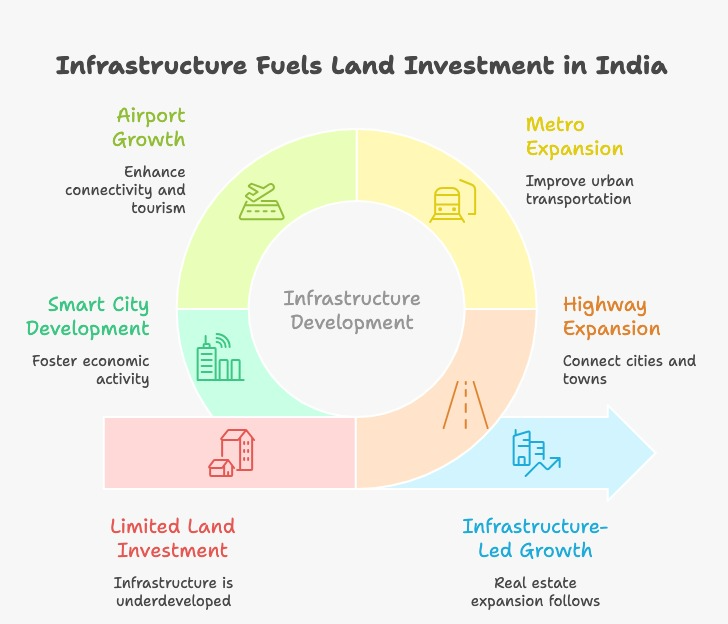
At the same time, highway expansion, airport connectivity, smart city initiatives, and industrial corridors are opening new investment corridors beyond traditional metro cities.
This evolving landscape is creating a powerful narrative around land investment in India, particularly in locations benefiting from:
- Infrastructure development
- Connectivity upgrades
- Urban expansion
- Tourism growth
- Industrial activity
- Lifestyle migration
- Logistics and economic corridors
The growing interest in plotted developments, second homes, wellness communities, eco-living concepts, and experiential real estate further highlights how investor preferences are evolving.
This article explores why land investment in India is increasingly becoming one of the strongest long-term investment themes in the country and how infrastructure-led real estate growth is creating future appreciation opportunities across emerging regions.
India’s Macro Infrastructure Transformation Is Reshaping Real Estate
India’s infrastructure expansion is no longer limited to urban beautification or isolated development projects. The country is witnessing a structural transformation driven by highways, expressways, logistics corridors, industrial zones, metro systems, airport networks, dedicated freight corridors, tourism infrastructure, and integrated urban planning.
This large-scale infrastructure push is becoming one of the strongest catalysts behind land investment in India.
According to the Government of India, the national highway network has expanded substantially over the past decade, while expressway and access-controlled corridor development have accelerated rapidly.
Infrastructure is important for land because connectivity directly influences economic activity, accessibility, migration patterns, business movement, tourism potential, and future urban expansion. Historically, regions that receive major infrastructure upgrades often experience a gradual transformation in land demand over time.
Infrastructure Development in India Is Entering a Historic Growth Phase
India’s long-term infrastructure planning now focuses on integrated economic growth rather than isolated construction projects.
Initiatives such as:
- PM Gati Shakti
- National Infrastructure Pipeline
- Smart Cities Mission
- Dedicated Freight Corridors
- Industrial Corridors
- Regional airport expansion
- Metro rail expansion
are collectively reshaping investment geography across the country.
PM Gati Shakti National Master Plan
National Infrastructure Pipeline
These initiatives are not just improving mobility. They are expanding the economic potential of regions previously considered peripheral or underdeveloped.
For investors studying land investment in India, infrastructure development acts as one of the clearest indicators of future demand generation.
When expressways reduce travel time, airports improve accessibility, industrial corridors generate employment, and logistics hubs increase commercial movement, nearby land gradually becomes more attractive for:
- Residential developments
- Plotted communities
- Warehousing
- Hospitality
- Tourism projects
- Commercial ecosystems
- Lifestyle-driven developments
This is one of the key reasons why infrastructure-led real estate growth is becoming a central theme in modern land investing.
Highways, Expressways & Economic Corridors Are Creating New Growth Belts
India’s expressway and highway network expansion is significantly changing the country’s real estate map.
The rapid development of:
- Delhi-Mumbai Expressway
- Samruddhi Mahamarg
- Bengaluru-Chennai Corridor
- Dedicated Freight Corridors
- Peripheral ring roads
- Regional connectivity highways
is creating entirely new investment corridors.
Historically, major highways and expressways have influenced land appreciation because improved connectivity reduces travel friction and expands urban influence beyond city centers.
For example:
- Peripheral regions become accessible for daily commuting
- Tourism destinations witness increased inflow
- Industrial activity attracts workforce migration
- Logistics hubs increase warehousing demand
- Developers begin exploring plotted and township projects
This expanding economic activity creates long-term relevance for land investment in India.
Unlike apartments that depend heavily on local micro-market cycles, land often benefits directly from macro infrastructure expansion.
In many emerging corridors, investors enter during early infrastructure stages because land values tend to evolve gradually through:
- Announcement phase
- Construction phase
- Connectivity completion
- Economic activation
- Residential and commercial demand growth
This phased transformation is one of the most important concepts behind long-term land investment in India.
Metro Expansion, Rapid Rail & Airport Infrastructure Are Expanding City Boundaries
India’s metro network and airport ecosystem are expanding rapidly.
Metro systems are increasingly transforming suburban regions into viable residential and commercial zones. Regional rapid rail systems are further reducing travel time between cities and peripheral districts.
At the same time, airport development is creating long-term economic ecosystems around emerging cities and tourism destinations.
The Government of India has emphasized regional air connectivity through the UDAN scheme and future airport expansion plans.
Airport-led development influences:
- Hospitality demand
- Tourism growth
- Second-home markets
- Business travel
- Commercial ecosystems
- Luxury villa demand
- Weekend destination economies
As accessibility improves, regions that were once considered distant become part of active investment conversations.
This is another major reason why land investment in India is increasingly shifting toward infrastructure-connected locations instead of only established urban centers.
Why Investors Are Increasingly Shifting Toward Land Investment in India
Modern investors are increasingly reevaluating traditional investment models.
Apartments in many urban markets face challenges such as:
- High density
- Maintenance costs
- Supply competition
- Rental yield limitations
- Structural aging
- Lifestyle shifts
Meanwhile, land investment in India offers a fundamentally different value proposition.
Land is finite. Infrastructure expands, but strategically located land supply remains limited.
This scarcity factor plays an important role in long-term value creation.
Land as a Strategic Long-Term Asset Class
Land is increasingly viewed as:
- A strategic wealth asset
- A long-term inflation hedge
- A legacy investment
- A future utility asset
- A flexible development opportunity
Unlike constructed assets, land does not physically depreciate over time.
Its value is influenced by:
- Connectivity
- Accessibility
- Infrastructure
- Urban growth
- Tourism
- Economic activity
- Government planning
This is why land investment in India is becoming increasingly attractive for long-term wealth creators.
Investors are also recognizing the flexibility associated with land ownership. Land can later evolve into:
- Residential projects
- Villas
- Hospitality spaces
- Commercial developments
- Wellness communities
- Eco-living projects
- Long-term holding assets
This adaptability strengthens the long-term appeal of land compared to fixed-format built structures.
Psychology Behind Modern Land Investors
The psychology of modern investors is shifting toward long-duration asset ownership.
HNIs, NRIs, entrepreneurs, and strategic investors increasingly prioritize:
- Tangible ownership
- Scarcity-based assets
- Long-term preservation of capital
- Intergenerational wealth creation
- Strategic location positioning
This is particularly visible in land investment in India, where investors are studying future infrastructure corridors rather than only current market popularity.
The focus is gradually moving from “where demand exists today” to “where economic and infrastructure activity is likely to expand tomorrow.”
This forward-looking approach is creating growing interest in:
- Peri-urban locations
- Airport corridors
- Tourism destinations
- Coastal belts
- Industrial zones
- Smart city regions
- Emerging suburban growth corridors
How Infrastructure-Led Real Estate Growth Creates Appreciation Potential
Infrastructure-led appreciation works differently from speculative real estate cycles.
When large infrastructure investments enter a region, they often trigger gradual economic transformation.
This includes:
- Improved accessibility
- Increased tourism
- Business movement
- Commercial demand
- Residential migration
- Hospitality growth
- Retail activity
Over time, this economic ecosystem can influence land demand positively.
This is why many strategic investors study infrastructure before making decisions related to land investment in India.
The strongest appreciation cycles generally occur when investors identify regions during:
- Early infrastructure announcements
- Construction stages
- Pre-commercialization phases
- Early tourism expansion
- Industrial activation periods
However, infrastructure-led appreciation should always be viewed as a long-term process rather than immediate short-term returns.
Rise of Urban & Peri-Urban Land Investment Opportunities
India’s urbanization story is expanding beyond traditional city centers.
As metro cities become denser and more expensive, surrounding regions are increasingly becoming active real estate zones.
This trend is strengthening land investment in India, especially in peri-urban and infrastructure-connected regions.
Why Urban Land Investment Is Expanding Beyond Core Cities
Major cities are gradually expanding outward due to:
- Population growth
- Infrastructure expansion
- Traffic congestion
- Pricing pressure
- Commercial decentralization
Peripheral zones are increasingly attracting:
- Residential townships
- Plotted developments
- Logistics parks
- Commercial ecosystems
- Lifestyle communities
This shift is changing how investors approach urban land investment.
Rather than focusing only on central urban areas, many investors now study:
- Outer ring roads
- Highway-connected zones
- Upcoming metro corridors
- Airport influence belts
- Peripheral growth clusters
These regions often become long-term urban extensions as infrastructure matures.
Plotted Development Investment & Future Residential Patterns
The demand for plotted developments has increased significantly in recent years.
Changing lifestyle preferences are influencing residential choices.
Many buyers increasingly prefer:
- Lower-density environments
- Open spaces
- Flexible construction options
- Independent living concepts
- Nature-connected communities
This trend is supporting the growth of plotted development investment across India.
Post-pandemic lifestyle changes have further accelerated interest in:
- Wellness communities
- Farm living
- Eco-living
- Weekend homes
- Leisure-driven developments
These evolving preferences are becoming closely connected with land investment in India.
Tourism, Lifestyle Migration & Experiential Living Are Reshaping Land Demand
Tourism and experiential living are becoming major drivers of regional land demand.
India’s tourism economy is expanding through:
- Spiritual tourism
- Coastal tourism
- Eco-tourism
- Wellness travel
- Heritage tourism
- Hospitality-led development
This growth is influencing land investment in India, especially in tourism-driven regions.
Rise of Second Homes, Wellness Living & Lifestyle Migration
Urban fatigue and changing lifestyle priorities are influencing migration trends.
Professionals, entrepreneurs, retirees, and global Indians increasingly seek:
- Nature-connected living
- Wellness-focused environments
- Flexible lifestyle destinations
- Low-density communities
- Coastal and scenic locations
This is increasing demand for:
- Villa plots
- Wellness retreats
- Boutique hospitality spaces
- Leisure-driven land investments
Experiential living is no longer a niche category. It is becoming a broader lifestyle movement influencing future real estate demand.
Tourism Expansion Is Increasing Strategic Land Value
Tourism infrastructure often creates long-term economic ecosystems.
When tourism grows, supporting demand emerges for:
- Hotels
- Resorts
- Vacation rentals
- Restaurants
- Retail ecosystems
- Wellness spaces
- Hospitality infrastructure
This economic activity gradually influences surrounding land values.
Regions with improving tourism infrastructure often attract long-term interest from investors studying land investment in India.
The rise of the Airbnb economy and experiential hospitality models has also expanded the relevance of tourism-driven land ownership.
Future Growth Corridors in India & Strategic Land Investment Zones
India’s future growth corridors are increasingly being shaped by infrastructure connectivity and economic planning.
These include:
- Airport zones
- Industrial corridors
- Coastal belts
- Tourism circuits
- Smart city regions
- Logistics hubs
- Highway influence corridors
Smart City Investment Opportunities & Planned Urban Growth
The Smart Cities Mission represents one of India’s most ambitious urban modernization initiatives.
Planned urban development can influence:
- Commercial activity
- Infrastructure quality
- Residential demand
- Economic expansion
- Technology integration
These factors strengthen long-term urban relevance and influence land investment in India.
Industrial Corridors & Logistics Hubs as Future Wealth Corridors
Industrial growth creates employment ecosystems.
Employment generates residential demand, commercial movement, and economic expansion.
India’s industrial corridor strategy is becoming increasingly important for future land demand.
Invest India Infrastructure Reports
Manufacturing, warehousing, and logistics expansion are reshaping many emerging regions.
As these ecosystems mature, surrounding land becomes strategically important for:
- Housing
- Retail
- Hospitality
- Mixed-use development
- Warehousing
- Township projects
This is one of the strongest long-term themes supporting land investment in India.
Coastal & Tourism-Led Regions Are Becoming Long-Term Investment Destinations
India’s coastal and tourism regions are attracting growing investor attention.
These locations benefit from dual growth drivers:
- Tourism expansion
- Infrastructure connectivity
Limited coastal land supply also adds scarcity value.
Improved highways, airports, cruise tourism, hospitality growth, and tourism branding are increasing long-term relevance for coastal land investments.
As tourism economies mature, many coastal regions gradually transition into:
- Premium second-home markets
- Hospitality investment zones
- Wellness destinations
- Lifestyle migration corridors
This trend continues, strengthening the long-term outlook for land investment in India.
Strategic Investment Outlook: Why Land Investment in India Is Becoming a Long-Term Wealth Strategy
India’s economic expansion, urbanization, and infrastructure transformation are creating a strong long-term backdrop for land ownership.
Land Scarcity, Urban Expansion & Long-Term Appreciation
Strategically located land remains finite.
As infrastructure expands and cities grow outward, demand increasingly shifts toward surrounding regions.
This scarcity dynamic is one of the most important foundations behind long-term land investment in India.
Unlike short-term speculative trends, infrastructure-driven land appreciation generally evolves over extended periods through gradual economic activation.
Importance of Timing, Connectivity & Government Planning
Timing plays a significant role in infrastructure-led investing.
Historically, early-stage positioning near future infrastructure often creates stronger long-term appreciation potential compared to entering fully saturated markets later.
Strategic investors typically study:
- Master plans
- Connectivity projects
- Government announcements
- Economic corridors
- Tourism expansion
- Urban planning trends
before evaluating opportunities related to land investment in India.
However, long-term patience remains essential.
Infrastructure development is a multi-year process, and appreciation cycles usually align with economic maturity and connectivity completion.
Strategic Considerations Before Investing in Land
Before making long-term land investments, investors often evaluate:
- Title clarity
- Legal documentation
- Road connectivity
- Infrastructure visibility
- Zoning regulations
- Future development plans
- Accessibility
- Economic activity
- Tourism potential
- Urban growth trajectory
Strategic research and due diligence remain critical in responsible land investment in India.
FAQ
India is entering a historic infrastructure-led transformation phase that is reshaping how investors perceive long-term real estate opportunities.
Expressways, highways, industrial corridors, metro systems, airport development, tourism infrastructure, smart cities, logistics hubs, and regional connectivity upgrades are collectively changing the economic geography of the country.
As cities continue expanding and infrastructure reaches deeper into emerging regions, land investment in India is increasingly being viewed as a strategic long-term asset class rather than only a speculative purchase.
The combination of:
- Infrastructure development in India
- Urban expansion
- Tourism growth
- Industrial activity
- Lifestyle migration
- Land scarcity
- Connectivity improvements
is creating a powerful long-term narrative around land ownership.
For investors focused on long-duration wealth creation, strategic location selection, infrastructure visibility, connectivity analysis, and future urban planning are becoming increasingly important.
Rather than chasing short-term cycles, many sophisticated investors now evaluate how future infrastructure and economic ecosystems may shape land demand over the next decade and beyond.
In this evolving landscape, research-driven platforms like TOTL Realty are increasingly focusing on infrastructure-connected and future-ready land opportunities aligned with India’s long-term growth story.
As India’s economic and infrastructure expansion continues, the future of land investment in India is likely to remain closely connected with connectivity, urbanization, tourism growth, and the emergence of new economic corridors across the country.