Why Land Investment in India May Become a Better Investment Than Gold in the Next Decade
For generations, gold has represented financial security, cultural wealth, and long-term stability in India. From weddings and family inheritances to inflation hedging and crisis protection, Indian households have historically trusted gold as one of the safest forms of preserving wealth. However, India’s economic landscape is evolving rapidly.
The country is now entering one of the largest infrastructure-led growth cycles in its modern history. Massive investments in expressways, airports, logistics corridors, smart cities, industrial zones, tourism infrastructure, and urban expansion are reshaping how investors think about wealth creation.
This shift became even more relevant after recent statements and economic observations linked to Prime Minister Narendra Modi encouraging citizens to focus more on productive economic participation instead of excessive dependency on imported assets like gold. The broader economic message was clear: India’s next decade of growth may reward ownership in productive assets connected to infrastructure, urbanization, tourism, and economic expansion.
In this changing environment, the conversation around real estate vs gold investment is becoming increasingly important among HNIs, NRIs, businessmen, bureaucrats, political investors, and long-term wealth creators.
Today, many strategic investors are asking:
- Is land investment in India becoming a better investment than gold?
- Could infrastructure-led appreciation outperform traditional safe-haven assets over the next decade?
- Why are investors increasingly moving toward land banking and plotted developments?
- What is the future of land investment in India as urban expansion accelerates?
This article explores the economic, infrastructure, and investment trends shaping the future of land investment in India and why land ownership is increasingly emerging as a strategic long-term wealth creation opportunity.
Understanding the Economic Shift Behind India’s Changing Investment Narrative
Why Gold Has Traditionally Been India’s Preferred Wealth Asset
Gold has always held emotional and financial significance in India. According to the Reserve Bank of India (RBI), Indian households collectively hold one of the largest private gold reserves in the world.
Official RBI data and global market estimates indicate that gold remains deeply integrated into India’s savings culture due to:
- Inflation protection
- Liquidity during emergencies
- Intergenerational wealth transfer
- Currency depreciation hedging
- Cultural and social value
Historically, gold has delivered relatively stable long-term returns, especially during periods of global uncertainty, inflation, geopolitical conflicts, or economic slowdowns.
According to historical market studies, gold in India has delivered approximately 10–12% CAGR over long investment cycles.
However, India’s economy today is significantly different from what it was 20 or 30 years ago.
India is no longer only a consumption-driven economy. It is rapidly becoming:
- A manufacturing hub
- A logistics and infrastructure powerhouse
- A tourism growth market
- A digital economy leader
- A global investment destination
This transition is creating a strong case for productive assets such as land investment in India.
The Economic Challenges of Excessive Gold Dependency
While gold remains an important portfolio hedge, economists often categorize excessive gold imports as economically unproductive because they increase import pressure without contributing directly to domestic economic output.
India imports a substantial percentage of its gold demand every year. Rising gold imports increase pressure on:
- Foreign exchange reserves
- Current account deficit
- Currency stability
- National import expenditure
According to the Ministry of Commerce and economic reports, India’s gold import bill crossed tens of billions of dollars in recent financial cycles.
Unlike infrastructure assets or productive land development, physical gold typically does not:
- Generate employment multipliers
- Create rental ecosystems
- Support industrial expansion
- Contribute directly to logistics growth
- Create tourism or hospitality income
This is one of the major reasons policymakers increasingly encourage productive capital participation in sectors connected to India’s long-term economic growth.
Why India Is Entering a Productive Asset Growth Cycle
India is currently witnessing one of the world’s largest public infrastructure spending cycles.
Government-led programs such as:
- PM Gati Shakti
- Bharatmala Pariyojana
- Sagarmala
- Dedicated Freight Corridors
- Smart Cities Mission
- Industrial Corridors
- UDAN aviation expansion
They are reshaping the country’s economic geography.
These projects are transforming previously underdeveloped regions into emerging investment corridors.
As connectivity improves, land values in strategic locations often appreciate due to:
- Increased migration
- Industrial activity
- Tourism growth
- Residential demand
- Logistics expansion
- Hospitality investments
This is where the debate around real estate vs gold investment becomes highly relevant.
Gold may preserve wealth.
But land investment in India is increasingly participating in economic expansion itself.
Real Estate vs Gold Investment: Understanding the Long-Term Wealth Equation
How Gold Generates Wealth
Gold continues to play an important role in diversified investment portfolios.
Its advantages include:
- High liquidity
- Inflation protection
- Currency hedge benefits
- Global demand stability
- Safe-haven characteristics during uncertainty
Gold historically performs well during:
- Global crises
- Inflationary cycles
- Geopolitical tensions
- Currency depreciation
This makes gold a valuable defensive asset.
However, most gold returns are primarily appreciation-driven.
Gold generally does not create:
- Rental income
- Business ecosystems
- Tourism monetization
- Operational cash flow
- Leasing opportunities
This is where land investment in India differs significantly.
How Land Investment in India Creates Multi-Layered Wealth
Land ownership is increasingly being viewed as a productive and strategic long-term asset.
Unlike passive stores of value, land investment in India can generate multiple forms of wealth simultaneously.
These include:
1. Capital Appreciation
As infrastructure develops and cities expand, strategically located land often appreciates substantially over long periods.
2. Tourism and Hospitality Income
Land near tourism corridors can support:
- Villas
- Resorts
- Farm stays
- Eco-tourism projects
- Airbnb rentals
- Wellness retreats
3. Leasing Opportunities
Land can generate income through:
- Warehousing
- Parking
- Solar leasing
- Commercial operations
- Agriculture
- Logistics infrastructure
4. Legacy Wealth Creation
High-value land assets are often viewed as generational wealth transfer assets among HNIs and political investors.
This multi-income capability is one of the strongest arguments supporting the future of land investment in India.
Historical Return Trends: Gold vs Strategic Land Assets in India
The comparison between real estate vs gold investment becomes particularly interesting when studied through the lens of infrastructure-led growth.
Several Indian regions have historically witnessed exponential land appreciation after major infrastructure announcements.
Examples include:
- Gurugram after the highway and corporate expansion
- Greater Noida after the Yamuna Expressway developmentThe
- Hyderabad western corridor after IT and infrastructure growth
- Bengaluru outskirts after tech ecosystem expansion
- Goa and Konkan regions due to tourism and airport growth
In many such micro-markets, strategic land investment in India has significantly outperformed traditional asset classes over long holding periods.
The key reason is simple:
Land appreciation is often linked to infrastructure transformation.
When connectivity improves, entire economic ecosystems emerge.
This can include:
- Residential demand
- Commercial activity
- Hospitality growth
- Tourism expansion
- Industrial development
- Migration-driven housing demand
Gold, by comparison, follows global commodity pricing cycles.
This distinction is increasingly shaping sophisticated investment strategies.
Why Land Investment in India Is Entering a Structural Growth Era
India’s Infrastructure Revolution Is Rewriting Real Estate Economics
India’s infrastructure pipeline is among the largest globally.
According to official government announcements and infrastructure planning frameworks, India is aggressively investing in:
- Roads and highways
- Airports
- Freight corridors
- Ports
- Industrial clusters
- Logistics parks
- Metro rail networks
- Smart city projects
Historically, infrastructure has always played a central role in land appreciation.
When a region receives:
- Faster connectivity
- Airport access
- Industrial investment
- Tourism infrastructure
- Logistics hubs
land values often begin to rise long before full urban development occurs.
This is why many investors now consider land investment in India a strategic infrastructure participation asset.
Expressways Are Creating New Investment Corridors
India’s expressway expansion is transforming real estate economics.
Major projects include:
- Delhi-Mumbai Expressway
- Dwarka Expressway
- Ganga Expressway
- Samruddhi Mahamarg
- Bengaluru-Chennai Expressway
- Delhi-Dehradun Expressway
Historically, regions connected by high-speed transport infrastructure experience:
- Faster urbanization
- Increased land demand
- Industrial investments
- Logistics development
- Commercial expansion
This is particularly relevant for the future of land investment in India.
Previously remote or undervalued regions can become strategic investment zones once infrastructure reduces travel time and improves accessibility.
Many investors today are actively evaluating land opportunities near:
- Expressway interchanges
- Industrial nodes
- Tourism corridors
- Future logistics hubs
- Peripheral urban growth zones
This shift is strengthening the case for land investment in India as a long-term wealth creation strategy.
Airport Expansion Is Driving Peripheral Land Appreciation
Airport infrastructure historically creates some of the strongest real estate appreciation cycles globally.
India’s aviation expansion includes:
- Jewar International Airport
- Navi Mumbai International Airport
- Mopa Airport in Goa
- Ayodhya Airport
- Regional connectivity through the UDAN scheme
Airport-driven ecosystems typically create:
- Hospitality demand
- Commercial development
- Tourism growth
- Logistics activity
- Luxury second-home demand
- Retail expansion
This is one reason why land investment in India near upcoming airports is attracting increasing attention from HNIs and NRIs.
The Konkan and Goa regions are especially important in this context due to:
- Tourism growth
- Coastal lifestyle demand
- Mopa Airport connectivity
- Luxury villa development
- Second-home investments
Industrial and Logistics Growth Is Fueling Land Demand
India’s manufacturing ambitions are creating new industrial land opportunities.
Government initiatives such as Production Linked Incentive (PLI) schemes and industrial corridor projects are encouraging:
- Electronics manufacturing
- Semiconductor investments
- Warehousing expansion
- Data center development
- Logistics modernization
As industrial activity grows, demand for strategic land parcels also rises.
This includes demand for:
- Warehouses
- Worker housing
- Commercial infrastructure
- Hospitality
- Residential communities
- Logistics parks
Such trends are further supporting the future of land investment in India.
The Future of Land Investment in India and the Rise of Strategic Land Banking
Why HNIs and NRIs Are Increasingly Looking at Land Assets
Across India, affluent investors are increasingly diversifying toward land banking.
The reasons are strategic.
Land ownership provides:
- Tangible control
- Long-term scarcity value
- Development flexibility
- Inflation protection
- Legacy wealth preservation
For NRIs, land investment in India also offers:
- Exposure to India’s growth story
- Currency diversification benefits
- Retirement planning opportunities
- Vacation and second-home potential
This trend is particularly visible in:
- Goa
- Konkan belt
- Hyderabad outskirts
- Bengaluru peripheral corridors
- Pune growth zones
- Yamuna Expressway region
These markets are benefiting from infrastructure, tourism, and urban expansion simultaneously.
The Rise of Plotted Developments and Managed Land Communities
Another major trend shaping the future of land investment in India is the rise of plotted developments.
Modern buyers increasingly prefer:
- Gated plotted communities
- Wellness-focused living
- Nature-driven second homes
- Low-density developments
- Weekend investment properties
Post-pandemic lifestyle changes accelerated demand for:
- Open spaces
- Wellness environments
- Remote-work compatible homes
- Hospitality-integrated living
This is creating a new category of strategic land demand.
Unlike traditional urban apartments, plotted developments often provide:
- Higher long-term appreciation flexibility
- Independent construction control
- Better customization
- Lower density environments
This trend is especially strong in tourism and lifestyle destinations.
Why Finite Land Supply Changes the Wealth Equation
One of the strongest long-term arguments supporting land investment in India is finite supply.
Gold production continues globally.
Prime infrastructure-connected land, however, remains permanently limited.
As India urbanizes and infrastructure expands:
- centrally connected land becomes scarcer,
- peripheral land becomes strategic,
- tourism-driven regions gain premium value,
- infrastructure corridors attract higher capital flows.
This supply-demand imbalance historically supports long-term land appreciation.
For sophisticated investors, scarcity often becomes one of the most important wealth creation drivers.
Infrastructure-Led Appreciation: The New Wealth Creation Formula
How Infrastructure Historically Multiplies Land Value
Throughout history, infrastructure has consistently transformed land economics.
When governments invest in:
- highways,
- airports,
- industrial parks,
- freight corridors,
- tourism infrastructure,
surrounding regions often experience accelerated economic activity.
This eventually influences:
- residential demand,
- commercial investments,
- hospitality growth,
- tourism traffic,
- employment migration.
The result is often sustained land appreciation over long investment cycles.
This relationship between infrastructure and real estate value creation is one of the strongest foundations supporting the future of land investment in India.
India’s Emerging High-Growth Investment Corridors
Several regions across India are increasingly attracting investor attention.
Yamuna Expressway Region
Key growth drivers:
- Jewar International Airport
- Industrial development
- Logistics hubs
- Film City projects
- Semiconductor investment discussions
Goa and Konkan Belt
Key growth drivers:
- Tourism demand
- Luxury villa investments
- Mopa Airport
- Coastal infrastructure
- Hospitality growth
Hyderabad Peripheral Corridors
Key growth drivers:
- IT expansion
- Data centers
- Pharma investments
- Infrastructure upgrades
Bengaluru Growth Corridors
Key growth drivers:
- Startup ecosystem
- Technology sector growth
- Peripheral expansion
- Industrial and logistics investments
Maharashtra Infrastructure Belt
Including:
- Samruddhi Mahamarg
- Navi Mumbai Airport
- Alibaug growth corridors
- Coastal tourism demand
These regions are becoming increasingly important in discussions around land investment in India.
Tourism Growth Is Creating a New Category of Land Opportunity
India’s tourism sector is rapidly expanding.
According to Ministry of Tourism initiatives and hospitality market reports, demand is rising for:
- Luxury villas
- Wellness retreats
- Eco-tourism projects
- Boutique hospitality
- Vacation homes
- Airbnb-style rentals
Tourism-linked land assets can create multiple revenue opportunities.
For example:
- villa rentals,
- hospitality leasing,
- resort development,
- wellness tourism projects,
- luxury second-home communities.
This is one reason why many investors now view tourism-driven land investment in India as a strategic long-term asset class.
Regions such as Goa, Konkan, Uttarakhand, Himachal Pradesh, and Kerala are witnessing rising interest in this segment.
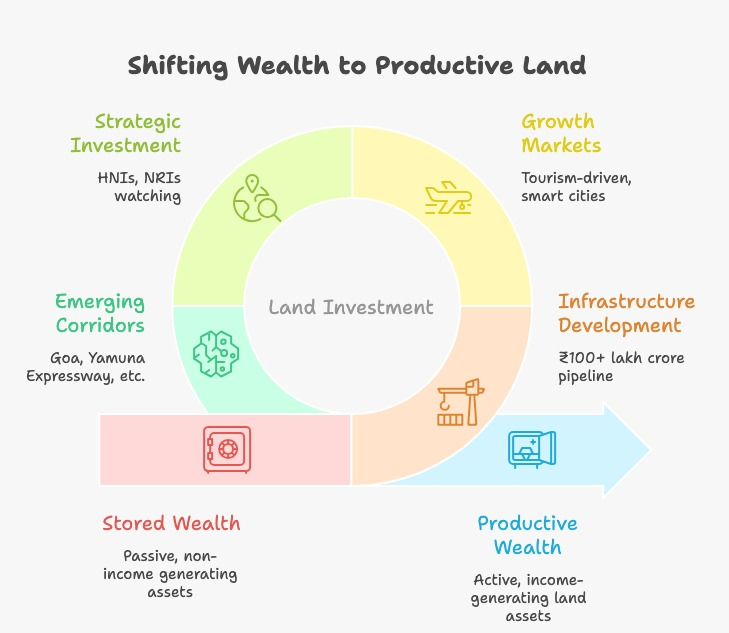
Why Productive Assets May Define India’s Next Wealth Cycle
India’s Urbanization Story Is Still in Early Stages
India remains significantly less urbanized compared to many developed economies.
As urbanization accelerates, demand for:
- housing,
- logistics,
- infrastructure,
- commercial spaces,
- tourism ecosystems,
is expected to rise.
This long-term demographic and economic transformation could significantly influence the future of land investment in India.
As cities expand outward, peripheral land often becomes strategically important.
This transformation has historically created generational wealth across multiple global economies.
The Shift From Wealth Preservation to Wealth Participation
A major investment philosophy shift is occurring globally.
Many sophisticated investors no longer focus only on preserving wealth.
They increasingly seek ownership in assets connected to:
- economic expansion,
- infrastructure growth,
- tourism ecosystems,
- industrialization,
- urban migration.
This is where the discussion around real estate vs gold investment becomes more nuanced.
Gold may continue serving as a defensive hedge.
But productive assets such as land may increasingly participate directly in economic activity.
This is why many investors now see land investment in India as part of a broader participation strategy in India’s long-term growth story.
The Strategic Role of Land in Emerging Economies
Historically, rapidly developing economies often witness strong appreciation in infrastructure-connected land.
This happens because economic growth creates:
- migration,
- housing demand,
- tourism demand,
- industrial ecosystems,
- transportation networks,
- commercial activity.
Land sits at the center of these transformations.
This is one reason why many long-term investors consider the future of land investment in India highly compelling over the next decade.
Key Risks and Considerations Before Investing in Land
Importance of Legal Due Diligence
Every land investment in India requires detailed due diligence.
Important factors include:
- Clear title verification
- Land zoning regulations
- Conversion permissions
- Development approvals
- Environmental regulations
- Infrastructure feasibility
Strategic investors should always work with qualified legal and real estate professionals.
Infrastructure Timing Matters
Infrastructure-led appreciation often depends heavily on timing.
Early-stage investment corridors may offer higher long-term upside but also require patience.
Mature corridors may offer:
- Greater stability
- Faster monetization
- Lower development uncertainty
This is why understanding infrastructure execution timelines becomes important when evaluating land investment in India.
Long-Term Patience Is Essential in Land Investment
Unlike short-term speculative trading, strategic land investing often works best over long holding cycles.
Infrastructure projects can take years to fully transform surrounding ecosystems.
Sophisticated investors therefore often focus on:
- location quality,
- connectivity,
- infrastructure pipelines,
- tourism potential,
- economic growth patterns.
This disciplined approach is central to successful land investment in India.
Real Estate vs Gold Investment: What Sophisticated Investors Are Watching in 2026
The discussion around real estate vs gold investment is not about eliminating one asset in favor of another.
Gold continues to remain an important diversification and hedging asset.
However, India’s next decade may increasingly reward productive assets connected to:
- infrastructure,
- tourism,
- logistics,
- industrialization,
- urban expansion,
- economic participation.
This is one reason why the future of land investment in India is attracting increasing attention among:
- HNIs,
- NRIs,
- businessmen,
- family offices,
- long-term wealth creators.
Land ownership today is no longer viewed only as static ownership.
It is increasingly seen as:
- infrastructure participation,
- tourism participation,
- urbanization participation,
- and long-term economic participation.
This strategic shift could define India’s next major wealth creation cycle.
FAQ
1. Is land investment in India considered a better investment than gold in 2026?
Both gold and land serve different investment purposes. Gold has traditionally been viewed as a defensive hedge against inflation and uncertainty, while land investment in India is increasingly being viewed as a productive long-term growth asset linked to infrastructure, tourism, industrialization, and urban expansion.
As India continues investing heavily in expressways, airports, logistics corridors, and smart cities, many investors believe strategic land assets may benefit from long-term appreciation opportunities connected to economic growth.
Government infrastructure initiatives:
- PM Gati Shakti National Master Plan
- National Infrastructure Pipeline
2. Why is land investment in India attracting HNIs and NRIs?
HNIs and NRIs are increasingly exploring land investment in India because of:
- Long-term appreciation potential
- Tangible ownership
- Legacy wealth creation
- Tourism and hospitality opportunities
- Infrastructure-led growth corridors
- Currency diversification advantages for NRIs
Many affluent investors are particularly focused on regions connected to:
- airports,
- expressways,
- tourism growth,
- and industrial development.
NRI investment guidelines:
3. How do infrastructure projects increase land prices?
Infrastructure projects improve connectivity, accessibility, and economic activity in surrounding regions. Historically, highways, airports, metro systems, industrial corridors, and logistics hubs have significantly influenced real estate appreciation.
When infrastructure improves:
- Travel time reduces,
- Tourism increases,
- businesses expand,
- logistics become more efficient,
- and housing demand rises.
This often creates long-term appreciation potential for strategically located land parcels.
4. What is the future of land investment in India over the next decade?
The future of land investment in India is closely connected to:
- urbanization,
- industrial expansion,
- tourism growth,
- infrastructure development,
- and rising demand for second homes and plotted communities.
India’s long-term growth trajectory, combined with limited land supply in strategic locations, is one reason many investors are evaluating land as a long-duration wealth creation asset.
5. Which regions in India currently have strong land appreciation potential?
Several regions are attracting investor interest due to infrastructure and tourism growth, including:
- Yamuna Expressway region
- Goa and Konkan belt
- Hyderabad peripheral corridors
- Bengaluru outskirts
- Pune growth zones
- Navi Mumbai and Alibaug corridors
These regions are benefiting from:
- airports,
- industrial projects,
- tourism expansion,
- logistics growth,
- and connectivity upgrades.
6. Can land investment generate passive income opportunities?
Yes. Unlike gold, land can potentially create multiple income streams depending on location, zoning, and development potential.
Possible income opportunities include:
- hospitality projects,
- villa rentals,
- warehousing,
- farming,
- tourism stays,
- solar leasing,
- commercial leasing,
- and parking operations.
Tourism-driven land assets are especially gaining attention in lifestyle and coastal destinations.
7. What are the biggest risks involved in land investment in India?
Every land investment carries certain risks, which is why due diligence is critical.
Important considerations include:
- title verification,
- zoning compliance,
- legal approvals,
- environmental clearances,
- infrastructure feasibility,
- and market timing.
Investors should always consult qualified legal and real estate professionals before purchasing land assets.
8. Why are plotted developments becoming popular in India?
Modern buyers increasingly prefer plotted developments because they offer:
- lower-density living,
- independent ownership,
- construction flexibility,
- wellness-focused environments,
- and long-term appreciation potential.
Post-pandemic lifestyle changes also accelerated interest in:
- second homes,
- nature-driven communities,
- remote-working destinations,
- and tourism-linked residential projects.
9. How does tourism impact land investment in India?
Tourism often creates strong demand for:
- villas,
- resorts,
- boutique hospitality,
- vacation rentals,
- eco-tourism projects,
- and second homes.
As tourism infrastructure improves, surrounding land values may appreciate due to increased commercial and hospitality activity.
This trend is particularly visible in:
- Goa,
- Konkan,
- Himachal Pradesh,
- Uttarakhand,
- Kerala,
- and coastal Maharashtra
10. How should investors approach real estate vs gold investment strategically?
The discussion around real estate vs gold investment should ideally focus on diversification rather than replacement.
Gold continues to play an important role as:
- a defensive hedge,
- a liquidity asset,
- and a portfolio stabilizer.
Land investment in India, meanwhile, is increasingly viewed as:
- a growth-oriented asset,
- an infrastructure participation asset,
- and a long-term wealth creation opportunity linked to India’s economic expansion.
Sophisticated investors often balance:
- defensive assets,
- productive assets,
- and long-term growth opportunities
within diversified portfolios.
The Future of Land Investment in India May Be Closer Than Many Realize
As connectivity improves through expressways, airports, logistics corridors, and smart infrastructure projects, regions once considered peripheral are increasingly becoming strategic economic zones.
This evolving landscape is reshaping how sophisticated investors think about long-term wealth creation.
The future of land investment in India may not simply be about owning property.
It may increasingly be about owning strategically positioned assets connected to India’s next phase of economic expansion.
While gold will likely continue to be an important defensive and diversifying asset, productive assets such as land investments in India are gaining greater relevance in a rapidly expanding economy.
For investors evaluating long-term opportunities, understanding infrastructure trends, tourism growth, connectivity pipelines, and urban expansion may be more important than ever.
At TOTL Realty, the focus remains on research-driven investment perspectives aligned with emerging infrastructure and tourism growth corridors across India. Rather than speculative positioning, the emphasis is on identifying regions where long-term connectivity, economic activity, and strategic development could influence future land appreciation.
As India’s investment landscape evolves, data-backed decision-making, infrastructure understanding, and long-term strategic thinking may define the next generation of wealth creation opportunities in land investment in India.