
Invest in Land: Why India’s Smart Investors Are Turning Toward Land for Long-Term Wealth Creation
Over the last decade, India’s investment landscape has undergone a significant transformation. Investors who once focused primarily on traditional assets such as gold, fixed deposits, apartments, or equities are increasingly exploring one asset class that has historically stood the test of time — land.
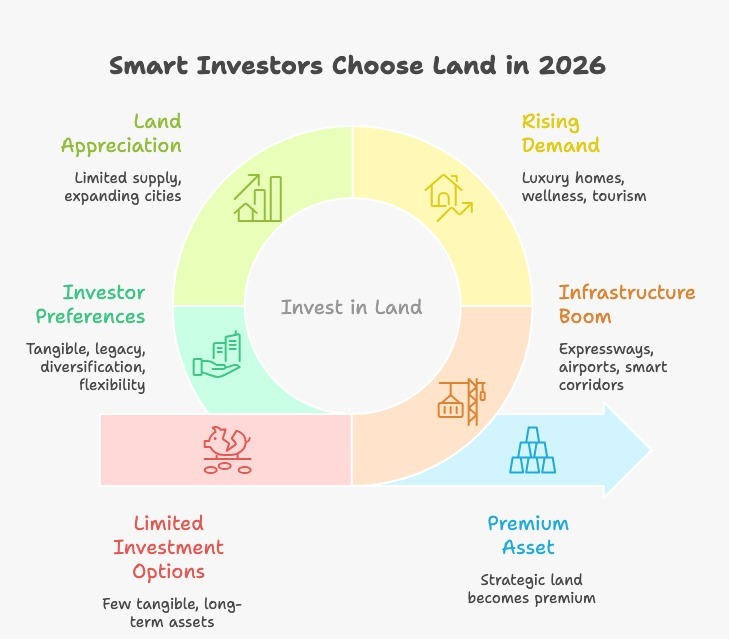
From high-net-worth individuals and business families to NRIs, bureaucrats, and seasoned investors, the conversation around wealth creation is shifting toward long-term, tangible assets with appreciation potential. The growing interest is not simply about owning property; it is about securing strategic assets aligned with infrastructure growth, urban expansion, tourism development, and future economic corridors.
India is currently witnessing one of the largest infrastructure expansion phases in its modern history. Expressways, airports, logistics corridors, industrial hubs, smart cities, and tourism-focused development are reshaping how investors evaluate real estate opportunities. According to the Ministry of Road Transport and Highways, India’s national highway network has expanded rapidly over the last decade, improving connectivity between urban and emerging regions. At the same time, projects like the Delhi-Mumbai Expressway, Jewar International Airport, Dedicated Freight Corridors, and Regional Rapid Transit Systems are opening new growth zones for long-term land appreciation.
The demand for premium plots, second homes, and nature-centric developments has also accelerated after the pandemic. Investors are no longer looking only at metro apartments. They are looking at open spaces, wellness-driven lifestyles, and future-ready locations with long-term potential.
This shift explains why more investors today are choosing to invest in land as part of a diversified wealth strategy.
According to recent reports from The Economic Times Real Estate and Knight Frank India, plotted developments and luxury second-home investments are among the fastest-growing segments in India’s premium real estate market.
The reason is simple: land combines scarcity, flexibility, long-term appreciation potential, and strategic value in a way very few asset classes can.
The Changing Psychology of Wealth Creation in India
India’s affluent investor class is increasingly moving away from short-term speculative thinking toward long-term wealth preservation and legacy creation.
This shift is changing how investors allocate capital.
Earlier, wealth accumulation was often linked with visible consumption — luxury vehicles, urban apartments, and lifestyle-driven spending. Today, however, investors are becoming more strategic. They are prioritizing assets that can preserve value over decades while also offering flexibility and long-term appreciation.
Land naturally fits into this investment philosophy.
Unlike many constructed assets that may depreciate with age, strategically located land often benefits from:
- infrastructure-led appreciation,
- population growth,
- urban expansion,
- tourism demand,
- and increasing scarcity.
India’s urbanization rate is expected to continue rising significantly over the next two decades, according to World Bank Urban Development Data. As cities expand outward, peripheral growth corridors are becoming highly relevant for long-term investors.
This is one of the key reasons why experienced investors increasingly invest in land before large-scale development reaches maturity.
Another important factor is investor psychology during uncertain economic cycles.
Global inflationary pressures, market volatility, and economic uncertainty have reinforced the importance of tangible assets. While financial markets remain important components of wealth portfolios, many investors prefer balancing those risks with physical assets that are finite in nature.
Land ownership also carries emotional and strategic value.
For many Indian business families and NRIs, land is viewed not just as an investment, but as:
- a legacy asset,
- a hedge against inflation,
- a long-term security mechanism,
- and a generational wealth transfer tool.
The principle of scarcity further strengthens this perception.
Unlike manufactured assets, land cannot be reproduced. Prime locations around infrastructure hubs, tourism zones, and high-growth corridors become increasingly limited over time. As demand rises and supply tightens, appreciation potential often increases.
This scarcity-driven economics is one of the strongest reasons investors continue to invest in land across both emerging and established markets.
Why Infrastructure Growth Is Driving Land Appreciation Across India
Infrastructure has always played a defining role in real estate growth. However, the scale of infrastructure development currently underway in India is unprecedented.
Modern investors no longer evaluate locations based only on present conditions. They increasingly evaluate future connectivity, economic activity, logistics expansion, and planned government investments.
This approach has transformed infrastructure into one of the biggest catalysts for land appreciation.
Projects such as:
- Delhi-Mumbai Expressway,
- Jewar International Airport,
- Dedicated Freight Corridor,
- Regional Rapid Transit System (RRTS),
- Bharatmala Project,
- Smart Cities Mission,
- industrial corridors,
- and metro expansion networks
are reshaping investment maps across India.
According to National Highways Authority of India (NHAI), India continues to expand expressway and highway infrastructure at a historic pace. Improved connectivity often reduces travel time, enhances commercial activity, and increases real estate demand around surrounding regions.
One of the clearest examples is the impact of airport-led development.
Historically, regions around major airports have witnessed rapid growth in:
- hospitality,
- logistics,
- residential demand,
- commercial expansion,
- and tourism activity.
The development of Noida International Airport (Jewar Airport) has significantly increased investor interest in surrounding regions due to expected economic and infrastructure growth.
Similarly, the Delhi-Mumbai Expressway is expected to improve regional connectivity and industrial development across multiple states. According to the Ministry of Road Transport and Highways, the corridor is designed to strengthen logistics and economic efficiency while accelerating urban growth.
This creates a strong “early-entry advantage” for land investors.
Historically, many successful real estate investors entered locations before infrastructure projects became fully operational. Once connectivity improves and economic activity expands, land demand typically increases rapidly.
The most experienced investors often focus on:
- future growth corridors,
- government-backed development,
- tourism-linked infrastructure,
- industrial expansion,
- and emerging urban clusters.
This is why infrastructure intelligence has become central to modern real estate investment strategies.
For investors planning to invest in land, understanding infrastructure timing is often more important than following short-term market sentiment.
How Land Investment Supports Long-Term Wealth Creation
Long-term wealth creation rarely happens through impulsive decisions. It is usually built through patient ownership of strategic assets over time.
Land has historically been associated with long-term appreciation because its value is often influenced by:
- urban expansion,
- infrastructure development,
- economic activity,
- and demographic growth.
Unlike constructed assets, land does not suffer physical wear and tear in the same way. Buildings may require maintenance, upgrades, and redevelopment over time, but strategically located land often benefits from surrounding development.
This makes land particularly attractive for investors focused on wealth preservation.
Many affluent investors practice what is known as “land banking.”
Land banking refers to acquiring strategically located land in areas expected to witness future growth. Investors hold these assets over extended periods while infrastructure and demand mature around them.
This strategy has been widely used globally by:
- institutional investors,
- business families,
- developers,
- and long-term wealth managers.
Another reason investors increasingly invest in land is flexibility.
Land offers multiple future possibilities depending on regulations and location:
- residential development,
- hospitality projects,
- second homes,
- wellness retreats,
- farmhouses,
- tourism-driven developments,
- leasing opportunities,
- or long-term holding.
This adaptability makes land a highly versatile asset class.
For many Indian families, land also represents continuity across generations.
Family-owned land assets are often preserved for decades because they combine:
- financial value,
- emotional attachment,
- inheritance potential,
- and long-term security.
As India’s affluent population grows, legacy planning is becoming increasingly important. According to reports from Knight Frank Wealth Report, India continues to witness significant growth in HNI and ultra-HNI wealth creation.
This growing wealth base is expected to further increase demand for premium land investments, second homes, and strategic real estate assets.
The Rise of Luxury Second Homes and Nature-Centric Living
One of the most important post-pandemic lifestyle shifts has been the rise of second-home demand.
Across India, affluent buyers are increasingly prioritizing:
- open spaces,
- wellness-oriented living,
- privacy,
- greenery,
- and low-density environments.
This has accelerated demand for luxury plotted developments, farmhouses, vacation homes, and nature-centric communities.
According to Outlook Money, India’s luxury second-home market has seen substantial growth as HNIs and NRIs look beyond traditional urban living.
The rise of hybrid work and remote working models has also influenced investor behavior.
Many professionals and business owners no longer need to remain physically present in metro cities every day. This flexibility has encouraged interest in:
- weekend homes,
- wellness retreats,
- gated plotted developments,
- and low-density luxury communities.
Locations near:
- hills,
- forests,
- tourism hubs,
- lakes,
- and emerging infrastructure corridors
are increasingly attracting investor attention.
Importantly, second homes are no longer viewed only as lifestyle purchases.
They are increasingly viewed as hybrid assets combining:
- personal usage,
- long-term appreciation,
- and rental income potential.
This shift has strengthened the appeal of land ownership in premium destinations.
Investors who invest in land within high-growth tourism and infrastructure regions often view these assets as long-duration wealth positions aligned with changing lifestyle preferences.
Tourism Growth and the Rise of Experience-Driven Real Estate
Tourism has emerged as one of the strongest drivers of premium real estate demand in India.
As domestic tourism, wellness travel, and experiential hospitality continue expanding, investor interest in tourism-linked land assets has also increased.
According to Ministry of Tourism, Government of India, India continues to witness strong growth in domestic tourism infrastructure and hospitality investments.
This trend is especially visible in:
- Goa,
- Uttarakhand,
- Himachal Pradesh,
- Rajasthan,
- Alibaug,
- and peripheral NCR regions.
Modern travelers increasingly prefer:
- private villas,
- nature retreats,
- wellness resorts,
- eco-luxury stays,
- and personalized travel experiences.
This shift has created strong opportunities for:
- villa developments,
- boutique hospitality,
- and premium land investments near tourism corridors.
The rise of short-term rental platforms has further accelerated this trend.
According to Airbnb Newsroom, travelers increasingly prefer larger homes, experiential stays, and nature-based accommodations over conventional hotel formats.
As a result, investors are evaluating land not only for appreciation but also for future hospitality and rental possibilities.
Tourism-led real estate markets often benefit from:
- infrastructure upgrades,
- improved connectivity,
- hospitality expansion,
- and increasing lifestyle demand.
This creates long-term growth potential for strategic land investments.
Can Land Generate Passive Income?
One of the common misconceptions is that land only generates value through appreciation.
In reality, modern land investments can support multiple monetization opportunities depending on location, regulations, and development trends.
The rise of the villa economy and experiential hospitality has changed how investors view land ownership.
Today, premium land parcels are increasingly being used for:
- luxury farmhouses,
- boutique stays,
- wellness retreats,
- eco-resorts,
- vacation rentals,
- and private hospitality projects.
The rapid growth of platforms such as Airbnb has transformed short-term rental economics globally.
India’s domestic travel market continues expanding rapidly, particularly in premium tourism and weekend destination markets.
This has encouraged investors to explore:
- second homes with rental potential,
- managed villa concepts,
- and experiential hospitality models.
Many investors who invest in land near tourism and infrastructure hubs increasingly evaluate future income possibilities alongside appreciation.
However, passive income potential depends heavily on:
- location quality,
- accessibility,
- tourism demand,
- infrastructure,
- and legal compliance.
Strategic due diligence remains critical.
Comparing Land with Other Investment Options
Every asset class has unique strengths and investment characteristics. The objective of diversification is not to replace one asset entirely with another, but to build a balanced portfolio aligned with long-term goals.
Gold has historically been viewed as a store of value and an important wealth preservation tool in India. It offers liquidity and cultural significance.
Equities provide growth potential and market participation but are often subject to volatility and macroeconomic fluctuations.
Apartments offer rental possibilities and urban accessibility, but constructed structures may depreciate over time while requiring maintenance.
Land, however, occupies a distinct position because it combines:
- scarcity,
- flexibility,
- long-term appreciation potential,
- and strategic development possibilities.
Unlike built structures, land can adapt to future use cases depending on market conditions and regulations.
Many investors also prefer land because maintenance requirements are often lower compared to constructed real estate assets.
Importantly, experienced investors rarely depend entirely on one asset category.
Instead, they focus on:
- diversification,
- long-term risk management,
- and strategic asset allocation.
For investors seeking wealth preservation combined with future appreciation potential, many continue to invest in land as part of a broader portfolio strategy.
Why NRIs and HNIs Are Increasingly Choosing Land Investments in India
India’s economic growth story continues attracting strong attention from global investors and NRIs.
Large-scale infrastructure spending, expanding urbanization, digital transformation, and rising consumption are reshaping India’s long-term economic outlook.
According to Invest India, India remains one of the world’s fastest-growing major economies with increasing investor confidence across sectors.
For NRIs, land ownership often carries both financial and emotional significance.
Many prefer investing in tangible assets within their home country because of:
- familiarity,
- legacy planning,
- family security,
- and long-term wealth diversification.
Premium land investments are also increasingly viewed as prestige assets among affluent investors.
Exclusive plotted developments, wellness communities, and second-home destinations appeal to investors seeking:
- privacy,
- exclusivity,
- low-density living,
- and future lifestyle flexibility.
As India’s luxury market matures, demand for premium land assets is expected to remain strong among HNIs and global Indian investors.
Key Factors Investors Should Evaluate Before They Invest in Land
While land offers long-term potential, informed decision-making remains essential.
Experienced investors typically evaluate multiple factors before making investment decisions.
1. Infrastructure Potential
Understanding upcoming infrastructure projects is critical.
Key questions include:
- Is connectivity improving?
- Are highways or airports planned nearby?
- Is economic activity expected to increase?
Infrastructure often drives future demand and appreciation.
2. Legal Due Diligence
Clear legal verification is essential.
Investors should review:
- ownership records,
- title clarity,
- land-use permissions,
- approvals,
- and regulatory compliance.
3. Location Quality
Strong investment locations typically benefit from:
- accessibility,
- tourism demand,
- economic activity,
- urban expansion,
- and future growth visibility.
4. Developer or Advisory Credibility
Transparency and long-term vision matter significantly in real estate investments.
Investors increasingly prefer working with experienced and research-driven advisory platforms.
5. Exit Potential
Liquidity and future resale demand should always be evaluated carefully.
The best investments often combine:
- appreciation potential,
- usability,
- and future market demand.
The Future of Land Investment in India
India’s urban transformation is still in its early stages.
Over the next two decades, the country is expected to witness:
- expanding infrastructure networks,
- rising urban populations,
- tourism-led development,
- industrial corridor growth,
- and increasing demand for premium lifestyle communities.
At the same time, environmental awareness and wellness-driven living are influencing real estate preferences globally.
This is accelerating demand for:
- sustainable communities,
- eco-conscious developments,
- low-density living,
- and nature-integrated lifestyles.
Land ownership aligns naturally with these future trends.
As cities become denser and premium land becomes increasingly scarce, strategically located land assets may continue attracting investor attention for both lifestyle and wealth-preservation purposes.
The investors who identify future growth corridors early often position themselves ahead of broader market demand.
This explains why many experienced investors continue to invest in land as a long-term strategic decision rather than a short-term speculative opportunity.
FAQs
1. Why do many investors prefer to invest in land for long-term wealth creation?
Many investors prefer to invest in land because land is a finite and tangible asset with long-term appreciation potential. Unlike some constructed assets that may depreciate over time due to maintenance and aging structures, strategically located land often benefits from infrastructure growth, urban expansion, tourism development, and increasing demand. Land is also viewed as a legacy asset that can support long-term wealth preservation and portfolio diversification.
2. How does infrastructure development impact land prices in India?
Infrastructure development plays a major role in increasing land value. Projects such as expressways, airports, metro corridors, industrial zones, and logistics hubs improve connectivity and economic activity in surrounding regions. Historically, areas near major infrastructure developments have experienced strong real estate demand and appreciation. Investors often monitor government-backed infrastructure projects to identify emerging growth corridors before prices rise significantly.
3. Is land investment better than apartments for long-term appreciation?
Both land and apartments have different investment characteristics, but land is often preferred for long-term appreciation because of its scarcity and flexibility. Apartments may generate rental income in urban areas, but buildings can depreciate over time and require maintenance. Land, especially in strategic locations, can appreciate significantly as surrounding infrastructure and demand increase. Many investors choose land as part of a diversified portfolio strategy focused on long-term growth.
4. Can land generate passive income opportunities?
Yes, land can support passive income opportunities depending on location, tourism demand, and development potential. Investors today are increasingly exploring luxury farmhouses, vacation villas, eco-retreats, wellness resorts, and short-term rental models on strategically located land parcels. Tourism-driven destinations and second-home markets have especially increased the monetization potential of premium land investments in India.
5. Why are NRIs increasingly choosing to invest in land in India?
NRIs often invest in land in India because it combines emotional connection, long-term security, and wealth preservation. Many NRIs view land as a stable and tangible asset in their home country. India’s infrastructure growth, expanding economy, and rising demand for premium real estate have also increased investor confidence. Land investments are frequently seen as legacy assets that can be transferred across generations while benefiting from long-term appreciation.
6. What factors should investors evaluate before purchasing land?
Before purchasing land, investors should evaluate multiple factors including:
- location quality,
- infrastructure growth potential,
- legal title clarity,
- land-use permissions,
- connectivity,
- tourism potential,
- future demand,
- and developer credibility.
Due diligence is extremely important in land investment. Investors should also assess whether the location aligns with future economic and infrastructure expansion plans.
7. How is tourism growth influencing land investment opportunities in India?
Tourism growth is significantly influencing premium real estate demand across India. Locations experiencing rising tourism activity often witness improvements in roads, hospitality infrastructure, and commercial development. This creates opportunities for second homes, vacation villas, boutique hospitality projects, and wellness retreats. Investors increasingly invest in land near tourism destinations because these regions may benefit from both appreciation and rental income potential over time.
8. Why are luxury second homes becoming popular among HNIs and investors?
Luxury second homes are becoming popular because affluent buyers increasingly prioritize wellness, privacy, open spaces, and nature-centric living. After the pandemic, many investors began looking beyond crowded metro environments toward low-density and lifestyle-focused communities. Second homes are now viewed not only as lifestyle assets but also as long-term investments with appreciation and hospitality potential.
9. Is land considered a safe investment during economic uncertainty?
Many investors consider land a relatively stable long-term asset because it is tangible, limited in supply, and less directly affected by short-term market fluctuations compared to some financial instruments. During periods of inflation or economic uncertainty, investors often diversify into physical assets such as land to balance portfolio risks. However, like all investments, land investments should be evaluated carefully with proper due diligence and long-term planning.
10. What is the future outlook for land investment in India?
The future outlook for land investment in India remains closely linked to infrastructure expansion, urbanization, tourism growth, industrial development, and rising demand for premium lifestyle communities. Emerging corridors around airports, expressways, and smart cities are expected to attract increasing investor interest over the coming years. As land becomes more scarce in strategic locations, many long-term investors believe premium land assets may continue playing an important role in wealth creation and portfolio diversification strategies.
India’s real estate landscape is evolving beyond traditional urban ownership patterns. Infrastructure expansion, tourism growth, second-home demand, wellness-driven lifestyles, and long-term wealth planning are reshaping how investors evaluate opportunities.
For many investors, land represents more than a physical asset. It represents flexibility, scarcity, strategic positioning, and generational wealth creation potential. While every investment decision requires careful research and due diligence, the long-term fundamentals supporting premium land investments continue strengthening across multiple high-growth regions in India.
As infrastructure corridors expand and investor preferences shift toward future-ready assets, land is increasingly becoming an important component of diversified wealth strategies among HNIs, NRIs, business owners, and long-term investors.
Companies such as TOTL Realty are increasingly focusing on research-driven real estate opportunities aligned with infrastructure growth, premium land investments, and evolving lifestyle trends across India. In a rapidly changing market, informed decision-making, strategic location analysis, and long-term market understanding are becoming essential for investors seeking sustainable wealth creation through real estate.