
Government Infrastructure and Policy Reforms Driving Real Estate Growth in India: Mapping the Next Investment Corridors (2026–2030)
A Structural Shift in India’s Real Estate Growth Story
India’s real estate sector is undergoing a decisive transformation. What was once driven by speculative cycles, fragmented development, and informal transactions is now increasingly shaped by structured planning, regulatory oversight, and large-scale public investment. At the center of this transition lies a powerful force: government infrastructure real estate growth in India.
Over the past decade, India has significantly increased its capital expenditure on infrastructure—from approximately ₹2 lakh crore in FY2014–15 to an estimated ₹12.2 lakh crore in FY2026–27, according to the Press Information Bureau. This shift reflects not just fiscal expansion, but a strategic reorientation toward long-term asset creation.
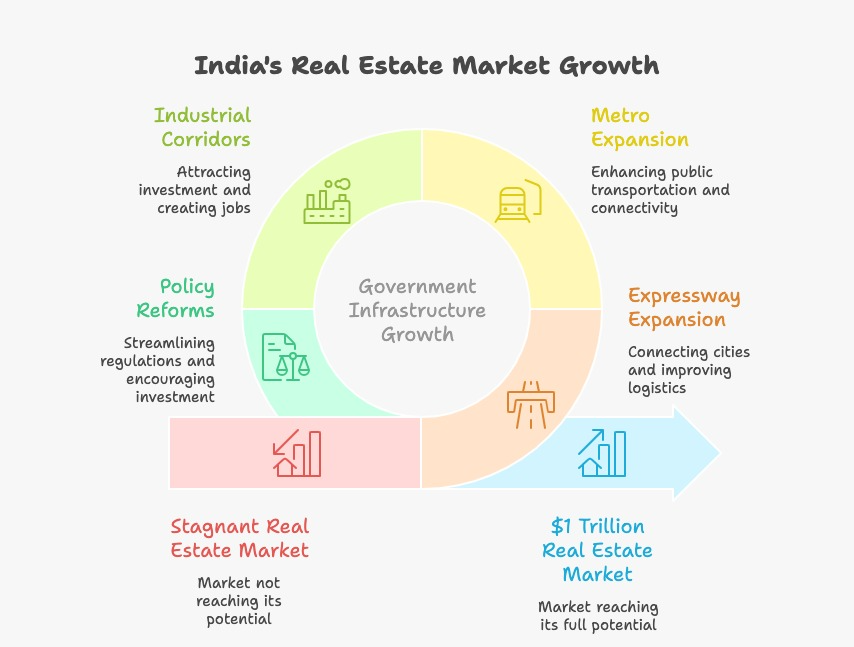
At the same time, India’s urban population is projected to reach nearly 600 million by 2036, contributing close to 70% of GDP, as highlighted by the World Bank. Parallelly, the Indian real estate sector is expected to approach a valuation of nearly US$1 trillion by 2030, as reported by India Brand Equity Foundation.
These are not isolated statistics—they represent a coordinated transformation. Infrastructure expansion, policy reform, and demographic shifts are converging to redefine how and where value is created in real estate. For investors, especially HNIs and institutional participants, understanding government infrastructure real estate growth in India is no longer optional—it is foundational.
India’s Real Estate Growth Is Now Government-Engineered, Not Market-Driven
The evolution of India’s real estate sector over the last decade marks a transition from informality to institutionalisation. Historically, real estate growth was largely unregulated, driven by opaque transactions, speculative investments, and fragmented development practices.
This changed significantly with the introduction of the Real Estate (Regulation and Development) Act (RERA). RERA brought in project registration, escrow mechanisms, and accountability standards that fundamentally altered the sector’s risk profile. For investors, this meant greater transparency and reduced execution risk—critical components in long-term capital allocation.
In addition, the implementation of the Goods and Services Tax (GST) streamlined indirect taxation, further formalising the sector. Combined, these reforms laid the groundwork for government infrastructure real estate growth in India by aligning regulatory frameworks with investor expectations.
The result is visible today: increasing participation from institutional capital, greater trust among buyers, and improved project delivery timelines. Real estate is no longer merely a speculative asset class—it is becoming an organised investment domain.
Infrastructure Investment: The Primary Catalyst Behind Land Value Expansion
At the core of government infrastructure real estate growth in India lies a simple but powerful mechanism: infrastructure drives accessibility, accessibility drives demand, and demand drives price discovery.
India’s National Infrastructure Pipeline (NIP) initially outlined investments worth ₹111 lakh crore across sectors such as energy, roads, urban infrastructure, and railways. According to Invest India, this pipeline represents one of the largest coordinated infrastructure programs globally.
As of 2026, over 1,900 infrastructure projects worth approximately ₹41.98 lakh crore are under active monitoring by the government. These include expressways, logistics corridors, industrial zones, and urban mobility systems.
Transport Infrastructure and Expressways
High-speed expressways such as the Delhi-Mumbai Expressway are significantly reducing travel times and opening up previously inaccessible regions. This transformation directly impacts land valuation. Peripheral zones that were once considered remote are now emerging as high-potential investment destinations.
Airport Expansion and Regional Connectivity
India’s airport infrastructure is also expanding under regional connectivity schemes. New airports in tier-2 and tier-3 cities are not only improving mobility but also catalysing tourism, business activity, and real estate demand.
Industrial Corridors
Projects like the Delhi-Mumbai Industrial Corridor (DMIC) are reshaping industrial geography. These corridors integrate logistics, manufacturing, and urban development, creating new economic ecosystems—and with them, new real estate markets.
In essence, government infrastructure real estate growth in India is not abstract—it is geographically visible, economically measurable, and strategically predictable.
Urban Mobility Revolution: Metro Expansion and the Redefinition of City Boundaries
Urban mobility is another critical driver of government infrastructure real estate growth in India. As of 2025–26, India has over 1,000 km of operational metro and regional rapid transit systems across more than 20 cities, according to the Press Information Bureau.
This expansion has a profound implication: it extends the functional boundaries of cities.
Areas that were once considered peripheral are now within viable commuting distance. This shift effectively increases the supply of developable land while simultaneously enhancing its desirability. For investors, this translates into opportunities in emerging micro-markets where infrastructure precedes price appreciation.
Metro-led development is particularly relevant for land investors, as early-stage entry in such zones often yields disproportionate long-term gains.
Policy Reforms Strengthening Investor Confidence and Capital Flow
Infrastructure alone cannot drive sustainable growth without supportive policy frameworks. Recognising this, the government has introduced multiple reforms that reinforce government infrastructure real estate growth in India.
The Pradhan Mantri Awas Yojana (PMAY) has expanded access to affordable housing, increasing end-user demand. The Model Tenancy Act aims to formalise rental markets, while the SWAMIH Fund addresses stalled housing projects, improving liquidity and restoring confidence.
Together, these initiatives reduce systemic risk and enhance capital efficiency. For institutional investors, this creates a more predictable investment environment—one that aligns with global standards.
The Rise of New Investment Corridors: Where Policy Meets Opportunity
One of the most significant outcomes of government infrastructure real estate growth in India is the emergence of corridor-based investment strategies.
Unlike traditional city-centric investing, corridor-based investing focuses on regions aligned with infrastructure and industrial development.
Key Emerging Corridors
- Jewar International Airport region
- Delhi-Mumbai Industrial Corridor belt
- Goa-Konkan coastal corridor
- Rajasthan eco-tourism and logistics zones
These corridors benefit from concentrated public investment, policy support, and economic activity. As a result, they often outperform traditional markets in terms of land appreciation and development potential.
For investors, identifying these corridors early is critical to capturing value before it is fully priced in.
Urbanisation and Demographics: The Silent Demand Engine
Demand-side dynamics further reinforce government infrastructure real estate growth in India.
India’s urban population is expected to grow to 600 million by 2036. This demographic shift is driven by migration, employment opportunities, and changing lifestyle preferences.
Urbanisation increases demand for:
- Residential housing
- Commercial spaces
- Logistics and warehousing
- Lifestyle and second-home developments
This sustained demand ensures that infrastructure-led supply expansion is absorbed efficiently, supporting long-term price stability and growth.
Institutional Capital and Global Investor Confidence
Another defining feature of government infrastructure real estate growth in India is the rise of institutional capital.
The introduction of Real Estate Investment Trusts (REITs), regulated by the Securities and Exchange Board of India, has provided new investment avenues. Additionally, increasing foreign direct investment (FDI) inflows reflect growing global confidence in India’s real estate sector.
Institutional participation enhances market discipline, improves governance standards, and increases liquidity—further strengthening the sector’s growth trajectory.
Can India Witness a 10x Real Estate Boom? A Data-Backed Perspective
The idea of a “10x boom” often attracts attention, but it requires careful contextualisation.
At a macro level, India’s real estate sector is projected to grow significantly, but not uniformly by 10x in the short term. However, within the broader framework of government infrastructure real estate growth in India, certain micro-markets—particularly those aligned with infrastructure corridors—may experience outsized appreciation.
These include:
- Pre-infrastructure land zones
- Airport-led development regions
- Industrial corridor nodes
For investors, the key is not to chase headlines but to analyse underlying drivers: infrastructure alignment, policy support, and supply-demand dynamics.
Strategic Insights for HNIs, NRIs, and Institutional Investors
For sophisticated investors, government infrastructure real estate growth in India offers a strategic framework for decision-making.
Key Strategies
- Corridor-first investing: Focus on infrastructure-aligned regions
- Land banking: Acquire land before full development
- Policy tracking: Monitor government announcements and approvals
- Long-term horizon: Align investments with infrastructure timelines
These strategies emphasise foresight over speculation—an approach that is increasingly essential in a structured market.
Risks, Realities, and the Importance of Due Diligence
While the outlook is strong, government infrastructure real estate growth in India is not without risks.
Investors must consider:
- Regulatory compliance
- Title verification
- Execution delays
- Liquidity constraints
Due diligence remains critical, particularly in land investments where legal and zoning complexities can impact outcomes.
Real Estate Growth Will Follow Policy Direction
India’s real estate sector is entering a new phase—one defined not by speculation, but by structure.
Infrastructure investment, policy reform, and urbanisation are collectively shaping government infrastructure real estate growth in India. For investors, this represents a shift from reactive investing to strategic alignment with national development priorities.
The next decade of real estate growth in India will not be random. It will be directional, policy-driven, and infrastructure-led.
Those who understand this alignment early will not just participate in growth—they will anticipate it.
FAQs
1. How is government infrastructure driving real estate growth in India?
Government infrastructure real estate growth in India is primarily driven by large-scale investments in expressways, airports, metro networks, and industrial corridors. These projects improve connectivity, reduce travel time, and unlock new regions for development. As accessibility improves, demand for residential, commercial, and land investments increases, leading to price appreciation.
For example, the Indian government’s infrastructure push under capital expenditure programs and the National Infrastructure Pipeline has significantly expanded economic activity across regions. This directly influences real estate valuation by creating new investment corridors.
2. What are the key government policies shaping real estate growth in India?
Several reforms have strengthened government infrastructure real estate growth in India, including:
- Real Estate (Regulation and Development) Act (RERA) for transparency
- Pradhan Mantri Awas Yojana (PMAY) for housing demand
- Model Tenancy Act for rental reforms
- SWAMIH Fund for stalled project completion
These policies reduce risk, improve trust, and increase institutional participation in real estate markets.
3. Which infrastructure projects are creating the biggest real estate opportunities in India?
Major infrastructure projects contributing to government infrastructure real estate growth in India include:
- Delhi-Mumbai Industrial Corridor
- Jewar International Airport
- Expressway networks like Delhi-Mumbai Expressway
- Metro expansions across major cities
These projects create economic hubs, improve logistics, and attract both residential and commercial development, making the surrounding land highly valuable.
4. Why do infrastructure corridors outperform traditional real estate markets?
Infrastructure corridors outperform because they combine policy support, economic activity, and connectivity. Government infrastructure real estate growth in India is increasingly corridor-based rather than city-based.
When infrastructure is planned in clusters—such as industrial corridors or airport zones—it creates concentrated demand, faster development, and higher appreciation potential compared to saturated urban markets.
5. How does metro expansion impact property prices in India?
Metro expansion significantly boosts government infrastructure real estate growth in India by improving urban mobility. Areas connected by metro lines often witness increased demand due to reduced commute times and improved accessibility.
As per government data, India’s metro network has expanded rapidly across multiple cities, leading to price appreciation in previously underdeveloped micro-markets.
6. Is India expected to experience a real estate boom by 2030?
India’s real estate sector is projected to reach nearly US$1 trillion by 2030, according to industry reports. While this indicates strong growth, government infrastructure real estate growth in India will not be uniform across all regions.
Instead, high-growth opportunities are likely to emerge in infrastructure-linked micro-markets such as industrial corridors, airport zones, and emerging urban clusters.
7. How does urbanisation support real estate demand in India?
Urbanisation is a major driver of government infrastructure real estate growth in India. India’s urban population is expected to reach around 600 million by 2036, increasing demand for housing, commercial spaces, and infrastructure.
This demographic shift ensures sustained absorption of real estate supply, especially in cities and emerging corridors.
8. What role does institutional investment play in India’s real estate growth?
Institutional investment strengthens government infrastructure real estate growth in India by bringing in capital, governance, and long-term stability.
The introduction of REITs regulated by the Securities and Exchange Board of India and increasing foreign direct investment (FDI) inflows have made Indian real estate more attractive to global investors.
9. What are the risks investors should consider in infrastructure-led real estate?
While government infrastructure real estate growth in India presents strong opportunities, investors must evaluate:
- Project execution timelines
- Legal and title verification
- Regulatory compliance
- Liquidity risks
Infrastructure-led growth often requires patience, as returns are aligned with development timelines.
10. How can investors identify high-growth real estate opportunities early?
To benefit from government infrastructure real estate growth in India, investors should:
- Track government infrastructure announcements
- Identify pre-development zones near major projects
- Analyse policy alignment and economic activity
- Focus on long-term investment horizons
Early-stage entry in infrastructure corridors often provides the highest appreciation potential.
Understanding Policy Today Can Define Investment Outcomes Tomorrow
India’s real estate market is no longer shaped by speculation—it is being systematically redesigned through infrastructure expansion, regulatory reform, and strategic policy direction. The shift toward government infrastructure real estate growth in India signals a new phase where data, planning, and foresight matter more than timing alone.
For investors, this presents both an opportunity and a responsibility.
The opportunity lies in identifying emerging corridors, infrastructure-linked micro-markets, and policy-backed regions before they reach maturity. The responsibility lies in approaching real estate with a structured, research-driven mindset—one that evaluates not just location, but alignment with national development priorities.
As India moves toward becoming a $1 trillion real estate market, those who understand the intersection of infrastructure, policy, and land economics will be better positioned to navigate this transformation.
If you are evaluating real estate from an investment perspective—whether as an HNI, NRI, or institutional participant—the key question is not whether the market will grow.
It is:
Where is the government building the future—and how early can you align with it?