
India’s Infrastructure Supercycle 2026: 7 Government-Backed Corridors Powering the Next Land Investment Boom
India’s real estate story is quietly changing. Not through speculative hype or flashy launches—but through something far more structural: infrastructure corridors. Roads, freight rail, industrial corridors, and port-led development are increasingly determining where economic activity flows and how land markets respond.
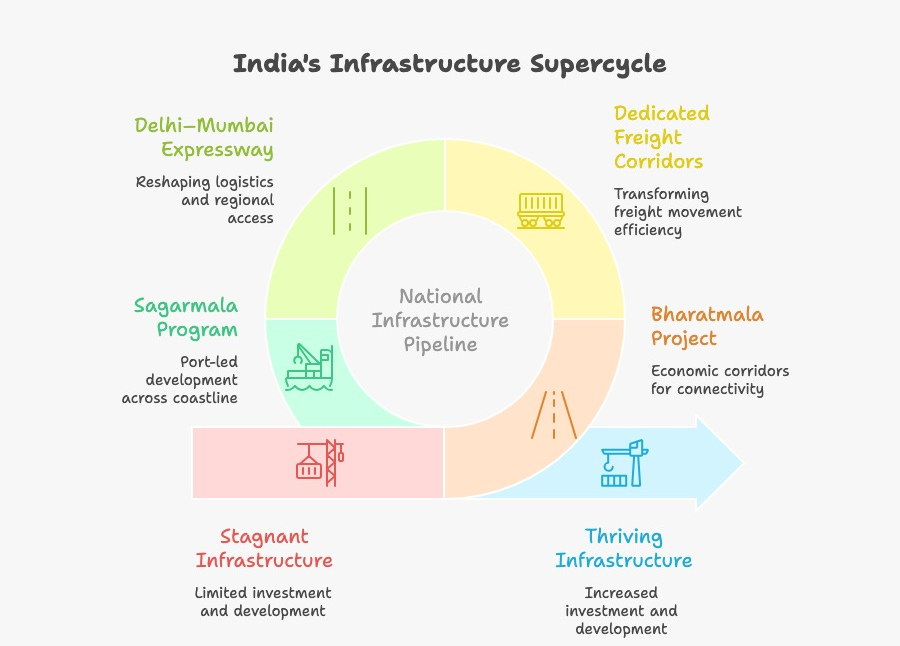
By 2026, India will be deep into what many policy analysts describe as an infrastructure supercycle—a period where large, coordinated public investments fundamentally reshape connectivity, logistics efficiency, and regional growth. For those studying infrastructure corridors land investment India 2026, the question is no longer whether infrastructure impacts land, but how to read that impact correctly.
This blog is a fact-first, hype-free guide to understanding the 7 most important government-backed infrastructure corridors shaping land demand across India. It does not promise returns. Instead, it explains mechanisms: how corridors alter land utility, why some locations benefit more than others, and how to separate execution-led growth from speculative noise.
Why Infrastructure Corridors Change Land Markets (Without Guarantees)
To understand infrastructure corridors land investment India 2026, it helps to step back from real estate language and look at economic behavior.
Infrastructure does not increase land value simply because it exists. It does so because it changes how land is used.
The Corridor Effect: A Four-Stage Shift
- Connectivity improves
Travel time, freight movement, and access costs are reduced. - Economic activity clusters
Logistics, manufacturing, warehousing, and services move closer to efficient routes. - Employment ecosystems form
Workers, suppliers, and ancillary services follow. - Residential and civic demand emerges
Housing, retail, healthcare, and education develop around sustained demand.
This process unfolds over years, not months. That’s why infrastructure corridors land investment India 2026 is best viewed through a long-term, utility-driven lens, not short-term price movements.
Route vs Node: The Most Common Misunderstanding
One of the biggest misconceptions around corridor-led growth is assuming that all land along a corridor benefits equally. In reality, value creation is node-centric, not linear.
Land demand tends to concentrate around:
- Expressway interchanges
- Freight terminals and ICDs
- Industrial nodes and logistics parks
- Port-connected zones
- Urban extensions with planned access
Understanding this distinction is foundational when evaluating infrastructure corridors land investment in India 2026.
India’s Infrastructure Supercycle: The Policy Backbone
The credibility of corridor-led growth in India is anchored in the scale and structure of government planning.
The National Infrastructure Pipeline (NIP)
The National Infrastructure Pipeline (NIP) was introduced to provide visibility and coordination to India’s infrastructure push. According to the Task Force report by the Ministry of Finance, the NIP envisaged ₹111 lakh crore of infrastructure investment between FY2020 and FY2025, spanning transport, logistics, energy, urban infrastructure, and more.
While timelines evolve, the structural intent remains intact: infrastructure as a growth multiplier, not isolated projects.
Interlocking National Programs
Several national initiatives work together to shape infrastructure corridors land investment India 2026:
- Bharatmala Pariyojana – Economic corridors and highways
- Dedicated Freight Corridors (DFC) – Rail-based freight efficiency
- National Industrial Corridor Development Programme (NICDP) – Industrial nodes and smart cities
- Sagarmala – Port-led development and coastal connectivity
Rather than operating in silos, these programs increasingly overlap geographically, amplifying land-use transformation where multiple systems converge.
The 7 Government-Backed Corridors Shaping Land Demand in 2026
1. Delhi–Mumbai Expressway: Speed as an Economic Catalyst
The Delhi–Mumbai Expressway is one of India’s most ambitious road projects. As per government updates, the expressway—including spurs—spans approximately 1,386 km, constructed in 53 packages under the Bharatmala framework.
Why It Matters for Land
Expressways reduce travel time dramatically, but their deeper impact lies in logistics re-routing. Freight movement, warehousing decisions, and regional manufacturing layouts begin to reorganize around high-speed corridors.
For the infrastructure corridors land investment India 2026, the expressway’s true land impact is visible around:
- Major interchanges
- Logistics hubs
- Industrial feeder zones
- Planned townships linked to access points
Land far from controlled access points often sees limited structural benefit.
2. Western Dedicated Freight Corridor (WDFC): The Invisible Engine
The Western Dedicated Freight Corridor runs from Jawaharlal Nehru Port Trust (JNPT) near Mumbai to Dadri near Delhi NCR, spanning 1,504 km, according to DFCCIL.
Why Freight Corridors Matter More Than They Appear
Unlike highways, freight corridors don’t attract attention—but they profoundly alter land demand. Faster, heavier, and more reliable freight movement reduces logistics costs and enables industrial decentralization.
For infrastructure corridors land investment India 2026, WDFC-linked land demand is driven by:
- Container depots
- Warehousing parks
- Manufacturing supply chains
- Worker housing clusters
These effects are strongest where rail connectivity aligns with expressways or industrial nodes.
3. Delhi–Mumbai Industrial Corridor (DMIC): Node-Led Land Transformation
The Delhi–Mumbai Industrial Corridor (DMIC) is being developed along the backbone of the Western DFC, spanning multiple states and industrial regions.
Why DMIC Is Different
DMIC is not a continuous strip of development. It is node-driven, with designated investment regions, industrial cities, and logistics hubs.
From an infrastructure corridors land investment India 2026 perspective, DMIC reinforces an important principle:
Land value emerges where policy, infrastructure, and economic intent intersect.
Investors tracking DMIC often focus on:
- Proximity to notified nodes
- Trunk infrastructure availability
- State-level industrial incentives
- Long-term urban planning alignment
4. Bharatmala Economic Corridors: Rewiring National Freight Movement
Under Bharatmala Pariyojana, the Ministry of Road Transport and Highways envisaged around 26,000 km of economic corridors, designed to carry a majority of freight traffic.
Land Implications
Bharatmala is best understood as a system, not a single project. Its feeder routes, inter-corridors, and port connectivity roads expand the influence of primary highways.
For the infrastructure corridors land investment India 2026, Bharatmala matters because it:
- Expands the radius of viable logistics zones
- Enables secondary cities to integrate into national supply chains
- Creates land demand beyond metro peripheries
5. Eastern Dedicated Freight Corridor (EDFC): Industrial Spillover in Motion
The Eastern Dedicated Freight Corridor, spanning approximately 1,337 km, connects Punjab, Haryana, Uttar Pradesh, Bihar, Jharkhand, and West Bengal.
Official source:
Why EDFC Shapes Land Demand
EDFC supports coal, steel, food grains, and industrial freight. Over time, this efficiency encourages:
- Industrial parks near feeder routes
- Warehousing clusters
- Processing hubs close to production centers
For infrastructure corridors land investment India 2026, EDFC’s impact is gradual but structurally strong, particularly where road and rail logistics converge.
6. Ganga Expressway: Unlocking “Between-City” Markets
The Ganga Expressway, led by UPEIDA, spans approximately 594 km, connecting western and eastern Uttar Pradesh.
Why This Expressway Is Different
Unlike metro-centric corridors, the Ganga Expressway passes through regions historically overlooked by large-scale logistics and industrial planning.
From an infrastructure corridors land investment India 2026 lens, its significance lies in:
- Agro-logistics potential
- Warehousing and cold storage demand
- New residential clusters serving regional economies
The expressway changes viability, not just accessibility.
7. Sagarmala: Port-Led Development and Coastal Land Utility
Launched in March 2015, Sagarmala focuses on port modernization, coastal connectivity, and port-led industrialization.
Why Ports Influence Land Differently
Port-led development ties land demand directly to trade flows, not population growth. Industrial zones, logistics parks, and storage facilities drive land use.
For infrastructure corridors land investment India 2026, Sagarmala highlights:
- Coastal industrial clusters
- Multimodal logistics advantages
- Long-term trade-linked land demand
How to Evaluate Land Around Infrastructure Corridors (A Practical Framework)
Understanding infrastructure corridors land investment India 2026 requires discipline. Here’s a grounded evaluation framework:
1. Node Proximity
Is the land near:
- Interchanges?
- Freight terminals?
- Industrial nodes?
Distance matters more than corridor visibility.
2. Execution Evidence
Check:
- Government progress updates
- Commissioning milestones
- Budget allocations
(PIB and MoRTH updates are reliable indicators.)
3. Multimodal Access
Land with road + rail + port/airport connectivity tends to attract institutional demand faster.
4. Policy Alignment
Look for:
- Industrial policies
- Logistics plans
- Urban master plans
Infrastructure without policy support often underperforms.
5. Livability Layer
Sustainable land demand requires:
- Water
- Access roads
- Social infrastructure
Pure logistics zones behave differently from mixed-use ecosystems.
What Makes 2026 a Distinct Moment
Infrastructure corridors land investment India 2026 stands out because:
- Multiple national programs are simultaneously maturing
- Freight, road, port, and industrial infrastructure increasingly overlap
- Supply chains are reorganizing post-pandemic
- Manufacturing and logistics demand is policy-supported
However, timelines shift. Markets correct. Execution matters more than announcements.
FAQ
1. What are infrastructure corridors, and why are they important for land investment in India 2026?
Infrastructure corridors are planned networks of highways, freight rail lines, industrial zones, and ports designed to improve connectivity and reduce logistics costs across regions. In the context of infrastructure corridors land investment India 2026, these corridors matter because they directly influence how land is used—transforming agricultural or underutilized land into logistics hubs, industrial zones, and residential ecosystems over time.
Government programs like Bharatmala, Dedicated Freight Corridors, and the National Industrial Corridor Development Programme form the backbone of this transformation.
2. How do infrastructure corridors actually increase land demand (not just land prices)?
Infrastructure corridors increase land demand by changing economic behavior, not by creating speculative interest alone. When transport time reduces and logistics efficiency improves, businesses relocate closer to these corridors. This creates sustained demand for:
- Warehousing and logistics parks
- Manufacturing and processing units
- Worker housing and civic infrastructure
This is why infrastructure corridors land investment India 2026 should be evaluated through end-use demand, not short-term price movement.
3. What is the National Infrastructure Pipeline (NIP), and how does it support corridor-led growth?
The National Infrastructure Pipeline (NIP) is a government framework that outlined ₹111 lakh crore of infrastructure investment between FY2020 and FY2025, covering transport, logistics, energy, and urban infrastructure. Its purpose is to ensure coordinated execution rather than isolated projects.
For infrastructure corridors land investment India 2026, NIP provides macro-level confidence that corridor projects are part of a long-term national strategy.
4. What is the difference between a corridor “route” and a “node” in land investment analysis?
A corridor route is the physical alignment of a road or railway. A node is where economic activity concentrates—such as:
- Expressway interchanges
- Freight terminals
- Industrial parks
- Port-adjacent zones
Land demand is strongest around nodes, not evenly along the route. Understanding this distinction is critical when analyzing infrastructure corridors land investment India 2026, as node-led development drives sustainable land use.
5. How does the Delhi–Mumbai Expressway influence land markets differently from older highways?
The Delhi–Mumbai Expressway is a controlled-access, high-speed corridor, built in multiple packages under Bharatmala. Unlike legacy highways, it prioritizes freight efficiency and long-distance movement.
Its land impact is most visible around:
- Designated interchanges
- Logistics and warehousing clusters
- Industrial feeder zones
This expressway exemplifies how modern corridors reshape infrastructure corridors land investment India 2026 by enabling entirely new economic catchments.
6. Why are Dedicated Freight Corridors (DFC) critical for long-term land investment?
Dedicated Freight Corridors separate freight from passenger rail, allowing heavier loads, faster movement, and reliable schedules. The Western DFC (1,504 km) and Eastern DFC (1,337 km) are central to India’s logistics transformation.
For infrastructure corridors land investment India 2026, DFCs drive demand for:
- Industrial land
- Container depots
- Warehousing ecosystems
These impacts unfold steadily and are often more resilient than purely residential demand.
7. How does the Delhi–Mumbai Industrial Corridor (DMIC) affect land utility?
The DMIC is a node-based industrial corridor aligned with the Western DFC. Rather than continuous development, it focuses on designated investment regions and industrial cities.
Land within DMIC influence zones benefits when:
- Trunk infrastructure is operational
- Industrial policies are active
- Urban planning supports worker ecosystems
This makes DMIC a textbook case for evaluating infrastructure corridors land investment India 2026 through policy + infrastructure alignment.
8. What makes the Ganga Expressway significant for regional land markets?
The Ganga Expressway (594 km) passes through regions historically outside major logistics networks. Its importance lies in unlocking:
- Agro-logistics potential
- Warehousing and cold storage demand
- Regional residential growth
For infrastructure corridors land investment India 2026, the expressway demonstrates how infrastructure can create new viable markets—not just expand existing ones.
9. How does Sagarmala influence coastal land investment differently from inland corridors?
Sagarmala is a port-led development program focused on modernizing ports and improving coastal connectivity. Unlike inland corridors driven by population growth, port-led development ties land demand to trade volumes and logistics efficiency.
This results in demand for:
- Industrial land near ports
- Logistics and storage facilities
- Coastal economic clusters
Sagarmala is a key pillar of infrastructure corridors land investment India 2026 for EXIM-oriented regions.
10. What risks should investors be aware of when evaluating corridor-led land opportunities?
While infrastructure corridors create opportunity, risks include:
- Execution delays
- Speculative pricing ahead of development
- Lack of zoning clarity
- Absence of end-use demand
A disciplined approach to infrastructure corridors land investment India 2026 involves verifying project progress, understanding land-use regulations, and prioritizing utility over announcements.
Reading India’s Infrastructure Map With Patience and Precision
India’s infrastructure push is not about overnight transformation—it is about quiet, compounding change. Roads, freight corridors, industrial nodes, and ports do not create instant wealth. What they create is direction. Over time, that direction reshapes where businesses operate, where people work, and how land is ultimately used.
The real lesson behind infrastructure corridors land investment India 2026 is not speed, but sequence. Connectivity comes first. Economic activity follows. Only then does land begin to reflect its new utility. When investors attempt to reverse this sequence—chasing price before purpose—the outcomes are often inconsistent.
What distinguishes resilient land markets from speculative ones is execution-backed infrastructure. Expressways that are operational, freight corridors that are commissioned, industrial nodes that have policy clarity—these are the signals that matter. Announcements may move sentiment, but only delivery changes demand.
Equally important is understanding that corridors do not act in isolation. The strongest land ecosystems emerge where multiple layers of infrastructure overlap—road, rail, logistics, and urban planning working in tandem. These intersections tend to attract long-term capital, institutional interest, and sustainable development, rather than short-lived spikes.
As India moves deeper into this infrastructure supercycle, the opportunity lies in reading maps, policies, and progress updates with discipline, not emotion. Land aligned with connectivity, economic intent, and real end-use demand tends to mature steadily, even when market cycles fluctuate.
For those exploring infrastructure corridors land investment India 2026, the most valuable approach is a research-led one—grounded in data, guided by patience, and focused on long-term utility rather than short-term noise.
And when evaluating such opportunities on the ground, having access to curated land insights, verified locations, and a long-term perspective can make all the difference. This is where TOTL Realty offers value—by aligning land selection with infrastructure reality, policy-backed growth, and sustainable, future-ready demand rather than speculation.