
How Land Investment in India Could 10X in the Coming Years
For decades, real estate in India has been synonymous with apartments—high-rise living, rental yields, and urban expansion. But quietly, a shift has been taking place. Investors, especially those thinking long-term, are revisiting a much older, more fundamental asset class: land investment in India.
This shift is not driven by hype. It is driven by changing economic realities, infrastructure growth, evolving buyer preferences, and a deeper understanding of how wealth is created over time.
Today, land investment is no longer seen as unstructured or speculative. Instead, it is increasingly being viewed as a strategic asset class—one that, under the right conditions, has the potential to deliver significant long-term appreciation.
The idea that land investment in India could generate multi-fold returns over the coming years is not unrealistic. But it requires a clear understanding of market dynamics, patience, and informed decision-making.
Why Land Investment in India Is Gaining Momentum in 2026
The rising interest in land investment in India is supported by strong macroeconomic and sectoral trends.
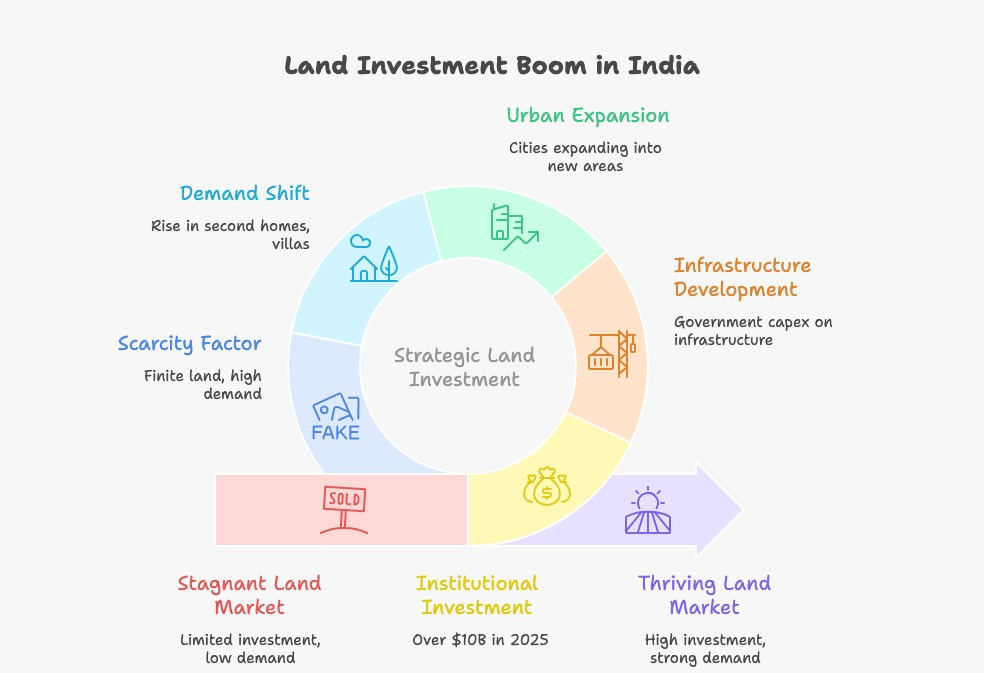
India’s real estate sector has witnessed record institutional inflows, crossing $10 billion in 2025, with a notable share directed toward land and development opportunities. This indicates growing confidence in long-term real estate fundamentals.
Infrastructure Is the Biggest Growth Engine
Infrastructure development continues to play a central role in shaping land investment in India.
- New highways
- Expanding metro networks
- Airport developments
- Industrial and logistics corridors
Government capital expenditure has consistently focused on these areas, creating long-term value for surrounding land parcels.
Unlike built properties, land directly benefits from infrastructure expansion. When connectivity improves, previously overlooked areas can quickly become high-demand zones.
Urban Expansion Is Creating New Investment Corridors
Cities in India are no longer confined to traditional boundaries. Expansion is happening outward, creating new micro-markets.
This expansion naturally increases the relevance of land investment, especially in emerging corridors where development is still in its early stages.
Scarcity Is Driving Value
Land is finite. While apartments can be built repeatedly, land cannot be replicated.
As demand increases and supply remains limited, land investment in India benefits from this fundamental imbalance—making it one of the few real estate assets where scarcity plays a direct role in long-term appreciation.
Land vs Apartments: Why Investors Are Rethinking Strategy
Understanding the shift toward land investment in India requires a comparison with traditional apartment-based investments.
Depreciation vs Appreciation
Apartments are subject to depreciation. Over time:
- Buildings age
- Maintenance costs increase
- Newer developments compete with older inventory
Land, on the other hand, does not depreciate in the same way. Its value is driven primarily by location, demand, and future potential.
This makes land investment particularly attractive for investors focused on long-term wealth creation.
Flexibility and Control
One of the biggest advantages of land investment in India is flexibility.
Investors can:
- Hold the asset for long-term appreciation
- Develop it when market conditions are favorable
- Use it for personal or commercial purposes
This flexibility is rarely available with built properties.
The Rise of Plotted Developments
India is witnessing a growing preference for plotted developments and low-density housing formats.
According to Grant Thornton’s real estate outlook, there is a clear shift toward villas, townhouses, and plotted communities in premium segments.
This trend aligns perfectly with the increasing interest in land investment in India, especially among high-net-worth individuals and second-home buyers.
Can Land Investment in India Really 10X? Understanding the Reality
The idea that land investment in India can deliver 10X returns is powerful—but it needs to be understood in the right context.
What Drives Exceptional Returns?
For land investment to generate significant appreciation, several factors must align:
- Entry into a high-growth corridor
- Strong infrastructure development
- Increasing demand from end-users or investors
- Clear legal and ownership structures
- Long holding periods
When these conditions are met, land values can increase substantially over time.
Time Is the Most Important Factor
Unlike short-term investments, land investment rewards patience.
The most successful land investments are those held through multiple phases of development—before, during, and after infrastructure expansion.
Not Every Land Investment Will Perform Equally
It is important to understand that not all land parcels will deliver high returns.
The difference lies in:
- Location selection
- Market timing
- Due diligence
A strategic approach is essential when considering land investment in India.
Changing Buyer Preferences: Lifestyle Meets Investment
Another major driver of land investment in India is the evolving mindset of buyers.
Rise of Second Homes and Lifestyle Investments
Modern investors are not just looking for financial returns. They are also seeking lifestyle value.
- Vacation homes
- Weekend retreats
- Private villas
These trends are shaping demand for land-based developments.
According to IBEF, HNIs and NRIs are expected to play a significant role in driving luxury housing demand in India.
Preference for Low-Density Living
There is a growing preference for:
- Open spaces
- Privacy
- Lower population density
This shift has increased interest in plotted developments, further strengthening the case for land investment in India.
Land as a Multi-Purpose Asset
Unlike apartments, land investment in India allows investors to combine:
- Financial growth
- Lifestyle benefits
- Future development opportunities
This versatility is one of the key reasons behind its growing popularity.
Why Goa Is Emerging as a Key Market for Land Investment
Within the broader landscape of land investment in India, certain regions stand out—and Goa is one of them.
Tourism as a Demand Driver
Goa recorded over 1.08 crore tourist arrivals in 2025, reflecting strong and sustained demand.
This level of tourism supports:
- Short-term rental markets
- Second-home demand
- Lifestyle investments
Improving Connectivity
The development of Mopa Airport has significantly enhanced Goa’s connectivity.
Its phased expansion is expected to support long-term growth in tourism and real estate demand.
Beyond Tourism: A Lifestyle Destination
Goa is evolving into more than just a holiday destination. It is becoming a place where people:
- Spend extended time
- Work remotely
- Invest in lifestyle-driven assets
This transformation makes it highly relevant in the context of land investment in India.
What Makes a Strong Land Investment in India
Not all opportunities are equal. A well-informed approach is essential.
Legal Clarity Is Non-Negotiable
The foundation of any successful land investment in India is clear documentation.
Investors should ensure:
- Clear title
- Proper zoning
- Verified ownership
Infrastructure and Accessibility
Proximity to infrastructure is one of the strongest drivers of land appreciation.
However, infrastructure must be supported by actual demand—not just announcements.
Demand Drivers
The most successful land investments are located in areas with:
- Population growth
- Tourism activity
- Employment opportunities
Exit Potential
Liquidity is often overlooked in land investment in India. A good investment should have clear resale potential.
Risks and Misconceptions in Land Investment
While land investment in India offers strong potential, it is important to approach it with awareness.
Myth: All Land Appreciates
In reality, appreciation depends on location, demand, and development potential.
Myth: Lower Price Means Better Deal
Affordable land is not always a good investment. It may indicate lack of demand or infrastructure.
Risk: Legal Complexity
Land transactions can involve multiple layers of verification. Proper due diligence is essential.
Risk: Unrealistic Expectations
Expecting rapid returns can lead to poor investment decisions. Land investment in India requires patience.
The Long-Term Outlook for Land Investment in India
Looking ahead, the outlook for land investment in India remains strong.
Key drivers include:
- Continued infrastructure development
- Growing urban expansion
- Increasing demand for lifestyle assets
- Rising interest from HNIs and NRIs
As these trends continue, land investment in India is likely to remain a key area of focus for long-term investors.
FAQs
1. Is land investment in India a good idea in 2026?
Yes, land investment in India is increasingly seen as a strong long-term investment due to infrastructure growth and rising demand for plotted developments.
India’s real estate sector has witnessed record institutional inflows, crossing $10 billion in 2025, with land and development assets gaining attention.
Government-led infrastructure projects—such as highways, airports, and smart cities—are also driving long-term value creation.
These factors make land investment in India a compelling option for long-term wealth creation.
2. Can land investment in India really give 10X returns?
Land investment in India can deliver multi-fold returns over time, but only under the right conditions.
High returns are typically seen when:
- Investment is made early in growth corridors
- Infrastructure development follows
- Demand increases over time
While 10X growth is possible, it depends on location, timing, and patience—not speculation.
3. What are the best places for land investment in India?
The best locations for land investment in India are areas with strong growth drivers such as infrastructure, tourism, or urban expansion.
Examples include:
- Emerging zones near metro cities
- Tourism-driven markets like Goa
- Industrial corridors
Infrastructure development plays a major role in determining land appreciation.
Identifying areas before they fully develop is key.
4. Is land investment in India better than apartment investment?
Land investment in India is generally better suited for long-term appreciation, while apartments are preferred for rental income.
- Land does not depreciate
- Apartments require maintenance and may lose value over time
- Land offers flexibility for future development
Many investors now diversify by including land investment in India alongside built assets.
5. Why are plotted developments becoming popular in India?
Plotted developments are gaining popularity because they combine land ownership with planned infrastructure.
Industry reports show a shift toward villas, plots, and low-density housing formats.
This trend is strengthening demand for land investment in India, especially among lifestyle buyers.
6. What factors should I check before investing in land in India?
Before making a land investment in India, investors should evaluate:
- Legal title clarity
- Zoning and land use
- Infrastructure connectivity
- Demand drivers in the area
For legal verification, you can refer to land record systems like:
Due diligence is critical for safe and successful land investment in India.
7. Why is Goa considered a strong market for land investment in India?
Goa is one of the most talked-about destinations for land investment in India due to tourism and lifestyle demand.
In 2025, Goa recorded over 1 crore tourist arrivals, indicating strong demand.
Additionally, infrastructure developments like Mopa Airport are improving connectivity.
These factors support long-term potential for land investment in India in Goa.
8. Is land investment in India safe from a legal perspective?
Land investment in India can be safe if proper due diligence is done.
Investors should verify:
- Ownership records
- Land classification
- Local regulations
Government digitization efforts have improved transparency in land records.
Taking the right precautions ensures secure land investment in India.
9. How long should I hold land for maximum returns in India?
The ideal holding period for land investment in India is typically 5–10 years or more.
Land value increases as:
- Infrastructure develops
- Demand grows
- Markets mature
Long-term holding is key to maximizing returns in land investment in India.
10. What are the risks involved in land investment in India?
Like any asset, land investment in India comes with risks:
- Legal issues if due diligence is skipped
- Low liquidity in some markets
- Overestimating growth potential
Understanding these risks and investing strategically can help reduce uncertainty.
Understanding the Real Potential of Land Investment in India
At its core, land investment in India is not just about buying a piece of property—it is about understanding how value is created over time.
Unlike fast-moving financial assets, land operates on a different timeline. It responds to infrastructure, connectivity, demand patterns, and economic expansion. It rewards patience, not urgency. And most importantly, it reflects a deeper principle of real estate: growth follows development.
Over the past few years, this principle has become increasingly visible. As India continues to invest heavily in infrastructure—through highways, airports, urban expansion, and tourism development—the impact on surrounding land markets is becoming more pronounced. These changes are not always immediate, but when they materialize, they often reshape entire micro-markets.
This is where land investment in India begins to stand out. It offers a unique combination of scarcity, flexibility, and long-term appreciation potential. While built properties serve a clear purpose—especially for rental income and immediate use—land remains one of the few real estate assets that can evolve with time, adapting to changing market conditions and future development opportunities.
The idea that land investment in India could deliver multi-fold growth, even up to 10X in certain scenarios, is not about speculation—it is about alignment. Alignment between:
- infrastructure and accessibility
- demand and lifestyle shifts
- location and long-term vision
When these elements come together, land has historically shown the ability to create significant value over extended periods.
However, it is equally important to approach this asset class with clarity. Not every opportunity will deliver exceptional returns. The strength of land investment in India lies not in randomness, but in informed decision-making—understanding where growth is likely to happen, why it is happening, and how long it may take.
Markets like Goa, for instance, demonstrate how tourism, lifestyle demand, and improving connectivity can create strong real estate ecosystems. But the broader story of land investment in India goes far beyond any single destination. It is a national narrative—one shaped by economic growth, urban expansion, and evolving investor priorities.
As more buyers begin to look beyond traditional formats and explore long-term asset creation, land is gradually reclaiming its place as a serious investment category.
For those navigating this space—especially in premium segments such as plotted developments, villa plots, and lifestyle-driven locations—having the right perspective matters as much as choosing the right asset.
In such cases, working with experienced real estate professionals who understand both macro trends and on-ground realities can offer valuable guidance, helping investors make more informed and confident decisions in an increasingly dynamic market.