
Land Investment in India 2026: How Digital Land Records and Infrastructure Corridors Are Reshaping Micro-Market Growth
India is entering a new era of structured real estate decision-making. In previous decades, land buying was often influenced by word-of-mouth momentum, speculative optimism, and informal networks. In contrast, land investment in India is increasingly shaped by transparency, governance reforms, infrastructure coordination, and digital traceability.
The most important shift in land investment in India 2026 is not just about price appreciation. It is about clarity. It is about documentation confidence. It is about understanding how infrastructure corridors create measurable, predictable micro-markets over time.
Today’s investor is not asking, “Where is the next hot spot?”
They are asking, “Where is the next structurally supported growth zone?”
That question defines land investment in India .
Two large structural forces are driving this transformation:
- Digital land record modernisation
- National infrastructure corridor integration
Together, they are redefining how investors evaluate risk, opportunity, and long-term holding strategy in land investment in India.
Why 2026 Marks a Structural Shift in Land Buying
The foundation of land investment in India 2026 is transparency.
The Government of India’s Digital India Land Records Modernisation Programme (DILRMP) has been designed to modernise land record management, digitise ownership data, and integrate registration systems.
DILRMP aims to:
- Digitise textual land records
- Digitise cadastral maps
- Integrate registration and mutation systems
- Improve accessibility of land records
This does not eliminate due diligence. However, it improves visibility. For investors evaluating land investment in India, access to digitised records enhances confidence and reduces opacity.
When transparency improves, institutional and serious retail investors participate with greater comfort. That shift alone is redefining land investment in India 2026.
The New Risk Equation in Land Investment in India 2026
Risk in land buying historically came from three core uncertainties:
- Ownership ambiguity
- Boundary disputes
- Infrastructure unpredictability
In land investment in India, these variables are increasingly measurable.
While land due diligence remains essential, digitised records allow:
- Easier verification of ownership chains
- Faster access to mutation records (where digitised)
- Improved traceability of survey references
Extension and strengthening of DILRMP further reinforce policy continuity
This reform ecosystem strengthens structured land investment in India 2026 by encouraging document-first decisions.
SVAMITVA: Strengthening Rural and Peri-Urban Ownership Clarity
The SVAMITVA scheme focuses on drone-based mapping and the issuance of property cards in rural inhabited areas.
Technical Overview (Survey of India
This initiative improves spatial clarity and boundary mapping in habitation zones. For investors evaluating peri-urban belts and lifestyle destinations, this adds layer of formal recognition.
In the context of land investment in India 2026, initiatives like SVAMITVA contribute to:
- Clearer mapped boundaries
- Formal documentation strengthening
- Increased confidence in emerging regions
Clarity is becoming central to land investment in India 2026.
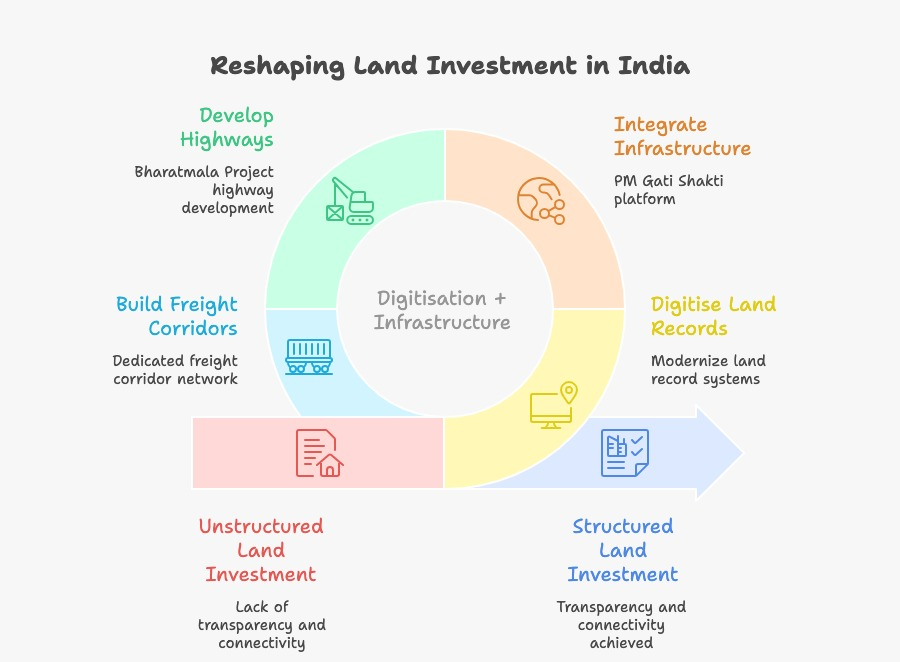
Infrastructure Corridors: The Engine Behind Micro-Market Growth
If digitisation builds trust, infrastructure builds demand.
India’s PM Gati Shakti National Master Plan integrates infrastructure planning across ministries to streamline execution and enhance connectivity.
Infrastructure corridors influence land investment in India 2026 in measurable stages:
- Announcement
- Land acquisition
- Construction
- Connectivity improvement
- Economic activity increases
- Value discovery
The gap between infrastructure confirmation and full price adjustment creates what can be called an “infrastructure-lag window.” Strategic investors study this window carefully.
In land investment in India 2026, corridors are not hype triggers — they are structural demand multipliers.
Understanding the Micro-Market Effect
A micro-market emerges when:
- Accessibility improves
- Demand begins to form
- Supply remains controlled
- Infrastructure execution is visible
Micro-markets are not defined by marketing campaigns. They are defined by fundamentals.
In land investment in India 2026, micro-markets often appear near:
- Expanding highway corridors
- Airport influence zones
- Logistics clusters
- Tourism-linked growth areas
These zones typically move through gradual appreciation cycles rather than sudden spikes.
Goa as a Connectivity and Lifestyle Case Study
Lifestyle-driven markets demonstrate how connectivity transforms accessibility.
The operational Manohar International Airport in North Goa has strengthened regional connectivity.
Improved access influences tourism, second homes, and lifestyle migration patterns. However, as with all regions, structured land investment in India 2026 still depends on:
- Documentation clarity
- Infrastructure alignment
- Realistic pricing
Connectivity enhances opportunity — but documentation sustains it.
A Structured Framework for Land Investment in India 2026
Serious investors approach land investment in India 2026 systematically.
Step 1: Verify Documentation
- Ownership chain
- Mutation updates
- Survey alignment
Step 2: Evaluate Connectivity
- Distance to major corridors
- Airport access
- Highway expansion proximity
Step 3: Assess Livability Signals
- Water feasibility
- Road access
- Surrounding land use patterns
Step 4: Compare Pricing Rationally
Avoid paying “future” prices for “present” land.
In land investment in India 2026, discipline creates an advantage.
Common Mistakes to Avoid in Land Investment in India 2026
Even in a reform-backed environment, caution is essential.
Mistake 1: Ignoring mutation records
Fix: Cross-check registration and mutation consistency.
Mistake 2: Buying purely on corridor announcements
Fix: Monitor execution progress.
Mistake 3: Over-leveraging short-term speculation
Fix: Align with long-term holding strategy.
Mistake 4: Skipping professional verification
Fix: Consult qualified legal and documentation experts.
Prudent structuring defines successful land investment in India 2026.
The Maturity Phase of Land Investment in India 2026
India’s real estate market is evolving toward formalisation. Digitization, infrastructure integration, and policy continuity are improving long-term stability.
While land will always require careful due diligence, the environment surrounding land investment in India 2026 is more transparent than in previous decades.
The emphasis today is not on urgency.
It is on clarity.
It is not on speculation.
It is on structure.
It is not on hype.
It is on fundamentals.
FAQs
1️⃣ Is land investment in India 2026 safer than in previous years?
Land investment in India 2026 is benefiting from improved transparency due to digitisation initiatives such as the Digital India Land Records Modernization Programme (DILRMP). This programme aims to digitize textual and spatial land records, improving access and reducing documentation opacity.
However, while digitization improves visibility, safety still depends on due diligence, title verification, mutation updates, and legal checks. Structured evaluation is essential in land investment in India 2026, especially in emerging micro-markets.
2️⃣ What is DILRMP and how does it impact land investment in India 2026?
The Digital India Land Records Modernization Programme (DILRMP) is a government initiative aimed at modernizing land record systems by digitizing ownership records, integrating registration systems, and improving cadastral mapping.
For land investment in India 2026, DILRMP contributes to:
- Improved access to land records
- Better ownership traceability
- Reduced manual documentation dependency
- Integration of registration and mutation systems
This reform strengthens structured decision-making in land investment in India 2026.
3️⃣ What is mutation and why is it important in land investment in India 2026?
Mutation refers to the process of updating land revenue records after ownership changes due to sale, inheritance, or transfer. While registration confirms a transaction, mutation updates revenue records.
In Land Investment in India 2026, ensuring mutation has been completed helps maintain consistency between registered ownership and revenue records. This reduces potential future disputes.
Although mutation processes vary across states, verifying its completion is a critical step in structured land investment in India 2026.
4️⃣ What is the SVAMITVA scheme and how does it affect land investment in India 2026?
The SVAMITVA scheme uses drone-based mapping to issue property cards in rural inhabited areas. It is implemented by the Ministry of Panchayati Raj.
For investors evaluating peri-urban regions, SVAMITVA improves boundary clarity and spatial documentation. While it does not replace due diligence, it enhances mapping accuracy in many areas.
As peri-urban zones grow, initiatives like SVAMITVA strengthen documentation frameworks relevant to land investment in India 2026.
5️⃣ How do infrastructure corridors influence land investment in India 2026?
Infrastructure corridors such as highways, freight corridors, and airport expansions improve connectivity, reduce travel time, and enhance regional accessibility.
In Land Investment in India 2026, corridor-led development can create micro-markets — areas that benefit from connectivity before full-scale urban saturation.
Investors typically track:
- PM Gati Shakti projects
- Bharatmala highway development
- Dedicated Freight Corridors
Connectivity does not guarantee appreciation, but it strengthens demand fundamentals in structured land investment in India 2026.
6️⃣ What is a micro-market in land investment in India 2026?
A micro-market is a smaller geographic cluster that experiences focused growth due to infrastructure, connectivity, or lifestyle demand.
In land investment in India 2026, micro-markets typically form near:
- Highway corridors
- Airport influence zones
- Tourism-driven regions
- Logistics clusters
These areas often grow steadily over time rather than experiencing sudden spikes. Identifying documentation clarity and infrastructure alignment is crucial in evaluating micro-markets.
7️⃣ How long should one hold land in land investment in India 2026?
Land investment in India 2026 is generally aligned with medium to long-term holding strategies. Infrastructure-led growth cycles often take several years to mature.
Investors typically align holding periods with:
- Corridor execution timelines
- Regional demand absorption
- Economic activity expansion
Short-term speculation can increase volatility, whereas long-term planning aligns better with structured land investment in India 2026.
8️⃣ What documents should be verified before land investment in India 2026?
For structured land investment in India 2026, investors should review:
- Title chain
- Sale deed
- Mutation records
- Survey details
- Encumbrance certificate (as applicable)
Digitisation initiatives improve access to records in many regions, but verification should still be conducted thoroughly and professionally.
9️⃣ Does digitisation eliminate disputes in land investment in India 2026?
Digitisation improves transparency but does not eliminate disputes. It reduces documentation opacity and enhances record accessibility.
In land investment in India 2026, digitised records help investors:
- Cross-check ownership
- Track historical entries
- Reduce manual inconsistencies
However, professional legal review remains essential for secure transactions.
🔟 How can investors approach land investment in India 2026 systematically?
A structured approach to land investment in India 2026 includes:
- Documentation verification
- Mutation confirmation
- Survey alignment checks
- Infrastructure mapping
- Connectivity analysis
- Long-term holding assessment
When clarity and connectivity are evaluated together, land investment in India 2026 becomes less speculative and more strategic.
Structured, Informed, Long-Term Thinking in Land Investment in India 2026
The defining characteristic of land investment in India 2026 is not speed — it is structure.
For decades, land as an asset class has rewarded patience. What distinguishes land investment in India 2026 from previous cycles is the availability of better tools, clearer data, and coordinated infrastructure planning. Investors today operate in a more informed ecosystem where documentation transparency and connectivity mapping play central roles.
Structured thinking in land investment in India 2026 begins with verification. Government-led digitisation initiatives such as the Digital India Land Records Modernisation Programme (DILRMP) are steadily modernising land record systems across states. By digitising textual and spatial records and integrating registration processes, DILRMP enhances accessibility and traceability. While due diligence remains essential, improved record systems strengthen confidence in long-term holding strategies.
In parallel, national infrastructure coordination under PM Gati Shakti is aligning transportation, logistics, and urban planning under a unified framework. This integrated planning approach reduces fragmented development and supports corridor-led regional growth. For investors, this means land investment in India 2026 can be evaluated through measurable infrastructure signals rather than speculative narratives.
Long-term thinking in land investment in India 2026 also requires understanding execution timelines. Infrastructure expansion under programmes such as Bharatmala and the Dedicated Freight Corridor Corporation of India (DFCCIL) unfolds over structured phases. The most stable gains historically occur when investments align with execution visibility rather than early announcement excitement.
Patience is not passive in land investment in India 2026 — it is strategic. Investors who combine documentation clarity with infrastructure mapping reduce uncertainty and enhance predictability.
Another element of informed thinking is recognising the growing formalisation of rural and peri-urban land systems. The SVAMITVA scheme, which uses drone-based mapping to provide property cards in rural habitation areas, strengthens spatial clarity. While this does not replace legal due diligence, it reinforces structured documentation frameworks that support confidence in land investment in India 2026.
A mature approach to land investment in India 2026 typically follows five core principles:
- Documentation before valuation
- Connectivity before speculation
- Infrastructure execution before premium pricing
- Long-term horizon before short-term momentum
- Professional verification before commitment
This is not about urgency. It is about alignment.
It is also important to recognise that land investment in India 2026 operates within India’s broader economic growth narrative. As logistics corridors expand, airports improve connectivity, and regional clusters strengthen, land becomes a foundational asset linked to mobility, commerce, and lifestyle evolution.
However, sustainable outcomes depend on discipline. Structured land investment in India 2026 avoids exaggerated assumptions and instead relies on:
- Official infrastructure data
- Record verification systems
- Realistic entry pricing
- Holding capacity alignment
The difference between reactive buying and informed investing lies in the process. In 2026, the investors who benefit most from land investment in India 2026 are those who treat land as a long-term capital allocation decision rather than a short-term trade.
Verification builds confidence.
Connectivity builds demand.
Time builds value.
When these three pillars align, land investment in India 2026 becomes a strategic wealth-building tool rather than a speculative bet.
For investors who prefer clarity over hype and structure over speed, this new phase of land investment in India 2026 offers a more transparent and infrastructure-backed environment than ever before.