
North Goa Real Estate: Could Easier International Travel Boost Second Homes & Holiday Rentals?
India’s international tourism ecosystem is becoming easier to navigate. Digital visa processing, expanding e-Visa access, airport modernization and the rollout of biometric immigration infrastructure are gradually reducing friction for travellers entering the country. For North Goa real estate, these changes matter because tourism accessibility is one of the factors that can influence accommodation demand, second-home interest and holiday-rental activity.
The question, however, is not whether easier international travel will automatically increase property prices. The more relevant question is whether improved accessibility can contribute to sustained visitor demand, longer stays and stronger demand for quality accommodation—and whether those trends can create opportunities for selected properties.
Goa recorded 517,802 foreign tourist arrivals in 2025, compared with 467,911 in 2024, according to the Goa Tourism Department. While this represents a significant year-on-year increase, international arrivals remain below Goa’s 2017 peak of 890,459.
This creates an interesting backdrop for North Goa real estate. International tourism is recovering, Mopa Airport is strengthening the state’s connectivity, and Goa is implementing additional immigration facilitation. At the same time, the holiday-rental market is becoming more competitive and parts of the residential market are undergoing normalization.
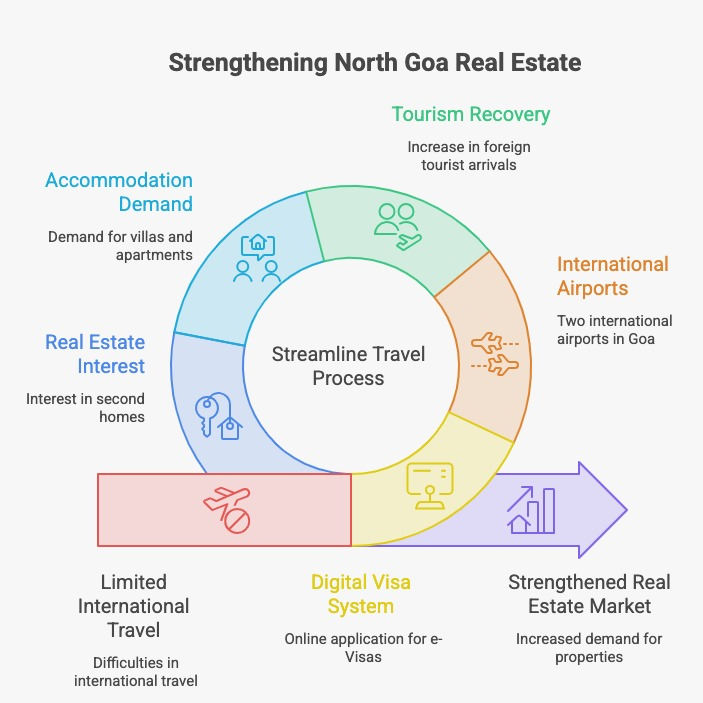
The potential investment chain can therefore be expressed as:
Easier international travel → improved accessibility → potential increase in visitors → accommodation demand → holiday-rental demand → greater second-home visibility → potential real-estate opportunity.
The important word is potential.
What Is Changing in India’s Immigration and Visa System?
One of the most important developments for understanding North Goa real estate is India’s Fast Track Immigration–Trusted Traveller Programme, or FTI-TTP.
The programme uses biometric identification and automated e-gates to speed up immigration clearance for eligible travellers.
According to the official Bureau of Immigration – FTI-TTP portal, the programme currently covers:
- Indian nationals
- Foreign nationals holding OCI cards
Applicants provide passport information and undergo biometric enrolment, including facial and fingerprint data. The programme is currently provided without an enrolment fee.
The Bureau of Immigration currently lists 31 designated international airports for the programme, including both Goa’s Dabolim Airport and Manohar International Airport, Mopa.
That is an important distinction.
FTI-TTP is not yet a universal fast-track facility for foreign tourists
Ordinary foreign tourists should not be told that they can currently register for FTI-TTP simply because they are travelling to Goa.
The current official eligibility remains Indian nationals and OCI cardholders.
The significance for North Goa real estate is therefore indirect at this stage.
The programme demonstrates India’s broader movement toward digital, biometric and automated immigration processing, while Goa’s inclusion establishes the infrastructure pathway for faster airport processing.
For international tourism, the more directly relevant facility today is India’s e-Visa system.
India’s e-Visa System Already Supports Goa’s International Accessibility
India’s official e-Visa portal allows eligible foreign travellers to apply electronically before travelling to India.
Goa benefits from having two international airports with e-Visa entry capability:
- Dabolim Airport
- Manohar International Airport, Mopa
The official immigration-post information published by the Ministry of Home Affairs identifies both airports among India’s e-Visa-enabled immigration points.
For North Goa real estate, Mopa is particularly relevant because of its geographic relationship with the state’s northern tourism corridor.
A traveller’s experience can now be viewed as a connected journey:
Digital visa application → flight booking → arrival at Goa → immigration clearance → airport transfer → accommodation.
Reducing friction across this journey can improve the destination’s accessibility.
However, immigration efficiency alone cannot create tourism demand. International flight capacity, airfare, destination marketing, accommodation quality and the broader travel experience remain equally important.
Goa’s International Tourism Market Is Recovering
The latest Goa Tourism Department figures provide an encouraging foundation for North Goa real estate.
Goa recorded:
Year | Foreign Tourist Arrivals |
2022 | 169,005 |
2023 | 452,702 |
2024 | 467,911 |
2025 | 517,802 |
The state recorded more than 10.8 million total tourist arrivals in 2025, including 10.28 million domestic visitors and 517,802 foreign visitors.
Foreign arrivals therefore increased by approximately 10.7% between 2024 and 2025.
For North Goa real estate, the more interesting point is the longer-term comparison.
Goa received approximately 890,459 foreign tourists in 2017, substantially higher than the 517,802 recorded in 2025.
That means the international tourism market has not simply reached a ceiling.
There remains considerable room for recovery if international connectivity, visa facilitation, destination marketing and traveller confidence continue improving.
Why Mopa Airport Matters to North Goa Real Estate
Airport connectivity is one of the most important structural factors supporting North Goa real estate.
Goa’s tourism department reported that 1,784 international flights operated through Dabolim and Mopa during 2025, carrying approximately 235,798 foreign tourists. Mopa accounted for 1,141 international flights compared with 643 through Dabolim.
For North Goa real estate, this matters because Mopa provides an additional international gateway closer to several northern tourism and residential markets.
The broader corridor includes areas such as:
- Pernem
- Mandrem
- Morjim
- Ashwem
- Siolim
- Vagator
- Anjuna
- Assagao
- Arpora
- Mapusa and surrounding areas
Airport accessibility does not guarantee appreciation in any particular locality. Instead, it can improve the underlying accessibility of the wider northern market.
That becomes particularly relevant for second-home owners who may travel between India and overseas destinations.
What Could Easier International Travel Do to Goa Tourism?
The first possible impact is reduced travel friction.
For an international tourist, every additional administrative or logistical step can influence destination selection.
A smoother journey can potentially make a destination more attractive to:
- repeat travellers,
- families,
- long-stay visitors,
- premium travellers,
- wellness tourists,
- workation travellers,
- international second-home owners.
For North Goa real estate, this matters because longer or repeat visits can create a stronger connection between tourism and residential demand.
A person who visits Goa once for three nights is primarily a tourist.
A visitor who returns repeatedly for two or three weeks may begin considering:
- serviced apartments,
- villas,
- second homes,
- managed residences,
- long-stay accommodation.
This does not mean every tourist becomes a property buyer. It means that a larger and more engaged visitor base can expand the potential pool of future lifestyle-property buyers.
International Tourists Are Not All Short-Stay Visitors
The latest India Tourism Data Compendium provides an important perspective.
For international tourists visiting India in 2024, the reported duration distribution included:
- 0–1 day: 7.70%
- 2–3 days: 10.75%
- 4–7 days: 19.18%
- 1–2 weeks: 21.64%
- 2–4 weeks: 21.54%
- More than one month: 14.49%
These figures are India-wide and should not be interpreted as Goa-specific stay-duration statistics.
Nevertheless, they demonstrate the relevance of longer-duration international travel.
For North Goa real estate, longer stays are important because residential-style accommodation becomes more useful as the length of a trip increases.
A traveller staying for two or three weeks may value:
- a kitchen,
- private outdoor space,
- washing facilities,
- multiple bedrooms,
- reliable Wi-Fi,
- workspace,
- residential neighbourhoods,
- access to restaurants and beaches.
This creates a potential overlap between tourism demand and residential accommodation.
North Goa’s Tourism Ecosystem Supports Different Visitor Segments
The strength of North Goa real estate is not based on one tourism attraction.
The region combines several demand generators.
Beaches and coastal experiences
The northern coastline includes well-known tourism markets such as Morjim, Mandrem, Ashwem, Vagator, Anjuna, Baga, Calangute and Candolim.
Restaurants and lifestyle
North Goa has developed a broad ecosystem of restaurants, cafés, beach venues, markets and entertainment.
Wellness and experiential travel
Yoga, wellness retreats, Ayurveda, spas and experience-led hospitality have become part of Goa’s broader tourism proposition.
Workations
Goa is also developing a stronger workation identity.
In 2026, the state hosted a government-backed Shackathon at Baga Beach focused on startups, creators and flexible work. The event attracted more than 500 participants and was positioned around emerging work culture.
For North Goa real estate, this diversification matters because different visitor segments can potentially create demand across different periods of the year.
A property does not necessarily need to depend entirely on conventional beach tourism.
From Tourism Growth to North Goa Real Estate Demand
The relationship between tourism and North Goa real estate is best understood through accommodation demand.
Suppose international visitor numbers increase.
The immediate impact is not necessarily on property prices.
The first impact is on:
Number of visitors
Then:
Number of nights
Then:
Accommodation demand
Then:
Demand for hotels, villas, apartments and holiday homes
Only after these stages can tourism potentially influence:
Property ownership and investment demand.
This distinction is important.
A tourism increase does not automatically create capital appreciation.
For North Goa real estate, the strongest relationship exists where tourism demand intersects with:
- good connectivity,
- limited or differentiated supply,
- attractive neighbourhoods,
- strong hospitality infrastructure,
- legal suitability,
- quality property management,
- long-term residential appeal.
Could Tourism Growth Strengthen the North Goa Second-Home Market?
The second-home market is different from the conventional investment-property market.
A second-home buyer often values several things simultaneously:
- Personal use
- Lifestyle
- Capital preservation
- Potential rental income
- Long-term ownership
This makes North Goa real estate particularly interesting for buyers who want a property that can function as both a residence and an occasional holiday rental.
The strongest candidates may include:
Luxury villas
Villas can appeal to families, HNIs and travellers seeking privacy and space.
Premium apartments
Apartments can offer easier maintenance, amenities and lock-and-leave convenience.
Boutique residences
Boutique properties can sit between conventional hotels and standalone villas.
Managed second homes
A professionally managed residence can potentially address the operational challenge faced by owners who spend only part of the year in Goa.
Plotted developments
Plots appeal more strongly to buyers with a longer investment horizon and an intention to develop or hold land.
The suitability of each category depends on the buyer’s objectives.
There is no single property format that automatically represents the best North Goa real estate investment.
The Rise of Managed Second Homes
One important development in North Goa real estate is the growing relevance of managed ownership.
The traditional second-home model requires the owner to manage:
- maintenance,
- housekeeping,
- landscaping,
- repairs,
- utilities,
- security,
- guest preparation,
- rental operations.
A managed-residency model can centralize many of these responsibilities.
For an NRI or investor living outside Goa, that can be particularly useful.
However, professional management does not eliminate market risk.
Rental demand can fluctuate, operating expenses can change and occupancy is never guaranteed.
Therefore, managed second homes should be evaluated as a hybrid lifestyle and investment model, not simply as guaranteed-income products.
What Does the 2026 Holiday-Rental Market Tell Us?
The latest AirDNA data provides one of the clearest snapshots of Goa’s short-term rental environment.
As of June 2026, AirDNA reported:
Indicator | Goa Market |
Active listings | 6,849 |
Average occupancy | 42% |
Average ADR | $75 |
RevPAR | $28 |
Listing growth | +26.1% YoY |
Occupancy growth | +18.1% YoY |
ADR change | -18.9% YoY |
Revenue per listing | -13.8% YoY |
This is one of the most important findings for North Goa real estate investors.
The market is showing higher occupancy but lower average daily rates and lower revenue per listing.
That demonstrates why increasing tourism does not automatically translate into higher rental returns.
Supply matters.
Competition matters.
Pricing matters.
Property quality matters.
Management matters.
North Goa Micro-Markets Show Different Rental Dynamics
Market-wide data can conceal significant differences between localities.
For example, AirDNA’s June 2026 data shows:
Assagao
- 899 active listings
- 45% occupancy
- $181 ADR
- $72 RevPAR
Arpora
- 1,072 active listings
- 46% occupancy
- $76 ADR
- $33 RevPAR
Mandrem
- 1,042 active listings
- 39% occupancy
- $52 ADR
- $18 RevPAR
Nerul
- 297 active listings
- 45% occupancy
- $128 ADR
- $50 RevPAR
These figures should not be used to predict the income of an individual property.
They do, however, demonstrate that North Goa real estate operates within highly differentiated micro-markets.
The same purchase strategy cannot be applied uniformly across North Goa.
Why Short-Term Rental Regulation Matters
Any discussion about North Goa real estate and Airbnb-style income must include regulation.
The Goa Department of Tourism issued an April 24, 2026 advisory stating that individuals operating accommodation through platforms such as Airbnb or similar short-term rental services are required to obtain registration with the Department of Tourism.
The department also emphasized tourist-data reporting through the TIME application and warned that unregistered accommodation can face enforcement action.
Investors should therefore verify:
- tourism registration requirements,
- permitted property use,
- local permissions,
- applicable NOCs,
- building or society restrictions,
- foreign-guest reporting requirements,
- taxation,
- environmental permissions where applicable,
- property-management arrangements.
The correct question is not:
“Can I list this North Goa real estate asset on Airbnb?”
The better question is:
“Can this specific property legally and practically be operated as short-term tourist accommodation under the applicable rules?”
That distinction protects investors from building a financial model around an assumption that may not apply to the property.
How Could International Tourism Influence Holiday Rentals?
If international arrivals continue increasing, the first possible effect could be greater demand for accommodation.
But the quality of that demand matters.
International visitors who stay longer may create more opportunities for:
- villas,
- serviced apartments,
- boutique residences,
- managed homes,
- family accommodation.
International travellers may also have different expectations regarding:
- Wi-Fi,
- kitchens,
- privacy,
- service,
- cleanliness,
- design,
- location,
- workspaces.
This can favour properties that are differentiated rather than simply inexpensive.
For North Goa real estate, the opportunity therefore lies less in the total number of tourists and more in the relationship between tourist nights, property positioning and supply.
Key North Goa Locations to Watch
There is no universally “best” location in North Goa real estate. Different micro-markets serve different investment objectives.
Morjim, Mandrem and Ashwem
These markets combine beach tourism, international visitors and boutique hospitality.
Their proximity to Mopa is also relevant to the northern tourism corridor.
They may therefore appeal to buyers interested in lifestyle residences, villas and hospitality-oriented properties.
Siolim
Siolim combines residential character with access to several established tourism areas.
Its positioning can be relevant for buyers seeking a second home that is connected to the broader North Goa tourism ecosystem.
Assagao
Assagao has developed a strong lifestyle ecosystem involving restaurants, villas, wellness and experiential tourism.
Its short-term rental market is also significant according to AirDNA data.
Anjuna and Vagator
These markets have established tourism ecosystems with beaches, hospitality, restaurants and entertainment.
They can therefore be relevant to holiday-oriented residences.
Arpora
Arpora provides access to major tourism areas while retaining a substantial residential and hospitality ecosystem.
Its 2026 AirDNA data shows 46% average occupancy across tracked listings.
Candolim, Calangute and Baga
These are among North Goa’s most established tourism markets, with extensive accommodation, restaurants and visitor infrastructure.
Nerul and Reis Magos
These areas can be viewed through a longer-term residential lens, with connectivity to Panaji and coastal tourism zones.
Nerul also has an active short-term rental market according to AirDNA.
Moira
Moira offers a lower-density lifestyle environment and is increasingly relevant to buyers seeking larger homes and a quieter residential setting.
The broader movement of demand beyond traditional coastal hubs is one of the trends worth watching in North Goa real estate.
Porvorim
Porvorim has a more urban residential character and can appeal to buyers prioritizing connectivity, services, and year-round residential utility.
Is 2026 a Good Time to Consider North Goa Real Estate?
The current market does not support a blanket “buy everything” conclusion.
Instead, 2026 appears more suitable for selective acquisition based on fundamentals.
There are several positive factors.
Tourism recovery
Foreign tourist arrivals increased in 2025.
International connectivity
Mopa is handling an increasing share of international flight activity.
Visa accessibility
Mopa and Dabolim are e-Visa-enabled entry points.
Immigration modernization
FTI-TTP infrastructure includes both Goa airports, while current eligibility remains limited to Indian nationals and OCI cardholders.
Lifestyle demand
North Goa continues to attract visitors seeking beaches, wellness, restaurants, entertainment and workation experiences.
These factors provide a constructive backdrop for North Goa real estate.
But investors should also recognize the counterpoints.
The short-term rental market has increasing supply.
AirDNA reported active listings up 26.1% year-on-year while ADR fell 18.9%.
That means investors need to evaluate the asset rather than simply the destination.
What Should Investors Evaluate Before Buying?
A disciplined North Goa real estate evaluation can begin with eight questions.
1. What is the primary objective?
Is the property primarily for:
- personal use,
- rental income,
- long-term holding,
- lifestyle,
- or a combination?
2. Does the micro-market have proven demand?
Tourism demand should be assessed at the locality level rather than using Goa-wide statistics alone.
3. How accessible is the property?
Airport access, roads, beaches, restaurants and daily services all matter.
4. Is the intended use legally permitted?
This is particularly important for short-term rental strategies.
5. What happens outside peak season?
A realistic investment model should account for slower periods.
6. What are the operating costs?
Consider:
- maintenance,
- utilities,
- housekeeping,
- landscaping,
- management,
- repairs,
- taxes,
- platform charges.
7. Can the property compete?
Design, amenities, privacy, location and guest experience influence rental demand.
8. Would the property still make sense without rental income?
This is perhaps the most useful test for a second-home buyer.
If the property provides genuine lifestyle utility and remains financially sensible without aggressive rental assumptions, the investment thesis can be more resilient.
Risks That Could Affect North Goa Real Estate
A balanced North Goa real estate outlook must recognize several uncertainties.
Seasonality
Tourism remains seasonal, even though some segments are becoming more diversified.
Rental supply
An expanding short-term rental market can create pricing competition.
Rental-rate compression
Higher occupancy does not necessarily mean higher revenue. Goa’s 2026 AirDNA figures demonstrate this clearly.
Regulatory changes
Tourism registration and reporting requirements can evolve.
Operating expenses
Villas and larger residences can require substantial ongoing maintenance.
International tourism volatility
Currency movements, airline capacity, geopolitical developments and global economic conditions can affect international travel.
Property-specific risks
Title, approvals, zoning, permitted use and environmental restrictions must be assessed independently for every property.
Liquidity
A physical property generally takes longer to sell than a liquid financial instrument.
These considerations do not invalidate the North Goa real estate opportunity. They simply reinforce the importance of asset-level due diligence.
The Bigger Picture: Easier Travel and North Goa Real Estate
The strongest argument is not that a new immigration initiative will suddenly create a property boom.
The more defensible argument is that India is gradually improving the international visitor journey.
That journey includes:
Digital visa access
International airport connectivity
Biometric immigration infrastructure
Destination marketing
Improving tourism infrastructure
Diversified visitor experiences
Together, these factors can potentially improve Goa’s ability to attract and retain international visitors.
For North Goa real estate, the opportunity emerges when these tourism fundamentals intersect with residential demand.
A visitor may initially come for the beach.
Later, they may return for a month-long workation.
Eventually, repeated visits may create interest in owning a holiday home.
That is the longer-term pathway through which tourism can potentially influence real estate.
North Goa Real Estate: Opportunity or Overstatement?
The evidence supports opportunity, but not certainty.
The tourism side of the equation is constructive.
Foreign arrivals reached 517,802 in 2025, international flights are operating through Mopa and Dabolim, and Goa is advancing airport immigration infrastructure.
The short-term rental side is active but competitive.
AirDNA reports 6,849 active listings across Goa, 42% average occupancy and $75 average ADR as of June 2026, while listing supply increased significantly year-on-year.
The regulatory environment also requires attention.
Goa’s Tourism Department has specifically stated that Airbnb and similar short-term rental operators require tourism registration and must comply with applicable reporting requirements.
Therefore, the investment thesis for North Goa real estate should not be:
“More tourists mean guaranteed returns.”
It should be:
“Improving international accessibility may strengthen tourism fundamentals, and selected properties positioned within strong tourism and residential ecosystems could potentially benefit from this demand.”
Could Easier International Travel Make North Goa Real Estate More Attractive?
The answer is potentially yes, but conditionally.
India’s immigration and visa ecosystem is becoming increasingly digital. Goa has access to e-Visa-enabled international airports, Mopa is expanding its role as an international gateway, and FTI-TTP infrastructure now includes both Goa airports. The current FTI-TTP eligibility, however, remains limited to Indian nationals and OCI cardholders.
At the same time, Goa’s foreign tourist arrivals increased to 517,802 in 2025, demonstrating continued recovery in international tourism.
For North Goa real estate, these developments could create a favourable structural environment if they translate into sustained visitor growth, longer stays and healthy accommodation demand.
But the opportunity will not be uniform.
The strongest prospects are likely to be associated with properties that combine:
Accessibility + strong micro-market fundamentals + lifestyle appeal + quality construction + legal usability + professional management + realistic financial assumptions.
The potential chain is therefore:
Easier international travel
→ lower visitor friction
→ potentially stronger international tourism
→ more accommodation demand
→ greater holiday-rental opportunities
→ greater visibility of second-home ownership
→ potential opportunities in North Goa real estate
The final step is not guaranteed.
For investors, the most important decision is therefore not simply when to buy North Goa real estate, but which property, in which micro-market, for what purpose and under what operating assumptions.
In that context, 2026 can be viewed as a period for selective, research-driven evaluation rather than destination-wide speculation.
FAQs
1. Could easier international travel increase demand for North Goa real estate?
Easier international travel could support North Goa real estate by reducing friction at different stages of the visitor journey. India’s e-Visa system already allows eligible international travellers to complete visa formalities electronically, while Goa’s Mopa and Dabolim airports are among the designated e-Visa entry points. The official India e-Visa portal provides the current eligibility and application framework.
India is also expanding biometric immigration infrastructure through the Fast Track Immigration–Trusted Traveller Programme (FTI-TTP). The Bureau of Immigration currently lists Mopa and Dabolim among participating airports, although the present FTI-TTP eligibility is primarily for Indian nationals and OCI cardholders.
For North Goa real estate, the potential effect is indirect: easier access can encourage tourism, tourism can increase accommodation demand, and sustained accommodation demand can support interest in holiday homes and second homes. However, increased tourist accessibility alone does not guarantee property appreciation or rental returns.
2. Is North Goa real estate likely to benefit from rising international tourist arrivals?
The outlook for North Goa real estate could become more supportive if Goa’s international tourism recovery continues. According to the Goa Tourism Department, Goa recorded 517,802 foreign tourist arrivals in 2025, up from 467,911 in 2024.
The state’s international tourism market is still below its historical peak, which indicates that there remains potential for further recovery. However, the impact on North Goa real estate depends on how additional tourism translates into actual nights spent, accommodation demand and spending within the region.
Investors should therefore look beyond headline arrival numbers. Length of stay, seasonality, visitor profile, accommodation preferences and the supply of competing properties are equally important when assessing the potential effect on North Goa real estate.
3. How does Mopa Airport influence North Goa real estate investment potential?
Mopa Airport is an important connectivity factor for North Goa real estate because it provides an international gateway positioned closer to several northern tourism and residential markets.
According to the Goa Tourism Department, Mopa handled a significant share of Goa’s international flight activity during 2025.
Better airport connectivity can reduce travel time for visitors and second-home owners, potentially improving the attractiveness of locations within the northern tourism corridor. For North Goa real estate, this can be particularly relevant for areas such as Pernem, Mandrem, Morjim, Ashwem, Siolim and other connected markets.
However, airport proximity should be evaluated alongside road access, local infrastructure, tourism demand, property quality and legal suitability rather than being treated as a standalone appreciation indicator.
4. Is North Goa real estate suitable for a second-home investment?
North Goa real estate can be relevant to second-home buyers who want to combine personal lifestyle use with potential rental opportunities. The region offers a combination of beaches, hospitality, restaurants, wellness experiences, entertainment and international connectivity.
A second home can serve several purposes: personal holidays, family use, long-term ownership and occasional rental activity. This hybrid utility can make tourism destinations attractive to lifestyle-oriented investors.
However, buyers should distinguish between owning a second home and operating a short-term rental. Rental use may involve tourism registration, property-use requirements, local permissions and reporting obligations.
Before purchasing North Goa real estate for this purpose, investors should review the applicable rules through the Goa Tourism Department and verify the property’s specific legal and operational status.
5. Can North Goa real estate generate Airbnb or holiday-rental income?
Selected North Goa real estate properties may be suitable for holiday rentals, but rental income should never be assumed to be automatic or guaranteed.
Third-party market data indicates that Goa has a substantial short-term rental ecosystem. AirDNA’s Goa market data reported thousands of active listings in 2026, demonstrating the scale of the market.
At the same time, the data shows why investors need to look beyond occupancy. Market-wide occupancy, ADR, RevPAR, supply growth and seasonality can move in different directions. Individual property performance can vary considerably based on location, design, amenities, pricing, reviews and management.
Anyone considering North Goa real estate for holiday rentals should therefore prepare a property-level financial model using conservative occupancy and pricing assumptions rather than relying on destination-wide averages.
6. What regulations apply when using North Goa real estate as a short-term rental?
Regulatory compliance is an important part of evaluating North Goa real estate for holiday rentals. Goa’s tourism authorities have stated that accommodation being offered through platforms such as Airbnb and similar short-term rental platforms requires appropriate registration with the Department of Tourism.
The Goa Government’s official advisory on tourist-data reporting also highlights the requirement for registered accommodation providers to comply with applicable tourist-data reporting through the TIME system.
Depending on the property and operating model, investors should verify tourism registration, permitted property use, local permissions, applicable NOCs, guest reporting requirements, taxation and other regulatory obligations.
For North Goa real estate, regulatory due diligence should be completed before incorporating short-term rental revenue into an investment calculation.
7. Which locations should investors consider when evaluating North Goa real estate?
There is no single location that is universally superior for North Goa real estate because different micro-markets serve different investment objectives.
Morjim, Mandrem and Ashwem are closely associated with beach tourism and international visitors. Siolim offers access to established tourism corridors while retaining a stronger residential character. Assagao has developed a lifestyle-oriented ecosystem involving restaurants, villas and experiential hospitality.
Anjuna and Vagator have established tourism and entertainment infrastructure, while Arpora offers connectivity to several major tourism areas. Candolim, Calangute and Baga have mature hospitality and visitor ecosystems.
Further south and inland, Nerul, Reis Magos, Moira and Porvorim can be considered from different residential and lifestyle perspectives.
When assessing North Goa real estate, investors should compare locations based on airport access, road connectivity, tourism demand, residential infrastructure, rental ecosystem, property supply and intended holding period rather than relying on generic location rankings.
The Goa Tourism Department is a useful starting point for understanding the state’s tourism geography.
8. Is 2026 a good time to invest in North Goa real estate?
Whether 2026 is the right time to invest in North Goa real estate depends primarily on the investor’s objectives, time horizon and property selection.
Several fundamentals are supportive: Goa’s foreign tourist arrivals increased in 2025, international connectivity through Mopa continues to develop, and the state remains an established lifestyle and tourism destination. Official tourism statistics can be reviewed through the Goa Tourism Department.
At the same time, investors should recognize that the holiday-rental market is competitive. AirDNA’s Goa data indicates substantial listing growth, meaning increased tourism does not automatically translate into stronger revenue for every property.
For North Goa real estate, a selective approach is therefore more defensible than a blanket market-timing recommendation. Investors should assess location, acquisition price, legal status, rental feasibility, operating costs, infrastructure, property quality and long-term lifestyle utility.
The strongest investment case is generally one where the property remains financially and personally useful even if rental performance is lower than initially projected.