
Why North Goa Is Becoming a Year-Round Tourism & Real Estate Investment Destination in 2026
North Goa is entering a new phase in its evolution. Once understood primarily through the lens of beach holidays and peak-season tourism, the region is increasingly developing into a broader lifestyle, hospitality and real estate ecosystem.
The investment narrative is no longer simply about tourist footfall. It is about the interaction between tourism growth, year-round visitor demand, improving connectivity, infrastructure development, premium hospitality, lifestyle migration and real estate demand.
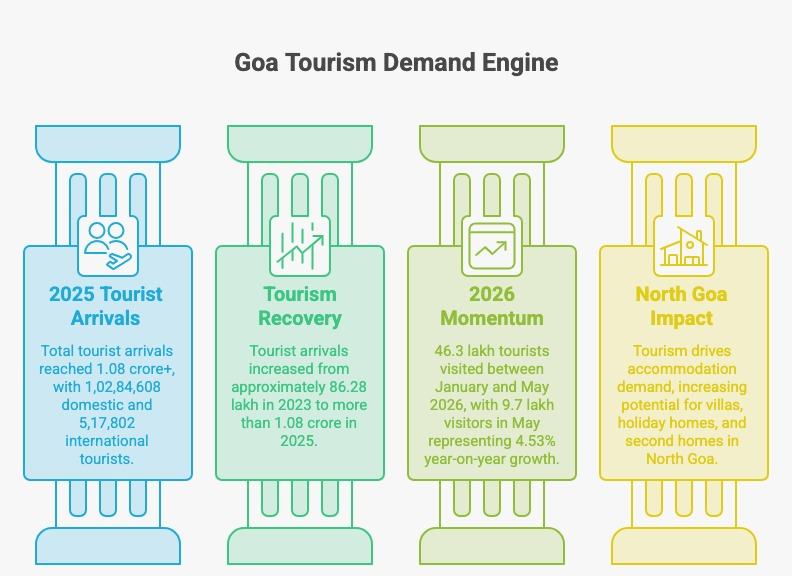
The latest available data provides several encouraging signals. Goa recorded 1.08 crore tourist arrivals in 2025, including 1.03 crore domestic and 5.18 lakh international visitors, according to the Department of Tourism, Government of Goa.
The first five months of 2026 brought another 46.3 lakh visitors to Goa. Although growth over the corresponding 2025 period was relatively modest, May 2026 recorded 9.7 lakh visitors, up 4.53% year-on-year.
More importantly for North Goa’s long-term investment story, tourism is increasingly being deliberately developed beyond the traditional winter season. Goa’s tourism policy describes the state’s ambition to become a year-round responsible tourism destination, while current campaigns are actively promoting monsoon gastronomy, wellness, hinterland experiences and other activities.
For investors, this matters because sustained tourism can support a wider ecosystem of hotels, villas, holiday homes, managed residences, restaurants, experiences and premium residential communities.
The question is therefore no longer simply whether North Goa is popular.
The more important question is:
Can North Goa’s expanding tourism economy create the conditions for sustained real estate demand and long-term capital appreciation?
Goa Tourism Growth: The Numbers Behind North Goa’s Expanding Opportunity
The foundation of the North Goa real estate investment thesis is tourism.
According to official Goa Tourism data, the state received 77.86 lakh tourists in 2017. Total arrivals reached 80.64 lakh in 2019 before the pandemic disruption. Tourism subsequently recovered strongly, reaching 86.28 lakh visitors in 2023 and 1.04 crore in 2024.
In 2025, Goa recorded:
Tourism indicator | 2025 |
Domestic tourists | 1,02,84,608 |
Foreign tourists | 5,17,802 |
Total arrivals | 1,08,02,410 |
This demonstrates the scale of the destination’s tourism economy.
It also reveals something important about the composition of demand.
Domestic visitors now represent the overwhelming majority of arrivals. That gives Goa a much broader tourism base than a market dependent primarily on international travellers.
International tourism remains important, however. The recovery of overseas demand provides an additional layer of hospitality and premium accommodation demand, particularly in established tourism zones.
What does the latest 2026 data show?
As of 8 August 2026, complete official full-year 2026 tourism statistics are not yet available. Therefore, claims about the entire 2026 monsoon season outperforming previous years should be treated cautiously.
The latest reported official figure shows approximately 46.3 lakh tourists between January and May 2026, compared with 41.3 lakh during January–May 2025. May itself recorded 9.7 lakh visitors, representing 4.53% growth over May 2025.
The significance is less about declaring a record year and more about recognising that visitor demand remains substantial even outside the traditional winter peak.
That distinction is important for anyone evaluating North Goa real estate investment over a five- or ten-year horizon.
Is North Goa Becoming a Year-Round Tourism Destination?
Historically, Goa’s tourism economy has been highly seasonal. The traditional October-to-March period has attracted significant tourist volumes, while the monsoon months have generally been viewed differently.
That pattern is beginning to broaden.
Goa’s own tourism policy identifies year-round tourism as a strategic objective. The state’s tourism framework seeks to diversify the destination beyond beaches and develop experiences around culture, heritage, hinterlands, wellness and nature.
The Department of Tourism also explicitly describes the monsoon as a period in which visitors increasingly come to experience Goa’s greenery and landscapes, supported by hotel and resort promotions.
The 2025 monsoon provided an important signal
Government reporting on the first half of 2025 highlighted strong visitor numbers and specifically pointed towards monsoon tourism, cultural experiences, hinterland trails, spiritual circuits and wellness offerings as part of Goa’s diversification strategy.
This is significant because year-round tourism does not require every month to produce the same number of visitors.
Instead, it means creating different reasons to visit during different parts of the year.
Monsoon tourism is becoming experience-led
Goa Tourism’s Goa Monsoon on a Plate campaign for July and August is one example. It positions gastronomy as a tourism experience during the rainy season, connecting food with culture, local produce and the landscape.
Other initiatives have promoted:
- monsoon trekking
- rafting
- wellness
- yoga
- heritage experiences
- hinterland tourism
- culinary tourism
- homestays
- nature-based travel
Goa Tourism’s policy documents similarly emphasise diversification beyond beaches and the creation of new tourism activities to attract wider categories of travellers and repeat visitors.
For North Goa real estate investment, this broadening matters because it can potentially reduce dependence on a narrow winter holiday window.
Changing Traveller Behaviour Is Expanding the Tourism Economy
The modern Goa visitor is not necessarily travelling only for a beach holiday.
Travellers increasingly combine accommodation with experiences, food, wellness, nature, culture and longer stays.
Goa’s tourism strategy reflects this shift. The state’s tourism department has been promoting a broader identity encompassing hinterland trails, heritage, spiritual and wellness experiences, festivals and monsoon tourism.
The result is a more diversified tourism economy.
For the real estate market, this creates several potential demand categories:
- short-stay holiday accommodation
- premium villas
- second homes
- managed residences
- long-stay accommodation
- boutique hospitality
- lifestyle communities
- land for future development
The implications become particularly relevant in North Goa because the region already contains a dense network of established tourism and lifestyle destinations.
North Goa’s Major Tourism & Lifestyle Hubs
North Goa should not be viewed as a single uniform property market.
Different micro-markets serve different tourism and residential functions.
Morjim, Ashwem and Mandrem
These coastal belts are associated with premium beach experiences, boutique hospitality, wellness-oriented travel and luxury accommodation.
Their appeal extends beyond conventional mass tourism and can support premium positioning.
Vagator and Chapora
Vagator and Chapora combine beaches with restaurants, hospitality, entertainment, lifestyle experiences and premium residential development.
This combination makes them important areas to monitor for North Goa real estate investment.
Anjuna
Anjuna has an established tourism identity supported by hospitality, restaurants, wellness, entertainment and lifestyle businesses.
Its mature ecosystem creates a different investment proposition from an emerging connectivity-led location.
Assagao, Parra and Siolim
These locations increasingly appeal to buyers seeking a quieter lifestyle while retaining proximity to established tourism hubs.
The second-home and premium residential story is particularly relevant here.
Arpora, Baga, Calangute and Candolim
These markets benefit from established visitor infrastructure, hospitality, restaurants, entertainment and strong tourism visibility.
Savills data reported by Business Standard previously showed a 19% year-on-year price increase in the North Beach District locations including Anjuna, Arpora, Baga, Calangute, Candolim and Vagator during the relevant period.
Pernem and the MOPA influence zone
The northern belt has a different long-term story.
Its potential is increasingly linked to airport accessibility, highway connectivity and the gradual expansion of tourism and economic activity around the MOPA corridor.
MOPA Airport Is Reshaping North Goa’s Connectivity Story
Infrastructure is one of the strongest structural components of the North Goa real estate investment narrative.
The opening and expansion of Manohar International Airport at Mopa has strengthened northern Goa’s air-connectivity proposition.
The Directorate of Civil Aviation, Government of Goa states that Mopa has been designed for phased expansion, beginning with a Phase 1 capacity of 4.4 million passengers per annum and an ultimate potential capacity of 28 million passengers per annum.
This provides a long-term infrastructure framework rather than simply a short-term tourism catalyst.
Airport infrastructure matters because accessibility influences how easily tourists, second-home owners, business travellers and hospitality operators can reach a destination.
As Mopa’s network develops, the potential chain is straightforward:
Improved Air Connectivity → Higher Accessibility → Tourism Growth → Hospitality Expansion → Lifestyle Demand → Real Estate Demand
For North Goa, this is particularly relevant because Mopa is located in the northern part of the state.
NH-66 and Regional Infrastructure Add Another Layer of Potential
Air connectivity works best when supported by efficient road infrastructure.
NH-66 remains an important transportation spine for Goa and the broader Konkan region, while infrastructure projects around North Goa and Mopa are designed to improve regional accessibility.
Government investment platforms continue to list major NH-66 improvement projects, including the six-lane elevated corridor in North Goa.
The importance for real estate is not simply the existence of a highway.
It is the possibility of reduced travel friction.
A destination that becomes easier to reach can become more attractive for:
- weekend homes
- second homes
- holiday rentals
- hospitality projects
- premium residences
- commercial activity
For investors, however, infrastructure should always be assessed according to actual execution status rather than future announcements alone.
Hospitality Growth Is Strengthening the Real Estate Ecosystem
Tourism growth and real estate growth rarely operate independently.
A growing tourism economy requires accommodation, restaurants, experiences, transportation, wellness facilities and entertainment.
That creates a wider hospitality ecosystem.
JLL’s latest India hotel investment research found that hotel investment reached US$567 million in 2025, up 67% from US$340 million in 2024. The report also noted that Tier-II and Tier-III destinations accounted for 40% of transaction volume, with Goa among the destinations attracting premium hospitality investment.
The luxury segment accounted for 42% of transaction volume.
HNIs and family offices represented 27% of hotel investment transactions.
This matters because it demonstrates growing institutional and private-capital interest in hospitality assets and premium destinations.
JLL also reported that Q1 2026 hotel transaction volumes reached US$185 million, 58% higher than Q1 2025.
For North Goa, expanding hospitality can reinforce the destination’s premium positioning and support demand for professionally managed accommodation and lifestyle real estate.
Why Tourism Growth Can Translate Into North Goa Real Estate Demand
The relationship between tourism and property demand is not automatic, but the connection can be understood through several layers.
Luxury villas
Premium travellers increasingly seek privacy, space and differentiated experiences.
Second homes
Affluent buyers can combine personal use with potential holiday accommodation.
Holiday homes
Properties in established tourism corridors may serve short-stay demand.
Managed residences
Professional management can make second-home ownership more practical for owners who spend only part of the year in Goa.
Hospitality-led real estate
Tourism infrastructure can create demand for properties designed around accommodation and lifestyle experiences.
Land
Long-term investors may focus on locations where connectivity and development activity are gradually improving.
This is why North Goa real estate investment should be evaluated as a relationship between tourism fundamentals and property fundamentals rather than as a simple bet on visitor numbers.
Second-Home Demand Is Becoming a Structural Theme
The latest market research provides another useful signal.
A Times of India report published in August 2026, citing India Sotheby’s International Realty’s Luxury Outlook Survey 2024, reported that around 35% of wealthy Indians intended to invest in a second or vacation home in Goa within one to two years, while 71% of affluent respondents planned to invest in luxury real estate.
The same report noted that Goa was the preferred domestic destination for second homes among the surveyed respondents.
This indicates that the demand base extends beyond traditional property investors.
The buyer may be an HNI, NRI, entrepreneur, business leader or family looking for an asset that provides:
Lifestyle + Personal Use + Potential Rental Income + Long-Term Ownership
That multifunctionality is one of the reasons North Goa real estate investment has become an increasingly relevant theme for wealth creators.
North Goa Property Appreciation: What Does the Data Actually Show?
Historical data provides encouraging evidence, but it also demonstrates why investors should avoid extrapolating short-term growth indefinitely.
Savills data reported by Business Standard showed average North Goa villa capital values increasing by approximately 16% year-on-year during the relevant period. Emerging peri-coastal and North Hinterland micro-markets reportedly recorded increases of around 22–23%.
These figures demonstrate that selected North Goa markets have previously experienced substantial appreciation.
However, the 2026 market has also shown the importance of supply-demand dynamics.
A February 2026 Times of India report citing Savills India reported that villa prices in several North Goa localities declined 3–5% year-on-year, with increased inventory and softer demand contributing to the correction.
This does not negate the long-term case for North Goa real estate investment.
Instead, it highlights an important principle:
Destination-level growth does not guarantee identical performance for every property.
Location, entry price, asset quality, supply, accessibility, design, management and buyer depth can all influence performance.
Holiday Homes and Rental Demand: A Complementary Investment Driver
Tourism can support holiday-home demand, but rental economics should be analysed independently.
A successful holiday home depends on more than tourist arrivals.
Factors include:
- occupancy
- average daily rate
- seasonality
- location
- property design
- management
- maintenance
- guest experience
- operating costs
- competition
This distinction is especially important in North Goa because increasing accommodation supply can create both opportunity and competition.
For a North Goa real estate investment, rental potential should therefore be treated as a potential supplementary return stream rather than a guaranteed income source.
The strongest properties may be those that combine:
location + differentiated experience + premium design + professional management + year-round appeal.
North Goa Real Estate Investment Outlook: The Next Five Years
The five-year outlook should be considered through scenarios rather than a single forecast.
Conservative scenario
Assuming approximately 5% annual capital appreciation, a ₹1 crore property would reach roughly ₹1.28 crore after five years.
Base scenario
At approximately 7.5% annual appreciation, the same property would reach around ₹1.44 crore.
Growth scenario
At approximately 10% annual appreciation, it would reach roughly ₹1.61 crore.
These are mathematical scenarios, not forecasts.
The factors that could influence the outcome include tourism growth, MOPA connectivity, infrastructure execution, supply levels, premium residential demand, interest rates and broader economic conditions.
Can North Goa Property Double in Value Over 10 Years?
This is one of the most important questions for long-term investors.
A doubling scenario is mathematically possible without assuming exceptionally high annual growth.
To double in ten years, an investment needs approximately 7.2% annual compounded capital appreciation.
For example:
Annual capital appreciation | Approx. 10-year value of ₹1 crore |
5% | ₹1.63 crore |
7.2% | Approximately ₹2 crore |
10% | ₹2.59 crore |
The 7.2% figure should not be interpreted as a prediction.
It simply establishes the mathematical threshold for a 2X capital-value scenario.
The question then becomes whether North Goa has fundamentals that could support such an outcome over a decade.
Potential supporting factors include:
- sustained tourism demand
- broader year-round tourism
- MOPA passenger growth
- improved road connectivity
- premium hospitality expansion
- second-home demand
- lifestyle migration
- limited supply of high-quality coastal assets
- increasing demand for differentiated residences
At the same time, supply expansion, market cycles, regulatory changes, rental economics and asset-specific liquidity can influence actual results.
Therefore, 2X should be discussed as a scenario, not as a promised return.
What Could Shape North Goa’s Long-Term Capital Appreciation?
Over the next decade, several variables will determine whether North Goa can sustain strong real estate performance.
Tourism growth
Continued visitor growth and higher tourism spending can support the wider local economy.
Year-round tourism
If monsoon, wellness, food, culture, nature and experiential tourism continue to expand, accommodation demand could become more evenly distributed across the year.
MOPA Airport
Increasing passenger volumes and route connectivity could strengthen northern Goa’s accessibility.
Infrastructure
Road and transport improvements can expand the practical catchment of tourism and residential markets.
Premium hospitality
More high-quality hotels and hospitality assets can deepen the destination ecosystem.
Lifestyle demand
Second-home buyers increasingly evaluate properties as lifestyle assets as well as financial assets.
Supply discipline
Long-term appreciation depends not merely on demand growth but on how much quality inventory enters the market.
Key Catalysts to Watch From 2026 Onward
For investors monitoring North Goa real estate investment, the following indicators deserve attention:
- MOPA passenger growth
- New domestic and international air routes
- NH-66 and regional road improvements
- Tourism arrivals during monsoon months
- Domestic and international visitor mix
- Hotel occupancy and room additions
- New branded hospitality investments
- Second-home transaction activity
- Villa inventory and absorption
- Land and infrastructure development around emerging corridors
These indicators can provide a more useful picture of the market than relying on property-price headlines alone.
What Investors Should Evaluate Before Buying North Goa Property
A positive market outlook should never replace property-level due diligence.
Before making a North Goa real estate investment, investors should evaluate:
Title and legal documentation
Verify ownership, approvals, land-use status and applicable permissions.
Micro-location
Analyse the actual neighbourhood rather than relying on the reputation of North Goa as a whole.
Infrastructure status
Separate operational infrastructure from announced or proposed projects.
Supply
Understand existing inventory, upcoming projects and resale competition.
Rental economics
Analyse actual occupancy, achievable rates and operating costs rather than relying on headline yield claims.
Asset quality
Location, construction quality, design, amenities and management can influence long-term demand.
Exit liquidity
Consider who the likely future buyer could be and how easily the asset could be resold.
These considerations are particularly important because the 2026 correction in some North Goa villa markets demonstrates that attractive destinations can still experience normal real estate cycles.
North Goa 2026–2036: The Bigger Investment Picture
The long-term story is ultimately larger than tourism alone.
North Goa is gradually developing an interconnected ecosystem:
Tourism Growth
↓
Year-Round Visitor Demand
↓
MOPA & Infrastructure
↓
Hospitality Expansion
↓
Lifestyle & Second-Home Demand
↓
Premium Residential Real Estate
↓
Potential Long-Term Capital Appreciation
The evidence available as of August 2026 supports the first stages of this chain.
Goa’s tourist arrivals have reached more than 1 crore annually. The government is actively pursuing year-round and diversified tourism. MOPA is expanding its role as a northern aviation gateway. Hospitality investment is strengthening. And affluent buyers continue to show interest in Goa’s second-home market.
What remains uncertain is the exact magnitude of future property appreciation.
That is why the strongest investment argument is not a promise of a particular return.
It is the possibility that multiple structural demand drivers continue reinforcing one another over a sufficiently long period.
FAQs
1. Is North Goa real estate investment a good option in 2026?
North Goa real estate investment is increasingly attracting attention because the region combines a large tourism economy, improving connectivity, premium hospitality, lifestyle demand and an expanding second-home market. Goa recorded more than 1.08 crore tourist arrivals in 2025, including over 1.02 crore domestic visitors and more than 5 lakh international tourists, according to the Department of Tourism, Government of Goa.
The investment case is particularly relevant for buyers looking beyond short-term speculation. MOPA Airport is strengthening North Goa’s accessibility, while government initiatives are encouraging year-round and experiential tourism.
However, the performance of individual properties can vary significantly according to location, title, construction quality, supply, accessibility, rental economics and purchase price. Therefore, North Goa real estate investment should be evaluated at the micro-market and asset level rather than based solely on Goa’s overall tourism growth.
2. Is North Goa becoming a year-round tourism destination?
Yes, the available evidence indicates that North Goa real estate investment is increasingly supported by a tourism ecosystem that is becoming less dependent on the traditional winter season.
The Goa Tourism Department has highlighted the development of monsoon tourism, hinterland experiences, wellness, culture, heritage, food and nature-based activities as part of Goa’s broader tourism diversification strategy.
Goa’s tourism policy also identifies year-round tourism as a strategic objective, with efforts to expand tourism beyond conventional beach experiences.
This does not mean that visitor numbers will be identical throughout the year. Instead, the destination is developing different demand drivers for different seasons.
For North Goa real estate investment, this evolution could be important because properties supported by year-round tourism may have a broader potential demand base than assets dependent exclusively on peak-season visitors.
3. How is MOPA Airport influencing North Goa real estate investment?
MOPA Airport is one of the most important infrastructure developments supporting the long-term North Goa real estate investment narrative.
The Directorate of Civil Aviation, Government of Goa states that Manohar International Airport at Mopa has an initial Phase 1 capacity of approximately 4.4 million passengers per year, with a planned ultimate capacity of up to 28 million passengers annually.
Improved air connectivity can make northern Goa more accessible to domestic and international travellers, second-home owners, business travellers and hospitality guests.
The potential economic chain is:
MOPA Airport → Better Connectivity → Tourism Growth → Hospitality Expansion → Lifestyle Demand → Real Estate Demand
The airport itself does not guarantee property appreciation. Investors should also evaluate road connectivity, surrounding development, current infrastructure, property supply and the specific micro-market before making a North Goa real estate investment.
4. Can tourism growth increase demand for North Goa real estate?
Tourism growth can contribute to real estate demand by increasing the need for accommodation, hospitality infrastructure, holiday homes, villas, second homes and lifestyle properties.
Goa recorded 1,08,02,410 tourist arrivals in 2025, according to the Goa Tourism Department.
For North Goa real estate investment, the important consideration is how tourism translates into actual local demand. A growing visitor economy can support hotels, restaurants, experiences and short-stay accommodation, while affluent travellers may also develop an interest in owning second homes.
The connection is strongest in locations where tourism is supported by good accessibility, established hospitality infrastructure, lifestyle amenities and limited availability of high-quality properties.
However, tourism growth should be considered one component of the investment thesis, not a standalone guarantee of property appreciation.
5. Can North Goa real estate investment generate rental income through holiday homes?
Potentially, yes. A well-located holiday home or managed villa can potentially generate rental income by serving short-stay visitors, but rental performance varies significantly from property to property.
Factors affecting rental performance include:
Location and accessibility
Property size and design
Amenities
Guest experience
Seasonal occupancy
Average daily rental rates
Professional property management
Maintenance and operating expenses
Competition from hotels, villas and other holiday rentals
The expansion of tourism and the development of year-round experiences can create a broader demand environment for holiday accommodation.
However, investors considering North Goa real estate investment should calculate rental income using realistic occupancy and operating-cost assumptions rather than relying on headline rental-yield claims.
Tourism arrival statistics indicate destination-level demand; they do not automatically establish the rental yield of an individual property.
6. Can North Goa property prices double in 10 years?
A 2X outcome is mathematically possible, but it should be treated as a scenario rather than a guaranteed investment return.
To approximately double an investment over 10 years, the required compounded annual growth rate is around 7.2%.
For example:
Annual appreciation | ₹1 crore after 10 years |
5% | ₹1.63 crore |
7.2% | Approximately ₹2 crore |
10% | ₹2.59 crore |
Historical market data has shown periods of strong appreciation in selected North Goa micro-markets. At the same time, market reports have also documented periods of price moderation in certain villa markets.
This means the future performance of a North Goa real estate investment will depend on factors such as tourism growth, infrastructure execution, demand-supply balance, entry price, property quality, regulatory conditions and broader economic cycles.
Therefore, 2X should be presented as a 10-year investment scenario, not a promise or expected guaranteed return.
7. Which factors could support long-term North Goa real estate investment?
Several structural factors could support the long-term North Goa real estate investment outlook.
These include:
Year-round tourism: Goa is actively diversifying its tourism economy through wellness, culture, gastronomy, hinterland and monsoon experiences.
MOPA Airport: Increasing aviation capacity and connectivity can improve access to northern Goa.
Road infrastructure: NH-66 and associated regional infrastructure can improve connectivity between tourism and residential corridors.
Hospitality investment: JLL reported strong hotel investment activity in India in 2025, with Goa among the destinations attracting premium hospitality investment.
Second-home demand: Affluent buyers continue to show interest in Goa as a second-home market, adding a lifestyle-driven demand component.
Together, these factors can create a supportive environment, although actual property performance will remain dependent on the individual asset and micro-market.
8. What should investors check before making a North Goa real estate investment?
Before making a North Goa real estate investment, investors should conduct property-level due diligence rather than relying only on broader tourism and infrastructure trends.
Key areas to examine include:
Title and ownership: Verify ownership records, title history and applicable legal documentation.
Land use and approvals: Confirm that the property’s permitted use aligns with the intended residential, hospitality or development purpose.
Location: Analyse accessibility, nearby infrastructure, tourism demand and surrounding development.
Supply: Review existing and upcoming properties within the same micro-market.
Rental economics: Assess realistic occupancy, rental rates, management fees, maintenance and other operating costs.
Infrastructure: Distinguish between operational infrastructure and projects that are merely announced or proposed.
Exit potential: Consider the likely future buyer profile and liquidity of comparable properties.
Regulatory compliance: Where applicable, verify RERA registration and relevant permissions through official authorities.
The Government of Goa and relevant state planning and regulatory departments should be used for official verification wherever possible.
Ultimately, a strong North Goa real estate investment decision should combine tourism research, infrastructure analysis, property-level due diligence and a realistic long-term financial model.
Why North Goa Deserves a Place on the Long-Term Investment Radar
North Goa’s evolution is increasingly visible across tourism, aviation, infrastructure, hospitality and residential demand.
The region is moving beyond the idea of being valuable only during the traditional holiday season. Goa’s tourism policy is explicitly pursuing year-round responsible tourism, while monsoon campaigns are creating new reasons to visit during traditionally quieter months.
At the same time, MOPA is strengthening northern connectivity, hospitality investment is expanding, and affluent buyers continue to show interest in second homes.
For North Goa real estate investment, this creates a compelling long-term framework:
Tourism Growth → Year-Round Demand → Connectivity → Lifestyle → Real Estate Demand → Long-Term Appreciation Potential
A 2X capital-value outcome over ten years would require approximately 7.2% annual compounded appreciation. That is a mathematical scenario, not a guaranteed outcome.
The more important investment question is whether the underlying ecosystem can continue expanding at a pace that supports sustained demand for high-quality real estate.
For HNIs, NRIs, entrepreneurs, second-home buyers and long-term wealth creators, North Goa therefore deserves to be evaluated not merely as a holiday destination, but as an evolving lifestyle and tourism-led real estate market.
The opportunity, however, will ultimately depend on selecting the right micro-market, the right asset and the right entry point.
For investors, that is where research becomes more valuable than speculation.