Why 2026 Is Different for Indian Property Markets
Over the past decade, India’s real estate sector has transformed from a fragmented, sentiment-driven industry to one increasingly shaped by policy clarity, infrastructure expansion, and data-driven investment decisions. As we approach India real estate 2026, the narrative is less about speculation and more about structural shifts. Investors, researchers, and high-intent homebuyers are no longer asking if prices will rise; they are asking what will drive real estate markets next, and where the real opportunities lie.
In earlier cycles, city centres and metropolitan markets were the primary growth drivers. However, as urbanization expands into peripheral zones, the way value is created is fundamentally changing. Connectivity — via expressways, logistics corridors, and rail networks — is now taking precedence over traditional locational attributes. This is part of a broader trend where infrastructure and governance reforms are reshaping how property markets function.
Consider the scale of infrastructure spending planned by the government: India has embarked on one of the world’s largest infrastructure pushes, with allocations across roads, rail, airports, and industrial corridors designed to sustain growth well into the next decade. This is significant because such capital expenditure not only improves connectivity but also increases economic activity, employment, and demand for both residential and commercial real estate.
At the same time, reforms like digital land records and strengthened regulatory frameworks have increased transparency and investor confidence. As a result, india real estate 2026 has emerged not just as a forecast year but as a milestone for evaluating the impact of integrated policy and infrastructure on property markets.
In this comprehensive blog, we will explore what makes 2026 different, how infrastructure influences real estate value, the role of policy reforms, why certain markets outperform others, and what investors should consider when shaping long-term property strategies.
Infrastructure as a Value Creator — The Backbone of Property Markets
Infrastructure is one of the most important determinants of long-term real estate value. Unlike short-term demand that fluctuates with market sentiment, infrastructure projects change the economic fundamentals of regions, creating new growth centres and shifting demand patterns.
Expressways and Connectivity Corridors
Expressways and highways significantly improve accessibility between major economic centres and satellite regions. For example, the Delhi–Mumbai Industrial Corridor (DMIC), one of India’s most ambitious infrastructure projects, spans six states and is designed to accelerate industrial growth and spur development in residential, commercial, and logistics sectors. Improved connectivity reduces travel time, lowers transportation costs, and makes peripheral regions more attractive for investment.
Similarly, the Bengaluru–Chennai Expressway is set to transform the economic potential between two major cities in South India, opening new corridors for real estate growth outside traditional urban cores. (Source: Wikipedia)
As roads and expressways mature, they facilitate not only residential mobility but also economic activity, creating hubs of employment. This attracts demand for housing, retail spaces, and services, further enhancing property values in previously underdeveloped areas.
Airports and Logistics Hubs
Airports act as catalysts for both commercial and residential growth. When a new airport is announced or expanded, the surrounding region often experiences a surge in real estate interest well before project completion. This is because airports stimulate ancillary development such as hotels, business parks, logistics zones, and housing clusters.
Consider the impact of the upcoming Noida International Airport near Jewar. Projections indicate significant real estate appreciation in areas within its catchment due to improved domestic and international connectivity — particularly for investment-oriented buyers and businesses alike.
Rail Connectivity Projects
Rail networks play a crucial role in integrating distant regions into the mainstream economic fold. Projects such as the North Eastern Railway connectivity initiatives are improving linkages across states in the northeast, making these markets more attractive for investment and sustainable real estate demand.
Enhanced rail connectivity not only supports population movement but also stimulates commercial activity by reducing transit costs for businesses.
Policy Reforms Driving Transparency and Confidence
While infrastructure builds physical connectivity, regulatory and policy reforms are improving the trust ecosystem necessary for large-scale real estate investment.
RERA — Creating Accountability and Consumer Protection
The Real Estate (Regulation and Development) Act (RERA) was introduced to combat delays, promote accountability, and protect buyers’ interests. Since its implementation, RERA has enforced stricter timelines for project delivery, transparent pricing, and a requirement for developers to deposit a significant portion of project funds in escrow.
These measures have decreased project uncertainty and enhanced buyer confidence. For both domestic and foreign investors, the assurance of regulatory compliance has made long-term property investment more attractive.
Digital Land Records and Ease of Due Diligence
Land title clarity is a crucial factor in real estate investment. Historically, ambiguous land records and manual systems have acted as barriers to investment. However, recent digitization initiatives, driven by state and central government efforts, are offering clearer title histories, reducing litigation risk, and accelerating transaction timelines.
For investors considering india real estate 2026, this reform is particularly meaningful because transparency accelerates decision-making and reduces legal costs associated with due diligence.
Foreign Direct Investment (FDI) and Liberalization
India’s real estate sector has opened doors to greater foreign investment through policy liberalization. With up to 100% FDI permitted in certain real estate segments, global investors are increasingly considering Indian property markets as long-term investment destinations.
The liberalization of FDI rules signals confidence in the market’s regulatory framework and stability, which bodes well for future capital inflows.
Unified Approvals and Faster Clearances
The government’s ongoing efforts toward unified approvals and single-window clearances aim to reduce bureaucratic delays for project approvals. These initiatives are expected to expedite project timelines and encourage new developments, especially in emerging growth zones, boosting investor confidence and contributing to india real estate 2026 narratives.
Understanding the Land Appreciation Advantage
One of the most significant shifts in the investment mindset is the realization that land — especially near strategic infrastructure nodes — often outperforms built properties over the long term.
Why Land Outperforms Built Properties
Unlike apartments or built structures that depreciate due to wear and functionality, land has no physical depreciation. Its value is driven primarily by scarcity, location improvements, and demand changes — making it a fundamentally robust asset over longer horizons.
Historical data suggests that in markets where major infrastructure projects are executed, land values tend to appreciate ahead of built properties. For instance, in the Nagpur region, land transactions and price points surged after metro connectivity and expressway linkages were announced, even before developers began launching large-scale residential projects.
This pattern highlights a key insight: infrastructure investment creates real estate demand before traditional supply enters the market, and land prices re-rate accordingly.
Land vs Apartments: A Value Comparison
Factor | Land | Built Property (Apartment/House) |
Scarcity | High | Dependent on construction supply |
Depreciation | None | Exists over time |
Flexibility | High (multiple uses) | Medium |
Liquidity | Increasing in growth corridors | Varies with market cycle |
Value Re-rating | Early with infrastructure | Later as amenities mature |
From a portfolio perspective, land often constitutes a core growth asset, whereas built properties may behave as income or shelter assets. Investors examining india real estate 2026 need to differentiate between these asset behaviors to position capital more effectively.
Peripheral Markets and Edge Cities
Peripheral markets — often adjacent to major urban centres — are increasingly outpacing core city markets in price growth. Cities such as Pune, Ahmedabad, Lucknow, and Jaipur are prime examples where infrastructure has extended urban gravity beyond traditional boundaries, resulting in land price uplift and sustainable demand.
The phenomenon of urban spillover has made these edge markets attractive not only for homebuyers seeking affordability but for investors anticipating structural growth.
Emerging Micro-Markets — The Next Growth Engines
Growth in Indian real estate is no longer driven solely by major metropolitan areas. Instead, micro-markets — localized regions within larger economic zones — are becoming hotspots due to specific growth drivers such as connectivity, employment clusters, and industrial hubs.
Tier-2 and Tier-3 Cities on the Rise
As urban cores become saturated and expensive, demand has organically shifted toward Tier-2 and Tier-3 cities. These cities offer a balance of affordability, accessibility, and growth potential. Government and private investment in urban infrastructure, transit systems, and employment centres have further accelerated this trend.
For example, in the Budget 2026 discourse, there has been a significant emphasis on urban development outside megacities, with enhanced allocation for smart cities and regional planning frameworks.
These cities are now drawing not just residential demand but commercial and retail investment as well.
Industrial Clusters and Economic Zones
Industrial parks, logistics hubs, and manufacturing corridors are transforming peripheral regions into employment magnets. Manufacturing clusters adjacent to expressways or rail networks create jobs, boost local incomes, and increase housing demand.
Take the Special Economic Zones (SEZs) and industrial corridors in western and southern India. These regions act as micro-markets — smaller than a city but larger than a sub-neighbourhood — and offer distinctive investment opportunities with less competition than traditional metro markets.
Capital Flows and Investment Sentiment
Real estate investment in India is no longer a localized, retail-heavy phenomenon. Capital flows are becoming more diversified, structured, and strategic.
Institutional Investments and REITs
Real Estate Investment Trusts (REITs) have gained traction as a mechanism for institutional and retail participation in commercial real estate. By offering liquidity and dividend income, REITs have made structured property investment a viable option for many.
REIT inflows signal confidence in commercial and office assets, which indirectly benefits adjacent residential markets by stimulating job creation and localized demand.
Fractional Ownership and Technology Platforms
Innovations such as fractional ownership models are democratizing real estate ownership. Platforms that allow multiple investors to own a fraction of high-value property provide exposure to assets previously accessible only to large institutional or high-net-worth buyers.
These models are contributing to a broader diversification of capital sources — another reason why india real estate 2026 is being studied as a capital allocation benchmark.
Investor Confidence and Long-Term Capital
Regions that attract continuous capital — due to transparent regulation, clear infrastructure timelines, and economic diversification — often outperform others over longer cycles. Cities that integrate educational centres, healthcare facilities, and corporate parks into urban pl Gurugram attracted investments of approximately ₹87,000 crore across 131 real estate projects in 2025, indicating strong developer and inveanning have more sustainable demand profiles.
For example,stor confidence in growth markets with diversified economic bases.
Common Investor Mistakes and Smart Strategies
Investing in India real estate 2026 is not about following headlines — it’s about understanding where structural value lies and avoiding common missteps.
Mistake 1: Chasing Short-Term Price Movements
Real estate markets can show volatility based on announcements alone. However, price appreciation often materializes only once infrastructure is executed and demand anchors are established. Reacting too early to announcements without assessing delivery risk can lead to suboptimal outcomes.
Mistake 2: Focusing Only on City Cores
While metros will always have relevance, peripheral and corridor markets often offer higher growth potential due to lower entry costs and faster relative appreciation. Markets associated with industrial or logistics growth frequently outperform city centres in percentage terms.
Mistake 3: Ignoring Regulatory Clarity
Failing to prioritize clear titles, RERA compliance, and land record transparency can lead to legal complications. These factors dramatically impact resale potential and investor confidence.
How to Evaluate Real Estate Opportunities
For investors and informed buyers evaluating india real estate 2026, a disciplined framework is essential.
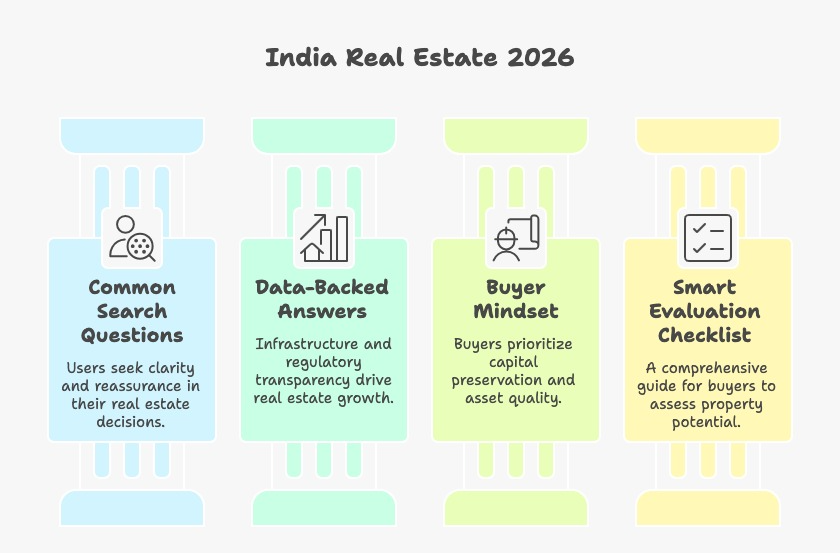
Checklist for Evaluation
- Proximity to Confirmed Infrastructure
- Verify project timelines through government portals or tender documents.
- Assess travel time improvements rather than mere distance on maps.
- Economic Activity and Employment Hubs
- Focus on areas with job creation, corporate parks, and industrial growth.
- Land Record Transparency
- Ensure digital land records and clear title histories to minimize risk.
- Affordability Relative to Growth Potential
- Evaluate price appreciation against long-term rental yields or resale value.
- Exit Strategy Visibility
- Understand market liquidity and resale demand in the sub-micro market being considered.
FAQ— India Real Estate 2026
1. What is india real estate 2026 all about?
Answer:
India real estate 2026 refers to the evolving narrative around how the Indian property market is expected to perform through policy reforms, infrastructure expansion, demographic shifts, and investor sentiment. Rather than a simple price prediction, it represents the structural forces that will shape demand, supply, pricing, and capital inflows up to, into, and beyond 2026.
Government infrastructure programs and regulatory changes — such as the National Infrastructure Pipeline — are driving this shift by improving connectivity and reducing barriers to investment.
2. How will infrastructure projects influence india real estate 2026 trends?
Answer:
Infrastructure projects act as value multipliers in real estate. Projects like expressways, logistics corridors, and airports reduce commute times, connect markets, and stimulate economic activity. This boosts demand for nearby residential and commercial real estate and often leads to earlier land price appreciation compared to built assets.
For example, expressway expansions and airport connectivity near regions like Pune and Jaipur have increased investor confidence and demand well ahead of major launches.
3. Why does policy reform matter in india real estate 2026?
Answer:
Policy reforms such as RERA (Real Estate Regulation Act), digital land records, and unified approvals boost transparency, accountability, and confidence in the real estate sector. These reforms mitigate legal risk, speed up project timelines, and make due diligence more efficient — essential conditions for sustainable long-term growth.
RERA’s enforcement has reduced project delays and given buyers and investors greater confidence in property transactions.
4. Is investing in land better than apartments for india real estate 2026?
Answer:
In many cases, land — especially in growth corridors or infrastructure-linked regions — tends to appreciate ahead of built properties (like apartments). While apartments provide immediate shelter and rental opportunities, land benefits from scarcity, location improvements, and macroeconomic shifts.
For example, peripheral land markets near Nagpur experienced price momentum as connectivity improved.
5. Which cities or regions are likely to benefit the most in india real estate 2026?
Answer:
Emerging micro-markets and Tier-II cities are gaining traction due to affordability and connectivity. Cities such as Pune, Lucknow, Ahmedabad, Jaipur, and Nagpur are attracting interest due to expanding job markets, infrastructure upgrades, and integrated development plans.
Budget allocations and urban development frameworks are increasingly focused on these regions.
6. How does india real estate 2026 differ from traditional market forecasts?
Answer:
Traditional forecasts often focus on short-term price movements. In contrast, india real estate 2026 is a structural outlook — emphasizing longer-term fundamental drivers like infrastructure execution, governance reforms, population shifts, and sustainable economic growth.
This makes the conversation more about value creation rather than price speculation.
7. What role do REITs and fractional ownership play in india real estate 2026?
Answer:
REITs (Real Estate Investment Trusts) and fractional ownership platforms democratize access to real estate assets. They attract institutional capital and provide liquidity and diversification options for smaller investors. This trend contributes to deeper capital markets and more efficient price discovery — key ingredients of india real estate 2026.
For example, commercial REITs have increased institutional interest in Indian real estate.
8. What common mistakes should investors avoid in india real estate 2026?
Answer:
Key mistakes include:
Chasing short-term hype without assessing execution timelines
Ignoring regulatory clarity or title diligence
Focusing only on metropolitan cores instead of micro-markets
Overleveraging early without exit clarity
Understanding the fundamentals — infrastructure timelines, policy shifts, and economic drivers — can reduce risk and improve decision quality.
9. How can investors evaluate opportunities in india real estate 2026?
Answer:
Here’s a practical checklist:
Proximity to confirmed infrastructure — review government project documents
Local economic activity — employment growth, corporate parks, industrial hubs
Land title clarity — digitized records reduce legal risk
Affordability vs long-term value — pricing relative to growth potential
Liquidity and exit prospects — resale and rent-demand evaluations
This framework ensures that investment decisions are data-driven and risk-evaluated rather than speculative.
10. How should a long-term strategy be shaped around india real estate 2026?
Answer:
A long-term strategy should:
Prioritize structural value drivers (infrastructure, regulation)
Consider land and micro-market growth over headline city price spikes
Avoid reactive investing based on announcements alone
Align investment timelines with execution milestones of major projects
This strategic approach positions investors to benefit from sustainable growth patterns rather than short-term volatility.
Why India Real Estate 2026 Is About Preparedness, Not Prediction
As the discussion around india real estate 2026 gains momentum, one theme emerges consistently across data, policy direction, and market behaviour: the next phase of real estate growth in India will reward preparation far more than prediction.
Unlike earlier cycles driven by speculative demand or short-term sentiment, the current and upcoming real estate environment is being shaped by structural forces that operate over years, not quarters. Infrastructure investments are no longer isolated projects — they are part of coordinated national frameworks designed to improve connectivity, productivity, and economic integration. Initiatives such as the National Infrastructure Pipeline and PM Gati Shakti Master Plan clearly signal the government’s long-term intent to decentralise growth and unlock new regions for development.
At the same time, regulatory reforms have meaningfully reduced uncertainty — a factor that historically held back long-term capital in Indian real estate. With stronger enforcement of RERA, digitisation of land records, and improved approval mechanisms, investors today are able to evaluate opportunities with greater clarity and confidence. This regulatory maturity is one of the most under-appreciated pillars supporting india real estate 2026.
Another defining feature of this cycle is where growth is occurring. Instead of being concentrated solely in traditional metropolitan cores, value creation is increasingly visible in micro-markets, infrastructure corridors, and Tier-2 cities. These regions benefit from lower entry costs, improving employment ecosystems, and long-term urban planning initiatives. Budgetary focus on non-metro urban centres further reinforces this decentralised growth trajectory.
Importantly, india real estate 2026 is not a promise of uniform growth across all asset classes or geographies. It is a reminder that disciplined selection matters more than broad exposure. Land parcels near confirmed infrastructure, regions aligned with employment creation, and markets supported by policy clarity are structurally positioned to outperform. Conversely, assets driven purely by hype, announcements without execution, or short-term leverage carry significantly higher risk.
For individuals researching real estate today — whether as investors, long-term buyers, or strategic planners — the most valuable takeaway is this:
real estate success in the coming years will belong to those who understand cycles, respect data, and align decisions with long-term fundamentals.
In that sense, india real estate 2026 should not be viewed as a deadline or a speculative milestone. It represents a transition point — from fragmented growth to coordinated development, from opaque transactions to transparent systems, and from reactive investing to informed strategy.
Those who take the time to study infrastructure execution, policy direction, and regional economics today will be far better positioned to make confident, resilient decisions tomorrow — not just in 2026, but well beyond it.