
Why Invest in North Goa in 2026? 7 Key Tourism, Infrastructure & Real Estate Drivers
North Goa has entered 2026 with a market story that is more nuanced than a simple “property prices are rising” narrative. For investors, the stronger case lies in the convergence of tourism scale, improving connectivity, infrastructure development, premium hospitality, lifestyle demand and an established second-home ecosystem.
So, why invest in North Goa in 2026? The answer begins with demand.
Goa recorded 10,802,410 tourist arrivals in 2025, including 10,284,608 domestic and 517,802 international visitors, according to the Department of Tourism, Government of Goa. That was up from 10,409,196 total arrivals in 2024.
The momentum has continued into 2026. Between January and July, Goa recorded 61.38 lakh tourist arrivals, including 59.02 lakh domestic and 2.36 lakh international visitors. July alone recorded 6.94 lakh arrivals, 2.27% higher than July 2025.
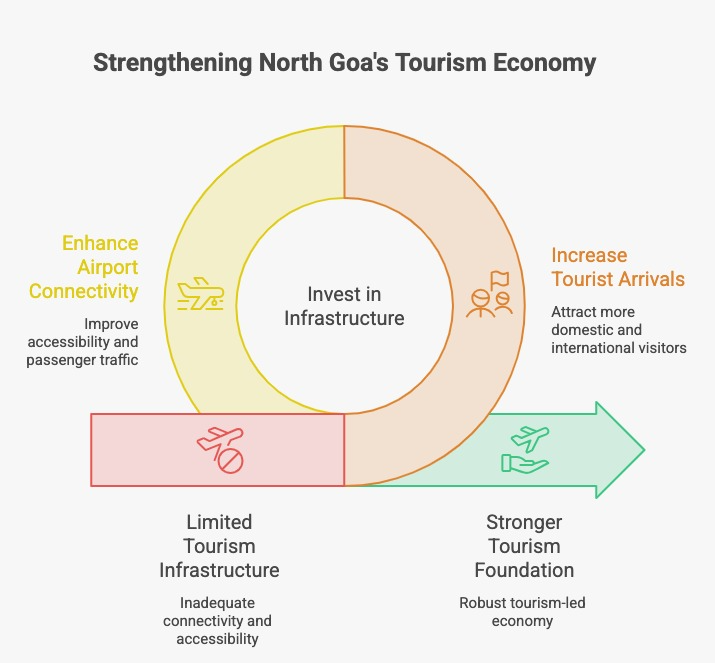
At the same time, Manohar International Airport (MOPA) has become an increasingly important gateway for North Goa. GMR reported 5.37 million passengers at Mopa in FY2025–26, representing approximately 15% year-on-year growth.
These numbers do not guarantee property appreciation or rental returns. They do, however, provide a strong foundation for understanding why North Goa real estate continues to attract serious attention from HNIs, NRIs, entrepreneurs, second-home buyers and long-term investors.
1. Why Invest in North Goa in 2026? Start With the Tourism Economy
One of the strongest reasons to invest in North Goa is the scale of the tourism ecosystem surrounding the region.
Tourism is not simply about hotel rooms. It supports restaurants, cafés, transportation, entertainment, wellness businesses, events, retail, experiences, villas and other accommodation formats.
That wider ecosystem matters for real estate because properties located within established tourism economies can have multiple potential use cases.
Goa tourism growth: 2024 to 2026
The official tourism numbers show a significant increase between 2024 and 2025.
Year / Period | Domestic Visitors | International Visitors | Total Visitors |
2024 | — | — | 1.04 crore |
2025 | 1,02,84,608 | 5,17,802 | 1,08,02,410 |
Jan–Jul 2026 | 59.02 lakh | 2.36 lakh | 61.38 lakh |
The 2025 numbers are particularly significant because domestic visitors accounted for roughly 95% of total arrivals. This means the tourism economy is supported by a large domestic travel market in addition to international demand.
For anyone evaluating whether to invest in North Goa, this distinction matters. The market is not dependent solely on foreign travellers. India’s growing domestic leisure market is an important part of Goa’s demand base.
2. Goa Tourism Is Becoming More Diversified
The second reason to invest in North Goa is that Goa’s tourism proposition is expanding beyond conventional beach holidays.
The Goa Tourism Department is actively promoting experiences associated with wellness, heritage, culture, gastronomy, adventure, spiritual tourism, MICE and workations. In 2026, the state has also been promoting monsoon and experience-led tourism.
The significance for real estate is that diversified tourism can potentially support different accommodation requirements.
Experiential tourism
Modern travellers increasingly look for experiences rather than simply a room near a beach.
That can include:
- Local food and gastronomy
- Heritage experiences
- Wellness retreats
- Nature activities
- Adventure tourism
- Cultural experiences
- Longer leisure stays
- Workations
- Events and destination weddings
North Goa already has a mature ecosystem of beaches, restaurants, hospitality venues and lifestyle businesses, making it naturally relevant to this broader tourism model.
Wellness tourism
Wellness has also become part of Goa’s formal tourism policy framework. The Department of Tourism lists the Goa Wellness, Ayurveda and Yoga Policy 2026, indicating increasing institutional attention to this segment.
For investors, the implication is not that every wellness-oriented property will outperform. Instead, wellness can create additional demand for resorts, managed residences, retreats and lifestyle accommodation.
Destination weddings and events
Goa’s tourism ecosystem also includes destination weddings, conferences and events.
These segments can generate demand across hotels, villas, event venues, restaurants, transportation and supporting services.
That creates a broader tourism economy within which North Goa property investment can operate.
3. MOPA Airport Is Changing North Goa’s Connectivity Equation
Any serious discussion about whether to invest in North Goa in 2026 needs to examine Manohar International Airport.
MOPA became operational in January 2023 and has rapidly expanded its role in Goa’s aviation network.
According to the Goa Economic Survey 2025–26, MOPA handled 14,094,729 domestic and international passengers between its commencement on January 5, 2023 and January 2026. During that period, the airport connected Goa with 20 domestic and 12 international destinations.
The same Economic Survey states that terminal expansion is underway at a cost of ₹255.69 crore, increasing the terminal’s built-up area from 65,600 sq m to 83,900 sq m.
The airport has continued to grow during FY2025–26.
GMR reported:
- 5.37 million passengers in FY2025–26
- Approximately 15% year-on-year growth
- 1.5 million passengers in Q4 FY2026
- Approximately 21% Q4 year-on-year passenger growth This makes MOPA one of the most important infrastructure developments to consider when assessing North Goa real estate.
How can MOPA influence real estate?
Improved airport connectivity can potentially influence:
- Second-home accessibility
- Tourist catchment areas
- Hospitality development
- Business travel
- Long-stay demand
- Premium residential interest
However, investors should distinguish infrastructure impact from guaranteed appreciation.
An airport can improve accessibility, but the performance of an individual property still depends on its location, legal status, design, pricing, competition, management and actual market demand.
4. NH-66 and Regional Connectivity Add Another Layer
Air connectivity is only one part of the investment equation.
Road infrastructure remains critical because North Goa’s tourism economy is spread across beaches, villages, hospitality clusters, commercial centres and residential areas.
NH-66 provides an important north-south road connection along India’s western coast, while local and state roads connect North Goa’s tourism and residential micro-markets.
For investors considering whether to invest in North Goa, connectivity should therefore be evaluated at the property level.
Instead of relying only on advertised travel times, examine:
- Actual road access
- Road width
- Approach quality
- Distance from NH-66
- Distance from MOPA
- Access to major commercial areas
- Public transportation
- Seasonal traffic conditions
The same principle applies to railway connectivity. Goa’s rail network provides another important access channel for domestic visitors, particularly from Maharashtra and Karnataka.
5. North Goa Real Estate Is Evolving Beyond the Traditional Holiday Home
The next major reason to invest in North Goa is the evolution of its residential market.
North Goa has developed into a prominent second-home and lifestyle property market attracting buyers from major Indian cities and overseas markets.
The buyer profile can include:
- HNIs
- NRIs
- Entrepreneurs
- Professionals
- Second-home buyers
- Lifestyle buyers
- Hospitality investors
- Long-term wealth creators
The market therefore sits at the intersection of residential ownership and tourism demand.
Second-home demand
A second home can have two forms of utility.
Lifestyle utility:
The owner has a personal retreat that can be used for holidays, family gatherings or longer stays.
Financial utility:
Subject to regulations and operating arrangements, the property may potentially be used for income-generating purposes when the owner is away.
That combination helps explain the continuing relevance of North Goa property investment.
But it also makes property selection more important.
6. The North Goa Market Is Becoming More Selective
One of the most important findings from the latest research is that investors should not interpret the North Goa market as a uniform upward-price market.
Savills Research’s North Goa Residential Market Watch focuses on the premium residential segment and provides evidence of differentiated market performance.
Recent reporting based on Savills research indicated that villa prices in North Goa declined by approximately 3–5% in 2025, reflecting changing demand-supply conditions.
This is an important fact for anyone looking to invest in North Goa.
The investment thesis should not be:
“North Goa property prices always increase.”
Instead, the more credible approach is:
North Goa remains a structurally important second-home and tourism-linked market, but individual properties need to be evaluated on location, pricing, legal clarity, quality and demand.
That distinction is essential for serious investors.
What should investors compare?
Before purchasing, examine:
- Comparable transactions
- Current asking prices
- Actual transaction values where available
- Inventory levels
- Property type
- Location-specific demand
- Rental history
- Maintenance costs
- Legal status
- Exit liquidity
7. Luxury Villas and Premium Residential Demand
Luxury villas remain an important component of the North Goa property ecosystem.
Locations such as Assagao, Vagator, Anjuna, Siolim, Morjim and surrounding areas have developed strong lifestyle identities.
Premium properties can appeal to buyers seeking:
- Privacy
- Larger spaces
- Pools and outdoor areas
- Personalisation
- Family accommodation
- Hospitality potential
- Lifestyle experiences
For investors evaluating North Goa real estate, however, the luxury label alone should not determine value.
A premium property should be assessed against:
Location + land/title quality + construction + design + access + operating costs + market demand.
A beautifully designed property in a weakly accessible location may not necessarily perform like a well-located asset with strong end-user demand.
8. North Goa Micro-Markets to Understand Before You Invest
A major advantage of researching invest in North Goa opportunities is that the region should not be treated as one homogeneous market.
Each micro-market has a different tourism profile, connectivity pattern and lifestyle character.
Pernem
Pernem has gained strategic relevance from its proximity to MOPA and the northern tourism belt.
Its characteristics include:
- MOPA accessibility
- Proximity to northern beaches
- Emerging hospitality activity
- Larger surrounding land parcels
- Infrastructure-led relevance
For investors, Pernem is particularly interesting from a connectivity and emerging-market perspective.
Morjim
Morjim is an established coastal tourism location with:
- Beach tourism
- Boutique hospitality
- Restaurants
- International visitor appeal
- Proximity to Mandrem and Ashwem
Its established tourism ecosystem gives the location a distinctive lifestyle profile.
Mandrem
Mandrem combines beach access with a quieter lifestyle environment.
Its profile includes:
- Coastal tourism
- Wellness
- Boutique accommodation
- Longer-stay potential
- Proximity to Morjim and Ashwem
Ashwem
Ashwem has developed a premium coastal identity supported by boutique hospitality and lifestyle tourism.
Its relevance for North Goa property investment comes from its established tourism appeal and premium visitor positioning.
Anjuna
Anjuna is one of North Goa’s best-established tourism markets.
Its ecosystem includes:
- Beach tourism
- Restaurants
- Entertainment
- Hospitality
- Holiday homes
- Residential development
Vagator
Vagator combines tourism, hospitality, restaurants and lifestyle experiences.
It is particularly relevant to buyers looking for a property close to a mature leisure ecosystem.
Assagao
Assagao is strongly associated with premium lifestyle real estate.
Its characteristics include:
- Luxury villas
- Boutique hospitality
- Restaurants
- Green surroundings
- Second-home demand
Savills’ research identifies Assagao among North Goa locations attracting interest in managed and lifestyle-oriented residential formats.
Siolim
Siolim provides a bridge between coastal tourism and a more residential environment.
Its relevance includes:
- Access to Morjim and Vagator
- Residential development
- Villa communities
- Lifestyle appeal
- Connectivity to northern Goa
Arpora
Arpora sits within North Goa’s established tourism ecosystem.
It offers access to:
- Baga
- Calangute
- Hospitality
- Restaurants
- Entertainment
- Residential properties
Mapusa
Mapusa plays a different role.
It is an important commercial and service centre supporting:
- Retail
- Markets
- Healthcare
- Education
- Everyday services
- Regional connectivity
For investors who value practical access to services, Mapusa provides a different proposition within the broader North Goa ecosystem.
9. What Makes North Goa Attractive for Long-Term Investors?
The strongest case to invest in North Goa is not based on one statistic.
It is based on the interaction of several structural factors.
Tourism scale
Goa recorded more than 1.08 crore visitors in 2025, demonstrating the size of the destination economy.
Continued 2026 demand
More than 61 lakh visitors arrived between January and July 2026, with domestic tourists accounting for the overwhelming majority. Airport connectivity
MOPA handled 5.37 million passengers in FY2025–26, demonstrating significant passenger growth. (The Economic Times)
Tourism diversification
Goa is actively developing wellness, heritage, MICE, gastronomy, adventure, spiritual tourism and workation segments.
Established second-home ecosystem
North Goa already has a mature base of premium residential, villa and hospitality assets.
Together, these factors create a market worth researching.
They do not eliminate the need for investment discipline.
10. Rental Demand: Opportunity, But Not a Guaranteed Return
Another reason people consider whether to invest in North Goa is the possibility of rental income.
Tourism clearly creates demand for accommodation. But the rental performance of a particular property can vary significantly.
Factors include:
- Location
- Property size
- Design
- Amenities
- Pool/outdoor space
- Interior quality
- Online reputation
- Management
- Pricing strategy
- Seasonality
- Competition
- Regulatory compliance
A property may perform strongly during peak tourism periods but experience weaker demand during other periods.
The latest tourism data provides an encouraging signal regarding monsoon demand: July 2026 recorded 6.94 lakh visitors, 2.27% higher than July 2025.
Goa Tourism has also been deliberately promoting monsoon and experience-led tourism to diversify demand across the calendar.
For investors, the correct approach is therefore to analyse actual occupancy and rental history, rather than relying solely on projected returns.
11. Legal Due Diligence Is Essential
Anyone planning to invest in North Goa should treat legal verification as seriously as location research.
Goa RERA
For applicable projects, investors should verify:
- RERA registration
- Promoter details
- Project approvals
- Development status
- Completion timelines
- Disclosures
- Project documentation
The official Goa RERA system provides project and agent-related regulatory information.
Title verification
For land and independent properties, investors should conduct appropriate legal due diligence covering:
- Ownership chain
- Encumbrances
- Survey records
- Land use
- Conversion status
- Access rights
- Construction approvals
- Existing structures
- Utility rights
A marketing brochure should never substitute for independent legal verification.
12. Coastal Property Requires CRZ Verification
Coastal proximity is one of North Goa’s defining characteristics, but it also makes regulatory due diligence important.
The Goa Coastal Zone Management Plan identifies CRZ categories and relevant coastal boundaries, including the High Tide Line, No Development Zone and different CRZ classifications.
Therefore, before purchasing a coastal property, investors should verify:
- High Tide Line
- Applicable CRZ category
- No Development Zone status
- Existing structure permissions
- Construction restrictions
- Applicable environmental approvals
- Coastal development permissions
This is particularly important for investors considering beachfront or near-coastal land.
13. A Practical Framework for North Goa Property Investment
Rather than asking only whether to invest in North Goa, investors should ask six more specific questions.
1. Is the location fundamentally accessible?
Consider MOPA, NH-66, local roads, commercial centres and tourism attractions.
2. Is the property legally clear?
Check title, approvals, RERA applicability and CRZ status where relevant.
3. Is the purchase price supported by market evidence?
Compare similar properties and recent transactions.
4. Is there genuine end-user demand?
Understand who would actually buy or occupy the property.
5. Is the operating model realistic?
For rental-oriented assets, analyse occupancy, management costs, maintenance and seasonality.
6. Does the asset fit the investment horizon?
A second home, rental property and long-term land holding have different objectives.
This framework makes North Goa property investment a research exercise rather than a speculative purchase.
14. What Could Shape North Goa’s Investment Story Next?
The future of invest in North Goa opportunities will depend on several indicators.
Tourism
Investors should monitor:
- Full-year 2026 tourist arrivals
- Domestic vs international arrivals
- Hotel occupancy
- Monsoon tourism
- International charter activity
- New tourism segments
MOPA
Monitor:
- Passenger traffic
- New routes
- International connectivity
- Terminal expansion
- Airport-linked development
The Goa Economic Survey confirms that MOPA’s terminal expansion is already underway.
Real estate
Monitor:
- Villa inventory
- New project launches
- Transaction values
- Buyer profiles
- Rental performance
- Premium housing demand
Regulation
Monitor:
- Goa RERA developments
- Tourism accommodation regulations
- CRZ rules
- Land-use regulations
- Local planning changes
15. Final Verdict: Should You Invest in North Goa in 2026?
The evidence suggests that invest in North Goa remains a relevant strategy for investors who understand the market’s fundamentals and approach individual assets selectively.
The strongest structural drivers are clear.
First, tourism remains substantial. Goa recorded 10.8 million tourist arrivals in 2025 and more than 61 lakh during the first seven months of 2026.
Second, connectivity is improving. MOPA handled 5.37 million passengers during FY2025–26, while its terminal expansion is underway.
Third, tourism is becoming more diversified. Wellness, heritage, MICE, gastronomy, adventure and workation are being developed alongside traditional beach tourism.
Fourth, North Goa has an established second-home and premium residential ecosystem.
But the fifth point is equally important: the market is becoming more selective.
Recent research indicating a 3–5% villa price correction in 2025 demonstrates why investors should not assume that every property will appreciate at the same rate.
Therefore, the strongest approach to invest in North Goa is not to chase a headline forecast. It is to identify assets where location, connectivity, legal clarity, product quality, pricing, demand and long-term usability align.
For HNIs, NRIs, entrepreneurs, second-home buyers and long-term wealth creators, that makes North Goa a market worth serious research in 2026.
Frequently Asked Questions About Investing in North Goa
1. Is it a good idea to invest in North Goa in 2026?
Yes, investing in North Goa remains a market worth considering for investors who are evaluating tourism-led real estate, second homes, luxury residences and long-term property ownership. Goa recorded more than 1.08 crore tourist arrivals in 2025, while the state recorded 61.38 lakh visitors between January and July 2026.
The investment case is supported by several structural factors: sustained tourism demand, improving connectivity, the growing role of Manohar International Airport (MOPA), established hospitality infrastructure and demand for lifestyle-oriented properties. However, these factors should not be interpreted as a guarantee of appreciation or rental income. Investors should evaluate individual properties based on location, pricing, title, approvals, demand and long-term usability.
For regulatory verification, investors can also check applicable projects through the Goa RERA official portal and review tourism information from the Goa Tourism Department.
2. Why should investors invest in North Goa instead of looking only at established tourism markets?
The case to invest in North Goa is increasingly connected to the region’s combination of tourism, infrastructure and lifestyle demand. North Goa has a mature tourism ecosystem covering beaches, restaurants, hospitality, entertainment, wellness and premium accommodation, while locations such as Pernem are also benefiting from their proximity to MOPA.
Goa’s tourism strategy is also becoming more diversified, with increasing attention to wellness, heritage, gastronomy, adventure, MICE and experience-led travel. This creates a broader economic ecosystem around tourism rather than relying exclusively on conventional beach holidays.
For investors, the important point is that tourism growth can support different property-use models, including second homes, villas, managed residences and hospitality-linked accommodation. However, the performance of a specific asset will depend on its micro-location, pricing, quality, legal status and operating model.
The Ministry of Tourism, Government of India provides additional national tourism data and policy context.
3. How does MOPA Airport support the case to invest in North Goa?
MOPA is one of the most important infrastructure developments to consider when evaluating whether to invest in North Goa. The airport has expanded Goa’s northern air-connectivity infrastructure and provides an important gateway for domestic and international travellers.
According to the Goa Economic Survey 2025–26, MOPA handled more than 14 million passengers cumulatively between its January 2023 commencement and January 2026, while terminal expansion was underway to increase the terminal’s built-up area. MOPA also handled approximately 5.37 million passengers during FY2025–26, according to GMR-reported data.
Improved aviation connectivity can potentially support tourism, hospitality, second-home accessibility and commercial activity around the northern part of Goa. However, airport connectivity should be treated as one investment factor rather than evidence of guaranteed property appreciation.
Investors can verify broader infrastructure information through the Government of Goa’s Economic Survey and official Ministry of Civil Aviation resources.
4. Which locations should investors research when they want to invest in North Goa?
Investors considering invest in North Goa opportunities should examine individual micro-markets rather than treating the entire region as a single property market. Key locations include Pernem, Morjim, Mandrem, Ashwem, Anjuna, Vagator, Assagao, Siolim, Arpora and Mapusa.
Each has a distinct investment profile. Pernem benefits from its northern location and proximity to MOPA; Morjim, Mandrem and Ashwem have strong coastal and lifestyle identities; Anjuna and Vagator have established tourism and hospitality ecosystems; Assagao has a strong premium lifestyle and villa profile; Siolim combines residential and tourism accessibility; Arpora benefits from its proximity to established entertainment and hospitality areas; and Mapusa functions as an important commercial and service centre.
Rather than asking which location is universally “best,” investors should assess accessibility, land characteristics, existing demand, property pricing, surrounding development, infrastructure and intended use.
The Goa Tourism Department is a useful official source for understanding tourism destinations and visitor infrastructure across the state.
5. How is tourism growth affecting the decision to invest in North Goa?
Tourism is an important demand driver when evaluating whether to invest in North Goa because it supports a wider ecosystem of accommodation, restaurants, transportation, entertainment, wellness and leisure businesses.
Goa recorded 10,802,410 tourist arrivals in 2025, including more than 10.28 million domestic visitors and approximately 518,000 international visitors. The latest 2026 data also indicates continued visitor momentum, with 61.38 lakh arrivals between January and July 2026.
This scale of tourism can support demand for hotels, villas, holiday accommodation and second homes in suitable locations. At the same time, investors should understand that tourism arrivals and property performance are not directly interchangeable. Occupancy, rental rates and property values depend on numerous additional factors.
For the most reliable tourism statistics, investors should refer to the official Goa Tourism Department rather than relying solely on property marketing material.
6. Can investors invest in North Goa for rental income as well as personal use?
Yes, some buyers choose to invest in North Goa with a dual objective: personal use as a second home combined with the possibility of rental or managed accommodation when the property is not being used.
However, potential rental performance depends heavily on the individual asset. Important factors include location, property size, design, amenities, seasonality, management quality, online visibility, operating expenses and competition.
Investors should therefore request actual historical occupancy and revenue information wherever available rather than relying on projected rental yields. They should also verify whether the intended rental model is legally permissible and understand applicable taxes, management fees, maintenance expenses and platform or operator charges.
Tourism demand can create an underlying accommodation market, but rental income should never be treated as guaranteed.
For property-level regulatory checks, investors should consult the Goa RERA official portal and obtain independent professional advice regarding the proposed rental structure.
7. What legal checks should investors complete before they invest in North Goa?
Legal due diligence should be a fundamental part of any decision to invest in North Goa, particularly when purchasing land, villas or coastal property.
Investors should verify the ownership chain, title documents, encumbrances, survey records, land-use status, conversion permissions, access rights, construction approvals and applicable development regulations. For projects covered by RERA, investors should also verify the project’s registration and disclosures.
Coastal properties require additional attention because applicable Coastal Regulation Zone (CRZ) provisions can affect development and construction. Investors should establish the relevant CRZ classification, applicable development restrictions and required permissions before proceeding.
The Goa RERA official portal should be used for applicable project verification, while the Goa Coastal Zone Management Authority provides official information relating to coastal regulation.
Independent legal and technical due diligence should always be completed before committing capital.
8. What should long-term investors consider before deciding to invest in North Goa?
Before deciding to invest in North Goa, long-term investors should look beyond short-term market sentiment and evaluate the fundamentals of the specific asset.
A useful framework is:
Location + Connectivity + Legal Clarity + Pricing + Demand + Property Quality + Operating Costs + Holding Period
Investors should examine whether the property is accessible from MOPA and major roads, whether the surrounding area has sustainable demand, whether the purchase price is supported by comparable market evidence, and whether the property has clear title and appropriate approvals.
The broader market should also be monitored through indicators such as tourist arrivals, airport passenger traffic, hospitality supply, villa inventory, transaction values and regulatory changes.
The latest Savills North Goa Residential Market Watch provides useful premium-residential market context and can be used alongside government sources when assessing market trends. Savills North Goa Residential Market Watch
Ultimately, the objective should not simply be to invest in North Goa, but to identify a property whose location, legal position, pricing, utility and long-term demand profile align with the investor’s objectives.
Conclusion
The question of whether to invest in North Goa in 2026 is ultimately a question of fundamentals.
Tourism provides the demand ecosystem. MOPA is strengthening accessibility. Road infrastructure connects the region to wider markets. Tourism itself is becoming more diversified. Meanwhile, North Goa continues to attract second-home and premium residential buyers.
But informed investment requires more than a positive market narrative.
The most valuable properties are not necessarily those with the loudest marketing claims. They are the assets that can demonstrate credible location fundamentals, legal clarity, appropriate pricing, genuine demand and a clear ownership proposition.
For serious investors, North Goa property investment is therefore best approached as a long-term research decision—one that combines tourism data, infrastructure analysis, micro-market knowledge and rigorous property-level due diligence.