
India’s Infrastructure Boom 2026: Why Land Investment Is Emerging as the Smartest Real Estate Asset
India stands at an unprecedented crossroads of economic transformation. With a historic infrastructure expansion, evolving connectivity projects, and catalytic policy support, the land investment India 2026 landscape is rapidly shifting. Traditional real estate — residential apartments and commercial offices — is no longer the only game in town. Today, strategic land parcels tied to macroeconomic growth corridors are emerging as one of the smartest, long‑term wealth creation plays.
For serious investors — whether seasoned or just starting — understanding the forces shaping this transition is crucial. This extensive article deep‑dives into why land investment in India 2026 isn’t just another buzzword but an evolving asset class backed by policy imperatives and economic logic. We’ll explore infrastructure frameworks, valuation dynamics, comparison with other asset classes, risk mitigation, and a forward‑looking 2026 outlook.
India’s Infrastructure Push: The Biggest Since Independence
Infrastructure acts as the skeleton of economic growth. When connectivity improves, regions attract businesses, talent, and residents — creating sustained demand for land and property. India’s national leadership has recognized this, and the scale of investment planned is historic.
National Infrastructure Pipeline (NIP)
The Government of India’s National Infrastructure Pipeline (NIP) encompasses a wide array of sectors — railways, roads, airports, energy, urban development, logistics, and more. Valued at over ₹110 lakh crore for the period through 2025–26, NIP represents a holistic attempt to modernize India’s physical ecosystem.
This kind of capital deployment doesn’t just create new roads; it reshapes economic geography and trade flows — and land is where that transformation first happens.
PM Gati Shakti — A Multi‑Modal Framework
India’s PM Gati Shakti Master Plan further advances infrastructure coordination by integrating logistics, freight, urban transport, and energy networks into a unified planning mechanism. By aligning disparate ministries and project timelines, the initiative accelerates delivery and synchronizes growth across sectors.
For investors focusing on land investment India 2026, master planning clarity reduces uncertainty and highlights corridor‑linked pockets where new connectivity will unlock value first.
Road and Freight Connectivity
The Ministry of Road Transport & Highways (MoRTH) continues to expand expressway networks with record budget allocations and strategic routes linking hinterland to markets.
Examples include the Delhi–Mumbai Expressway, Ganga Expressway, and Mumbai–Nagpur Expressway. These high‑speed corridors cut commute times but, more importantly, lay the groundwork for economic densification — a critical precursor to land appreciation.
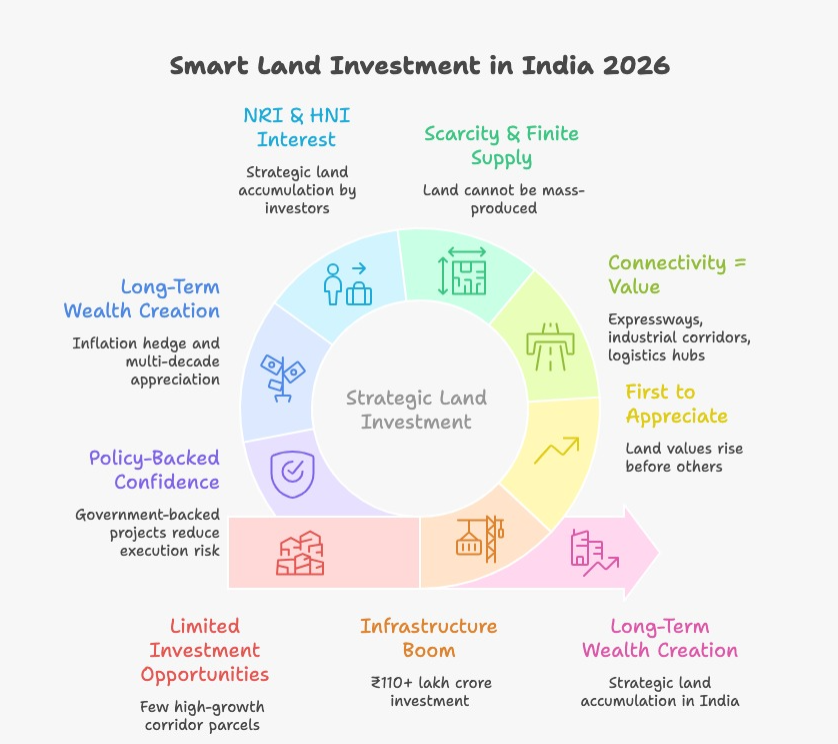
How Infrastructure Drives Land Value — The Value Chain Explained
Understanding how land appreciates requires seeing the sequence of value creation:
- Infrastructure plan announcement
- Connectivity upgrades commence
- Accessibility improves
- Regulatory and zoning clarity evolves
- Demand for land rises
- Development follows — but often later
- Land appreciates first, built assets later
This is why land investment India 2026 is fundamentally infrastructure‑led investing rather than speculative buying.
Case Study: Yamuna Expressway Region (NCR)
The Yamuna Expressway corridor in the National Capital Region (NCR) provides one of the most widely cited illustrations of infrastructure‑led land appreciation. Over five years, land prices near this expressway reportedly rose dramatically — in some cases, land values increased by over 400 % as demand surged from developers, industrialists, and long‑term investors.
In such corridors, land doesn’t merely benefit from local activity; it becomes part of a macro‑economic narrative where connectivity and mobility expand incomes, jobs, and long‑term prospects.
From Accessibility to Economic Opportunity
Connectivity creates economic opportunity, and economic opportunity increases demand for space — for manufacturing, logistics, housing, retail, and services.
Unlike apartments or commercial buildings — which may take years to develop, depend on financing cycles, and face regulatory bottlenecks — land reacts earlier and faster to infrastructure realities. This is why land investment India 2026 is quickly becoming a core theme among informed capital allocators.
Land Vs Apartments Vs Commercial: Understanding the Investment Math
To decide where to allocate capital, investors must compare asset classes on key financial and risk parameters. Below is a simplified but practical comparison:
Asset Class | Early Appreciation | Holding Costs | Liquidity | Risk Type |
Land | High (Infrastructure‑linked) | Low | Low | Title, zoning |
Residential (Apartments) | Moderate | Moderate | High | Project, cyclical |
Commercial Offices | Cyclical | High | Moderate | Tenant, economic |
Land — First to React
The main advantage of land is that it starts appreciating before built assets because it represents the raw factor of production tied to location. When infrastructure announcements signal new access points (like exits, interchanges, or transit nodes), nearby land re‑rates quickly.
Apartments — Lagged Response
Residential properties often appreciate based on consumer demand and micro‑market dynamics — factors that depend on employment growth, disposable income, and developer cycles. Even in fast‑growing regions, apartments are often late‑cycle assets relative to land.
Commercial — Cyclical and Tenant‑Dependent
Commercial properties require corporate demand and long‑term lease commitments. They also depend heavily on economic sentiment and interest rate cycles. Land, however, is not tied to tenant contracts or office absorption rates — making it more purely directional in response to connectivity improvements.
This foundational comparison explains why land investment India 2026 is attracting renewed attention.
Key Growth Corridors: The New Investment Map of India
Several high‑impact expressways and corridors are reshaping the economic map of India. These are not merely roads; they represent economic arteries that fuel factories, logistics hubs, urban expansions, and housing demand.
Delhi–Mumbai Expressway
Stretching over 1,300 km, this corridor connects two of India’s largest economic centers and passes through multiple growth belts. By reducing transit times and enhancing freight movement, it has spurred industrial activity and residential growth along its route.
Ganga Expressway (Uttar Pradesh)
This greenfield expressway connects eastern and western Uttar Pradesh, unlocking new inland economic routes and significantly improving access to national markets for interior regions.
Mumbai–Nagpur Expressway
Designed to enhance east–west connectivity within Maharashtra, this expressway is expected to spur new industrial, logistics, and housing clusters between the two cities.
Secondary Corridors and Satellite Nodes
Smaller yet critical links like Bengaluru–Mysore Expressway and various inter‑state connectors are creating micro‑hubs with strong growth potential.
These corridors directly influence land values and are core to understanding land investment India 2026.
Why Smart Capital Is Quietly Accumulating Land
Institutional and sophisticated investors are taking strategic positions in land for several reasons:
- Scarcity: Land is finite — and rapidly becoming harder to acquire near key corridors.
- Inflation Hedge: Land historically preserves wealth better than financial asset classes in inflationary periods.
- Macro Alignment: Connectivity and economic reforms create structural demand.
- NRI Demand: Non‑Resident Indians increasingly see land as a long‑horizon, high‑appreciation asset.
Recent trends show high‑net‑worth individuals (HNIs) and family offices diversifying into strategic land positions — especially in regions with high projected employment and logistics growth.
This Quiet accumulation isn’t speculative; it’s based on fundamental drivers that benefit land well ahead of apartments or office spaces.
Risks in Land Investment (And How to Mitigate Them)
No investment is without risk. For land, the most common concerns are:
Title & Encumbrance Risks
A clear title is non‑negotiable. Always verify title history for a minimum of 30 years and obtain encumbrance certificates.
Zoning & Land Use Classification
Understand whether land is designated agricultural, commercial, residential, or mixed use. This influences future development and conversion costs.
Government Approvals & Permissions
Planning approvals, environmental clearances, and local authority registrations vary by state and district. A lack of clarity increases execution risk.
Infrastructure Delivery Timeline
Announcement and execution timelines can differ. Delivery delays may slow land value appreciation, so always factor in realistic completion assumptions.
Mitigation Strategy
- Employ legal due diligence professionals
- Check local development master plans
- Use a survey and boundary verification
- Understand title chain and encumbrance records
- Cross‑verify infrastructure project timelines with official sources
Practical risk management transforms land investing from hope‑based to informed and disciplined, which is essential for land investment India 2026.
Long‑Term Outlook for Land Investment India 2026
Looking toward 2026 and beyond, several macro trends reinforce the strategic case for land investment:
India’s infrastructure vision spans well beyond 2026. Freight corridors, logistics parks, airport expansions, and smart city initiatives continue to drive investment flows.
Urban Decentralization
Tier‑2 and Tier‑3 cities — once considered peripherals — are now key demand centers because new expressway links improve their economic viability.
Demographic Dividend
Population growth, rising middle class, and increasing disposable income support sustained housing and commercial demand, which eventually pressurizes land demand as economic activity clusters around new connectivity nodes.
Policy Continuity
Unlike cycle‑linked real estate, infrastructure policy tends to be multi‑government and long‑horizon. The consistency of national plans like NIP and Gati Shakti creates multi‑year visibility — a rare benefit in property markets.
Practical Steps to Identify High‑Potential Land for Investment
Investors often ask: Where do I begin? What specific criteria indicate future appreciation?
Here’s a proven, methodical approach:
Step 1: Map Infrastructure Nodes
Start with expressway exits, freight corridor stations, planned logistics hubs, or industrial clusters. Sites within 10–20 km of these nodes often appreciate the earliest.
Step 2: Verify Zoning & Master Plans
Use official planning maps and land‑use certificates to understand permissible future development paths.
Step 3: Analyze Historical Price Trends
Corridors like the Yamuna Expressway show documented land appreciation patterns — a useful proxy for future behavior.
Step 4: Review Development Pipeline
Check for planned township projects, industrial parks, or mixed‑use developments in government or private master plans.
Step 5: Conduct Thorough Due Diligence
Legal, environmental, title, and encumbrance checks protect capital and lower execution risk.
This practical, step‑by‑step method gives investors clarity and confidence when approaching land investment India 2026 opportunities.
FAQ
1. What is Land Investment India 2026, and why is it gaining traction?
Answer:
Land investment India 2026 refers to the strategic acquisition of undeveloped land in India based on expected appreciation due to upcoming infrastructure projects, connectivity corridors, and economic growth. Unlike apartments or commercial buildings, land appreciates early when infrastructure plans are announced and executed.
👉 Government initiatives like the National Infrastructure Pipeline (NIP) support multi‑sector infrastructure spending, creating long‑term appreciation drivers.
2. How does infrastructure development increase land value?
Answer:
Infrastructure improves accessibility, reduces travel times, and attracts economic activity. When new expressways, freight corridors, or logistics hubs are built, land near these nodes becomes more valuable because businesses and residents pay premiums for better connectivity.
3. Which government plans are most relevant for understanding Indian land appreciation?
Answer:
The two most significant policy frameworks are:
- National Infrastructure Pipeline (NIP) — Over ₹110 lakh crore in planned investment across sectors through 2025–26.
- PM Gati Shakti Master Plan — An integrated approach to infrastructure planning.
Both provide visibility on future growth corridors and connectivity upgrades that influence land demand.
4. What are the key infrastructure corridors driving land demand?
Answer:
Major corridors that are reshaping economic geography include:
- Delhi–Mumbai Expressway
- Ganga Expressway (Uttar Pradesh)
- Mumbai–Nagpur Expressway
- Secondary links like Bengaluru–Mysore Expressway
These corridors improve logistics and accessibility across regions, increasing land appeal near exits and nodes.
5. How does land compare with apartments and commercial properties?
Answer:
Land typically appreciates earlier and more sharply in response to infrastructure upgrades. Apartments and built commercial assets often appreciate later, as demand cycles and construction timelines play out. Land also has lower holding costs but requires more due diligence.
6. What risks are associated with land investment, and how can they be mitigated?
Answer:
Common risks include unclear title, encumbrances, zoning mismatches, and delays in infrastructure delivery. These can be mitigated through professional title search, encumbrance certificates, zoning compliance checks, and verifying government project timelines with official plans.
7. Can Non‑Resident Indians (NRIs) invest in Indian land?
Answer:
Yes — NRIs can invest in non‑agricultural land in India, subject to RBI and FEMA guidelines. However, investment in agricultural land/farmhouses may have restrictions. Always consult legal and financial advisors before acquiring land.
8. What should an investor look for when identifying high‑potential land?
Answer:
Investors should evaluate:
✅ Proximity to planned expressway nodes or freight corridors
✅ Zoning & land‑use classifications
✅ Local master plans & approvals
✅ Accessibility to utilities and economic hubs
This structured approach increases the likelihood of capital appreciation.
9. How long does it typically take for land values to appreciate after an infrastructure announcement?
Answer:
Unlike ready assets, land often begins appreciating before or shortly after project announcements, because markets price in future potential. However, measurable uplift usually consolidates as projects move from planning to execution — typically 18–36 months. This can vary by project scale and region.
10. What role do industrial corridors play in land investment?
Answer:
Industrial corridors — like the Delhi–Mumbai Industrial Corridor (DMIC) — combine logistics, industrial parks, smart cities, and supply chain ecosystems. Land located near industrial nodes is attractive due to potential job creation, manufacturing activity, and population inflows, which in turn raise land demand and future development interest.
Infrastructure + Strategic Land = Smart Long‑Term Wealth
India’s real estate investment landscape is undergoing a paradigm shift. As infrastructure projects gain momentum, land is no longer just a passive asset; it has become a primary lever for long-term wealth creation. The principle is simple but powerful: connectivity drives economic activity, and land captures this value first.
Over the last decade, we have observed that areas adjacent to major infrastructure projects consistently outperform conventional residential and commercial assets. For example, the Yamuna Expressway corridor in NCR saw land prices rise by over 400% in just five years, far outpacing apartment appreciation in the same region. This demonstrates that land investment India 2026 isn’t speculative hype—it’s backed by tangible, infrastructure-driven growth.
The National Infrastructure Pipeline (NIP), valued at over ₹110 lakh crore, coupled with initiatives like PM Gati Shakti, creates multi-year visibility for strategic investors. These government-backed projects don’t just build roads or bridges; they reshape regional economies, industrial hubs, and residential catchment areas—and land, being the foundation of all development, benefits first.
Another key factor is scarcity and long-term demand. Unlike apartments or commercial buildings, which can be quickly developed, land is finite. Smart investors are quietly accumulating parcels in regions projected for future growth, particularly near expressway nodes, industrial corridors, and logistics hubs. This approach ensures early exposure to appreciation before built assets catch up.
Moreover, disciplined due diligence, zoning verification, and title checks mitigate traditional risks associated with land acquisition. By combining policy awareness, macroeconomic insight, and risk management, investors can position themselves to capture outsized returns while minimizing pitfalls.
In essence, the equation is clear:
Infrastructure + Strategic Land Selection + Risk-Aware Investment = Long-Term Wealth Creation
As India continues to expand its transport networks, industrial corridors, and smart urban hubs, Land Investment India 2026 represents a forward-looking strategy that aligns with macroeconomic growth, demographic trends, and policy direction. For investors focused on long-term wealth rather than short-term speculation, land near growth corridors is not just an asset—it is a strategic vehicle for sustainable financial growth.
By studying corridors, understanding government priorities, and selecting parcels with careful due diligence, investors can capitalize on India’s infrastructure boom while securing wealth for the next decade and beyond. This makes land not merely a property choice, but a smart, data-backed investment philosophy in 2026.