
Why Real Estate Investment in India Is Creating Long-Term Wealth Opportunities in Emerging Destinations
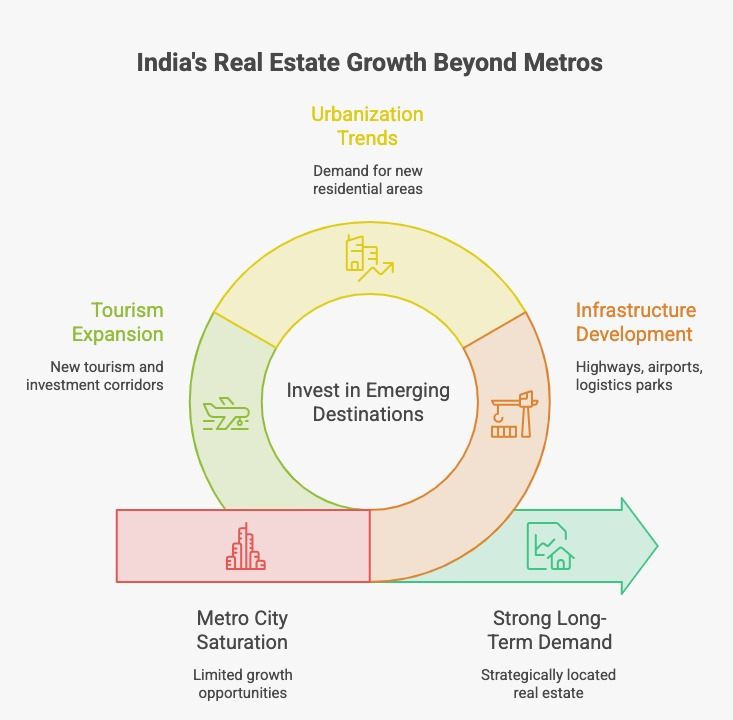
India’s real estate sector is undergoing one of its most transformative growth phases in recent decades. Supported by rapid infrastructure development, strong economic fundamentals, rising urbanisation, and increasing investor confidence, Real Estate Investment in India is evolving from a traditional asset class into a strategic long-term wealth creation opportunity. While metropolitan cities continue to attract capital, the spotlight is steadily shifting towards emerging investment destinations such as Maha Goa (Sindhudurg), North Goa’s expansion corridors, Sariska, and other infrastructure-led regions that offer significant appreciation potential.
According to the India Brand Equity Foundation (IBEF), India’s real estate market is expected to reach US$1 trillion by 2030, contributing nearly 13% to the country’s GDP, making it one of the largest contributors to India’s economic growth. This projection reflects not only rising residential demand but also the expansion of commercial, industrial, logistics, hospitality, and tourism-driven developments.
The World Bank also projects that India’s urban population will continue expanding rapidly over the coming decades. As cities become denser and land within metropolitan areas becomes increasingly scarce and expensive, investors are identifying emerging regions that combine affordability with long-term growth catalysts. Consequently, Real Estate Investment in India is increasingly being viewed through the lens of infrastructure, connectivity, and economic transformation rather than simply residential demand.
India’s Real Estate Market Has Entered a New Growth Cycle
Several structural factors are reshaping Real Estate Investment in India, creating favourable conditions for sustained appreciation.
Strong Macroeconomic Growth
India remains one of the world’s fastest-growing major economies. Stable GDP growth, increasing disposable incomes, expanding middle and affluent classes, and rising domestic consumption continue to strengthen the country’s investment landscape.
The Reserve Bank of India (RBI) has consistently highlighted infrastructure spending, private investment, and housing demand as key contributors to long-term economic growth.
For investors, these macroeconomic fundamentals provide confidence that Real Estate Investment in India is supported by broader economic expansion rather than isolated market trends.
Urbanisation Is Creating New Investment Corridors
India’s rapid urbanisation is extending beyond traditional metropolitan centres. New expressways, industrial corridors, airports, logistics hubs, and tourism infrastructure are encouraging development in Tier-II and Tier-III cities and emerging lifestyle destinations.
Government initiatives such as the PM Gati Shakti National Master Plan aim to integrate roads, railways, ports, airports, and logistics infrastructure into a unified development framework. This integrated approach is expected to improve connectivity, reduce logistics costs, and unlock economic opportunities across multiple regions.
As connectivity improves, previously underdeveloped locations become increasingly attractive for residential communities, hospitality projects, and premium plotted developments. This is one of the strongest long-term drivers of Real Estate Investment in India.
Why Land Continues to Appreciate in Emerging Destinations
Unlike constructed buildings, land is a finite resource. While buildings may require maintenance and experience physical depreciation over time, strategically located land often benefits from increasing demand as infrastructure and economic activity expand.
This fundamental characteristic has made premium plotted developments one of the fastest-growing residential segments in India.
According to research by Knight Frank India, affluent buyers increasingly prefer plotted developments because they offer flexibility, long-term appreciation potential, and the freedom to develop customised homes or hospitality assets in the future.
Several interconnected factors contribute to the appreciation of land:
- Limited availability of developable land.
- Expanding national highway networks.
- Airport-led regional development.
- Tourism growth.
- Industrial and commercial expansion.
- Population growth.
- Increasing demand for second homes and holiday residences.
- Rising interest from NRIs and institutional investors.
Together, these drivers have strengthened the investment case for Real Estate Investment in India, particularly in destinations where infrastructure investment precedes large-scale urban development.
Infrastructure Development Is Reshaping Real Estate Investment in India
Infrastructure has historically been one of the strongest catalysts for property appreciation. Every major improvement in transportation and connectivity enhances accessibility, attracts businesses, stimulates tourism, and creates new residential demand.
The Government of India continues to invest heavily in large-scale infrastructure programmes that are expected to influence regional real estate markets over the coming decade.
PM Gati Shakti
PM Gati Shakti integrates multiple ministries under a single infrastructure planning framework, improving coordination between transport, logistics, ports, industrial zones, and urban development.
This initiative seeks to improve efficiency while accelerating regional economic growth.
Government Reforms, Tourism Growth, and Changing Investor Preferences Are Strengthening Real Estate Investment in India
India’s real estate sector has become significantly more transparent, organised, and investor-friendly over the past decade. Alongside rapid infrastructure development, regulatory reforms and tourism-led economic growth have created a strong foundation for Real Estate Investment in India. These changes have increased confidence among homebuyers, HNIs, NRIs, entrepreneurs, family offices, and institutional investors seeking long-term wealth creation through strategically located land and premium plotted developments.
Rather than viewing property solely as a residential purchase, today’s investors increasingly recognise Real Estate Investment in India as a diversified asset class capable of supporting capital appreciation, legacy planning, lifestyle aspirations, and future development opportunities.
Government Policies Are Enhancing Investor Confidence
One of the strongest drivers of Real Estate Investment in India has been the government’s focus on improving transparency, regulatory oversight, and ease of doing business.
Real Estate (Regulation and Development) Act (RERA)
The implementation of the Real Estate (Regulation and Development) Act (RERA) has fundamentally transformed India’s residential property market. RERA introduced greater accountability, mandatory project registration, standardised disclosures, and stronger consumer protection measures, making the market more transparent for buyers and investors.
These reforms have increased confidence in organised real estate developments and encouraged long-term investment in regulated projects.
Digital Land Records Modernization
Secure land ownership is an important consideration for investors. The Digital India Land Records Modernization Programme (DILRMP) aims to digitise land records, modernise registration systems, and improve transparency in land transactions across states. Although implementation varies by region, this initiative supports more efficient property transactions and reduces documentation-related challenges over time.
Ease of Doing Business and Urban Development
Reforms led by the Department for Promotion of Industry and Internal Trade (DPIIT), together with initiatives such as the Smart Cities Mission, digital approvals, and urban infrastructure upgrades, have contributed to a more favourable investment environment.
These measures encourage private participation, improve project execution, and support long-term demand for Real Estate Investment in India.
Tourism Is Creating New Opportunities for Real Estate Investment in India
Tourism has become one of the most influential drivers of property demand across India’s emerging destinations. As domestic and international travel continues to grow, investors are increasingly recognising the relationship between tourism development and long-term real estate appreciation.
According to the Ministry of Tourism, India continues to witness strong domestic travel, while international arrivals are steadily recovering and expanding. Simultaneously, changing traveller preferences are increasing demand for unique accommodations such as beach villas, countryside retreats, boutique resorts, wellness destinations, and heritage-inspired stays.
The World Travel & Tourism Council (WTTC) also projects continued expansion of India’s travel and tourism sector, supported by rising incomes, improved transportation infrastructure, digital travel platforms, and increasing leisure travel.
This evolving tourism landscape is creating fresh opportunities for Real Estate Investment in India, particularly in destinations known for natural beauty, coastal lifestyles, wellness tourism, wildlife experiences, and cultural heritage.
Premium Plotted Developments Are Emerging as a Preferred Asset Class
Changing lifestyle preferences have significantly influenced buyer behaviour since the pandemic. Investors increasingly seek larger open spaces, lower-density communities, and flexible ownership models that can adapt to evolving family and investment needs.
Research from ANAROCK, Colliers, and Savills indicates that premium plotted developments have become one of the fastest-growing residential segments in India.
Several factors explain this trend:
- Ownership of a finite land asset with long-term appreciation potential.
- Freedom to design and construct a customised villa or family estate.
- Opportunity to develop the property at a future stage based on changing requirements.
- Lower maintenance obligations before construction compared with completed residential units.
- Suitability for second homes, retirement residences, or hospitality ventures.
- Greater flexibility for succession planning and intergenerational wealth transfer.
These advantages make plotted developments an increasingly attractive component of Real Estate Investment in India, particularly in destinations benefiting from improving infrastructure and tourism growth.
Why HNIs, NRIs, and Institutional Investors Are Increasing Their Exposure to Land
The investment priorities of affluent investors are evolving. Increasingly, HNIs, NRIs, entrepreneurs, corporate leaders, and family offices are allocating capital towards strategically located land as part of a diversified long-term portfolio.
According to Knight Frank’s Wealth Report, global wealthy investors continue to favour real assets because they provide tangible ownership, portfolio diversification, and potential protection against inflation over long investment horizons.
Several characteristics make land an attractive component of Real Estate Investment in India:
- Limited and non-replicable supply.
- Flexibility for future residential or hospitality development.
- Potential to benefit from infrastructure-led appreciation.
- Long-term capital preservation.
- Lower ongoing holding costs compared with certain developed assets.
- Opportunity to create a legacy asset for future generations.
For NRIs, improvements in digital processes, regulatory transparency, and professional property management services have also made investing in Indian real estate more accessible.
Real Estate Investment in India Is Increasingly Linked to Lifestyle and Legacy
Modern investors are not driven solely by financial returns. Lifestyle aspirations now play an equally important role in investment decisions. Premium villa plots, second homes, managed residences, and holiday properties offer owners the flexibility to enjoy the asset personally while also exploring hospitality or rental opportunities where appropriate.
This shift is particularly evident in destinations that combine strong infrastructure, tourism demand, natural surroundings, and long-term development potential. Investors increasingly seek properties that can evolve with changing family needs—whether as a retirement home, a holiday residence, a boutique hospitality venture, or an intergenerational asset.
As a result, Real Estate Investment in India is increasingly viewed as a combination of financial planning, lifestyle enhancement, and legacy creation rather than a purely transactional purchase.
Key Takeaway
The convergence of regulatory reforms, infrastructure expansion, tourism growth, and changing investor preferences has created a strong long-term foundation for Real Estate Investment in India. As government initiatives continue to improve connectivity and transparency, and as affluent investors seek diversified real assets with lifestyle value, emerging destinations are attracting increasing attention. For long-term investors, the focus is no longer limited to established metropolitan markets but extends to strategically positioned regions where infrastructure, tourism, and economic development can collectively support sustainable appreciation over time.
Up Next (Part 2): An in-depth exploration of Maha Goa (Sindhudurg), North Goa, Sariska, and other emerging investment corridors, including infrastructure-led growth, tourism trends, Airbnb and managed residency opportunities, case studies, market outlook, and long-term investment considerations.
Bharatmala Pariyojana
The Bharatmala programme focuses on constructing economic corridors, expressways, coastal roads, border roads, and national highways that enhance connectivity across India.
Improved road infrastructure reduces travel time, supports tourism, encourages industrial investment, and increases the attractiveness of surrounding land parcels.
Airport Expansion
India’s expanding aviation infrastructure is creating entirely new investment opportunities.
The Ministry of Civil Aviation continues to strengthen regional connectivity through airport expansion and the UDAN initiative. Airports significantly improve accessibility for business travellers, tourists, NRIs, and second-home buyers, making surrounding destinations increasingly attractive for Real Estate Investment in India.
Emerging coastal and tourism-driven regions that benefit from airport connectivity often experience increased hospitality demand, higher visitor inflows, and greater interest in luxury residences, villa plots, and managed holiday homes.
Infrastructure Creates a Multiplier Effect
Industry reports from JLL, CBRE, Colliers, and Savills consistently identify infrastructure-led development as one of the most significant contributors to long-term property appreciation.
When roads, airports, railways, ports, and commercial infrastructure improve, they create a multiplier effect that extends well beyond transportation. Improved accessibility attracts businesses, hospitality operators, educational institutions, healthcare facilities, and residential communities, all of which contribute to increasing land demand.
Rather than focusing solely on today’s property prices, experienced investors evaluate the future economic ecosystem that infrastructure is expected to create. This forward-looking approach explains why Real Estate Investment in India increasingly favours emerging destinations with strong government-backed development plans.
Emerging Investment Destinations Are Redefining Real Estate Investment in India
As India’s metropolitan markets mature, investors are increasingly identifying emerging destinations that combine infrastructure development, tourism growth, strategic connectivity, and lifestyle appeal. These regions often present an opportunity to participate in long-term economic transformation at an earlier stage of development. Consequently, Real Estate Investment in India is no longer confined to traditional metropolitan cities but is expanding toward high-growth corridors where government initiatives and private investment are creating new wealth-building opportunities.
For long-term investors, understanding these evolving destinations is essential because infrastructure-led growth often acts as the foundation for sustained residential, commercial, and hospitality demand.
Maha Goa (Sindhudurg): A Rising Coastal Investment Destination
One of the most promising emerging regions for Real Estate Investment in India is Sindhudurg, often referred to as Maha Goa because of its pristine coastline, improving infrastructure, and proximity to North Goa. Unlike heavily urbanised beach destinations, Sindhudurg continues to offer relatively low-density development, scenic landscapes, and growing tourism potential while benefiting from major public infrastructure investments.
Strategic Connectivity Is Driving Growth
The operational Manohar International Airport (Mopa Airport) has significantly improved access to the Konkan region for domestic and international travellers. Better air connectivity supports tourism, business travel, second-home ownership, and hospitality development, making surrounding regions increasingly attractive for long-term investment.
Simultaneously, the continued upgradation of National Highway 66 (NH-66) is reducing travel times between Mumbai, Goa, Karnataka, and Maharashtra’s coastal districts. Improved road infrastructure enhances logistics, tourism, and regional economic integration.
These developments are strengthening the investment outlook for Real Estate Investment in India, particularly in coastal destinations that combine accessibility with natural beauty.
Tourism Continues to Expand
Sindhudurg is increasingly recognised for its beaches, historic forts, water sports, scuba diving, coastal villages, eco-tourism experiences, and cultural heritage. Government initiatives promoting coastal tourism are encouraging greater visitor inflows while supporting hospitality investments across the region.
As tourism expands, demand for villas, managed holiday homes, boutique resorts, serviced residences, and premium plotted developments is expected to grow alongside supporting commercial infrastructure.
North Goa’s Success Is Creating Regional Opportunities
North Goa has established itself as one of India’s leading lifestyle and tourism destinations. Over the past decade, increasing demand for luxury residences, hospitality projects, and premium second homes has contributed to substantial appreciation in several established micro-markets.
As land availability becomes more limited and prices continue to rise, investors are increasingly exploring neighbouring regions that offer comparable lifestyle appeal while remaining at earlier stages of development.
Industry research from Knight Frank India and ANAROCK indicates that mature real estate markets often generate spillover demand into adjacent growth corridors. This pattern has encouraged many investors to evaluate emerging coastal destinations that benefit from improving connectivity to Goa without relying solely on established urban centres.
Such regional expansion demonstrates how Real Estate Investment in India increasingly follows infrastructure and tourism rather than administrative boundaries alone.
Sariska: Nature, Wellness, and Heritage-Led Investment
While coastal destinations benefit from beach tourism, locations such as Sariska illustrate another important trend shaping Real Estate Investment in India—the growing demand for experiential travel and wellness-focused destinations.
Situated within Rajasthan’s renowned wildlife and heritage circuit, Sariska attracts visitors seeking nature, luxury retreats, wellness experiences, and cultural tourism. Increasing interest in weekend destinations from Delhi NCR and neighbouring regions has strengthened hospitality demand.
This evolving travel pattern creates opportunities for thoughtfully planned developments that complement the region’s ecological and cultural character while supporting sustainable tourism.
Airbnb and Managed Residencies Are Reshaping Investment Strategies
The rapid growth of short-term accommodation platforms has introduced new opportunities for property owners. Travellers increasingly prefer private villas, holiday homes, nature retreats, and boutique accommodations that provide greater privacy and personalised experiences.
According to industry insights from Airbnb, domestic travel and longer leisure stays continue to support demand for unique accommodation formats across India.
Similarly, CBRE and JLL Hotels & Hospitality have identified branded residences and professionally managed holiday homes as growing segments within India’s hospitality sector.
Professional property management services—including guest support, housekeeping, maintenance, marketing, and booking management—allow owners to optimise operational efficiency while enhancing guest experiences.
For investors, these evolving business models have added another dimension to Real Estate Investment in India, particularly in tourism-driven destinations where hospitality demand complements residential ownership.
Why Long-Term Investors Continue to Prefer Land
Across global markets, land remains one of the few finite assets. Unlike constructed buildings that may require periodic renovation, strategically located land provides flexibility for future residential, commercial, hospitality, or mixed-use development.
This flexibility has encouraged many investors to include premium plotted developments within diversified portfolios.
The principal advantages include:
- Limited supply supporting long-term scarcity value.
- Opportunity for phased development.
- Adaptability to changing family or business requirements.
- Potential to benefit from future infrastructure expansion.
- Legacy planning across generations.
- Diversification alongside financial assets.
For these reasons, Real Estate Investment in India increasingly includes premium plotted communities in destinations where infrastructure, tourism, and lifestyle demand intersect.
Future Outlook for Real Estate Investment in India
The long-term outlook for Real Estate Investment in India remains supported by multiple structural growth drivers rather than any single market trend.
Key growth catalysts include:
- Continued GDP expansion.
- Rising urbanisation.
- National infrastructure development.
- Airport and highway expansion.
- Tourism and hospitality growth.
- Increasing NRI participation.
- Institutional investment.
- Premium residential demand.
- Wellness and experiential tourism.
- Technology-enabled property management.
Industry reports from Knight Frank, JLL, CBRE, Colliers, and Savills consistently indicate that infrastructure-led destinations are expected to attract increasing investor interest over the coming decade as connectivity and economic activity continue to improve.
Conclusion
India’s real estate landscape is evolving from a market driven primarily by urban housing demand to one increasingly influenced by infrastructure, tourism, connectivity, and lifestyle aspirations. As government initiatives strengthen transportation networks and regional development, destinations such as Maha Goa (Sindhudurg), North Goa’s surrounding corridors, and Sariska are attracting attention from HNIs, NRIs, entrepreneurs, family offices, and long-term investors seeking well-positioned real assets.
Rather than pursuing short-term market movements, informed investors are increasingly evaluating regions with strong economic fundamentals, improving accessibility, and sustainable development potential. Within this broader transformation, Real Estate Investment in India continues to emerge as an important component of long-term wealth creation, portfolio diversification, and intergenerational asset planning. While every investment decision should be supported by independent due diligence, research-backed insights consistently demonstrate that infrastructure-led and tourism-oriented destinations are becoming integral to India’s next phase of real estate growth.
FAQs
1. Why is Real Estate Investment in India becoming one of the most preferred long-term investment options?
Real Estate Investment in India has gained significant momentum due to the country’s strong economic growth, rapid urbanisation, large-scale infrastructure development, and increasing demand for residential, commercial, and hospitality properties. Government initiatives such as PM Gati Shakti, Bharatmala, airport expansion, and RERA have further strengthened investor confidence by improving connectivity, transparency, and ease of doing business. Unlike many financial assets, strategically located real estate offers the potential for long-term capital appreciation while serving as a tangible asset that can be passed on to future generations.
2. How does infrastructure influence Real Estate Investment in India?
Infrastructure is one of the strongest drivers of Real Estate Investment in India because it improves accessibility, reduces travel time, supports business growth, and enhances the overall attractiveness of a region. Projects such as expressways, national highways, airports, ports, metro networks, and industrial corridors often stimulate residential, commercial, and hospitality development. Investors typically monitor upcoming infrastructure projects because well-connected locations may experience increased demand over time.
3. Why are premium plotted developments gaining popularity in Real Estate Investment in India?
Premium plotted developments have become increasingly popular because they offer flexibility, lower maintenance obligations before construction, and the freedom to build a customised villa or holiday home according to future needs. Unlike completed residential buildings, land is a finite resource, and strategically located plots may benefit from infrastructure development, tourism growth, and urban expansion. Many investors also view plotted developments as suitable assets for long-term wealth preservation and legacy planning.
4. Why are HNIs and NRIs increasingly choosing Real Estate Investment in India?
Many High-Net-Worth Individuals (HNIs) and Non-Resident Indians (NRIs) view Real Estate Investment in India as an effective way to diversify their portfolios while investing in tangible assets with long-term potential. Rising infrastructure investments, regulatory reforms such as RERA, growing transparency, and increasing demand for premium residential and hospitality properties have contributed to stronger investor confidence. Additionally, many investors seek assets that can support both lifestyle aspirations and intergenerational wealth planning.
5. How does tourism contribute to Real Estate Investment in India?
Tourism plays a significant role in Real Estate Investment in India by creating demand for holiday homes, luxury villas, boutique resorts, serviced apartments, managed residences, and wellness retreats. As domestic and international tourism continues to grow, destinations with strong natural, cultural, or heritage appeal often witness increased hospitality investments and supporting infrastructure. This broader economic activity can positively influence surrounding real estate markets over the long term.
6. What factors should investors evaluate before making a Real Estate Investment in India?
Before making a Real Estate Investment in India, investors should evaluate several important factors, including location, connectivity, infrastructure projects, regulatory approvals, land title clarity, developer credibility, tourism potential, future urban development plans, environmental considerations, and local market demand. Reviewing government notifications and consulting qualified legal and financial professionals can help investors make informed decisions aligned with their long-term objectives.
7. Why are second homes and holiday homes becoming an important segment of Real Estate Investment in India?
Second homes and holiday homes have become an increasingly attractive segment of Real Estate Investment in India because they combine personal lifestyle benefits with the potential for hospitality use through professionally managed residency models. Improvements in road and air connectivity, along with changing travel preferences, have increased demand for private accommodations in coastal, hill, forest, and wellness destinations. Many buyers appreciate the flexibility of using these properties for family vacations while also exploring rental opportunities through professional management services.
8. How are government reforms supporting Real Estate Investment in India?
Government reforms have significantly strengthened Real Estate Investment in India by improving transparency, accountability, and investor protection. The implementation of RERA, digital land record initiatives, Smart Cities Mission, and infrastructure-focused programmes such as PM Gati Shakti have contributed to a more organised and efficient real estate ecosystem. These initiatives aim to enhance ease of doing business while encouraging sustainable urban and regional development.
9. Which emerging destinations are attracting attention for Real Estate Investment in India?
Several emerging destinations are attracting investor interest due to infrastructure expansion, tourism growth, and improving connectivity. Regions such as Maha Goa (Sindhudurg), North Goa’s surrounding corridors, Sariska, Jewar, Dholera, Konkan, and selected wellness and eco-tourism destinations are increasingly being studied by investors seeking long-term opportunities. Each location has unique growth drivers, making thorough market research and due diligence essential before investing.
10. What is the long-term outlook for Real Estate Investment in India?
The long-term outlook for Real Estate Investment in India remains positive, supported by structural factors such as economic growth, urbanisation, infrastructure investment, digital transformation, tourism expansion, and increasing institutional participation. According to leading research firms, the continued development of transport networks, industrial corridors, and lifestyle destinations is expected to shape future real estate demand. While market performance can vary by location and asset type, investors who conduct thorough due diligence and adopt a long-term perspective are generally better positioned to benefit from India’s evolving real estate landscape.