Tourism Boom 2026: Why the MahaGoa Region Is Emerging as India’s Next High-Potential Land Investment Destination
India’s tourism economy is entering a transformative phase, driven by rising domestic travel, improving international arrivals, stronger infrastructure investment, and a growing preference for experiential destinations. While Goa has long been regarded as India’s premier beach tourism destination, the latest tourism and infrastructure trends indicate that the benefits of this growth are increasingly extending beyond the state’s traditional boundaries. The MahaGoa Region—comprising the southern Konkan coast adjoining North Goa, including destinations such as Vengurla, Shiroda, Malvan, Sawantwadi, Redi, and surrounding areas—is steadily emerging as an important coastal tourism and investment corridor.
For long-term real estate investors, understanding tourism trends is not simply about tracking visitor numbers. Tourism acts as a leading economic indicator that influences infrastructure development, hospitality expansion, employment generation, demand for second homes, vacation rentals, retail activity, and, over time, land values. Across mature tourism markets worldwide, regions that experience sustained visitor growth often witness increased demand for residential and commercial real estate as supporting infrastructure develops around them.
According to the World Travel & Tourism Council (WTTC), India’s Travel & Tourism sector continues to be one of the country’s fastest-growing economic contributors, supporting millions of jobs while contributing significantly to national GDP. As tourism becomes more diversified and travellers increasingly seek less-crowded, nature-focused coastal destinations, emerging regions connected to established tourism hubs are attracting greater attention from both policymakers and investors.
This changing landscape is particularly relevant for the MahaGoa Region, where improved connectivity through the Mopa International Airport, the ongoing Mumbai–Goa Highway (NH-66) upgrades, expanding tourism infrastructure, and government-supported coastal development initiatives are gradually improving accessibility and increasing investor interest. Rather than replacing traditional destinations, the MahaGoa Region represents the natural geographical expansion of India’s western coastal tourism ecosystem.
This article examines the latest tourism data from January to June 2026, analyses the evolving tourism patterns across Goa and the adjoining Konkan coast, explores the infrastructure projects reshaping accessibility, and explains how these developments may influence long-term land investment opportunities. Throughout the article, the discussion remains fact-based, research-driven, and educational, enabling investors, policymakers, business leaders, and high-net-worth individuals to better understand the broader economic forces shaping the MahaGoa Region.
Goa Tourism in 2026: A Strong Start to the Year
The first half of 2026 demonstrates that Goa continues to strengthen its position as one of India’s most visited leisure destinations. The recovery witnessed after the pandemic has evolved into broader structural growth supported by improved aviation connectivity, stronger domestic travel demand, international charter operations, destination weddings, wellness tourism, and premium hospitality experiences.
Government tourism statistics indicate that both domestic and international arrivals have shown positive momentum during the first six months of 2026 compared with the same period in 2025.
Tourism Indicator | Jan–Jun 2025 | Jan–Jun 2026 | Approximate Growth |
Domestic Tourist Arrivals | ~4.35 Million | ~4.82 Million | 10–11% |
International Tourist Arrivals | ~0.47 Million | ~0.62 Million | 30–32% |
Total Tourist Arrivals | ~4.82 Million | ~5.44 Million | 13% |
Figures are based on the latest available government tourism data and industry estimates.
These numbers reflect more than seasonal recovery. They indicate sustained confidence among both domestic and international travellers. Stronger flight connectivity, an expanding calendar of leisure and business events, and continued investment in hospitality have helped maintain Goa’s position as India’s leading coastal tourism market.
Another notable trend is the continued recovery of international tourism. Charter flights from Europe have increased compared with previous years, while traditional source markets such as the United Kingdom and Russia have gradually regained momentum. Simultaneously, India’s expanding middle-income population, improved disposable incomes, and increasing preference for short coastal vacations continue to support robust domestic tourism.
Beyond visitor numbers, tourism spending patterns are also evolving. Industry research from JLL India and Knight Frank suggests that affluent travellers increasingly prioritise privacy, wellness, experiential stays, premium villas, boutique resorts, and longer leisure vacations over conventional hotel-based travel. These behavioural shifts are beginning to influence where future tourism infrastructure and real estate investments are concentrated.
For investors evaluating the MahaGoa Region, these changes are significant because expanding tourism demand rarely remains confined to one destination indefinitely. As established tourism markets mature, visitor flows often spread into neighbouring regions that offer natural beauty, improved accessibility, and opportunities for new hospitality development.
Tourism Trends Are Changing: Visitors Are Looking Beyond Traditional Destinations
The tourism industry is experiencing a broader transformation that extends well beyond rising visitor numbers. Travellers today increasingly seek authentic experiences, lower-density destinations, sustainable tourism, and personalised accommodations rather than relying solely on conventional tourist circuits.
This evolution is visible across India’s western coastline.
According to the World Travel & Tourism Council, experience-led tourism—including wellness travel, eco-tourism, cultural exploration, culinary tourism, and slow travel—is expected to remain one of the strongest growth segments over the coming decade.
This shift aligns closely with India’s National Tourism Policy objectives, which encourage sustainable tourism development, regional diversification, improved visitor experiences, and balanced economic growth.
More information is available through the:
Ministry of Tourism, Government of India
Luxury travel is also becoming increasingly experience-oriented. Instead of selecting destinations based solely on nightlife or established attractions, many high-spending travellers now value privacy, spacious accommodations, natural landscapes, wellness retreats, and exclusive coastal settings. Consequently, premium villas, managed holiday homes, boutique resorts, and branded residences are witnessing stronger demand across emerging coastal markets.
Industry reports from Colliers, ANAROCK, and Knight Frank consistently highlight rising investor interest in second homes and lifestyle-oriented real estate, supported by improved infrastructure and changing travel preferences.
These structural changes are particularly relevant for the MahaGoa Region. As visitor expectations continue to evolve, destinations offering cleaner coastlines, improved connectivity, lower development density, and opportunities for thoughtfully planned hospitality projects are attracting increasing attention from both tourists and investors.
Rather than competing directly with established tourism centres, the MahaGoa Region complements the broader western coastal tourism ecosystem by providing additional capacity for future tourism growth. Improved road networks, airport connectivity, and government-supported infrastructure projects are making these emerging coastal destinations more accessible than ever before.
For long-term land investors, tourism trends should therefore be viewed alongside infrastructure investment, policy support, and demographic changes. Together, these factors provide a broader understanding of how regional tourism ecosystems evolve and how emerging destinations within the MahaGoa Region may participate in India’s next phase of coastal tourism development.
Understanding Visitor Distribution Across Goa
Tourism statistics often reveal more than the total number of visitors—they also illustrate how travel demand is distributed across destinations. Understanding these movement patterns is essential for investors because tourism concentration frequently influences where infrastructure is expanded, where hospitality businesses invest, and where future real estate demand may emerge.
Goa continues to be India’s most recognised beach tourism destination, attracting millions of domestic and international visitors each year. However, tourism activity is not evenly distributed across the state. Different regions cater to different travel preferences, resulting in distinct tourism ecosystems that collectively strengthen Goa’s appeal.
Rather than viewing Goa as a single tourism market, industry experts increasingly analyse it as a collection of specialised tourism zones, each serving different traveller segments.
North Goa: India’s Most Active Coastal Tourism Hub
North Goa continues to attract the largest share of tourist activity due to its mature tourism ecosystem and extensive hospitality infrastructure. Destinations such as Calangute, Baga, Candolim, Anjuna, Vagator, Morjim, and Ashwem have evolved over several decades into internationally recognised leisure destinations.
Several factors contribute to North Goa’s sustained popularity.
Established Hospitality Ecosystem
North Goa has one of India’s highest concentrations of hotels, boutique resorts, luxury villas, serviced apartments, beach shacks, restaurants, cafés, nightlife venues, and recreational facilities. This comprehensive tourism infrastructure enables visitors to access accommodation, dining, entertainment, and transport within relatively short distances.
The hospitality ecosystem has expanded steadily alongside tourism demand, creating a self-reinforcing cycle in which visitor arrivals encourage further private investment.
According to hospitality market reports published by JLL India, Goa remains one of the country’s strongest leisure hospitality markets due to its diversified accommodation inventory and consistent domestic travel demand.
Improved Air Connectivity
The operationalisation of Manohar International Airport (Mopa) has significantly improved accessibility to North Goa and surrounding coastal areas. The airport has expanded domestic connectivity while strengthening international charter operations, allowing travellers to reach North Goa more efficiently from major Indian cities and overseas markets.
Official airport information is available at:
Diverse Tourism Experiences
North Goa offers visitors a broad range of experiences, including:
- Beach tourism
- Water sports
- Nightlife
- Culinary tourism
- Cultural festivals
- Music events
- Wellness retreats
- Luxury hospitality
- Heritage attractions
This diversity enables the region to attract multiple traveller segments throughout the year rather than relying exclusively on seasonal tourism.
Mature Tourism Infrastructure
Decades of tourism development have resulted in:
- well-established road connectivity
- extensive hospitality investments
- organised tourism services
- supporting retail infrastructure
- healthcare facilities
- entertainment districts
Together, these assets continue to reinforce North Goa’s position as India’s leading coastal tourism destination.
South Goa: A Distinct Tourism Experience
South Goa represents a different tourism proposition. Instead of high visitor density, it is widely recognised for its peaceful beaches, luxury resorts, wellness retreats, golf tourism, and nature-oriented experiences.
The region appeals particularly to travellers seeking:
- luxury holidays
- family vacations
- wellness retreats
- honeymoon travel
- slower-paced tourism
- premium resort experiences
Several internationally recognised hospitality brands operate in South Goa, contributing to its reputation as a destination for high-value leisure tourism.
The Goa Department of Tourism continues to promote South Goa through initiatives focused on sustainable tourism, cultural heritage, eco-tourism, and responsible destination management.
More information is available from:
Although visitor density is generally lower than North Goa, South Goa remains an important component of the state’s tourism economy, particularly within the luxury hospitality sector.
Tourism Distribution Is Becoming More Diverse
One of the most important trends emerging from recent tourism research is that visitor demand is becoming increasingly diversified.
Today’s travellers are no longer selecting destinations solely based on popularity. Instead, they increasingly evaluate destinations according to factors such as:
- natural surroundings
- environmental quality
- accessibility
- privacy
- wellness opportunities
- authentic local experiences
- lower visitor density
- outdoor recreation
This evolution reflects broader global tourism trends identified by the World Travel & Tourism Council, which notes that experiential travel and sustainable tourism continue gaining momentum across major tourism markets.
As tourism preferences diversify, surrounding coastal regions connected to established destinations often begin attracting increasing visitor attention.
The Rise of the MahaGoa Region
One of the most significant developments along India’s western coastline is the growing prominence of the MahaGoa Region.
Although not an official administrative designation, the term MahaGoa Region is increasingly used within tourism and investment discussions to describe the interconnected coastal belt stretching across southern Konkan and adjoining areas near North Goa. This broader geography includes destinations such as Vengurla, Shiroda, Redi, Malvan, Sawantwadi, Kudal, and neighbouring coastal communities that benefit from their proximity to Goa while maintaining their own unique tourism identity.
For investors, the MahaGoa Region is becoming relevant because tourism ecosystems rarely remain confined within political boundaries. Improved transportation networks naturally extend visitor movement into neighbouring destinations that offer complementary experiences.
Cleaner Coastlines and Nature-Based Tourism
Many destinations within the MahaGoa Region are recognised for their comparatively less-crowded beaches, coastal biodiversity, heritage sites, local cuisine, and scenic landscapes.
These characteristics align closely with emerging traveller preferences for:
- eco-tourism
- responsible tourism
- wellness retreats
- nature-based holidays
- slow travel
- coastal exploration
Rather than replacing traditional destinations, these locations provide additional choices for visitors seeking quieter experiences while remaining within convenient travelling distance of Goa.
Tourism Spillover: A Natural Economic Process
Economists often describe this pattern as the tourism spillover effect.
As established destinations mature, neighbouring regions frequently benefit from:
- increasing visitor movement
- rising hospitality demand
- expanding transport infrastructure
- greater private investment
- diversified accommodation options
This process has been observed internationally across numerous coastal tourism destinations where adjacent regions gradually become integrated into broader tourism circuits.
Within India’s western coastline, improved regional connectivity is enabling the MahaGoa Region to participate more actively in this evolving tourism ecosystem.
Why Accessibility Is Changing Everything
Historically, accessibility represented one of the largest constraints for many emerging coastal destinations.
However, this situation is changing rapidly.
Major infrastructure developments—including the operational Manohar International Airport (Mopa), the ongoing four-laning of the Mumbai–Goa Highway (NH-66), improvements to the Konkan Railway, and continued investment in coastal tourism infrastructure—are significantly enhancing regional mobility.
As travel times reduce and transport networks improve, destinations within the MahaGoa Region become increasingly integrated into broader tourism itineraries.
The Government of India continues to prioritise transport infrastructure through multiple national initiatives that improve connectivity between airports, highways, railway corridors, and tourism destinations.
Why Investors Are Watching the MahaGoa Region
Tourism researchers consistently emphasise that infrastructure investment often precedes broader economic development.
When improved connectivity is combined with growing tourism demand, hospitality investment, government support, and increasing visitor mobility, surrounding regions frequently experience stronger economic activity over time.
For long-term investors, the MahaGoa Region should therefore be understood not as a short-term trend but as part of a wider transformation occurring across India’s western coastal economy.
While tourism growth alone should never be considered the sole basis for investment decisions, analysing tourism alongside infrastructure development, regulatory frameworks, demographic changes, and regional planning provides a more comprehensive understanding of long-term market dynamics.
In the following section, we examine the infrastructure projects—including Mopa International Airport, NH-66, Konkan Railway modernisation, and government-backed tourism initiatives—that are reshaping accessibility and strengthening the long-term investment potential of the MahaGoa Region.
Infrastructure Is Reshaping the Future of the MahaGoa Region
Tourism growth rarely occurs in isolation. Sustainable tourism expansion is usually supported by long-term investments in transportation, public infrastructure, hospitality, and regional planning. Around the world, destinations that experience improved accessibility often witness increased visitor movement, broader economic activity, and, over time, growing interest in residential and commercial real estate.
This pattern is becoming increasingly visible across India’s western coastline. While Goa continues to strengthen its tourism ecosystem, several large-scale infrastructure projects are also enhancing connectivity to the adjoining MahaGoa Region, creating new opportunities for tourism, business, and long-term investment.
Rather than relying on a single catalyst, the MahaGoa Region is benefiting from multiple complementary infrastructure developments that collectively improve accessibility and support regional economic integration.
Mopa International Airport: A New Gateway for Coastal Tourism
Among the most transformative developments for India’s western coast is the operational Manohar International Airport (Mopa).
Strategically located in North Goa, the airport has significantly expanded domestic and international connectivity while improving access to destinations beyond Goa itself. For travellers arriving from major Indian metropolitan cities and international markets, reduced travel times have made nearby coastal destinations increasingly convenient to explore.
Unlike the earlier aviation infrastructure, Mopa Airport provides improved access not only to North Goa but also to several destinations across the adjoining MahaGoa Region, including Vengurla, Shiroda, Redi, and parts of Sindhudurg.
This enhanced connectivity supports multiple tourism segments, including:
- Leisure tourism
- Family vacations
- Luxury holidays
- Wellness tourism
- Weekend travel
- Destination weddings
- Business travel
- Premium second-home visits
As airport connectivity improves, surrounding tourism destinations often become more accessible for hospitality operators, investors, and visitors alike.
Official airport information is available through:
Manohar International Airport (Mopa)
According to aviation experts, airports frequently serve as long-term economic catalysts by encouraging investments in hotels, logistics, retail, transportation services, and residential development. While airport infrastructure alone does not determine property appreciation, it significantly improves regional accessibility—one of the most important variables considered by long-term investors evaluating the MahaGoa Region.
Mumbai–Goa Highway (NH-66): Transforming Regional Accessibility
Road infrastructure remains one of the strongest drivers of regional economic development.
The ongoing widening and modernization of the Mumbai–Goa Highway (National Highway-66) represents one of India’s most significant transportation projects along the western coast. Once fully operational, the upgraded corridor is expected to substantially reduce travel time between Mumbai, Goa, and several coastal districts across Maharashtra.
The project is expected to improve:
- Tourism mobility
- Freight movement
- Regional commerce
- Weekend tourism
- Inter-city connectivity
- Access to coastal destinations
For tourism destinations within the MahaGoa Region, improved highway infrastructure means easier access for visitors travelling from Mumbai, Pune, Kolhapur, Belagavi, Bengaluru, and other major cities.
National Highway improvements also create indirect economic benefits by strengthening supply chains, supporting hospitality operations, and encouraging private investment in tourism-related infrastructure.
From an investment perspective, transportation infrastructure often improves market efficiency by reducing travel friction and expanding the practical catchment area for tourism and business activities. This broader accessibility may contribute to increased demand for hospitality, retail, and residential developments across the MahaGoa Region over the long term.
Konkan Railway Continues to Strengthen Regional Connectivity
Rail connectivity has long played a vital role in supporting tourism across India’s western coastline.
The Konkan Railway remains one of the country’s most important transportation corridors, connecting Maharashtra, Goa, Karnataka, and Kerala while serving millions of passengers annually.
Ongoing modernization initiatives—including operational improvements, enhanced passenger amenities, and technology upgrades—continue to strengthen the railway’s role in regional tourism.
For visitors who prefer rail travel, improved services make destinations across the MahaGoa Region more accessible throughout the year.
Official information is available at:
Konkan Railway Corporation Limited
Together with airport connectivity and highway modernization, railway improvements contribute to a multi-modal transportation ecosystem that supports tourism growth and broader regional development.
Government Initiatives Supporting Coastal Tourism
Infrastructure development is being complemented by government policies aimed at strengthening coastal tourism across Maharashtra’s Konkan region.
The Maharashtra Tourism Development Corporation (MTDC) has continued promoting sustainable tourism through initiatives that focus on:
- Coastal tourism
- Heritage tourism
- Eco-tourism
- Beach infrastructure
- Water-based recreation
- Cultural tourism
- Rural tourism
- Homestay promotion
These initiatives seek to diversify tourism experiences while encouraging balanced regional development.
Similarly, the Ministry of Tourism, Government of India, continues supporting integrated destination development through various national tourism programmes aimed at improving infrastructure, visitor experiences, and sustainable tourism management.
Government investments in infrastructure, destination planning, and tourism promotion provide an important foundation for long-term private sector participation across the MahaGoa Region.
Hospitality Investments Reflect Growing Confidence
One of the clearest indicators of tourism confidence is private-sector investment in hospitality.
Hotel developers, resort operators, and branded hospitality companies typically evaluate destinations using long-term criteria such as visitor growth, transportation connectivity, infrastructure availability, and market demand before committing capital.
According to research published by JLL, Knight Frank, Colliers, and ANAROCK, India’s hospitality industry continues benefiting from rising domestic travel, premium leisure demand, and increasing interest in experiential tourism.
Industry reports indicate growing investment across:
- Boutique resorts
- Wellness retreats
- Luxury villas
- Managed residences
- Premium vacation homes
- Branded hospitality developments
Although investment decisions vary by location, improved accessibility is encouraging developers to evaluate emerging destinations across the MahaGoa Region alongside established tourism markets.
For investors, hospitality expansion often serves as an indicator that a destination’s tourism ecosystem is becoming more mature and capable of supporting broader economic activity.
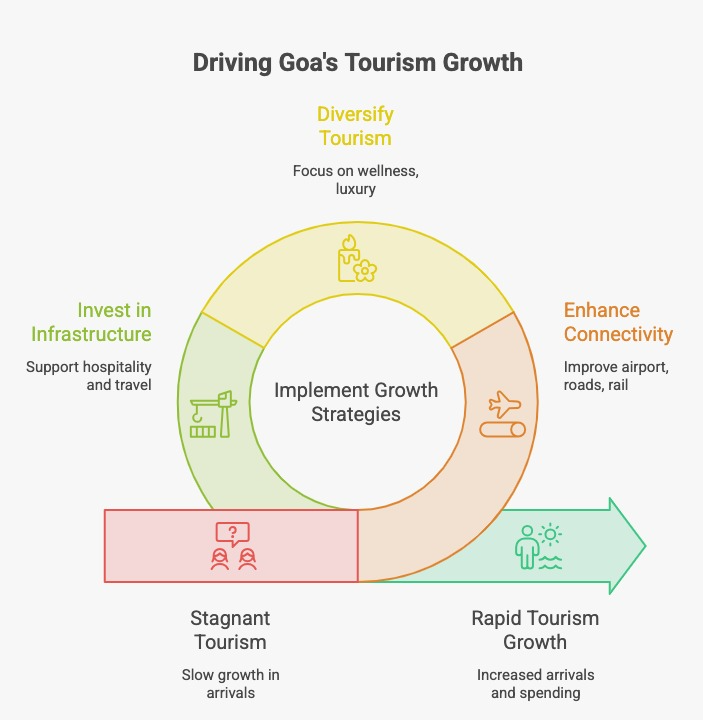
How Tourism Growth Influences Long-Term Land Investment
Tourism and real estate are closely interconnected, but the relationship is gradual rather than immediate.
As tourism expands, several sectors of the local economy typically experience increased demand, including:
- Hotels
- Restaurants
- Retail businesses
- Transport services
- Entertainment
- Local employment
- Infrastructure
- Residential accommodation
Over time, these economic activities may influence demand for residential, commercial, and mixed-use developments.
The World Travel & Tourism Council describes tourism as a significant economic multiplier because visitor spending supports employment, business creation, infrastructure investment, and regional income generation.
For long-term investors evaluating the MahaGoa Region, tourism indicators should therefore be considered alongside broader economic fundamentals rather than in isolation.
Important indicators include:
- Tourist arrivals
- Airport passenger growth
- Highway completion
- Railway improvements
- Hotel occupancy
- Hospitality investment
- Government infrastructure spending
- Population movement
- Employment generation
Collectively, these variables provide a more comprehensive understanding of regional development potential.
Why Serious Investors Track Infrastructure Before Markets Mature
Institutional investors, family offices, and experienced land investors often monitor infrastructure projects years before visible real estate development accelerates.
This approach reflects a simple principle: accessibility frequently precedes economic expansion.
Regions that experience sustained improvements in transportation networks, tourism infrastructure, hospitality investment, and public services may gradually attract greater business activity and residential demand over time. However, investment outcomes remain dependent on multiple factors, including regulatory approvals, land-use planning, environmental considerations, and overall market conditions.
The MahaGoa Region illustrates how coordinated investments in airports, highways, railways, and tourism infrastructure can improve regional connectivity and broaden economic opportunities. Rather than viewing any single project as a guarantee of appreciation, investors are better served by assessing the cumulative impact of infrastructure, tourism, policy support, and long-term demographic trends.
In the final section of this article, we will examine practical investment considerations, due diligence for coastal land purchases, expert insights from leading industry reports, key tourism and infrastructure statistics, frequently asked questions, and a balanced conclusion on what the evolving MahaGoa Region could mean for long-term land investors.
Investment Considerations Before Buying Land in the MahaGoa Region
Tourism growth often attracts investor attention, but experienced investors understand that long-term value is determined by multiple interconnected factors rather than visitor numbers alone. Infrastructure development, regulatory compliance, accessibility, local economic activity, and future planning all influence how a market evolves.
For anyone evaluating opportunities in the MahaGoa Region, adopting a disciplined and research-driven approach is essential.
Conduct Comprehensive Due Diligence
Before acquiring land in any emerging tourism corridor, investors should verify:
- Clear and marketable title ownership
- Land-use classification and zoning
- Coastal Regulation Zone (CRZ) applicability
- Development permissions
- Road access and right of way
- Water and electricity availability
- Flood risk and environmental restrictions
- Local development plans
- Encumbrance certificates
- Mutation records
Official land regulations can be verified through the respective state revenue departments and planning authorities.
Evaluate Infrastructure, Not Just Current Prices
Markets experiencing infrastructure upgrades often attract attention well before large-scale real estate development occurs. However, investors should distinguish between announced projects and completed infrastructure.
Important indicators include:
- Operational airports
- Highway completion status
- Railway connectivity
- Healthcare facilities
- Educational institutions
- Banking infrastructure
- Commercial activity
- Tourism amenities
The MahaGoa Region benefits from ongoing infrastructure improvements, but each micro-market should be evaluated independently.
Understand the Long-Term Nature of Land Investments
Unlike ready residential assets, land investments typically require longer holding periods.
Experienced investors generally evaluate:
- Regional economic growth
- Tourism expansion
- Infrastructure completion
- Urban planning
- Population movement
- Business activity
Rather than expecting immediate appreciation, successful land investors often align their strategies with long-term regional development cycles.
Consider Potential Risks
Balanced investment decisions require evaluating both opportunities and uncertainties.
Some important considerations include:
- Regulatory changes
- Environmental policies
- Infrastructure implementation timelines
- Market cycles
- Interest rate movements
- Economic conditions
- Demand fluctuations
- Climate resilience
Diversification and professional legal due diligence remain important components of responsible investing.
Expert Insights: What Industry Research Suggests
Several leading real estate and hospitality research organizations continue highlighting structural trends that are shaping India’s coastal property markets.
According to JLL India, premium leisure destinations are witnessing increasing demand driven by higher disposable incomes, evolving travel preferences, and the expansion of luxury hospitality.
Knight Frank India notes that affluent homebuyers continue showing growing interest in lifestyle-oriented second homes supported by improved infrastructure and changing work patterns.
Colliers India highlights that experiential tourism, branded hospitality, and destination-led investments are becoming increasingly important across India’s emerging leisure markets.
ANAROCK Research continues to observe sustained interest in premium residential markets supported by infrastructure-led development across several regions of India.
Collectively, these industry reports suggest that transportation infrastructure, tourism diversification, hospitality investment, and regional accessibility are becoming increasingly important factors when evaluating long-term coastal real estate markets.
For investors studying the MahaGoa Region, these broader trends provide valuable context when combined with local market research and professional due diligence.
Key Statistics at a Glance
Indicator | Latest Trend | Primary Source |
Domestic Tourist Arrivals (Goa, Jan–Jun 2026) | ~10–11% Growth | Ministry of Tourism |
International Tourist Arrivals | ~30–32% Growth | Goa Tourism |
Overall Tourist Growth | ~13% | Goa Tourism |
India’s Tourism Contribution to GDP | Significant and growing | WTTC |
Mopa International Airport | Operational with expanding connectivity | GMR Goa International Airport |
Mumbai–Goa Highway | Major four-laning project progressing | NHAI |
Konkan Railway | Continued modernization | Konkan Railway |
Hospitality Investment | Increasing across leisure destinations | JLL, Knight Frank, Colliers |
Luxury Travel Demand | Rising | WTTC |
Second Home Demand | Growing in infrastructure-led markets | ANAROCK |
FAQs
1. What is the MahaGoa Region?
The MahaGoa Region generally refers to the emerging coastal tourism and investment belt surrounding North Goa, extending into southern Maharashtra’s Konkan coastline. It commonly includes destinations such as Vengurla, Shiroda, Redi, Malvan, Sawantwadi, and nearby areas. While the term is used in tourism and investment discussions, it is not an official administrative designation.
2. Why is the MahaGoa Region receiving increased attention?
Improved connectivity through Manohar International Airport (Mopa), upgrades to NH-66, ongoing Konkan Railway improvements, government-supported tourism initiatives, and growing demand for experience-led coastal travel are increasing interest in the MahaGoa Region.
3. How does tourism influence land investment?
Tourism stimulates economic activity by supporting hospitality, retail, transportation, and employment. Over time, sustained tourism growth combined with infrastructure development may contribute to greater demand for residential and commercial real estate. However, investment outcomes depend on multiple market factors and should not be based on tourism trends alone.
4. Why do investors monitor tourism statistics before purchasing land?
Tourist arrivals, airport traffic, hotel occupancy, and hospitality investments provide insight into regional economic activity. These indicators can help investors understand long-term development trends alongside infrastructure, regulatory, and demographic factors.
5. How important is airport connectivity for real estate?
Improved air connectivity generally enhances regional accessibility, making destinations more attractive for tourism, business travel, and hospitality investment. Airports often act as long-term economic catalysts, although property performance depends on broader market conditions.
6. What government projects are supporting tourism along India’s western coast?
Key initiatives include:
- Manohar International Airport (Mopa)
- Mumbai–Goa Highway (NH-66)
- Konkan Railway modernization
- Maharashtra coastal tourism initiatives
- Ministry of Tourism destination development programs
- Sustainable tourism policies
7. What should investors verify before buying coastal land?
Investors should verify legal title, zoning, CRZ regulations, infrastructure availability, development permissions, environmental restrictions, access roads, and long-term regional planning before making any investment decision.
Key Takeaways
✔ Goa continues to experience strong domestic and international tourism growth in 2026.
✔ Traveller preferences are evolving toward experiential, wellness, and nature-based tourism.
✔ Improved connectivity is expanding tourism activity beyond traditional destinations.
✔ The MahaGoa Region is benefiting from enhanced accessibility through Mopa Airport, NH-66, and Konkan Railway improvements.
✔ Government investments in transportation and tourism infrastructure are strengthening regional economic integration.
✔ Hospitality investments often indicate increasing confidence in emerging tourism markets.
✔ Tourism should be evaluated alongside infrastructure, policy, legal due diligence, and market fundamentals when assessing land investment opportunities.
✔ Long-term investors typically focus on structural economic trends rather than short-term market movements.
Tourism Growth Is Creating New Long-Term Investment Corridors Along India’s Western Coast
India’s western coastline is entering an important phase of transformation. Tourism growth, infrastructure modernization, improved regional connectivity, and evolving traveller preferences are collectively reshaping how investors view coastal destinations.
Goa remains one of India’s strongest tourism economies, supported by robust domestic demand, recovering international arrivals, world-class hospitality, and continued government investment. At the same time, improvements in transportation networks are enabling tourism activity to extend naturally into neighbouring coastal destinations, contributing to the emergence of the MahaGoa Region as an increasingly connected tourism corridor.
Large-scale projects such as Manohar International Airport (Mopa), the Mumbai–Goa Highway (NH-66), and continued upgrades to the Konkan Railway are reducing travel times and strengthening accessibility. Complemented by Maharashtra’s coastal tourism initiatives and sustained private-sector hospitality investment, these developments are enhancing the long-term economic prospects of the broader region.
For investors, however, tourism growth should be viewed as one element within a broader investment framework. Sound decisions require careful evaluation of infrastructure readiness, regulatory compliance, land records, environmental considerations, regional planning, and market fundamentals. Tourism indicators, while valuable, are most meaningful when interpreted alongside these broader economic and legal factors.
The MahaGoa Region represents an example of how infrastructure, tourism, and regional development can converge to create new opportunities over time. Whether for policymakers assessing regional growth, business leaders evaluating emerging markets, or long-term investors exploring coastal land, the region demonstrates the importance of analysing development through evidence, credible research, and disciplined due diligence rather than short-term speculation.
As India’s tourism economy continues to evolve, the destinations that combine accessibility, sustainable planning, natural assets, and long-term infrastructure investment are likely to play an increasingly significant role in the country’s coastal growth story.