
Why Land Investment in India Is Booming: How Infrastructure Development Is Creating Long-Term Wealth Opportunities
India’s Infrastructure Revolution Is Redefining Land Investment
India is experiencing one of the most significant infrastructure transformations in its modern history. Massive investments in expressways, economic corridors, metro rail systems, airports, ports, logistics hubs, industrial corridors, and smart cities are reshaping how people live, travel, conduct business, and invest. This unprecedented development is creating new economic centres beyond traditional metropolitan cities, making Land Investment in India an increasingly important topic for investors seeking long-term wealth creation.
Unlike residential apartments or commercial buildings that may depreciate over time due to aging structures, land remains a finite resource. Its value is largely influenced by location, accessibility, economic activity, and future development potential. As infrastructure improves connectivity and reduces travel time, previously underdeveloped regions often become attractive destinations for residential communities, industries, tourism, logistics, and commercial businesses. This transformation has historically contributed to increased demand for strategically located land, although appreciation varies based on local market conditions, regulatory factors, and project execution.
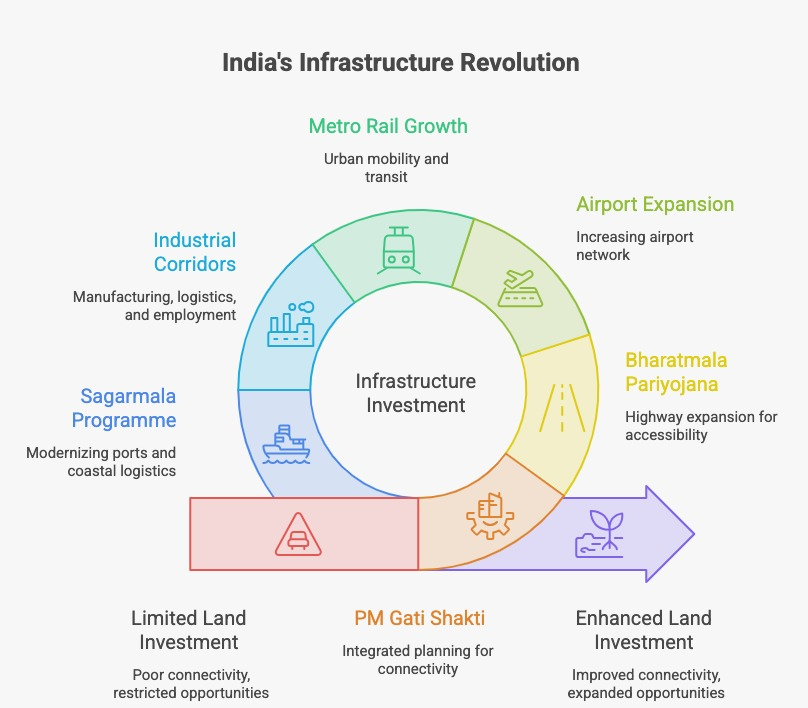
The Government of India’s long-term infrastructure vision aims to create a faster, more connected, and globally competitive economy. Programs such as PM Gati Shakti, Bharatmala Pariyojana, the National Infrastructure Pipeline (NIP), Sagarmala, Dedicated Freight Corridors (DFC), Smart Cities Mission, and major airport expansion projects are collectively changing India’s investment landscape. These initiatives are not merely transportation projects—they are catalysts for regional economic development, industrial expansion, urbanisation, and employment generation.
For investors, understanding how infrastructure influences land demand is becoming increasingly important. Rather than viewing Land Investment in India through the lens of speculation, experienced investors analyse infrastructure plans, government policies, demographic trends, industrial growth, and connectivity improvements to identify locations with long-term development potential.
According to the Government of India’s PM Gati Shakti National Master Plan, integrated infrastructure planning aims to reduce logistics costs, improve multimodal connectivity, and accelerate economic growth across the country. These improvements can enhance the economic utility of land by making it more accessible for businesses, industries, residents, and tourists.
Why Land Investment in India Is Gaining Momentum
The growing interest in Land Investment in India is closely linked to the country’s rapid infrastructure expansion and long-term economic transformation. Infrastructure serves as the foundation of economic development by improving mobility, reducing transportation costs, attracting industries, and increasing accessibility. As connectivity improves, regions that were once considered remote can evolve into thriving residential, commercial, industrial, or tourism destinations.
One of the key reasons Land Investment in India continues to attract long-term investors is that infrastructure fundamentally changes the economic value of a location. A new expressway, metro corridor, airport, or industrial zone can significantly reduce travel time, improve market access, and create employment opportunities. These factors often stimulate demand for housing, retail, offices, logistics facilities, hospitality projects, and supporting infrastructure.
For example, the completion of major highways and expressways in several parts of India has enabled businesses to transport goods more efficiently while encouraging people to live farther from congested city centres. As a result, surrounding regions have witnessed increased development activity, though outcomes vary depending on planning, infrastructure execution, and local demand.
Unlike short-term market fluctuations, infrastructure investments are typically planned over decades. This long-term approach aligns well with investors who view Land Investment in India as a patient wealth-building strategy rather than a speculative opportunity.
How Infrastructure Creates Long-Term Value for Land
Infrastructure enhances land value through several interconnected economic mechanisms.
Improved Connectivity
Roads, expressways, metro rail systems, airports, and ports reduce travel time and improve access to employment centres, markets, educational institutions, healthcare facilities, and tourism destinations. Better accessibility often increases the attractiveness of nearby land for future development.
Economic Activity
Large infrastructure projects attract manufacturing units, logistics companies, technology parks, retail businesses, hospitality projects, and service industries. Increased economic activity generates employment, which in turn drives demand for residential and commercial real estate.
Urban Expansion
As metropolitan cities become increasingly congested, improved transportation infrastructure enables urban expansion into surrounding districts. Many emerging suburbs and satellite cities have developed due to enhanced connectivity rather than geographical proximity alone.
Tourism Development
Improved airports, highways, coastal roads, and railway connectivity have made several leisure destinations more accessible. Better infrastructure often supports tourism-related businesses such as hotels, resorts, vacation homes, homestays, and short-term rental properties, creating additional demand for strategically located land.
Industrial Growth
Industrial corridors, freight corridors, logistics parks, and manufacturing clusters encourage businesses to establish operations in new regions. This industrial growth often contributes to higher demand for industrial, commercial, and residential land in nearby areas.
India’s Infrastructure Revolution: A New Era for Land Investment in India
India’s infrastructure expansion is among the largest globally, supported by significant public investment and policy reforms. The government’s focus extends beyond constructing roads and bridges; it aims to create integrated economic ecosystems that improve productivity, competitiveness, and regional development.
Some of the most important national initiatives influencing Land Investment in India include:
PM Gati Shakti National Master Plan
Launched in 2021, PM Gati Shakti integrates infrastructure planning across multiple ministries using GIS-based technology. The initiative coordinates the development of highways, railways, ports, airports, logistics parks, industrial corridors, and economic zones to improve efficiency and reduce logistics costs.
National Infrastructure Pipeline (NIP)
The National Infrastructure Pipeline includes thousands of infrastructure projects across transportation, energy, water resources, urban infrastructure, and digital connectivity. The objective is to strengthen India’s long-term economic growth while creating new investment opportunities.
Bharatmala Pariyojana
Bharatmala focuses on expanding India’s highway and expressway network by improving economic corridors, border roads, coastal roads, and interstate connectivity. Enhanced road infrastructure has historically supported industrial development, logistics, and real estate growth in several regions.
Sagarmala Programme
Sagarmala aims to modernise ports, improve coastal connectivity, and promote port-led industrialisation. The programme supports logistics efficiency, exports, manufacturing, and tourism development along India’s coastline.
Smart Cities Mission
The Smart Cities Mission focuses on improving urban infrastructure through technology-enabled governance, sustainable mobility, public transport, digital infrastructure, and better urban planning.
Why This Matters for Investors
While infrastructure alone does not guarantee appreciation, history demonstrates that improved connectivity often influences where people choose to live, businesses decide to invest, and industries establish operations. Investors evaluating Land Investment in India should therefore pay close attention to government infrastructure plans, master plans, industrial policies, and demographic trends rather than relying solely on current market prices.
As India’s infrastructure ecosystem continues to expand, understanding the relationship between connectivity, economic development, and land demand will become increasingly important for informed investment decisions.
How Infrastructure Is Influencing Land Investment in India Through Connectivity and Economic Growth
How Infrastructure Development Influences Land Investment in India
Infrastructure has always been one of the strongest catalysts for economic development. Throughout history, cities and regions connected by highways, railways, ports, airports, and industrial hubs have generally attracted greater investment, employment, and population growth than isolated locations. This relationship explains why Land Investment in India is increasingly being analysed through the lens of infrastructure rather than simply current market prices.
Land itself does not change, but its accessibility and economic utility do. When travel times reduce, logistics become more efficient, and businesses gain better connectivity, land often becomes more attractive for residential, commercial, industrial, and tourism-related development. As demand for these activities grows, the value proposition of strategically located land may strengthen over time, although actual appreciation depends on several local market factors.
According to the World Bank, infrastructure investment improves productivity, supports economic competitiveness, and enhances regional development by lowering transportation costs and improving market accessibility. Similarly, the Government of India’s infrastructure strategy aims to integrate transportation, logistics, manufacturing, and urban development through coordinated planning.
Why Connectivity Is the Foundation of Land Investment in India
One of the biggest drivers behind Land Investment in India is connectivity. Better roads, airports, metro systems, freight corridors, and ports improve accessibility, making land more suitable for various economic activities.
Consider a location that previously required four hours of travel from a major city. If a newly developed expressway reduces that travel time to just two hours, businesses can transport goods faster, employees can commute more efficiently, tourists can visit more frequently, and residents can access better healthcare, education, and employment opportunities. Although the land itself remains unchanged, its economic potential increases because accessibility has improved.
This transformation often creates opportunities for:
- Residential townships
- Commercial developments
- Industrial parks
- Logistics centres
- Warehousing facilities
- Hotels and resorts
- Vacation homes
- Healthcare institutions
- Educational campuses
For investors evaluating Land Investment in India, understanding planned and ongoing infrastructure projects is therefore as important as analysing current land prices.
Expressways and Highways: Expanding India’s Economic Geography
India’s rapidly expanding highway network is changing how goods and people move across the country. Projects such as the Delhi–Mumbai Expressway, Mumbai–Nagpur Samruddhi Mahamarg, Ganga Expressway, and Bharatmala Pariyojana are improving regional connectivity while encouraging new economic clusters.
The Ministry of Road Transport and Highways reports that India’s national highway network has expanded significantly over the past decade, supporting logistics efficiency and regional development.
Improved highway connectivity contributes to:
- Faster freight movement
- Reduced logistics costs
- Better access to industrial areas
- Increased tourism
- Growth of satellite cities
- Expansion of residential suburbs
These developments often influence Land Investment in India, particularly in locations situated near major highway interchanges and planned economic corridors.
Airports Are Creating New Growth Corridors
India is among the world’s fastest-growing aviation markets. The Government of India is investing heavily in airport modernization and the development of new greenfield airports to improve domestic and international connectivity.
Projects such as:
- Noida International Airport (Jewar)
- Navi Mumbai International Airport
- MOPA International Airport (Goa region)
- Bhogapuram International Airport
- Expansion of existing metro city airports
are expected to strengthen tourism, trade, business travel, and regional development.
Airport infrastructure often creates demand for:
- Hotels
- Convention centres
- Commercial offices
- Logistics parks
- Residential communities
- Holiday homes
As a result, investors researching Land Investment in India frequently monitor airport influence zones alongside government master plans and urban development policies.
Metro Rail Expansion Is Reshaping Urban Real Estate
Metro rail networks improve urban mobility while reducing travel times across rapidly growing cities.
Cities such as:
- Delhi NCR
- Mumbai
- Bengaluru
- Hyderabad
- Pune
- Ahmedabad
- Nagpur
- Kochi
- Indore
- Surat
have expanded metro connectivity over recent years.
International research consistently shows that transit-oriented development can increase the attractiveness of nearby residential and commercial districts by improving accessibility. While every market behaves differently, metro expansion often influences urban planning, mixed-use developments, and commercial investment.
For investors evaluating Land Investment in India, understanding future metro corridors may provide valuable insight into long-term urban expansion patterns.
Industrial Corridors Are Driving Long-Term Economic Growth
India’s industrial corridor strategy aims to create globally competitive manufacturing ecosystems supported by world-class infrastructure.
Major projects include:
- Delhi–Mumbai Industrial Corridor (DMIC)
- Chennai–Bengaluru Industrial Corridor
- Amritsar–Kolkata Industrial Corridor
- East Coast Economic Corridor
- Bengaluru–Mumbai Economic Corridor
These corridors integrate:
- Manufacturing
- Warehousing
- Logistics
- Urban development
- Skill development
- Freight transportation
As industries establish operations, employment opportunities expand, supporting demand for housing, retail, healthcare, education, and commercial services. These developments contribute to the long-term relevance of Land Investment in India for investors focused on infrastructure-led growth.
Dedicated Freight Corridors Are Supporting Industrial Land Demand
The Western and Eastern Dedicated Freight Corridors represent one of India’s most ambitious logistics initiatives.
By improving freight efficiency and reducing transportation time, these corridors are expected to strengthen:
- Manufacturing
- Warehousing
- Export-oriented industries
- Industrial clusters
- Logistics parks
Several logistics hubs have already emerged near freight corridor nodes, demonstrating how transportation infrastructure can influence industrial land demand.
Smart Cities and Urban Infrastructure
The Smart Cities Mission focuses on improving urban infrastructure through:
- Integrated transport
- Digital governance
- Sustainable mobility
- Smart utilities
- Public services
- Environmental sustainability
Although every Smart City is progressing differently, improved urban infrastructure enhances overall livability, supporting residential and commercial demand over time.
For investors studying Land Investment in India, urban infrastructure quality is becoming an increasingly important consideration alongside connectivity and economic activity.
Historical Case Studies: Infrastructure and Land Investment in India
Historical evidence demonstrates that infrastructure has often influenced land demand and development patterns across several Indian regions.
Yamuna Expressway
The Yamuna Expressway improved connectivity between Delhi NCR and Agra, encouraging residential townships, educational institutions, logistics facilities, and commercial projects in several surrounding areas.
Noida–Greater Noida Expressway
Improved connectivity attracted IT companies, educational campuses, residential communities, and commercial developments, contributing to long-term urban expansion.
Hyderabad Outer Ring Road
The Outer Ring Road strengthened connectivity between Hyderabad’s technology hubs, airport, and surrounding districts. Over time, the corridor witnessed substantial growth in residential, commercial, and industrial activity.
Dwarka Expressway
As construction progressed, the corridor experienced increased residential launches, commercial development, and investor interest due to improved regional connectivity.
Mumbai Trans Harbour Link (Atal Setu)
The bridge has enhanced connectivity between Mumbai and Navi Mumbai, improving accessibility to the upcoming Navi Mumbai International Airport and surrounding economic zones.
These examples illustrate that while infrastructure often supports regional development, investment outcomes depend on project execution, regulatory approvals, local demand, and broader economic conditions.
Global Examples Reinforcing the Infrastructure–Land Relationship
International experience also demonstrates the connection between transportation infrastructure and urban development.
Examples include:
- Elizabeth Line (London): Improved accessibility stimulated residential and commercial investment around several stations.
- Hong Kong MTR: Transit-oriented development integrated transport with high-density mixed-use real estate.
- Tokyo Rail Network: Extensive rail infrastructure supported long-term urban expansion and efficient land utilisation.
- Dubai Metro: Enhanced public transport improved accessibility to emerging business districts and residential communities.
These global examples reinforce a consistent principle: infrastructure improves accessibility, and accessibility often increases economic activity, which can positively influence land demand.
Market Trends, Emerging Investment Corridors, Due Diligence, and the Future of Land Investment in India
Emerging Infrastructure Corridors Driving the Future of Land Investment in India
India’s infrastructure pipeline is creating several emerging growth corridors that are attracting attention from investors, businesses, manufacturers, and policymakers. Rather than concentrating growth within traditional metropolitan cities, new infrastructure projects are encouraging regional development and expanding economic opportunities across multiple states.
For investors researching Land Investment in India, understanding these emerging corridors can provide valuable insights into regions that may benefit from improved connectivity, industrial expansion, and urbanisation over the coming years.
Delhi–Mumbai Expressway Corridor
The Delhi–Mumbai Expressway, one of India’s largest infrastructure projects, is expected to improve connectivity between the National Capital Region and western India. By reducing travel time and improving freight efficiency, the corridor is anticipated to support industrial parks, logistics hubs, warehousing, commercial centres, and residential developments in multiple states.
Delhi–Mumbai Industrial Corridor (DMIC)
The Delhi–Mumbai Industrial Corridor is among India’s flagship manufacturing initiatives. The project integrates industrial townships, logistics parks, multimodal transport systems, and smart infrastructure to strengthen India’s manufacturing competitiveness.
For Land Investment in India, industrial corridors such as DMIC demonstrate how planned infrastructure can influence employment generation, commercial activity, and residential demand over the long term.
Jewar International Airport Influence Zone
The upcoming Noida International Airport at Jewar is expected to improve regional connectivity within western Uttar Pradesh. Alongside planned road and rail infrastructure, the airport is likely to encourage commercial activity, logistics operations, hospitality businesses, and residential development.
Investors should note that actual market performance depends on infrastructure execution, planning regulations, and future demand rather than airport development alone.
Navi Mumbai International Airport Region
The Navi Mumbai International Airport complements the Mumbai Metropolitan Region’s long-term development plans. Combined with the Mumbai Trans Harbour Link and other transportation projects, the region illustrates how integrated infrastructure planning can support economic growth.
Bengaluru Expansion Corridors
Northern and eastern Bengaluru continue to attract investment due to technology parks, metro expansion, airport connectivity, and industrial development. These regions demonstrate how transportation infrastructure and employment centres often develop together.
Coastal Infrastructure and Tourism Corridors
Government initiatives such as Sagarmala are improving coastal connectivity through port modernisation, coastal highways, tourism infrastructure, and logistics development.
Improved accessibility can enhance tourism-related businesses including hotels, resorts, restaurants, waterfront developments, and vacation accommodations, creating additional opportunities linked to Land Investment in India.
Market Trends Supporting Long-Term Land Investment in India
Several macroeconomic trends continue to support long-term demand for strategically located land across India.
Urbanisation
According to the United Nations, India’s urban population is expected to continue increasing over the coming decades. Growing cities require additional residential communities, transportation infrastructure, commercial spaces, educational institutions, healthcare facilities, and public amenities.
As urban boundaries expand, nearby regions often experience increased development activity, making Land Investment in India relevant for investors seeking long-term opportunities.
Manufacturing Growth
Government initiatives such as Make in India and the Production Linked Incentive (PLI) schemes aim to strengthen domestic manufacturing across sectors including electronics, automobiles, pharmaceuticals, renewable energy, textiles, and semiconductors.
Manufacturing expansion typically increases demand for:
- Industrial land
- Warehousing
- Employee housing
- Commercial services
- Logistics infrastructure
Rising Domestic Tourism
India’s domestic tourism market continues to expand, supported by improved road connectivity, airport development, and increasing disposable incomes.
According to the Ministry of Tourism, domestic tourism plays an increasingly important role in regional economic development, particularly in destinations benefiting from improved accessibility.
Growing tourism supports demand for:
- Hotels
- Resorts
- Homestays
- Vacation homes
- Boutique hospitality
- Short-term rentals
Logistics and E-Commerce
The rapid expansion of e-commerce has increased demand for modern warehousing and logistics infrastructure.
Government initiatives aimed at reducing logistics costs through integrated transportation networks may further strengthen industrial and commercial real estate demand.
Key Statistics Every Land Investor Should Know
When evaluating Land Investment in India, investors should rely on verified data rather than market speculation.
Important indicators include:
- Growth in National Highway network
- Number of operational airports
- Metro rail expansion
- Infrastructure capital expenditure
- Urban population growth
- Manufacturing output
- Logistics performance
- Industrial corridor investments
- Tourism growth
- GDP growth trends
Reliable sources include:
- Ministry of Finance
- RBI
- NITI Aayog
- Ministry of Road Transport
- Ministry of Railways
- Ministry of Civil Aviation
- World Bank
- Invest India
How to Evaluate Land Investment in India
Infrastructure should be one component of a broader investment evaluation process.
Investors should carefully analyse multiple factors before purchasing land.
1. Verify Government Infrastructure Plans
Distinguish between announced projects and projects under construction or completed. Official notifications provide greater clarity than market rumours.
2. Study Regional Master Plans
Development authorities publish land-use plans that identify residential, commercial, industrial, agricultural, and conservation zones.
3. Assess Connectivity
Evaluate:
- Highways
- Expressways
- Railway stations
- Metro stations
- Airports
- Ports
- Public transport
4. Understand Economic Drivers
Look for regions benefiting from:
- Manufacturing
- IT
- Tourism
- Education
- Healthcare
- Logistics
- Government investments
5. Evaluate Future Demand
Long-term Land Investment in India depends on future demand rather than current prices alone.
Population growth, employment opportunities, business activity, and infrastructure execution all influence market performance.
Risks and Due Diligence Before Land Investment in India
While infrastructure creates opportunities, investors should also understand the associated risks.
Legal Title Verification
Verify ownership records through official land records and qualified legal professionals.
Land Use Regulations
Confirm permitted land use and applicable zoning regulations before investing.
Encumbrance Check
Ensure that the property is free from legal disputes, mortgages, or other encumbrances.
Environmental Restrictions
Some areas may be subject to Coastal Regulation Zone (CRZ), forest, wetland, or environmental restrictions.
Infrastructure Execution Risk
Not every announced project is completed on schedule. Investors should monitor actual implementation rather than relying solely on announcements.
Market Liquidity
Some land markets are less liquid than residential apartments or commercial offices, making exit timelines longer.
Regulatory Changes
Development regulations, taxation, and land-use policies may evolve.
Conducting professional legal and technical due diligence remains essential for responsible Land Investment in India.
The Future of Land Investment in India
India’s long-term economic outlook continues to be supported by infrastructure investment, urbanisation, manufacturing expansion, digital transformation, and increasing domestic consumption.
Government initiatives such as PM Gati Shakti, National Infrastructure Pipeline, Bharatmala, Dedicated Freight Corridors, Sagarmala, and industrial corridor development are reshaping regional connectivity across the country.
While no infrastructure project guarantees appreciation, historical evidence from India and global markets indicates that improved accessibility often contributes to stronger economic activity, increased development, and higher demand for strategically located land.
For investors, Land Investment in India should therefore be approached through disciplined research, verified government data, legal due diligence, and long-term planning rather than short-term speculation.
India is entering a transformative phase where infrastructure development is becoming one of the strongest drivers of regional economic growth. Highways, expressways, airports, metro rail systems, industrial corridors, logistics parks, ports, and smart cities are collectively redefining how people, businesses, and industries interact with land.
For investors, Land Investment in India offers an opportunity to participate in this long-term transformation. However, successful investing requires more than identifying upcoming infrastructure projects. It involves understanding regional development plans, verifying legal documentation, assessing market fundamentals, and evaluating long-term economic demand.
As India’s infrastructure network continues to expand, investors who prioritise research, due diligence, and evidence-based decision-making will be better positioned to identify sustainable opportunities while managing investment risks responsibly.
FAQs
1. Is Land Investment in India a good long-term investment?
Land Investment in India has long been considered one of the most resilient real estate asset classes because land is a finite resource that cannot be replicated. Unlike built properties, which may depreciate due to aging structures, strategically located land derives its value from factors such as infrastructure development, connectivity, economic activity, urban expansion, and future development potential. While no investment guarantees appreciation, historical evidence suggests that well-researched land investments in regions experiencing sustained infrastructure growth have often benefited from increased demand over time. Investors should always conduct legal due diligence, verify government development plans, and evaluate local market fundamentals before making any investment decision.
2. Why is Land Investment in India becoming increasingly popular?
The growing popularity of Land Investment in India is closely linked to India’s unprecedented infrastructure expansion. Government initiatives such as PM Gati Shakti, Bharatmala Pariyojana, National Infrastructure Pipeline, Dedicated Freight Corridors, airport expansion, metro rail development, industrial corridors, and smart cities are improving connectivity across the country. Better infrastructure encourages residential, commercial, industrial, logistics, and tourism-related development, making strategically located land more attractive for long-term investors seeking sustainable wealth creation opportunities.
3. How does infrastructure influence Land Investment in India?
Infrastructure plays a crucial role in Land Investment in India by improving accessibility and increasing the economic utility of land. New expressways, highways, metro systems, airports, ports, and industrial corridors reduce travel time, improve logistics efficiency, and attract businesses and residents. As employment opportunities and economic activity increase, demand for residential, commercial, industrial, and hospitality developments often follows. Although infrastructure can positively influence land demand, appreciation depends on several factors, including project execution, market conditions, regulatory approvals, and local demand.
4. Which government initiatives are supporting Land Investment in India?
Several national infrastructure programmes are influencing Land Investment in India, including:
- PM Gati Shakti National Master Plan
- Bharatmala Pariyojana
- National Infrastructure Pipeline (NIP)
- Sagarmala Programme
- Dedicated Freight Corridors (DFC)
- Smart Cities Mission
- National Industrial Corridor Development Programme
- Regional Connectivity Scheme (UDAN)
- Production Linked Incentive (PLI) Scheme
- Make in India Initiative
These initiatives aim to improve transportation, manufacturing, logistics, urban development, and economic competitiveness, creating long-term opportunities for strategically located land.
5. Can expressways increase the value of Land Investment in India?
Expressways have historically influenced Land Investment in India by improving regional connectivity and reducing travel time. Projects such as the Yamuna Expressway, Delhi–Mumbai Expressway, Samruddhi Mahamarg, and Dwarka Expressway have encouraged residential development, logistics parks, commercial activity, and industrial growth in several surrounding regions. However, land appreciation varies by location, infrastructure execution, government planning, and market demand. Investors should evaluate micro-market conditions rather than assuming uniform growth across an entire corridor.
6. How do airports affect Land Investment in India?
Airport development can significantly influence Land Investment in India by improving domestic and international connectivity. Airports often attract hotels, logistics parks, commercial offices, convention centres, retail developments, and residential communities. Regions surrounding airports such as Noida International Airport (Jewar), Navi Mumbai International Airport, and MOPA International Airport have attracted increased investor attention due to improved accessibility. However, airport development alone does not guarantee appreciation, and investors should consider regional planning, infrastructure execution, and economic activity before investing.
7. What role do industrial corridors play in Land Investment in India?
Industrial corridors contribute to Land Investment in India by encouraging manufacturing, logistics, warehousing, exports, and employment generation. Major corridors such as the Delhi–Mumbai Industrial Corridor (DMIC), Chennai–Bengaluru Industrial Corridor, and East Coast Economic Corridor integrate transportation infrastructure with industrial development. As industries establish operations, demand for employee housing, commercial services, logistics facilities, and supporting infrastructure often increases, influencing surrounding land markets over the long term.
8. Is Land Investment in India suitable for NRIs, HNIs, and long-term investors?
Yes, Land Investment in India can be suitable for NRIs (subject to RBI and FEMA regulations), High-Net-Worth Individuals (HNIs), family offices, entrepreneurs, and long-term investors seeking portfolio diversification. Many investors view land as a long-term asset that may benefit from infrastructure-led regional development. However, investment decisions should always be supported by legal verification, financial planning, market research, and professional advice to align with individual investment objectives.
9. What factors should investors evaluate before making a Land Investment in India?
Before proceeding with a land investment in India, investors should evaluate:
- Clear legal ownership and title verification
- Land-use zoning regulations
- Government-approved master plans
- Connectivity to highways, airports, metro stations, and railway networks
- Infrastructure project status
- Industrial and economic activity
- Population growth trends
- Environmental restrictions
- Encumbrance Certificate
- Future development potential
- Liquidity and exit opportunities
Professional legal and technical due diligence should always be completed before purchasing land.
10. What are the biggest risks associated with Land Investment in India?
Like any investment, Land Investment in India carries certain risks, including:
- Title disputes
- Regulatory changes
- Delays in infrastructure execution
- Zoning restrictions
- Environmental regulations
- Limited market liquidity
- Incorrect property documentation
- Unrealistic appreciation expectations
- Speculative pricing
- Fraudulent transactions
Mitigating these risks requires careful research, independent legal verification, and investing based on verified government information rather than market rumours.