North Goa Real Estate Investment: 7 Infrastructure Changes to Watch in 2026
North Goa has long been associated with beaches, tourism, luxury villas, second homes and a strong lifestyle economy.
But in 2026, another story is becoming increasingly important for anyone studying North Goa real estate investment: infrastructure.
Across the region, highways, airport connectivity, elevated road infrastructure and tourism facilities are changing the way different parts of North Goa connect with one another.
The significance is not limited to individual projects. A new elevated corridor can improve movement through a congested urban stretch. An airport connection can expand accessibility. Highway improvements can strengthen regional links. Tourism growth can create demand for hospitality, accommodation, retail and services.
When these factors develop together, they can influence the geography of economic activity and, consequently, the locations that investors choose to examine.
That does not mean infrastructure automatically translates into property appreciation. Real estate performance depends on several factors, including supply, pricing, title quality, land-use regulations, local accessibility, property quality, rental demand and broader economic conditions.
For anyone evaluating North Goa real estate investment, therefore, the more useful question is not simply, “Which infrastructure project will increase property prices?”
It is:
How is improving connectivity changing accessibility, tourism, economic activity and the long-term demand environment across North Goa?
Here are seven infrastructure and connectivity developments worth watching in 2026.
North Goa’s Infrastructure Story Is Entering a New Phase
North Goa’s infrastructure transformation is not being driven by one project.
It is a network of developments involving roads, aviation and tourism infrastructure.
Some of the most important developments include:
Infrastructure development | Current significance |
Porvorim Six-Lane Elevated Corridor | Operational after September 2026 inauguration |
Mopa–Dhargal NH-166S | Operational |
Mopa Airport terminal expansion | Underway |
NH-66 connectivity | Major regional highway corridor |
Tourism infrastructure | Continuing development |
Mopa Airport passenger infrastructure | Expanding with long-term capacity plans |
This distinction between operational, ongoing and planned infrastructure is important when assessing North Goa real estate investment.
An operational highway provides an immediate connectivity benefit. A project under construction may provide a future benefit, but its timeline and final implementation need to be monitored. A proposed project should be treated as a potential future infrastructure layer rather than an existing advantage.
The Government of Goa’s Economic Survey 2025–26 provides a useful official reference for understanding the state’s infrastructure, aviation and tourism ecosystem.
This infrastructure map is important because North Goa is increasingly becoming a connected network rather than a collection of isolated tourist destinations.
Porvorim Six-Lane Elevated Corridor: A Major Mobility Upgrade
One of the most significant recent developments for North Goa is the six-lane elevated corridor at Porvorim.
The project was inaugurated on 9 September 2026 by the Union Minister for Road Transport and Highways.
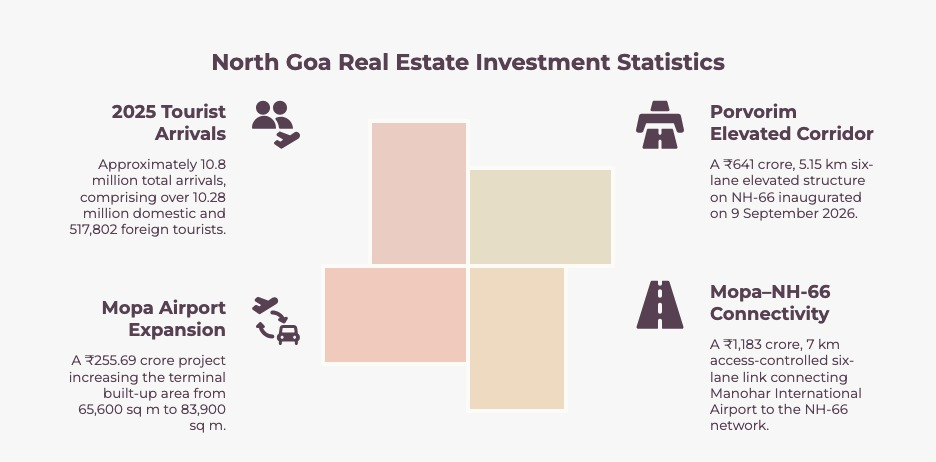
According to the Press Information Bureau, the elevated corridor is approximately 5.15 km long and was developed at a reported cost of ₹641 crore. The project forms part of NH-66 and is intended to improve traffic movement through Porvorim.
Why Porvorim matters
Porvorim occupies an important position within North Goa’s transport network.
It sits between Panaji and the wider northern part of the state, while also connecting into the NH-66 corridor towards Mapusa and northern Goa.
That makes congestion in Porvorim more than a local inconvenience.
It can affect the movement of:
- Residents
- Tourists
- Commercial vehicles
- Airport passengers
- Hospitality workers
- Businesses
- Daily commuters
The elevated corridor is designed to separate a significant portion of through traffic from surface-level movement.
The broader significance for North Goa real estate investment is therefore related to accessibility.
If movement through a major bottleneck becomes more efficient and reliable, the practical relationship between surrounding locations can change.
That does not mean every property in the surrounding area will benefit equally.
Instead, investors should examine whether a property has:
- Direct and convenient road access
- Reliable links to major highways
- Proximity to employment and commercial areas
- Access to tourism destinations
- Adequate local infrastructure
- Strong end-user or rental demand
The distinction is important because infrastructure benefits are often highly location-specific.
NH-66 Is Strengthening North Goa’s Regional Connectivity
The Porvorim corridor is one part of a much larger transportation system.
NH-66 is the major north-south highway spine running along India’s western coast, connecting Maharashtra, Goa, Karnataka and further south.
For North Goa, the highway provides a regional connection between areas such as Patradevi, Pernem, Mapusa, Porvorim, Panaji and the southern parts of the state.
Government project records show major four-laning work on sections of the Goa NH-66 network.
For example, the Patradevi–Karaswada four-laning project covers approximately 25.64 km. Government records list an original sanctioned cost of ₹634.32 crore and a revised cost of ₹769.52 crore.
Another major section covers the Karaswada–Bambolim corridor. Government project data lists an original cost of approximately ₹852.67 crore and a revised figure of ₹769.20 crore in the relevant project documentation.
These figures should be interpreted as project-level infrastructure costs, not as an indication of property-value growth.
Why NH-66 matters for North Goa real estate investment
Highways influence real estate primarily by improving accessibility.
A well-connected highway can reduce friction between:
Residential areas → commercial centres → airports → tourism destinations → employment hubs
That connectivity becomes especially relevant in a tourism-driven market.
A buyer considering a second home, for example, may evaluate not only how close a property is to a beach, but also how easily it can be reached from the airport.
A hospitality operator may consider access to tourist destinations and major roads.
A business owner may look at access to Panaji, Mapusa and other commercial centres.
This makes highway connectivity one of the factors worth incorporating into a broader North Goa real estate investment analysis.
Mopa Airport Is Becoming a Major Northern Connectivity Hub
Perhaps no infrastructure asset has changed North Goa’s connectivity narrative more significantly in recent years than Manohar International Airport at Mopa.
The airport began operations in January 2023 and has progressively expanded its role in Goa’s aviation network.
According to the Goa Economic Survey 2025–26, Mopa handled 14,094,729 domestic and international passengers between its commencement and January 2026.
During the same period, the airport facilitated 97,383 aircraft movements and connected Goa with 20 domestic and 12 international destinations.
The airport has also entered its Phase III development stage.
Mopa Airport terminal expansion
Terminal expansion is currently underway at an estimated cost of ₹255.69 crore.
The built-up area of the terminal is planned to increase from approximately:
65,600 sq m → 83,900 sq m
The Economic Survey also identifies an ultimate planned airport capacity of approximately 35 million passengers annually. This is a long-term planned capacity and should not be confused with current passenger traffic.
This distinction is important for investors.
Airport capacity does not automatically translate into property appreciation.
What it can do is create the infrastructure foundation for greater passenger movement, tourism, business travel, hospitality and related services.
That broader economic ecosystem is particularly relevant to North Goa real estate investment.
Why airports matter beyond passenger travel
A major airport can support:
- Tourism
- Hospitality
- Business travel
- Employment
- Transportation
- Retail
- Food and beverage
- Logistics
- Commercial services
- Second-home accessibility
As these activities develop, the economic catchment around the airport can expand.
For property investors, the relevant question is therefore not simply:
“How close is the property to Mopa Airport?”
Instead, it should be:
“How effectively is the property connected to the airport, highways, tourism destinations, commercial centres and local amenities?”
That is a much more useful framework for North Goa real estate investment.
The Mopa–NH-66 Link Is Connecting the Airport to the Highway Network
An airport becomes significantly more useful when it is efficiently connected to the wider road network.
This is where the NH-166S Mopa–Dhargal corridor becomes important.
In July 2024, the Ministry of Road Transport and Highways dedicated a 7-km, six-lane, access-controlled road with elevated viaducts connecting Manohar International Airport to Dhargal on NH-166S.
The project cost was reported at approximately ₹1,183 crore.
The Press Information Bureau stated that the project was intended to improve connectivity to Mopa Airport, support tourism and strengthen multimodal connectivity.
This creates an important connection between the airport and the wider NH-66 network.
Conceptually, the movement chain can be viewed as:
Mopa Airport → NH-166S → Dhargal → NH-66 → Mapusa/Porvorim/Panaji
The significance for North Goa real estate investment is the development of a more integrated regional mobility system.
An airport on its own is one infrastructure asset.
An airport connected to a major highway network is a broader economic platform.
That distinction matters.
It can improve the ability of visitors, businesses and residents to move across different parts of the region.
The government has also highlighted the broader road infrastructure network in Goa, with more than 299 km of national highways reported in the state as of June 2025.
Tourism Growth Is Adding a Strong Demand Layer
Infrastructure becomes more economically meaningful when it meets actual demand.
Goa already has one of India’s most established tourism economies.
According to the Department of Tourism, Government of Goa, Goa attracted more than 54.55 lakh tourists during January–June 2025, comprising approximately 51.84 lakh domestic and 2.71 lakh international visitors.
The full-year picture was also substantial.
Government tourism data reported approximately 10.8 million tourist arrivals in 2025, including more than 10.28 million domestic visitors and 517,802 foreign visitors.
International connectivity has also strengthened.
The Goa Economic Survey recorded 1,784 international flights through Dabolim and Mopa in 2025, carrying 235,798 foreign tourists.
These numbers matter for North Goa real estate investment because tourism creates a wide demand ecosystem.
It supports:
- Hotels
- Villas
- Managed residences
- Restaurants
- Cafés
- Retail
- Entertainment
- Wellness
- Transportation
- Leisure businesses
- Experience-led tourism
North Goa’s tourism geography is particularly diverse.
The official Goa Tourism destination guide highlights major northern destinations including Calangute, Baga and Candolim, while the wider northern belt extends towards Anjuna, Vagator, Morjim and other coastal destinations.
This established tourism ecosystem provides an underlying economic base for the region’s property market.
However, tourism growth should not be interpreted as an automatic property-price signal.
Tourist arrivals can increase while individual property markets experience different supply-demand conditions.
For investors, actual occupancy, rental rates, operating costs, competition and property quality remain critical.
Tourism Infrastructure Is Expanding Alongside Transport Infrastructure
Connectivity alone does not create a destination.
A successful tourism market requires a combination of accessibility, accommodation, attractions, public amenities, transportation and visitor experiences.
Goa’s tourism strategy increasingly reflects this broader approach.
The state has been developing and upgrading tourism infrastructure covering areas such as:
- Beach amenities
- Parking
- Public conveniences
- Tourist facilities
- Wayside amenities
- Beautification
- Cultural experiences
- Heritage attractions
- Wellness tourism
- Hinterland experiences
This matters because the real estate ecosystem surrounding tourism is broader than hotels.
A growing tourism destination can create demand for restaurants, cafés, retail, transportation, wellness facilities, entertainment and residential accommodation.
For North Goa real estate investment, this means investors should look beyond the traditional question of “How close is the property to the beach?”
A better framework is to examine the complete destination ecosystem.
How Connectivity Can Influence Long-Term Real Estate Demand
The relationship between infrastructure and property is rarely immediate or linear.
A more realistic framework is:
Infrastructure → Connectivity → Accessibility → Economic Activity → Tourism/Business Demand → Real Estate Demand
This does not mean every step happens automatically.
But infrastructure can create conditions that make certain locations more accessible and economically relevant.
Accessibility can expand the practical catchment
A location that once felt relatively distant from an airport or commercial centre can become more practical when road connectivity improves.
This can be relevant for:
- Second-home owners
- Remote professionals
- Entrepreneurs
- Hospitality operators
- Long-stay visitors
- Families seeking lifestyle properties
Airport connectivity can support hospitality demand
Better airport access can make short and extended stays more convenient.
This can potentially support accommodation and hospitality activity in locations that combine:
- Airport access
- Road connectivity
- Tourism attractions
- Lifestyle infrastructure
- Local services
Second-home demand is about usability
For many second-home buyers, location is not simply about scenic appeal.
Usability matters.
A property becomes more practical when the journey from the airport is straightforward, major roads are accessible and everyday services are nearby.
This is one reason connectivity deserves a prominent place in any North Goa real estate investment analysis.
Emerging North Goa Investment Corridors to Watch
North Goa should not be viewed as one homogeneous property market.
Different micro-markets have different infrastructure relationships, tourism profiles and development patterns.
Investors can therefore monitor several corridors without assuming that one will necessarily outperform another.
Panaji–Porvorim
This corridor benefits from its connection to Goa’s capital, commercial activity and NH-66.
The Porvorim elevated corridor adds another layer to the region’s mobility infrastructure.
Porvorim–Mapusa–Guirim
This corridor sits within an important northern movement network connecting residential areas, commercial activity and routes towards the tourism belt.
Improved highway movement makes this an important area to monitor for North Goa real estate investment.
Dhargalim–Mopa–Pernem
This is one of the most significant emerging infrastructure zones because of the combination of Mopa Airport, NH-166S and NH-66.
The area is particularly relevant for investors studying airport-led development and long-term northern connectivity.
Mapusa–Anjuna–Vagator–Morjim
This corridor is closely connected with North Goa’s established tourism ecosystem.
Its relevance comes from the combination of beaches, hospitality, restaurants, entertainment, lifestyle activity and established visitor demand.
Patradevi–Karaswada
This northern corridor connects Goa with Maharashtra and sits within the broader Mumbai–Goa highway system.
Its significance for North Goa real estate investment comes from regional connectivity rather than proximity to a single tourist attraction.
These corridors should be studied individually rather than ranked.
What Investors Should Evaluate Beyond Infrastructure
Infrastructure is important, but it should never be the only investment criterion.
A strong North Goa real estate investment analysis should include at least six additional factors.
1. Actual accessibility
Do not rely only on a map’s straight-line distance.
Study the actual road journey.
A property may be geographically close to an airport but poorly connected to the surrounding road network.
2. Legal and regulatory position
Investors should examine:
- Title
- Land-use classification
- Zoning
- Development permissions
- RERA applicability
- Construction approvals
- Environmental restrictions
- Local planning regulations
Goa’s Town and Country Planning Department is an important official reference for land-use and planning-related information.
3. Existing demand
Infrastructure is a potential demand enabler.
But actual demand must be established through evidence.
Look at:
- Rental occupancy
- Hotel performance
- Buyer profiles
- Local business activity
- Resale transactions
- New supply
- Tourism patterns
4. Supply
A location can have excellent infrastructure and still face oversupply.
Investors should understand how much competing inventory exists and how much additional development is likely.
5. Asset quality
Two properties in the same corridor can perform very differently.
Factors such as:
- Design
- Construction quality
- Maintenance
- Amenities
- Management
- Access
- Views
- Privacy
- Parking
can influence end-user and rental demand.
6. Long-term usability
A property designed only around short-term tourism may have a different demand profile from one that can also serve as a second home, long-stay residence or lifestyle property.
For North Goa real estate investment, flexibility can be an important consideration.
What North Goa’s Infrastructure Transformation Could Mean Over the Long Term
North Goa’s infrastructure story is becoming increasingly interconnected.
The Porvorim elevated corridor addresses a major movement point on NH-66.
The Mopa–Dhargal corridor connects the airport directly into the regional highway system.
Mopa Airport itself is expanding its terminal infrastructure and has a long-term planned capacity significantly above its original Phase-I capacity.
Tourism continues to provide a substantial demand base.
Together, these developments create a more connected economic geography.
The potential impact on real estate should therefore be understood through several layers.
First, accessibility can improve.
Second, travel friction between different parts of the region can reduce.
Third, tourism and hospitality can benefit from better connectivity.
Fourth, economic activity can spread along strategically connected corridors.
Fifth, selected real estate locations may become more relevant as their surrounding infrastructure and economic ecosystem develops.
But none of these factors guarantees appreciation.
Real estate markets remain influenced by supply, demand, regulation, pricing, financing conditions, local development and broader economic trends.
That is why infrastructure should be treated as a market signal to investigate, not as a guarantee of returns.
TOTL Realty’s Perspective on North Goa Real Estate Investment
At TOTL Realty, our approach to North Goa real estate investment is centred on understanding the larger ecosystem around a property rather than evaluating a location in isolation.
For an investor, a property should be viewed in relation to:
Airport + Highway + Urban Centre + Tourism + Local Infrastructure + Demand
That broader lens becomes increasingly relevant as North Goa’s infrastructure network evolves.
Mopa Airport is expanding.
NH-66 continues to form the region’s major road spine.
The Porvorim elevated corridor has introduced a major new mobility intervention.
Tourism continues to generate substantial visitor activity.
At the same time, individual micro-markets remain different.
The right approach is therefore to study the location, infrastructure status, legal framework, property fundamentals, demand profile and long-term usability together.
Our role as a real estate brokerage is not simply to point towards infrastructure announcements.
It is to help investors understand how those developments relate to actual property locations and market conditions.
For readers exploring North Goa real estate investment, that distinction can make infrastructure research considerably more useful.
Why Infrastructure Deserves a Place in the North Goa Investment Conversation
North Goa’s real estate story is increasingly connected to infrastructure.
The opening of the Porvorim six-lane elevated corridor, the Mopa–Dhargal NH-166S connection, continued NH-66 development, airport expansion and strong tourism activity are creating a more interconnected regional ecosystem.
The bigger story is not any one road or airport terminal.
It is the network.
When airports connect to highways, highways connect to urban centres, urban centres connect to tourism destinations and tourism supports hospitality and services, the economic geography of a region can gradually evolve.
For investors, that creates a reason to watch North Goa real estate investment through a broader infrastructure lens.
But infrastructure should remain one part of the decision-making process.
The most important questions remain practical:
Is the location accessible?
Is the property legally sound?
Is there genuine end-user or rental demand?
How much competing supply exists?
What infrastructure is operational versus merely proposed?
Does the property have long-term usability beyond a single investment narrative?
North Goa’s infrastructure transformation is still unfolding.
For long-term investors, the opportunity is not simply to follow headlines. It is to understand how connectivity, tourism, economic activity and real estate interact—and then evaluate individual properties on their own fundamentals.
That is where infrastructure-led real estate analysis becomes genuinely useful.
FAQs
1. Why is infrastructure important for North Goa real estate investment?
Infrastructure can improve accessibility between residential, tourism, commercial and employment centres. In North Goa, highway improvements, the Porvorim elevated corridor and Mopa Airport connectivity are strengthening the regional transport network.
However, infrastructure does not guarantee property appreciation. Investors should combine infrastructure analysis with demand, supply, legal, regulatory and property-level due diligence.
2. What is the Porvorim Elevated Corridor?
The Porvorim Elevated Corridor is a six-lane elevated road on NH-66 measuring approximately 5.15 km. It was inaugurated on 9 September 2026 at a reported project cost of ₹641 crore.
The official PIB announcement provides the latest government information on the project.
3. How important is Mopa Airport for North Goa real estate investment?
Mopa Airport is an important part of North Goa’s connectivity ecosystem.
The Goa Economic Survey 2025–26 reports that the airport handled more than 14.09 million domestic and international passengers between its January 2023 commencement and January 2026.
Terminal expansion is also underway at an estimated cost of ₹255.69 crore, with terminal built-up area planned to increase from 65,600 sq m to 83,900 sq m.
4. What is the Mopa–Dhargal road project?
The Mopa–Dhargal project is a six-lane, access-controlled, approximately 7-km road on NH-166S connecting Manohar International Airport with Dhargal.
The project cost was approximately ₹1,183 crore and it was dedicated to the nation in July 2024.
This connection links Mopa Airport more directly with the NH-66 highway network.
5. How does tourism influence North Goa real estate investment?
Tourism creates demand for accommodation, hospitality, restaurants, retail, transportation and leisure services.
Goa recorded more than 54.55 lakh tourist arrivals during January–June 2025, according to the Goa Department of Tourism.
The state recorded approximately 10.8 million tourist arrivals during 2025.
However, tourism growth should be treated as one demand indicator rather than a guarantee of property appreciation.
6. Which North Goa corridors should investors monitor?
Investors can examine several corridors, including:
Panaji–Porvorim
Porvorim–Mapusa–Guirim
Dhargalim–Mopa–Pernem
Mapusa–Anjuna–Vagator–Morjim
Patradevi–Karaswada
These areas have different infrastructure, tourism and property-market characteristics, so they should be evaluated individually rather than ranked.
7. Does better connectivity guarantee higher property prices?
No.
Better connectivity can improve accessibility and potentially support economic activity, but property prices depend on many additional factors.
These include:
Supply
Demand
Pricing
Location
Title
Regulations
Property quality
Rental demand
Infrastructure execution
Broader economic conditions
Therefore, infrastructure should be considered a supporting factor within a wider North Goa real estate investment framework.
8. What should investors check before buying property in North Goa?
Investors should examine:
Title and ownership documentation
Land-use and zoning status
Development permissions
RERA applicability
Physical road access
Existing and planned infrastructure
Local demand
Competing supply
Rental and resale potential
Total acquisition and holding costs
Official government sources such as the Goa Town and Country Planning Department and the Goa Economic Survey can be useful starting points for due diligence.
9. Is Mopa Airport’s 35-million-passenger capacity its current traffic?
No.
The approximately 35-million-passenger figure is the airport’s ultimate planned capacity, not its current annual passenger traffic.
The Goa Economic Survey 2025–26 separately reports cumulative passenger traffic since Mopa’s commencement and describes the airport’s ongoing terminal expansion.
This distinction is important when analysing North Goa real estate investment because planned capacity should not be treated as present-day demand.
10. What is the right way to evaluate North Goa real estate investment?
A useful framework is:
Infrastructure → Accessibility → Economic Activity → Tourism/Business Demand → Property-Level Fundamentals
Investors should then assess the specific property for legal status, location, pricing, demand, supply, construction quality, usability and long-term potential.
Infrastructure can help explain why a location may become more accessible or economically relevant, but the property itself still needs independent due diligence.
FAQs
1. Why is infrastructure important for North Goa real estate investment?
Infrastructure is an important factor to consider when evaluating North Goa real estate investment because connectivity can influence how easily people, businesses and tourists access different parts of the region.
Projects such as the Porvorim Six-Lane Elevated Corridor, NH-66 improvements and the Mopa–Dhargal connection are strengthening links between major urban centres, tourism destinations and Manohar International Airport.
For investors, the key consideration is not simply whether a major road or airport is nearby. It is whether the infrastructure creates practical accessibility for residents, visitors, businesses and hospitality activity.
Investors should therefore examine the actual travel route, local roads, public infrastructure, surrounding development and accessibility to important destinations before making a property decision.
The Goa Economic Survey 2025–26 provides useful official information on Goa’s infrastructure, airport activity, tourism and economic development.
2. How is Mopa Airport influencing North Goa real estate investment?
Manohar International Airport at Mopa has become an important component of the region’s connectivity infrastructure.
According to the Goa Economic Survey 2025–26, Mopa recorded more than 14.09 million domestic and international passengers cumulatively between its commencement and January 2026.
The airport is also undergoing terminal expansion, with an estimated investment of approximately ₹255.69 crore. The terminal’s built-up area is planned to increase from approximately 65,600 sq m to 83,900 sq m.
For North Goa real estate investment, the significance lies in the broader ecosystem that can develop around a growing airport—tourism, hospitality, transportation, commercial services and business activity.
However, airport expansion should not be treated as an automatic indicator of property appreciation. Investors should also evaluate local accessibility, property supply, demand, pricing, regulations and asset quality.
3. What role does NH-66 play in North Goa real estate investment?
NH-66 is a major north-south highway corridor connecting Goa with Maharashtra, Karnataka and the wider western coastal region.
Within Goa, the highway connects several important locations and supports movement between northern and central parts of the state.
Four-laning and supporting infrastructure on sections such as Patradevi–Karaswada have strengthened the highway network. The corridor also includes supporting infrastructure such as bridges, junction improvements, service roads and other mobility facilities.
For North Goa real estate investment, NH-66 is relevant because highway connectivity can influence the practical accessibility of a location.
A property with convenient access to NH-66 may have stronger connectivity to airports, commercial centres and tourism destinations than a comparable property with weaker road access.
Investors should nevertheless assess the actual local approach road, not just the property’s distance from the highway.
The Ministry of Road Transport & Highways and Government of Goa provide official information that can be used to verify major road infrastructure developments.
4. What is the Porvorim Elevated Corridor and why does it matter for North Goa real estate investment?
The Porvorim Six-Lane Elevated Corridor is a major NH-66 infrastructure project designed to improve traffic movement through Porvorim.
The approximately 5.15-km elevated corridor was inaugurated on 9 September 2026, with the project reported at a cost of approximately ₹641 crore.
The Press Information Bureau provides official information about the project’s inauguration and infrastructure scope.
Porvorim is strategically important because it sits within the movement network connecting Panaji, Mapusa and northern Goa.
For North Goa real estate investment, improved movement through such a strategic corridor can potentially make surrounding locations more accessible.
However, investors should avoid assuming that all properties around the corridor will experience the same market impact.
Property-level factors—including local road access, zoning, development potential, surrounding supply, pricing and actual demand—remain important.
Infrastructure should therefore be viewed as one component of a wider investment analysis.
5. How does tourism growth support North Goa real estate investment?
Tourism is one of the most important economic drivers of Goa’s property and hospitality ecosystem.
Goa recorded approximately 10.8 million tourist arrivals in 2025, according to government tourism data. The state also recorded more than 517,000 foreign tourist arrivals during the year.
The Goa Department of Tourism provides official information about tourism destinations, visitor trends and tourism-related developments.
Tourism can create demand across several interconnected sectors, including:
Hotels and resorts
Villas and managed residences
Restaurants and cafés
Retail
Transportation
Entertainment
Wellness
Leisure experiences
This makes tourism an important consideration for North Goa real estate investment, particularly in established tourism destinations.
However, investors should distinguish between overall tourist arrivals and the performance of an individual property.
A strong tourism market does not automatically mean every property will have high occupancy or rental demand. Property location, product quality, operating model, competition, seasonality and pricing all matter.
6. Which areas should investors monitor for North Goa real estate investment?
There is no single North Goa property corridor that should be viewed in isolation.
Different locations have different relationships with infrastructure, tourism, commercial activity and residential demand.
Investors studying North Goa real estate investment can monitor corridors such as:
Panaji–Porvorim: linked with Goa’s capital and major urban activity.
Porvorim–Mapusa–Guirim: an important movement corridor within northern Goa.
Dhargalim–Mopa–Pernem: closely connected with Mopa Airport and NH-166S.
Mapusa–Anjuna–Vagator–Morjim: strongly associated with North Goa’s tourism and lifestyle economy.
Patradevi–Karaswada: connected to the Maharashtra–Goa regional highway network.
These corridors should not be treated as a ranking.
The right location for an investor depends on the intended use of the property, budget, legal status, accessibility, demand profile, development potential and investment horizon.
The Goa Department of Town & Country Planning can also be consulted when researching planning and land-use considerations.
7. Does better infrastructure guarantee property appreciation in North Goa?
No. Infrastructure can improve accessibility and create conditions that support economic activity, but it does not guarantee property appreciation.
This distinction is particularly important when evaluating North Goa real estate investment.
A new highway or airport connection may improve accessibility, but property performance can still be affected by:
Local property supply
Purchase price
Demand
Rental economics
Legal title
Zoning
Development regulations
Construction quality
Local amenities
Infrastructure execution
Broader economic conditions
Investors should therefore treat infrastructure as a supporting market factor, rather than a guaranteed-return mechanism.
Official information from the Goa Economic Survey can help investors understand the broader economic and infrastructure context, while property-level due diligence is necessary before making an investment decision.
8. What should investors check before making a North Goa real estate investment?
Before making a North Goa real estate investment, investors should evaluate the property at both the macro and micro levels.
At the macro level, study:
Major highways
Airport connectivity
Tourism trends
Infrastructure projects
Economic activity
Future development plans
At the micro level, examine:
Title and ownership
Land-use classification
Zoning
Approvals
RERA applicability
Physical road access
Water and power infrastructure
Construction quality
Maintenance
Rental demand
Competing supply
Total acquisition cost
Government sources such as the Goa Town & Country Planning Department, Goa Economic Survey and Goa Department of Tourism can provide useful background information.
The most practical approach to North Goa real estate investment is to connect the infrastructure story with actual property fundamentals. A strong infrastructure narrative can explain why a location deserves attention, but the individual property still needs independent legal, financial and market due diligence.