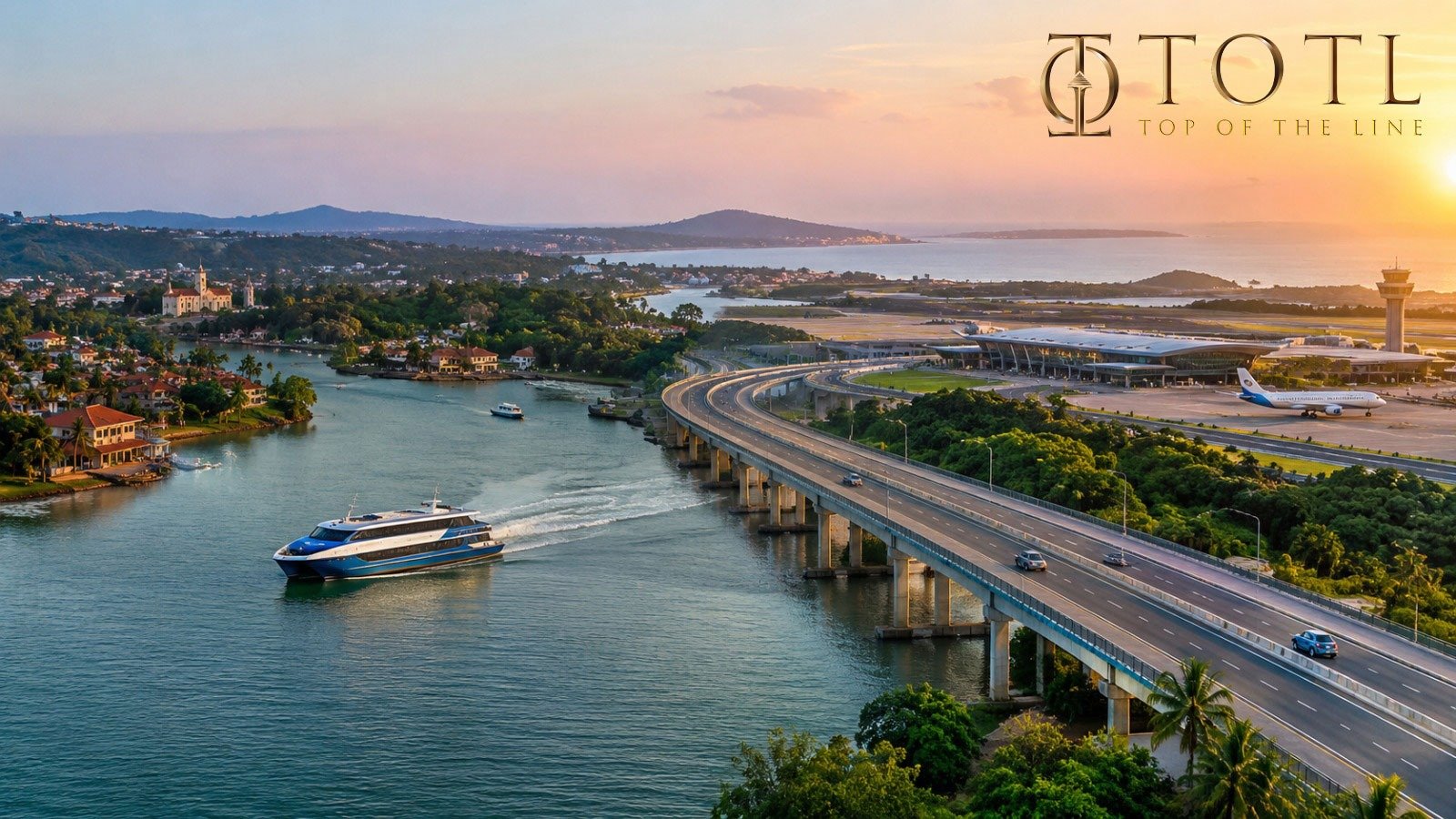
Infrastructure-Led Real Estate: 10 Growth Corridors to Watch in 2026
India’s real estate map is undergoing a structural transformation.
For decades, property markets were largely evaluated through the lens of location, pricing, neighbourhood development and immediate demand. Today, another factor is becoming increasingly important: infrastructure-led real estate.
Airports are expanding urban catchments. Expressways are shortening inter-city travel. Elevated corridors are restructuring urban movement. Rail and freight networks are connecting industrial centres with ports. Tourism infrastructure is creating new hospitality ecosystems. Even waterways are increasingly being considered as modern public-transport corridors.
This shift is particularly visible in Goa.
North Goa is witnessing the convergence of airport expansion, highway upgrades, the Porvorim–Guirim Elevated Corridor, Mopa–Dhargal connectivity and a proposed 111-km Water Metro network. At the same time, major infrastructure investments across India are creating new emerging corridors around airports, logistics hubs, expressways and multimodal transport networks.
For property investors, this creates a bigger question:
Where is infrastructure-led real estate likely to create the next generation of high-potential growth corridors?
The answer is not simply the location with the biggest project.
The stronger opportunity often lies where multiple infrastructure systems converge with tourism, employment, commercial activity, hospitality and existing population demand.
What Is Infrastructure-Led Real Estate?
Infrastructure-led real estate refers to property-market development influenced by major improvements in physical and economic connectivity.
These improvements can include:
- Airports
- Expressways and highways
- Metro systems
- Railway networks
- Freight corridors
- Ports
- Water transport
- Elevated road corridors
- Industrial infrastructure
- Tourism infrastructure
- Multimodal transportation systems
The underlying relationship is relatively straightforward:
Infrastructure → Better connectivity → Greater accessibility → Economic activity → Higher movement of people and capital → New real estate demand
However, infrastructure alone does not automatically create property appreciation.
That distinction is essential.
A proposed road does not necessarily create an immediate real estate opportunity. A new airport does not mean every surrounding parcel will perform equally. And a large infrastructure announcement should never be confused with completed infrastructure.
This is why investors should evaluate infrastructure-led real estate through project status, connectivity, demand, land-use planning, economic activity and execution.
Goa Water Metro: A New Dimension of Connectivity
One of the most interesting infrastructure developments currently being evaluated in Goa is the proposed Water Metro and inland water transport network.
The concept is significant because Goa already possesses an extensive natural network of rivers, waterways and coastal stretches.
According to the latest information available as of September 7, 2026, the feasibility study has been completed and the Detailed Project Report (DPR) is under preparation by Kochi Metro Rail Limited (KMRL).
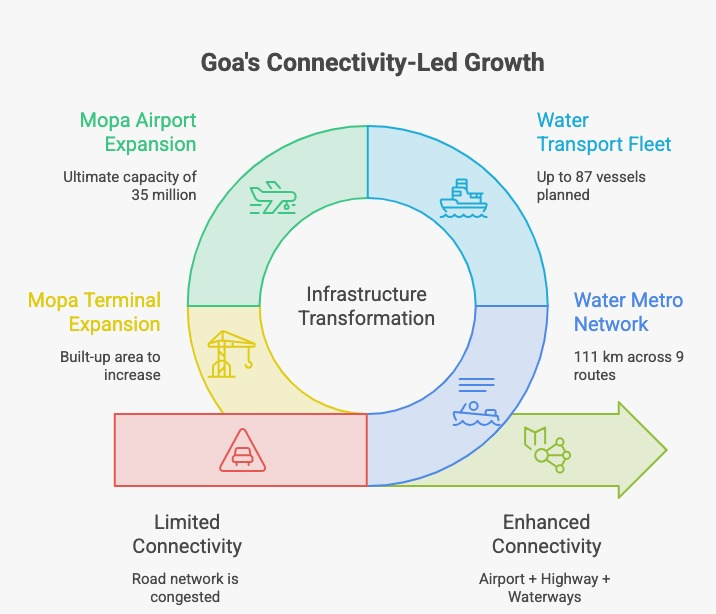
The proposed network covers approximately 111 km across nine routes, with around 32 terminals and a proposed fleet of approximately 87 vessels based on the feasibility-stage proposal.
The feasibility-stage routes include corridors connecting areas such as:
- Panaji
- Narve
- Betim
- Old Goa
- Sarmanas
- Vasco
- Cortalim
- Durbhat
- Cumbarjua
- Dona Paula
- Chapora
A potential coastal route towards Keri and Tiracol has also been discussed.
The important point for investors is that the project is not yet an operational Water Metro.
The feasibility study is complete, but the DPR is still being prepared. The final project cost, funding structure and implementation framework are therefore not yet final.
The feasibility-stage proposal reported in May 2026 had an indicative cost of approximately ₹3,146 crore, but this should not be treated as the final sanctioned project cost.
The latest government position is that the DPR will determine the realistic cost and funding structure.
This is an excellent example of how infrastructure-led real estate should be evaluated.
The correct question is not:
“Will the Water Metro increase property prices?”
The better question is:
“Which locations could become strategically better connected if the proposed network is implemented?”
That distinction moves the discussion from speculation to location intelligence.
Why Goa Water Metro Matters for Real Estate
Water transport could create a new layer of connectivity between tourism destinations, residential locations, commercial areas and existing transport hubs.
For example, a network linking Panaji, Betim, Old Goa, Dona Paula, Vasco and Chapora could potentially make several locations part of a broader mobility ecosystem.
That can influence:
- Visitor movement
- Tourist accessibility
- Commuting patterns
- Hospitality development
- Retail activity
- Commercial demand
- Second-home attractiveness
- Leisure-oriented development
The economic impact could become more significant if water transport integrates with road networks and existing public transport.
This is where infrastructure-led real estate becomes a network story rather than a single-project story.
A property does not necessarily benefit because it is located beside a terminal.
It may benefit because it becomes part of a better-connected regional ecosystem.
North Goa’s Connectivity Transformation
North Goa provides perhaps the clearest current example of infrastructure-led real estate in India’s tourism-led markets.
The region is increasingly connected through multiple infrastructure layers.
At the centre of this transformation is Manohar International Airport at Mopa.
According to the Goa Economic Survey 2025–26, terminal expansion at Mopa is underway at a cost of approximately ₹255.69 crore. The terminal’s built-up area is planned to increase from 65,600 sq m to 83,900 sq m.
The airport had handled more than 14.09 million domestic and international passengers cumulatively through January 2026, according to the same survey.
The airport has also entered its Phase III development stage, with an ultimate planned capacity of 35 million passengers annually.
This is important because airports do more than move passengers.
They create wider economic catchments.
Airport-led infrastructure can stimulate:
- Hotels
- Serviced residences
- Villas
- Restaurants
- Retail
- Commercial offices
- Logistics
- Transportation
- Tourism services
- Residential development
That is why airport-led infrastructure-led real estate deserves a long-term perspective.
Mopa–Dhargal–Porvorim–Panaji: A Strategic North Goa Spine
The Mopa ecosystem becomes even more important when viewed together with highway infrastructure.
In July 2024, a 7-km, six-lane access-controlled road connecting Manohar International Airport with Dhargal on NH-166S was inaugurated at a reported cost of ₹1,183 crore.
The project provides a direct high-capacity connection between Mopa Airport and the national highway network.
Further south, the Porvorim–Guirim Elevated Corridor represents another major mobility intervention.
The six-lane corridor extends across the NH-66 section around Porvorim and Sangolda.
The Government of Goa has described the corridor, along with the Dhargal flyover, as projects expected to improve inter-district connectivity, reduce congestion and cut travel times after completion.
The latest Goa government procurement records in September 2026 also show activity connected with the inauguration and finishing works around the Porvorim–Guirim corridor.
The strategic chain therefore looks increasingly interesting:
Mopa → Pernem → Dhargal → Mapusa → Porvorim → Panaji
This is precisely the kind of geographic relationship that investors should monitor when evaluating infrastructure-led real estate.
Tourism: The Demand Engine Behind Goa Real Estate
Infrastructure becomes more meaningful when it meets actual demand.
Goa’s tourism numbers provide an important foundation.
According to the Goa Tourism Development Corporation, Goa recorded 10,802,410 tourist arrivals in 2025, including:
- 10,284,608 domestic tourists
- 517,802 foreign tourists
Total arrivals increased from approximately 10.41 million in 2024 to more than 10.80 million in 2025.
The tourism ecosystem is also becoming more diversified.
Goa is increasingly promoting experiences beyond traditional beach tourism, including heritage, wellness, hinterland, culinary, spiritual and experiential tourism.
International connectivity also remains important.
In 2025, Goa recorded 1,784 international scheduled flights carrying 235,798 foreign tourists, while 189 charter flights carried 40,336 foreign tourists. The state also recorded 37 cruise vessels carrying 51,510 passengers.
For infrastructure-led real estate, tourism matters because visitor movement creates recurring demand for accommodation, hospitality, retail, dining and leisure infrastructure.
And where visitor demand becomes more distributed geographically, property demand can potentially expand beyond established tourism clusters.
Hospitality Is Following the Connectivity Story
Hospitality investment is another useful indicator for investors studying infrastructure-led real estate.
In April 2026, IHG Hotels & Resorts announced the signing of a 100-key Holiday Inn Goa Kadamba in Panaji, scheduled to open in Q1 2030.
The hotel is positioned to serve both leisure and business demand.
The importance of such developments is not simply the number of hotel rooms.
Institutional hospitality brands can indicate that developers and operators see sufficient long-term demand to justify new accommodation supply.
For real estate investors, the broader ecosystem matters:
Airport + Highway + Tourism + Hotels + Retail + Residential = stronger infrastructure-led real estate ecosystem
The convergence of these elements can be more important than any one infrastructure project in isolation.
Six Emerging Investment Corridors to Watch
1. Mopa–Pernem–Dhargal–Mapusa–Porvorim–Panaji
This is arguably one of the most compelling infrastructure-led real estate corridors in Goa.
It combines:
- Mopa Airport
- Mopa–Dhargal access-controlled road
- NH-66
- Dhargal connectivity improvements
- Porvorim Elevated Corridor
- Panaji’s administrative and commercial ecosystem
The corridor connects airport access with established urban centres and tourism markets.
Investors should monitor land-use planning, development permissions, accessibility and actual infrastructure completion rather than focusing only on airport proximity.
2. Panaji–Betim–Old Goa–Chapora Water Connectivity Corridor
The proposed Water Metro introduces an entirely different dimension.
If implemented according to the feasibility-stage network, waterways could create new connections between tourism, heritage and urban locations.
Areas around Panaji, Betim, Old Goa, Dona Paula and Chapora deserve attention from an infrastructure-led real estate perspective because their potential relevance comes from network connectivity rather than a single property market factor.
However, investors should remember that the Water Metro remains under DPR preparation.
3. Sindhudurg–North Goa
The broader Maha Goa corridor is another important regional story.
The geography between Sindhudurg and North Goa combines coastal tourism, road connectivity, airport access and expanding hospitality interest.
For investors, this corridor is particularly relevant because tourism demand does not necessarily stop at administrative boundaries.
As accessibility improves, travellers and second-home buyers increasingly evaluate destinations through travel time, experience and connectivity.
This creates a wider regional framework for infrastructure-led real estate.
4. Jewar–NCR
The Noida International Airport ecosystem provides one of India’s strongest examples of airport-led regional transformation.
The airport’s Phase I was inaugurated in March 2026 with an investment of approximately ₹11,200 crore.
Connectivity is being built alongside the airport.
In March 2026, the Union Cabinet approved a revised capital cost of ₹3,630.77 crore for a 31.42-km greenfield connectivity corridor linking the Delhi-Faridabad-Ballabhgarh-Sohna spur of the Delhi-Mumbai Expressway with Jewar International Airport.
The corridor will intersect the Eastern Peripheral Expressway, Yamuna Expressway and Dedicated Freight Corridor.
This is a textbook infrastructure-led real estate ecosystem because airport connectivity is being combined with expressways, freight infrastructure and regional urbanisation.
5. Navi Mumbai Airport Region
Navi Mumbai International Airport represents another major airport-led development story.
Its significance extends beyond aviation.
The airport is connected to the Mumbai Metropolitan Region’s wider road, metro, rail, port and commercial ecosystem.
For investors, the key lesson is that airport infrastructure becomes significantly more powerful when multiple transport modes converge around it.
That principle applies equally to Goa’s Mopa ecosystem.
Infrastructure-led real estate is strongest when infrastructure networks overlap.
6. Mira Road–Vasai–Virar
Mumbai Metropolitan Region is also witnessing major investments designed to improve east-west and regional connectivity.
Metro Line 13 has received approval at a reported cost of approximately ₹17,724 crore.
The proposed corridor is around 25 km long with 16 stations and includes a major integrated road-and-metro bridge across Vasai Creek.
The corridor is designed to improve connectivity between Mira Road and the Vasai–Virar region.
This demonstrates how infrastructure-led real estate can extend beyond traditional city centres into emerging suburban markets.
India’s Wider Infrastructure-Led Real Estate Story
The trend is not limited to airports and metro systems.
India is building infrastructure networks that increasingly connect cities, ports, industrial zones and logistics hubs.
One of the most significant examples is the Western Dedicated Freight Corridor.
As of September 7, 2026, three remaining sections covering approximately 326 route kilometres were scheduled for dedication on September 8 at a cost of more than ₹20,700 crore.
These sections include Sanand–Makarpura, New Umbergaon–New Saphale and New Saphale–JNPT.
The final sections will strengthen direct connectivity to Jawaharlal Nehru Port Authority, improve EXIM cargo movement and reduce pressure on Mumbai’s railway network.
This is significant for infrastructure-led real estate because freight infrastructure can influence industrial land, warehousing, logistics parks, commercial development and employment ecosystems.
Another major example is the Ahmedabad–Dholera corridor, where expressway connectivity is supporting the broader Dholera investment and industrial ecosystem.
Bengaluru’s suburban rail development and the Bengaluru–Chennai Expressway similarly demonstrate how connectivity can reshape urban and regional development patterns.
The broader pattern is clear:
India is increasingly building economic networks rather than isolated infrastructure projects.
How Investors Should Evaluate Infrastructure-Led Real Estate
Infrastructure announcements can generate excitement, but disciplined investors should go deeper.
Before considering an infrastructure-led property opportunity, ask:
1. Is the infrastructure real?
Check whether the project is:
- Announced
- Approved
- Tendered
- Under construction
- Substantially completed
- Operational
A DPR is not the same as a construction contract.
A tender is not the same as completion.
And an announcement is not the same as operational infrastructure.
2. What does it actually connect?
Distance alone is not enough.
Study the destinations, population centres, airports, employment hubs, tourism clusters and commercial centres connected by the project.
3. Is there existing demand?
The strongest infrastructure-led real estate opportunities generally combine infrastructure momentum with an existing demand engine.
This could be:
- Tourism
- Employment
- Industry
- Education
- Healthcare
- Commerce
- Logistics
- Second-home demand
4. What other infrastructure is nearby?
One highway can help.
But an airport + highway + rail + tourism ecosystem can create a much stronger regional network.
5. What is the land-use framework?
Infrastructure cannot override planning regulations.
Investors should examine:
- Zoning
- Land title
- Development permissions
- Regional plans
- Environmental restrictions
- Access roads
- Buildability
- Infrastructure availability
6. Is the opportunity already priced in?
An infrastructure announcement can attract speculative demand.
That does not mean every surrounding property represents good value.
The objective should be to identify fundamentally strong locations before assuming future appreciation.
The Real Estate Multiplier: Connectivity + Demand + Execution
The most important principle behind infrastructure-led real estate is convergence.
Consider two locations.
Location A receives a new road.
Location B receives:
- A new airport nearby
- Highway connectivity
- Tourism growth
- Hospitality investment
- Commercial development
- Public transport integration
- Improved road access
- Increasing residential demand
Both have infrastructure.
But Location B has a much stronger ecosystem.
This is why TOTL Realty looks beyond individual infrastructure announcements.
The question is not simply:
“What infrastructure is coming?”
The better question is:
“What economic ecosystem is being created around it?”
That is the foundation of intelligent infrastructure-led real estate analysis.
Where Does TOTL Realty Fit?
At TOTL Realty, the objective is to look beyond property advertisements and examine the larger location story.
For investors evaluating Goa, North Goa, Sindhudurg and emerging Indian corridors, this means analysing:
- Infrastructure
- Connectivity
- Tourism
- Economic activity
- Hospitality
- Urban expansion
- Development pipelines
- Accessibility
- Land-use potential
- Long-term demand
The philosophy is simple:
Understand the location first. Evaluate the property second.
This approach becomes particularly important in emerging markets, where the future value proposition may be shaped by infrastructure that is still being constructed, planned or evaluated.
For investors, infrastructure-led real estate is therefore not about chasing the next big announcement.
It is about identifying the intersection of infrastructure, demand and economic fundamentals.
The Bigger Picture: India’s Real Estate Map Is Changing
India is entering an infrastructure cycle in which airports, highways, freight corridors, metros, ports and waterways are increasingly interconnected.
Goa illustrates this transformation particularly well.
Mopa is strengthening aviation connectivity.
The Mopa–Dhargal road is improving airport access.
The Porvorim–Guirim Elevated Corridor is restructuring movement along NH-66.
The proposed Water Metro could introduce a new public-transport layer across Goa’s waterways.
Tourism continues to generate large-scale visitor demand.
Hospitality brands are expanding.
Together, these developments are creating a more connected regional economy.
Across the country, similar patterns are emerging around Jewar, Navi Mumbai, Dholera, western freight corridors, Bengaluru and the Mumbai Metropolitan Region.
This is the wider story of infrastructure-led real estate.
Real estate is increasingly being shaped not simply by where people live today, but by how efficiently people, businesses, tourists and capital will move tomorrow.
FAQs
1. What is infrastructure-led real estate and why is it important for investors?
Infrastructure-led real estate refers to property markets where major infrastructure improvements—such as airports, highways, expressways, metro systems, railways, ports and waterways—contribute to improving connectivity and supporting broader economic activity.
For investors, infrastructure-led real estate is important because improved connectivity can expand a location’s accessibility and potentially strengthen demand for residential, commercial, hospitality and leisure properties. However, infrastructure should be evaluated alongside actual economic activity, tourism, employment, land-use regulations and existing property demand rather than viewed as an automatic indicator of appreciation.
Investors can refer to the Goa Economic Survey 2025–26 for official information on the state’s infrastructure and economic development.
2. How is infrastructure-led real estate transforming North Goa?
Infrastructure-led real estate is becoming increasingly relevant in North Goa because several connectivity improvements are developing around the same regional ecosystem.
Manohar International Airport at Mopa, the Mopa–Dhargal access-controlled road, NH-66 improvements and the Porvorim–Guirim Elevated Corridor are strengthening connections between the airport, Pernem, Dhargal, Mapusa, Porvorim and Panaji.
At the same time, tourism and hospitality activity provide an underlying demand base. The combination of aviation, highways, tourism and urban connectivity makes North Goa an important market to monitor from an infrastructure-led real estate perspective.
The Goa Economic Survey 2025–26 provides official data on Mopa Airport and the state’s infrastructure ecosystem.
3. Can the proposed Goa Water Metro create infrastructure-led real estate opportunities?
Yes, the proposed Goa Water Metro could become an important component of infrastructure-led real estate if the project progresses from its current planning and DPR stage into implementation.
The proposed network is approximately 111 km across nine routes, based on the feasibility-stage proposal, with proposed connections involving locations such as Panaji, Betim, Old Goa, Vasco, Cortalim, Dona Paula and Chapora.
However, investors should distinguish between a feasibility proposal and operational infrastructure. As of September 7, 2026, the DPR is still under preparation, meaning the final cost, funding structure, implementation schedule and final network should not be treated as confirmed.
The latest Kochi Metro Rail Limited tender information provides useful official context on the ongoing DPR-related work.
4. Why is Mopa Airport important for infrastructure-led real estate in Goa?
Mopa Airport is important to infrastructure-led real estate because airports can expand the effective economic and tourism catchment of a region.
According to the Goa Economic Survey 2025–26, terminal expansion is underway, with the airport’s built-up area planned to increase from approximately 65,600 sq m to 83,900 sq m. The airport has also been planned for significant long-term capacity expansion.
Improved air connectivity can support tourism, hospitality, business travel, retail, transportation and other service sectors. These activities can, in turn, influence the demand ecosystem around strategically connected locations.
For investors studying infrastructure-led real estate, the key consideration is not simply proximity to an airport but how the airport connects with highways, urban centres, tourism destinations and economic activity.
The Goa Economic Survey 2025–26 contains the government’s latest published information on Mopa’s development.
5. Does tourism strengthen infrastructure-led real estate in Goa?
Tourism can be an important demand driver for infrastructure-led real estate, particularly in markets where infrastructure improves access to established and emerging destinations.
Goa recorded 10,802,410 tourist arrivals in 2025, including more than 10.28 million domestic visitors and over 517,000 foreign visitors, according to official tourism data.
As connectivity improves, tourism-related demand can support hotels, managed residences, villas, restaurants, retail, entertainment and other hospitality-oriented businesses.
For infrastructure-led real estate, the combination of improving accessibility and sustained tourism demand can be more meaningful than infrastructure investment alone.
Investors can refer to the Goa Tourism Development Corporation’s official 2025 tourism figures when evaluating Goa’s tourism demand.
6. Which emerging corridors are important for infrastructure-led real estate in 2026?
Several corridors are worth monitoring from an infrastructure-led real estate perspective.
In Goa, the Mopa–Pernem–Dhargal–Mapusa–Porvorim–Panaji corridor stands out because it combines airport connectivity, highway infrastructure and established urban and tourism centres.
The proposed Panaji–Betim–Old Goa–Chapora water-connectivity network is another corridor to watch, although the Water Metro remains at the DPR stage.
Beyond Goa, emerging infrastructure-led markets include the Jewar–NCR region, the Navi Mumbai Airport region, the Mira Road–Vasai–Virar corridor, the Dholera–Ahmedabad ecosystem and areas influenced by major freight infrastructure.
The PIB update on Jewar connectivity infrastructure provides an example of how airport, expressway and freight connectivity can converge to create a broader regional development ecosystem.
7. How can investors identify genuine infrastructure-led real estate opportunities?
Investors evaluating infrastructure-led real estate should first determine the actual status of the infrastructure project.
A useful framework is to distinguish between:
Announcement → Approval → DPR → Tender → Construction → Completion → Operations
The closer a project is to completion or operation, the more tangible its connectivity impact generally becomes.
Investors should then examine what the infrastructure actually connects, whether the surrounding area has existing demand, what other infrastructure projects are nearby, and whether the land has appropriate zoning and development permissions.
For infrastructure-led real estate, investors should also examine title, access roads, development regulations, environmental requirements and the broader supply-demand environment.
Official sources such as the Government of Goa, Ministry of Road Transport & Highways and Press Information Bureau can help investors distinguish announced projects from officially approved or progressing infrastructure.
8. Is infrastructure-led real estate only relevant to Goa?
No. Infrastructure-led real estate is becoming a broader Indian real estate theme.
Major airports, expressways, metro systems, dedicated freight corridors, ports and industrial infrastructure are creating new development ecosystems across multiple regions.
Jewar is developing around an international airport and multimodal connectivity. Navi Mumbai is benefiting from airport-led regional infrastructure. Dholera is being supported by expressway connectivity and industrial development. Mumbai’s wider metropolitan region is seeing major metro and road investments.
The Western Dedicated Freight Corridor is another example, connecting industrial regions with major logistics and port infrastructure.
For investors, the larger lesson from infrastructure-led real estate is that future property markets may increasingly be shaped by interconnected infrastructure networks rather than isolated projects.
The Prime Minister’s Office update on the Western Dedicated Freight Corridor provides official information on the latest commissioning phase of the corridor.
Invest Where Fundamentals Are Moving
Infrastructure can change the geography of opportunity.
But successful property investing requires more than identifying a large project.
The strongest infrastructure-led real estate opportunities generally emerge when connectivity converges with genuine economic demand.
In Goa, that convergence is becoming visible across the Mopa–North Goa ecosystem, the Panaji–Porvorim corridor, proposed Water Metro routes and the wider Sindhudurg–North Goa region.
At the national level, airports such as Jewar, major freight corridors, metro networks and industrial connectivity projects are creating new investment geographies.
For investors, the opportunity lies in studying these changes early—but evaluating them carefully.
The future of real estate may not belong only to established locations.
It may increasingly belong to locations where infrastructure, accessibility, tourism, economic activity and urban expansion converge.
That is where the next chapter of infrastructure-led real estate is likely to be written.
At TOTL Realty, the approach remains straightforward: understand the infrastructure, understand the location, understand the demand—and only then evaluate the property.