
North Goa Real Estate Investment: 8 Powerful 2026 Growth Drivers
North Goa has always attracted attention for its beaches, lifestyle, hospitality, and second-home appeal. But in 2026, the investment story is becoming much broader. The region is increasingly being shaped by transport infrastructure, airport expansion, road upgrades, emerging economic activity, tourism development, and new urban connectivity.
For investors evaluating North Goa real estate investment, this shift is important.
Property markets rarely develop in isolation. When airports expand, highways improve, new bridges connect previously separated areas, hospitality capacity increases, and employment-generating projects emerge, the economic geography of a region can change. Over time, these improvements can influence where people live, where businesses operate, where tourists stay and where investors look for property.
North Goa is now experiencing several of these infrastructure-led changes simultaneously.
The Manohar International Airport at Mopa is expanding its terminal capacity and moving through its next development phase. The Porvorim elevated corridor is approaching its scheduled opening. The Mumbai–Goa highway is in its advanced four-laning phase. A new four-lane approach to the proposed Electronics City in Pernem has entered the government tender process. Meanwhile, projects such as the Salvador-do-Mundo–Chodan bridge and the proposed Goa Water Metro point toward a more connected future.
For investors, the larger question is therefore not simply whether North Goa remains popular.
The more interesting question is: how could improving infrastructure reshape the long-term property landscape?
This article examines the major 2026 infrastructure and economic drivers behind North Goa real estate investment and explains why investors are increasingly looking beyond individual projects and examining the region as an interconnected growth corridor.
Why Infrastructure Matters for North Goa Real Estate Investment
Infrastructure is one of the most important long-term factors influencing real estate markets.
A new road does more than reduce travel time. It can improve accessibility to employment centres, tourism destinations, commercial areas and residential communities. An airport does more than move passengers. It can support hotels, retail, logistics, business travel, hospitality and employment.
This is why infrastructure-led development deserves particular attention when evaluating North Goa real estate investment.
The region’s infrastructure story in 2026 is increasingly multi-dimensional.
Road connectivity is being strengthened through NH-66 and the Porvorim elevated corridor. Airport infrastructure is expanding at Mopa. Pernem is seeing infrastructure planning around an electronics manufacturing cluster. Tourism infrastructure is expanding through hospitality projects. Bridges are being planned to improve connectivity between river-island and mainland areas.
The Government of Goa’s infrastructure pipeline also reflects a broader emphasis on roads, bridges, public facilities and economic development. The state’s 2026–27 Budget includes major connectivity allocations, including ₹274 crore for the Salvador-do-Mundo–Chodan bridge.
For a property investor, the significance lies in the network effect.
Several infrastructure projects working together can create a stronger economic ecosystem than any individual project operating alone.
NH-66 and the Mumbai–Goa Connectivity Story
One of the most important infrastructure corridors for North Goa real estate investment remains NH-66.
The Mumbai–Goa highway connects Maharashtra’s major urban markets with the Konkan region and Goa. Its continuing four-laning is therefore relevant not only to tourism but also to regional mobility, logistics and property accessibility.
In February 2026, the Union government stated that approximately 465 km of the 485-km Mumbai–Goa NH-66 corridor had been four-laned, with work continuing on the remaining stretch.
While the completion timeline has evolved, the larger structural transformation is clear: NH-66 is moving toward a more modern highway network.
For North Goa, this can strengthen connections between:
- Maharashtra and Goa
- North Goa and Pernem
- Mopa and surrounding markets
- Tourism destinations and residential communities
- Commercial centres and regional transport nodes
The significance for North Goa real estate investment is that accessibility increasingly extends beyond air connectivity.
A property that can benefit from multiple transport corridors may appeal to a broader pool of buyers, including second-home owners, hospitality operators, entrepreneurs and long-term investors.
The Government of Goa’s ongoing road infrastructure programme can be tracked through its official portals and project notifications.
MOPA Airport Is Becoming an Economic Node
Few developments have changed the geography of North Goa as significantly as Manohar International Airport.
The airport is no longer simply an alternative aviation gateway. Its surrounding ecosystem is beginning to develop around aviation, hospitality, retail, logistics, education and business activity.
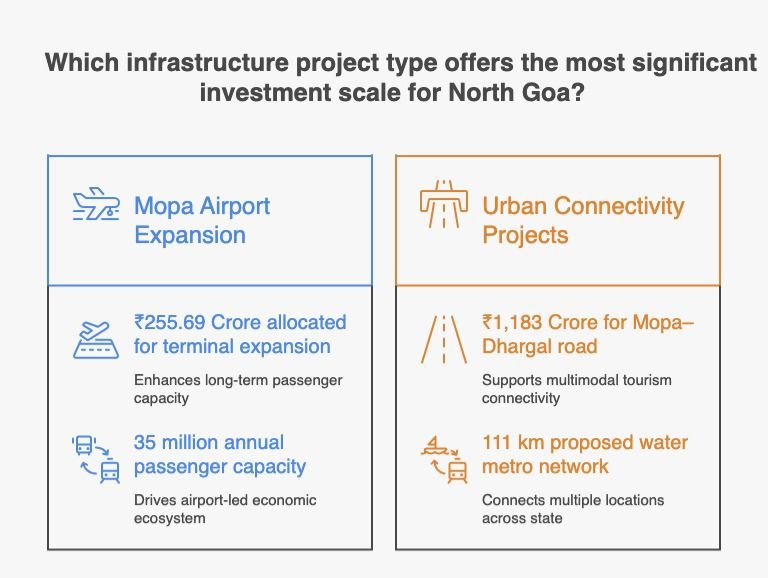
According to the Goa Economic Survey 2025–26, terminal expansion at Mopa is underway at a cost of approximately ₹255.69 crore. The terminal’s built-up area is planned to increase from 65,600 sq m to 83,900 sq m. The airport has entered Phase III, with an ultimate planned capacity of 35 million passengers annually.
The same Economic Survey recorded more than 14 million domestic and international passengers handled between the airport’s commencement in January 2023 and January 2026.
That scale matters for North Goa real estate investment.
An expanding airport creates opportunities beyond passenger movement.
Airport-linked ecosystems can support:
- Hotels and resorts
- Serviced residences
- Restaurants and retail
- Business travel
- MICE activity
- Logistics
- Education
- Staff and workforce accommodation
- Second homes
- Long-stay tourism
The airport’s surrounding development is already moving in this direction. GMR Airports has reported hotel projects, retail development, a packhouse, a school and other airport-adjacency initiatives around the Mopa ecosystem.
The Goa government has also signed an MoU with the airport operator for a pack house and agri-logistics facility, supporting the movement of agricultural produce through the airport.
For investors evaluating North Goa real estate investment, this suggests that Mopa should be considered as an emerging economic ecosystem rather than simply an airport location.
Porvorim Elevated Corridor and Urban Connectivity
Porvorim occupies a strategically important position between Panaji and North Goa.
Traffic movement through this corridor has historically made accessibility a key infrastructure consideration. The six-lane elevated corridor is intended to address this bottleneck and strengthen movement along NH-66.
The Government of Goa confirmed in April 2026 that construction of the six-lane elevated corridor from km 508.000 to km 513.150 was progressing, including approaches.
As of September 5, 2026, the corridor is approaching its scheduled traffic opening, with reports indicating an opening planned for September 11, 2026.
The corridor’s importance for North Goa real estate investment goes beyond Porvorim itself.
Improved movement through a major bottleneck can strengthen the relationship between:
Panaji → Porvorim → Mapusa → North Goa → Pernem → Mopa
This interconnected geography is increasingly important.
Instead of viewing individual towns as isolated markets, investors can examine them as parts of a wider urban and tourism network.
Porvorim also continues to receive public infrastructure attention, including road restoration and sewerage-related works, reinforcing its role as an established urban node.
New Roads and Bridges Expanding North Goa’s Accessibility
Road infrastructure is another major component of the North Goa real estate investment story.
The 2026 Goa infrastructure pipeline includes several road and bridge initiatives around North Goa and Pernem.
One particularly significant project is the proposed Salvador-do-Mundo–Chodan bridge.
The 2026–27 Goa Budget lists ₹274 crore for the project. Government infrastructure documents also provide project-location and soil-investigation information for the proposed bridge over the Mapusa River.
The bridge is designed to strengthen connectivity between Salvador-do-Mundo and Chodan, creating another connection within the wider North Goa transport network.
For property markets, the significance of such infrastructure is often cumulative.
Improved connectivity can make previously less-connected locations more accessible to:
- Residents
- Tourists
- Hospitality businesses
- Service providers
- Weekend-home buyers
- Commercial operators
Another important road asset is the Mopa–Dhargal six-lane access-controlled road.
The Union government has described the approximately 7-km project from Manohar International Airport to Dhargal on NH-166S as a ₹1,183-crore infrastructure project intended to strengthen tourism and multimodal connectivity.
This road was inaugurated in 2024, but its significance is increasingly visible as the Mopa ecosystem expands.
For North Goa real estate investment, the takeaway is straightforward: investors should study connectivity that already exists alongside infrastructure that is being developed.
Pernem and the Emerging Electronics Manufacturing Corridor
Pernem is gaining importance for another reason: economic diversification.
Tourism has traditionally dominated Goa’s real estate narrative. But industrial and technology-related employment can introduce a different form of property demand.
The Government of Goa’s e-procurement portal lists a tender for construction of a four-lane divided carriageway from NH to Electronic City, described as the Electronic City approach road under Pernem Constituency.
The tender value is approximately ₹250.88 crore, with a contract period of 720 days.
This road is particularly relevant because it connects transport infrastructure with an employment-generating economic zone.
The proposed Electronics Manufacturing Cluster at Tuem, Pernem, has also received government support, including a sanctioned grant-in-aid under the electronics manufacturing cluster programme.
This creates an important development mechanism for North Goa real estate investment:
Industrial investment → employment → workforce movement → commercial services → housing demand → broader local economic activity.
Not every property benefits equally from an economic project. However, areas located within practical commuting distance of employment centres can become increasingly relevant to residential and rental markets.
For investors, Pernem therefore deserves attention not only as a tourism market but as a location where tourism, airport infrastructure, highways and emerging economic activity intersect.
Tourism and Hospitality Are Deepening the Demand Base
Tourism remains one of the strongest foundations for North Goa real estate investment.
But the tourism economy is evolving.
The region is moving beyond a simple beach-holiday model toward a broader ecosystem involving luxury hospitality, destination weddings, experiential travel, wellness, second homes, restaurants, events and longer-stay accommodation.
A useful example is Taj Anjuna Goa.
Goa Tourism Development Corporation has announced the foundation stone for the new five-star resort in Anjuna. The property is planned with 161 rooms and a banquet hall, with completion targeted for March 2027. GTDC says the project is expected to contribute to tourism activity and employment in North Goa.
This matters because premium hospitality development can strengthen the positioning of an entire micro-market.
When established hospitality brands enter a location, they can contribute to:
- Destination recognition
- Premium tourism
- Business activity
- Weddings and events
- Employment
- Local services
- Supporting retail and F&B ecosystems
The relationship between hospitality and North Goa real estate investment is particularly relevant for properties positioned around tourism corridors.
An investor does not necessarily need to own a hotel to benefit from tourism-led economic activity. Residential properties, managed residences, villas, second homes and hospitality-oriented assets can all participate in the broader demand ecosystem.
Goa Water Metro: A Future Multimodal Catalyst
One of the most interesting future infrastructure proposals is the Goa Water Metro.
The project is still at the planning/DPR stage, so it should be considered a future catalyst rather than an operational transport system.
A feasibility study submitted in 2026 identified eight feasible river routes, with a proposed network of approximately 111 km, 87 vessels and 32 ferry terminals. The estimated project plan was around ₹3,146 crore.
The proposed routes include connections involving Panaji, Betim, Old Goa, Chapora and other locations.
For North Goa real estate investment, the most interesting element is the potential integration of water-based mobility with existing road infrastructure.
If developed, a multimodal system combining:
Road + Airport + Rail + Waterways
could create a more interconnected tourism and urban network.
That could eventually influence how people perceive accessibility across riverfront, coastal and inland locations.
However, investors should distinguish between announced infrastructure, projects under construction and projects still at the DPR stage.
The Water Metro belongs to the third category today.
Rail Connectivity Strengthening Goa’s Regional Network
Rail is another component of the broader connectivity story.
In 2026, the Union government reported that railway infrastructure works worth approximately ₹4,344 crore were in progress in Goa, including capacity augmentation, station redevelopment and safety improvements. Three stations were also being redeveloped under the Amrit Bharat Station Scheme.
A new Madgaon–Karwar Express service was also introduced in June 2026, strengthening connectivity between Goa and coastal Karnataka and supporting tourism and regional economic activity.
While rail is not a direct North Goa property catalyst in the same way as Mopa or NH-66, it improves the region’s overall accessibility.
For long-term North Goa real estate investment, this matters because property markets increasingly operate within regional rather than purely local networks.
Government Investment and Policy Support
Broader government policy supports infrastructure development.
Goa’s 2026–27 Budget places substantial emphasis on capital infrastructure, roads, bridges, public facilities and economic development.
The state also maintains investment facilitation mechanisms through the Goa Investment Promotion and Facilitation Board, designed to promote and facilitate investment and coordinate approvals.
Meanwhile, Goa’s industrial policy promotes areas including niche tourism, eco-tourism, wellness, marinas, river tourism and year-round tourism.
This policy environment is important for North Goa real estate investment because property demand is ultimately connected to the economic activity surrounding it.
Infrastructure can create accessibility.
Policy can encourage businesses.
Businesses can create employment.
Tourism can generate visitor demand.
Together, these factors can create a more diversified real estate ecosystem.
How Infrastructure Can Influence Property Demand
Infrastructure does not automatically guarantee property appreciation.
However, it can influence the fundamental factors that support real estate demand.
For North Goa real estate investment, five mechanisms are particularly important.
1. Accessibility
Better roads and transport links can expand the practical area people consider for living, working or owning a second home.
2. Tourism
Airport expansion and hospitality development can increase the attractiveness of surrounding locations for tourism-oriented properties.
3. Employment
Economic zones and new commercial activity can create recurring demand from employees and service providers.
4. Business Activity
Hotels, restaurants, retail, logistics and service businesses can create a stronger local economy.
5. Market Visibility
Large infrastructure projects can increase investor awareness of previously less prominent micro-markets.
This is why the best approach to North Goa real estate investment is not simply to ask, “Which location is popular today?”
A more strategic question is:
Which locations are becoming better connected to the next generation of economic activity?
North Goa Micro-Markets Investors Should Watch
Different micro-markets are responding to different infrastructure drivers.
Micro-market | Key growth driver | Investor relevance |
Porvorim | Elevated corridor + urban infrastructure | Established urban and connectivity market |
Pernem | Mopa + NH-66 + Electronics City | Airport and emerging economic corridor |
Mopa | International airport + logistics + hospitality | Long-term airport-led ecosystem |
Mapusa | Regional roads + commercial activity | Established North Goa service centre |
Anjuna | Premium hospitality + tourism | Luxury tourism and lifestyle demand |
Siolim–Morjim | Tourism + road connectivity | Second homes and hospitality ecosystem |
Chapora | Tourism + proposed water connectivity | Experiential and river-coastal ecosystem |
For North Goa real estate investment, this micro-market approach can be more useful than treating North Goa as one homogeneous property market.
Each location has a different relationship with infrastructure.
Why 2026 Could Be an Important Year for Investors
The significance of 2026 lies in the number of infrastructure themes converging at the same time.
Consider the larger picture:
Mopa Airport expansion
NH-66 connectivity
Porvorim elevated corridor
Mopa–Dhargal access road
Pernem Electronics City infrastructure
New bridge connectivity
Hospitality expansion
Future multimodal transport planning
Together, these developments point toward an increasingly interconnected North Goa economic landscape.
For North Goa real estate investment, this makes 2026 an interesting year for research and market positioning.
The objective should not be to chase infrastructure headlines.
Instead, investors should identify locations where infrastructure, tourism, employment, accessibility and property fundamentals overlap.
That is where long-term opportunities are more likely to emerge.
The TOTL Realty Perspective
At TOTL Realty, we believe real estate decisions should be based on more than today’s price or today’s popularity.
A strong property decision begins with understanding the larger development story.
For North Goa real estate investment, that means examining:
- Current and upcoming infrastructure
- Airport accessibility
- Highway connectivity
- Tourism demand
- Hospitality development
- Local economic activity
- Micro-market characteristics
- Property positioning
- Development quality
- Legal and title documentation
Infrastructure is particularly important because its effects can unfold over years rather than months.
A location that appears peripheral today can become more relevant as transport and economic networks expand.
That is why investors considering North Goa real estate investment should evaluate not only where the market stands today, but also how the region is being positioned for tomorrow.
North Goa’s Next Growth Story Is Infrastructure-Led
North Goa’s real estate narrative is entering a new phase.
The region continues to benefit from its established tourism identity and lifestyle appeal, but the investment landscape is becoming increasingly infrastructure-led.
Mopa Airport is expanding.
NH-66 is progressing through its transformation.
The Porvorim elevated corridor is nearing its scheduled opening.
Pernem is developing new economic infrastructure.
Hospitality investment is expanding.
Bridge and road connectivity are improving.
And proposed projects such as the Goa Water Metro could eventually add another dimension to regional mobility.
For investors, the opportunity is not simply about owning property in a popular tourism destination.
It is about understanding how connectivity, tourism, employment, infrastructure and economic activity interact to reshape real estate demand.
That is the larger opportunity behind North Goa real estate investment.
As these infrastructure projects mature, the most informed investors will be those who study the underlying development corridors, compare micro-markets carefully and identify properties positioned within the region’s evolving economic ecosystem.
For anyone evaluating North Goa real estate investment in 2026, the time is right to move beyond the conventional beach-property narrative and start looking at North Goa as a connected, infrastructure-backed growth market.
FAQs
1. Why is North Goa real estate investment gaining attention in 2026?
North Goa real estate investment is gaining attention in 2026 because the region is experiencing several infrastructure and economic developments at the same time. Mopa Airport is expanding its terminal infrastructure, NH-66 continues to strengthen regional road connectivity, the Porvorim Elevated Corridor is nearing its scheduled opening, and Pernem is developing infrastructure around emerging economic activity.
The combination of better connectivity, tourism, hospitality development and employment-generating projects can gradually strengthen the region’s real estate ecosystem. Investors can track Goa’s broader infrastructure and development priorities through the official Government of Goa portal.
2. How is Mopa Airport influencing North Goa real estate investment?
Mopa Airport is an important driver for North Goa real estate investment because airport infrastructure can influence much more than passenger movement. The airport’s expansion is supporting a wider ecosystem involving hospitality, retail, logistics, education, business travel and other airport-linked activities.
The Goa Economic Survey 2025–26 reports that terminal expansion is underway, with the terminal built-up area planned to increase from 65,600 sq m to 83,900 sq m. The airport is also progressing toward its planned long-term capacity of 35 million passengers annually.
For investors, this makes locations with practical access to Mopa increasingly relevant when evaluating North Goa real estate investment opportunities. The official data can be reviewed in the Goa Economic Survey 2025–26.
3. What role does NH-66 play in North Goa real estate investment?
NH-66 is one of the most important transport corridors supporting North Goa real estate investment because it connects Goa with Maharashtra and the wider Konkan region. The ongoing four-laning programme is designed to improve road capacity, regional mobility and connectivity between major destinations.
Improved highway connectivity can make tourism destinations, residential communities, commercial centres and emerging economic zones easier to access. For property investors, this creates an opportunity to examine locations based on their relationship with major transportation corridors rather than considering property prices alone.
Investors can follow national highway development and related infrastructure announcements through the Ministry of Road Transport and Highways and Press Information Bureau.
4. How can the Porvorim Elevated Corridor support North Goa real estate investment?
The Porvorim Elevated Corridor is significant for North Goa real estate investment because Porvorim is an important urban and transportation node between Panaji and the wider North Goa region.
The six-lane elevated corridor is being developed along NH-66 to improve traffic movement through the Porvorim section. Its scheduled opening in September 2026 represents another important stage in the region’s connectivity transformation.
Better movement through major urban corridors can improve accessibility between Panaji, Porvorim, Mapusa and other North Goa locations. Investors can monitor official project updates through the Government of Goa.
5. Why is Pernem becoming important for North Goa real estate investment?
Pernem is becoming increasingly relevant to North Goa real estate investment because it sits at the intersection of several major development themes: Mopa Airport, NH-66 connectivity, tourism and emerging economic infrastructure.
The Government of Goa has initiated infrastructure planning for an Electronics City approach road, with a four-lane divided carriageway proposed to connect the area with the national highway network. The wider electronics manufacturing cluster at Tuem adds an economic-development dimension to Pernem beyond tourism.
This creates an interesting long-term development chain:
Infrastructure → Economic activity → Employment → Services → Housing and rental demand.
Investors interested in this emerging corridor can monitor government tenders through the Goa e-Procurement Portal.
6. How does tourism and hospitality development support North Goa real estate investment?
Tourism remains a fundamental component of North Goa real estate investment. North Goa has an established ecosystem of beaches, restaurants, resorts, villas, entertainment venues and experiential tourism destinations.
The hospitality sector is also seeing continued investment. For example, Goa Tourism Development Corporation has announced the development of a new five-star Taj property in Anjuna, planned with 161 rooms and a banquet hall.
New hospitality capacity can contribute to destination visibility, employment, visitor spending and supporting businesses. These factors can create a broader ecosystem around residential, second-home and hospitality-oriented properties.
Investors can follow official tourism initiatives through Goa Tourism and Goa Tourism Development Corporation.
7. Can the proposed Goa Water Metro influence North Goa real estate investment in the future?
The proposed Goa Water Metro could become an additional connectivity catalyst for North Goa real estate investment, particularly around river-linked and tourism-oriented locations.
The feasibility study identified eight feasible river routes covering approximately 111 km, with proposed terminals and vessels connecting important locations across Goa. Routes involving Panaji, Betim and Chapora could potentially strengthen multimodal connectivity if the project progresses through the required planning and implementation stages.
It is important to note that the Water Metro remains a proposed/DPR-stage project, rather than an operational transport network. Therefore, investors should treat it as a potential future infrastructure catalyst rather than an existing benefit.
Updates can be followed through the Government of Goa and relevant government transport announcements through the Press Information Bureau.
8. What should investors consider before choosing a North Goa real estate investment?
A successful North Goa real estate investment should be evaluated through a combination of location, connectivity, infrastructure, tourism demand, surrounding development and property fundamentals.
Investors should examine the property’s proximity to major roads, airports, employment centres and tourism destinations while also reviewing ownership documentation, land-use permissions, development approvals and other applicable regulations.
The most important approach is to look beyond short-term infrastructure headlines. A stronger investment analysis considers how multiple factors—airport connectivity, highways, tourism, hospitality, economic activity and urban infrastructure—interact within a particular micro-market.
For official information about investment facilitation and approvals in Goa, investors can explore the Goa Investment Promotion and Facilitation Board.
Ultimately, North Goa real estate investment is best approached as a long-term market research exercise, with individual properties assessed on their location-specific fundamentals rather than relying on infrastructure announcements alone.