
Coastal Living Beyond the Crowds: Why Emerging Destinations Like Vengurla Are Attracting Long-Term Investors
The New Definition of Coastal Wealth Creation
For decades, coastal real estate in India has been synonymous with Goa. The state’s beaches, tourism ecosystem, hospitality infrastructure, and global recognition have made it one of the country’s most desirable property markets.
However, a new trend is quietly reshaping investor preferences.
Across the world, affluent buyers, NRIs, entrepreneurs, retirees, and second-home seekers are increasingly prioritizing Low-Density Coastal Living over crowded tourism hotspots. The emphasis is shifting from merely owning a beachside property to securing a lifestyle asset that offers privacy, environmental quality, long-term livability, and sustainable wealth creation.
This shift is prompting investors to look beyond established coastal markets and evaluate emerging destinations that still possess abundant natural assets, lower development pressure, and significant future growth potential.
One such destination attracting growing attention is Vengurla, located in Maharashtra’s Sindhudurg district along the Konkan coastline.
This discussion is not about choosing one destination over another. Goa remains one of India’s most important coastal economies. Instead, it is about understanding why Low-Density Coastal Living is becoming a significant investment theme and how emerging coastal destinations are positioning themselves within this larger trend.
Understanding the Rise of Low-Density Coastal Living
The concept of Low-Density Coastal Living revolves around creating residential environments where space, nature, and quality of life are prioritized over excessive urbanization.
Typically, such destinations offer:
- Lower population density
- Larger open spaces
- Better environmental quality
- Reduced congestion
- Greater privacy
- Stronger connection to nature
Globally, post-pandemic housing trends have accelerated demand for homes in less crowded locations. Investors and end users alike increasingly seek environments that support wellness, remote work, and long-term lifestyle value.
The growing popularity of Low-Density Coastal Living is visible across several international markets where buyers are moving away from densely populated tourism hubs toward emerging coastal regions offering a more balanced lifestyle.
For long-term investors, this trend is significant because lifestyle shifts often become real estate demand drivers.
Goa and Vengurla: Two Different Stages of Coastal Evolution
When comparing coastal markets, it is important to understand where they stand within their development cycle.
Goa represents a mature coastal market.
Its advantages include:
- Strong tourism infrastructure
- International visibility
- Established hospitality ecosystem
- High market liquidity
- Consistent property demand
Meanwhile, Vengurla represents a coastal market at an earlier stage of development.
Characteristics include:
- Lower population density
- Larger land availability
- Lower development intensity
- Expanding tourism activity
- Improving infrastructure connectivity
Historically, many successful coastal investment destinations globally have gone through similar phases before experiencing accelerated growth.
The increasing conversation around Low-Density Coastal Living suggests that investors are beginning to evaluate not only present conditions but also future potential.
Population Density and Why It Matters to Investors
One of the most important indicators of development pressure is population density.
According to Census-based district data, Goa has a population density of approximately 394 persons per square kilometre, while Sindhudurg district records approximately 163 persons per square kilometre.
This difference has important implications for Low-Density Coastal Living.
Lower density often translates into:
- More available land
- Less traffic congestion
- Lower environmental stress
- Greater privacy
- Better long-term livability
For investors, population density directly influences future development patterns.
In highly dense coastal markets, future growth may increasingly depend on redevelopment and scarcity premiums.
In lower-density coastal regions, value creation can be driven by both infrastructure expansion and increasing demand.
As a result, Low-Density Coastal Living is becoming a factor that many investors evaluate alongside traditional metrics such as location, connectivity, and tourism potential.
Land Availability and Development Patterns
Land remains the most finite component of coastal real estate.
In Goa, decades of tourism-driven development have resulted in increasing competition for premium coastal land. As infrastructure and hospitality investments expanded, many prime locations experienced significant development activity.
This evolution is natural for mature tourism markets.
In contrast, Vengurla and the surrounding areas within Sindhudurg still retain significant green cover, relatively lower built-up density, and larger land parcels.
The distinction is important because Low-Density Coastal Living depends heavily on preserving space and environmental quality.
Investors often seek markets where growth can occur without compromising the very characteristics that make a destination desirable.
In many cases, long-term appreciation is strongest when infrastructure improves while development remains measured and sustainable.
Infrastructure: The Foundation of Long-Term Value Creation
Infrastructure remains one of the strongest drivers of real estate appreciation.
Across India, airports, highways, ports, and tourism infrastructure have consistently influenced property demand patterns.
The western coastal corridor is currently benefiting from several major infrastructure initiatives.
The Mopa Airport Effect
One of the most significant developments in the region has been the operational growth of Manohar International Airport in North Goa.
According to official data published by GMR, the airport handled more than 5.5 million passengers during FY 2025-26 and serves over 35 destinations.
The airport’s influence extends beyond Goa itself.
Improved air connectivity is increasing accessibility across:
- North Goa
- Pernem
- Vengurla
- Shiroda
- Malvan
- Sindhudurg coastline
Infrastructure improvements often expand the effective economic radius of a region.
As accessibility improves, destinations previously considered peripheral begin attracting tourism, hospitality investment, and residential demand.
This is one reason why Low-Density Coastal Living destinations near major infrastructure corridors are receiving increasing attention from investors.
Highway Connectivity
The continued enhancement of NH-66 and broader Konkan connectivity has further improved accessibility across Maharashtra’s coastal belt.
For real estate markets, connectivity often acts as a catalyst that transforms lifestyle destinations into investment destinations.
Tourism Growth and Its Influence on Property Demand
Tourism and real estate share a deeply interconnected relationship.
Many successful coastal property markets first gained visibility through tourism before attracting residential investment.
Goa’s Established Tourism Ecosystem
Goa remains India’s most recognized coastal tourism destination.
Its tourism ecosystem includes:
- Hotels and resorts
- Vacation rentals
- International connectivity
- Entertainment infrastructure
- Hospitality investment
This maturity provides a strong foundation for sustained property demand.
Sindhudurg’s Emerging Tourism Story
At the same time, Maharashtra’s tourism authorities continue to promote Sindhudurg as a major coastal tourism destination actively.
The region is known for:
- Tarkarli Beach
- Devbag
- Malvan
- Vengurla
- Sindhudurg Fort
- Marine tourism activities
The Maharashtra Tourism Department highlights attractions such as marine sanctuaries, heritage sites, beaches, and eco-tourism experiences across the district.
Recent reports also indicate strong tourist movement across Sindhudurg’s coastal destinations, particularly during holiday periods.
As tourism expands, demand often follows for:
- Vacation homes
- Managed residences
- Hospitality assets
- Second homes
- Lifestyle investments
These trends strengthen the long-term case for Low-Density Coastal Living destinations positioned within emerging tourism corridors.
Sustainability and Environmental Quality as Investment Drivers
A decade ago, environmental quality was largely viewed as a lifestyle consideration.
Today, it has become an investment consideration.
Globally, buyers increasingly assess:
- Air quality
- Green cover
- Water resources
- Coastal ecosystems
- Environmental resilience
The relationship between sustainability and property value is becoming stronger.
Regions that preserve environmental quality often maintain long-term desirability among affluent buyers.
Sindhudurg’s 121-kilometre coastline, biodiversity, beaches, and marine ecosystems contribute significantly to its appeal.
In the context of Low-Density Coastal Living, environmental quality becomes a core component of value creation.
Properties located in environmentally attractive destinations frequently benefit from stronger long-term lifestyle demand.
Migration Trends and the Rise of Lifestyle Investing
Real estate demand increasingly reflects lifestyle decisions rather than purely financial calculations.
Several demographic groups are driving interest in Low-Density Coastal Living.
Remote Professionals
Flexible work arrangements allow professionals to prioritize lifestyle and location.
NRIs
Many overseas Indians seek coastal properties that can serve as:
- Vacation homes
- Retirement residences
- Long-term family assets
HNIs
High-net-worth individuals often value:
- Privacy
- Exclusivity
- Limited-density environments
Retirees
Retirement migration trends increasingly favor destinations offering:
- Natural surroundings
- Lower stress levels
- Better quality of life
The convergence of these buyer segments is creating sustained demand for emerging coastal markets.
Capital Appreciation Potential: A Long-Term Investor Perspective
Every investment market offers a different risk-reward profile.
Mature markets typically provide:
- Stability
- Stronger liquidity
- Established demand
Emerging markets may provide:
- Lower entry costs
- Greater appreciation potential
- Early-stage growth opportunities
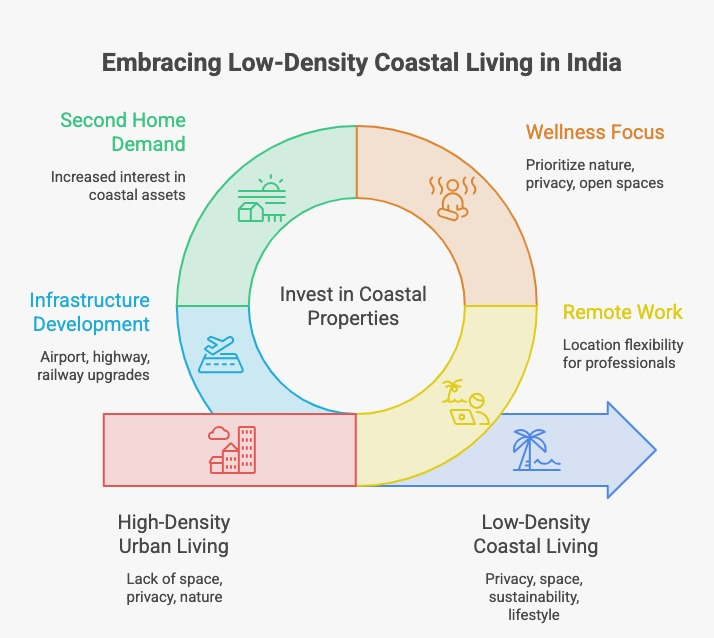
The investment appeal of Low-Density Coastal Living stems from its alignment with several long-term drivers:
Infrastructure Growth
Improved airports, roads, and connectivity.
Tourism Expansion
Increasing visitor volumes and hospitality activity.
Land Scarcity
Finite coastal inventory.
Lifestyle Migration
Growing demand for healthier environments.
Preference for environmentally resilient locations.
When multiple drivers converge, real estate markets often experience meaningful long-term value creation.
The Next Decade of Coastal Real Estate in India
India’s coastal real estate market is entering a new phase.
Historically, major attention focused on established destinations.
Going forward, investors may increasingly evaluate:
- Emerging tourism corridors
- Infrastructure-led growth regions
- Sustainable coastal markets
- Lifestyle-oriented investment destinations
The rise of Low-Density Coastal Living suggests that future demand may increasingly favor quality of life, environmental assets, and long-term livability.
As infrastructure expands across the Konkan region and tourism continues to evolve, emerging coastal destinations may become more prominent within India’s broader real estate landscape.
Key Takeaways for Investors
The data suggests several important trends:
- Demand for Low-Density Coastal Living is increasing.
- Infrastructure continues to reshape coastal investment opportunities.
- Tourism remains a powerful long-term demand driver.
- Environmental quality is becoming an important valuation factor.
- Emerging destinations may offer opportunities for investors with longer investment horizons.
The objective should not be to compare destinations as competitors.
Instead, investors should evaluate how different coastal markets align with their investment goals, lifestyle preferences, and risk appetite.
FAQs
1. What is Low-Density Coastal Living and why is it becoming popular among investors?
Low-Density Coastal Living refers to residential environments with lower population density, larger open spaces, less congestion, stronger environmental quality, and a greater connection to nature. Globally, investors are increasingly prioritizing wellness, privacy, and lifestyle-driven assets over crowded urban and tourism-centric locations. According to the United Nations Human Settlements Programme (UN-Habitat), sustainable urban planning and balanced population density are becoming critical components of future livability.
2. Why are investors exploring Low-Density Coastal Living destinations beyond Goa?
Many investors are diversifying beyond mature coastal markets to identify emerging destinations that offer lower entry costs, greater land availability, improving infrastructure, and long-term appreciation potential. The growing demand for Low-Density Coastal Living is driven by changing lifestyle preferences, remote work flexibility, and increasing interest in second homes and retirement properties.
3. How does infrastructure influence the value of Low-Density Coastal Living destinations?
Infrastructure is one of the strongest drivers of real estate appreciation. Airports, highways, rail connectivity, and tourism infrastructure improve accessibility and economic activity. For example, the development of Manohar International Airport (Mopa Airport) has significantly improved connectivity across North Goa and the Sindhudurg coastal region, increasing the attractiveness of nearby Low-Density Coastal Living destinations.
4. Does tourism growth support Low-Density Coastal Living investments?
Yes. Tourism often acts as a catalyst for real estate demand by increasing destination visibility, hospitality investment, and infrastructure development. Emerging coastal destinations with growing tourism ecosystems can benefit from increased demand for vacation homes, managed residences, and lifestyle-focused properties while preserving the appeal of Low-Density Coastal Living.
5. Why is population density important when evaluating coastal property investments?
Population density can influence congestion, infrastructure pressure, environmental quality, and future development patterns. Many investors consider Low-Density Coastal Living attractive because lower-density regions often provide greater privacy, better quality of life, and a more sustainable growth trajectory.
6. Is Low-Density Coastal Living suitable for second-home buyers and retirees?
Absolutely. Many second-home buyers and retirees prioritize peaceful surroundings, cleaner environments, and access to nature. These factors make Low-Density Coastal Living increasingly attractive for those seeking a lifestyle asset that can be enjoyed personally while potentially appreciating over time.
7. How are NRIs contributing to the demand for Low-Density Coastal Living?
NRIs are increasingly investing in coastal properties as vacation homes, retirement residences, and long-term family assets. The appeal of Low-Density Coastal Living lies in its combination of lifestyle benefits, environmental quality, and potential wealth preservation. Strong remittance inflows and growing interest in Indian real estate continue to support this trend.
8. What role does sustainability play in Low-Density Coastal Living investments?
Sustainability has become a major consideration for both investors and end-users. Coastal destinations that maintain green cover, biodiversity, clean beaches, and responsible development practices often remain desirable over the long term. This is one of the key reasons why Low-Density Coastal Living is gaining importance in modern real estate investment decisions.
9. Can Low-Density Coastal Living offer long-term capital appreciation?
While no investment guarantees returns, Low-Density Coastal Living destinations often benefit from long-term drivers such as infrastructure expansion, tourism growth, limited coastal land supply, and lifestyle migration trends. Investors typically evaluate these factors alongside market fundamentals before making investment decisions.
10. What should investors evaluate before investing in a Low-Density Coastal Living destination?
Investors should assess:
- Infrastructure and connectivity
- Tourism growth trends
- Land availability
- Environmental sustainability
- Regulatory compliance
- Market maturity
- Long-term demand drivers
Conducting due diligence and reviewing credible government and industry reports can help investors make informed decisions regarding Low-Density Coastal Living opportunities.
The Growing Value of Space, Sustainability and Strategic Location
The future of coastal real estate is being shaped by more than tourism alone.
Investors increasingly recognize that long-term value creation depends on a combination of infrastructure, environmental quality, demographic shifts, and lifestyle demand.
This is precisely why Low-Density Coastal Living has emerged as a significant theme within global and Indian real estate markets.
While Goa continues to demonstrate the strengths of a mature coastal economy, emerging destinations along the Konkan coastline are illustrating how infrastructure-led growth, tourism expansion, and sustainability can create new opportunities for long-term investors.
For investors, HNIs, NRIs, and decision-makers evaluating India’s coastal future, the most important question may no longer be where tourism exists today—but where quality of life, connectivity, and long-term demand are likely to converge tomorrow.