Table of Contents
ToggleHow the Porvorim Six-Lane Elevated Corridor Is Reshaping North Goa Connectivity
North Goa is entering a new phase of infrastructure-led growth, and few projects illustrate that transformation as clearly as the Porvorim Elevated Corridor.
For years, Porvorim has been one of the most important transit points between Panaji and northern Goa. It sits on NH-66, connecting the state capital with Mapusa, Guirim, Sangolda, and the wider North Goa tourism belt. As traffic volumes increased, particularly during peak travel periods and tourism seasons, the Porvorim stretch became an increasingly important point for regional connectivity.
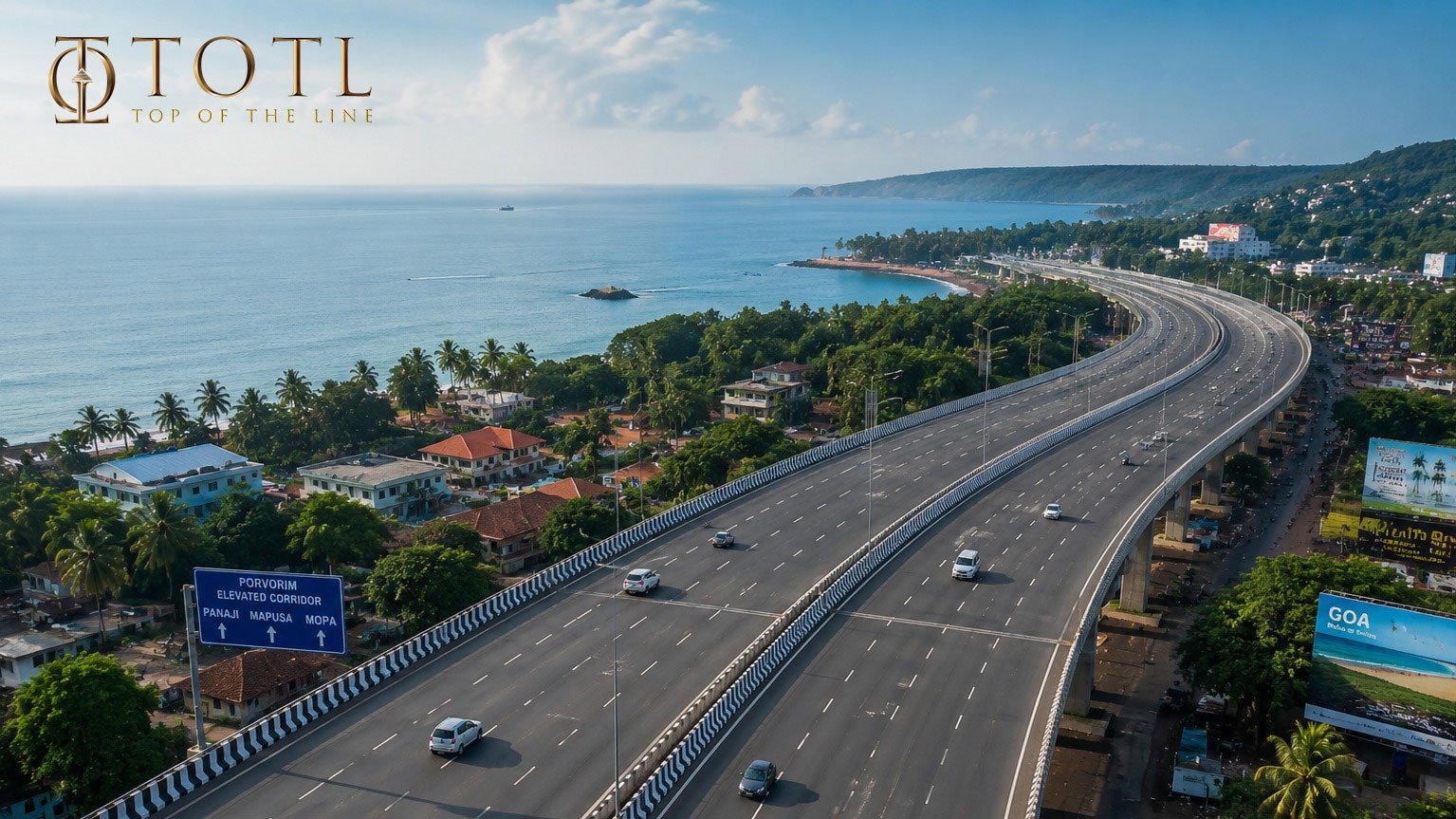
The Porvorim Elevated Corridor is designed to address that challenge by taking through traffic above the existing road network. The six-lane infrastructure project is therefore more than another road improvement. It is a strategic mobility project that can alter how people move between Panaji, Porvorim, Mapusa and northern Goa.
The latest announcement places the opening of the Porvorim Elevated Corridor to vehicular traffic at 4 PM on September 11, 2026, following its inauguration on September 9. The completed corridor is reported to be approximately 5.5 km and a project cost of ₹664.6 crore.
For North Goa’s property market, this matters because connectivity is one of the most important foundations of long-term real estate demand. Better roads do not automatically guarantee appreciation, but they can improve accessibility, usability, and the size of the catchment that a location can serve.
That makes the Porvorim Elevated Corridor an important development not only for commuters, but also for homebuyers, second-home owners, NRIs, and investors studying North Goa’s evolving real estate landscape.
What Is the Porvorim Elevated Corridor?
The Porvorim Elevated Corridor is a six-lane elevated road being constructed along NH-66 in North Goa.
According to the Government of Goa, the official project is described as the construction of a six-lane elevated corridor from km 508.000 to km 513.150, including approaches, on NH-66 in Goa under EPC mode.
That official chainage corresponds to approximately 5.15 km. More recent reports describing the completed structure refer to the corridor as approximately 5.5 km long.
The project stretches between the Sangolda/Guirim side and the Neo Majestic Hotel side of Porvorim, placing it directly on one of the most strategically important sections of NH-66 in North Goa. The Government of Goa formally notified the stretch between the vehicular underpass near Guirim Cross and Sangolda Junction as a construction zone during the project.
Porvorim Elevated Corridor: Key Facts
- Road: NH-66
- Configuration: Six lanes
- Official project chainage: km 508.000 to km 513.150, including approaches
- Latest reported completed length: approximately 5.5 km
- Latest reported project cost: ₹664.6 crore
- Route: Sangolda/Guirim side to Neo Majestic Hotel, Porvorim
- Opening to vehicular traffic: September 11, 2026, at 4 PM
- Inauguration: September 9, 2026
- Executing contractor: RRSM Infra Pvt Ltd
The latest opening schedule was announced by Goa’s PWD Minister Digambar Kamat, with the corridor scheduled to be inaugurated by Union Minister for Road Transport and Highways Nitin Gadkari.
For readers following official project developments, the Government of Goa’s official project notification provides the underlying NH-66 chainage and construction details.
Why Porvorim Matters to North Goa Connectivity
The significance of the Porvorim Elevated Corridor comes from its location.
Porvorim sits between Panaji and the wider North Goa network. From this area, traffic moves towards Mapusa, Guirim, Sangolda, Calangute, Baga, Anjuna, Vagator, Assagao, Siolim, Morjim, Mandrem and further north towards Pernem and MOPA Airport.
That gives the Porvorim section of NH-66 a role that goes well beyond local commuting.
It functions as part of a wider movement system:
Panaji → Porvorim → Guirim/Sangolda → Mapusa → North Goa
And through the broader northern road network:
Panaji → Porvorim → Mapusa → Pernem/MOPA Airport
The Government of Goa has itself highlighted the importance of the project to inter-district connectivity, noting that the elevated corridor and other infrastructure projects are expected to ease congestion and reduce travel times once completed.
This is why the Porvorim Elevated Corridor should be understood as a network improvement rather than an isolated flyover.
How the Porvorim Elevated Corridor Changes Traffic Flow
The primary purpose of the Porvorim Elevated Corridor is to improve the movement of through traffic along one of Goa’s busiest urban highway sections.
Before the project, regional traffic and local traffic shared the same broad surface-level road environment. Vehicles travelling between Panaji and Mapusa could encounter the same intersections, turning movements and local access points used by residents and businesses.
The elevated structure changes that movement pattern.
Through traffic can use the elevated route, while surface-level roads can increasingly serve local access and destination traffic.
Separating Through Traffic From Local Movement
This distinction is important.
The Porvorim Elevated Corridor is not simply about adding another road lane. Its strategic purpose is to create a grade-separated movement path for traffic travelling through the Porvorim section.
That can potentially create three benefits:
- smoother through movement;
- better journey-time predictability;
- reduced pressure on surface-level traffic movement.
The Government of Goa’s construction notifications show how carefully traffic management had to be handled during the construction period, including diversions around Neo Majestic Hotel and other portions of NH-66.
The fact that alternative routes in Guirim, Sangolda and Vaddem were prepared during construction also demonstrates the importance of this road segment to the wider traffic network.
Panaji–Mapusa Travel Time Could Change Significantly
One of the most frequently discussed benefits of the Porvorim Elevated Corridor is its potential impact on travel time between Panaji and Mapusa.
In June 2026, The Goan reported that the corridor was expected to reduce the Mapusa–Panaji journey to around 10 minutes, compared with an average of around 40 minutes during peak hours at the time.
That would represent a substantial improvement under the conditions described.
It is important, however, to interpret this figure correctly.
The 10-minute figure should be treated as a reported project expectation rather than a guaranteed journey time under every traffic, weather or road condition.
The more important takeaway is that the Porvorim Elevated Corridor is intended to remove a major source of delay from a key Panaji–North Goa route.
And in real estate, saving time can have economic value.
A property that becomes easier to reach from an airport, business centre, state capital or tourism destination can become more practical for a wider group of buyers.
Porvorim to Mapusa: Strengthening the North Goa Spine
The relationship between Porvorim and Mapusa is particularly important.
Mapusa is one of North Goa’s established commercial and residential centres. It also acts as a gateway to several coastal destinations.
The Porvorim Elevated Corridor therefore strengthens the broader:
Panaji–Porvorim–Mapusa connectivity corridor.
For commuters, this can mean greater journey efficiency.
For businesses, it can mean easier movement of employees, customers and goods.
For residents, it can improve access to Panaji and other parts of North Goa.
For investors, it creates another reason to examine the relationship between property location and infrastructure.
The Porvorim Elevated Corridor does not make every location equally attractive. Instead, it changes the accessibility equation for properties that are well positioned within the wider road network.
That distinction is important when evaluating North Goa property investment.
Guirim and Sangolda: Important Links in the Network
The Porvorim Elevated Corridor begins and ends within locations that already play an important role in North Goa’s movement network.
The Government of Goa’s notification identifies the construction zone around the Guirim Cross and Sangolda Junction sections of NH-66.
These locations are strategically relevant because they sit between Porvorim and the Mapusa side of the network.
Improved movement through this section can therefore have a wider impact on traffic travelling towards:
- Mapusa;
- Assagao;
- Anjuna;
- Vagator;
- Siolim;
- Morjim;
- Mandrem;
- Pernem;
- MOPA Airport.
The Porvorim Elevated Corridor should consequently be viewed as a connector within a larger North Goa mobility system.
How the Porvorim Elevated Corridor Improves MOPA Airport Connectivity
The connection between the Porvorim Elevated Corridor and MOPA Airport deserves particular attention.
The corridor is not a direct airport expressway. It would be inaccurate to describe it as a dedicated Panaji–MOPA Airport road.
Its significance is different.
The Porvorim Elevated Corridor improves an important section of the road network that connects Panaji and central North Goa with the northern NH-66 corridor. From there, travellers can continue towards Pernem and Manohar International Airport.
The practical connectivity chain can therefore be understood as:
Panaji → Porvorim → Guirim/Mapusa → Northern Goa → Pernem/MOPA Airport
This becomes more important as MOPA’s passenger traffic grows.
MOPA Is Already a Major Aviation Gateway
Goa’s tourism statistics show the growing role of Manohar International Airport in the state’s international connectivity.
According to the Department of Tourism, Government of Goa, Goa handled 1,784 international scheduled flights in 2025, with 1,141 operating through MOPA.
Those flights carried 235,798 foreign tourists through international scheduled services across Goa’s airports.
This is significant because the MOPA ecosystem is becoming an increasingly important component of North Goa’s accessibility.
When the Porvorim Elevated Corridor, NH-66 and MOPA Airport are considered together, the infrastructure story becomes much stronger than when each project is viewed independently.
Goa’s Tourism Growth Adds Another Layer to the Connectivity Story
Infrastructure becomes economically meaningful when there is sustained demand for movement.
Goa has a substantial tourism economy, and official tourism statistics demonstrate the scale of that demand.
According to the Goa Tourism Department, Goa recorded 1,08,02,410 tourist arrivals in 2025.
That included:
- 1,02,84,608 domestic tourists
- 5,17,802 foreign tourists
The state has therefore moved beyond the eight-million annual visitor level recorded in earlier years and crossed the one-crore mark.
The first half of 2025 was also strong. Official tourism data recorded 54.55 lakh visitors between January and June 2025, including 51.84 lakh domestic tourists and 2.71 lakh international visitors.
For North Goa, this matters because a significant portion of tourism activity is concentrated around the northern coastal and lifestyle belt.
The Porvorim Elevated Corridor can improve the road infrastructure serving the wider destination network through which these visitors travel.
From Tourism Destination to Connected Lifestyle Market
North Goa’s real estate market has evolved alongside its tourism economy.
The region now attracts several categories of buyers:
- primary-home buyers;
- second-home owners;
- NRIs;
- lifestyle buyers;
- hospitality investors;
- long-term property investors.
For these buyers, connectivity is increasingly important.
A second home is more useful when it can be reached conveniently from an airport.
A villa is more attractive when surrounding tourism destinations remain accessible.
A residential property becomes more practical when commuting to Panaji or Mapusa is easier.
A rental property can have a broader potential tenant or visitor base when the surrounding transport network is efficient.
The Porvorim Elevated Corridor contributes to this broader usability equation.
What the Porvorim Elevated Corridor Means for North Goa Real Estate
The relationship between infrastructure and property value requires a balanced interpretation.
A new road does not automatically guarantee property appreciation.
There is no credible basis for claiming that the Porvorim Elevated Corridor alone will produce a specific percentage increase in property prices.
The more defensible real-estate framework is:
Infrastructure improvement
↓
Better accessibility
↓
Greater location usability
↓
Potentially wider buyer and tenant catchment
↓
Stronger demand potential
↓
Potential long-term support for property values
This is particularly relevant in a market such as North Goa, where different locations serve different demand profiles.
Why Accessibility Matters to Investors
Real estate is fixed in location.
Infrastructure changes the time and effort required to reach that location.
That makes accessibility an important part of the underlying value proposition.
The Porvorim Elevated Corridor can improve accessibility between several important nodes of North Goa’s economy.
For investors, this means the question should not simply be:
“Will this road increase property prices?”
A better question is:
“How does this infrastructure change the practical usefulness of properties located within its influence area?”
That is a much more sophisticated way of looking at North Goa property investment.
Which North Goa Locations Deserve Investor Attention?
The impact of the Porvorim Elevated Corridor will not be identical across every North Goa micro-market.
Investors should instead consider the different characteristics of individual locations.
Porvorim
Porvorim has an established residential and commercial ecosystem and sits close to Panaji.
The Porvorim Elevated Corridor reinforces its strategic position within the North Goa road network.
For end-users, connectivity can support daily mobility.
For businesses, it can support accessibility.
For property investors, the area’s established character makes it an important market to monitor.
Guirim and Sangolda
These locations are directly connected to the corridor’s northern section.
Their strategic position between Porvorim and Mapusa makes them relevant when studying connectivity-driven development.
Mapusa
Mapusa remains an important commercial and residential centre.
Improved movement between Mapusa and Panaji can strengthen the area’s practical relationship with the state capital and the wider North Goa network.
MOPA–Pernem Corridor
The MOPA–Pernem belt represents a different investment story.
Here, airport infrastructure is an important demand driver.
The combination of aviation, tourism and road connectivity could support longer-term development across selected locations.
Coastal North Goa
Markets around Assagao, Anjuna, Vagator, Morjim and surrounding destinations are driven strongly by lifestyle and tourism demand.
For these locations, the benefit of the Porvorim Elevated Corridor is primarily through improved access to the broader North Goa network rather than direct proximity to the structure itself.
Why the Infrastructure Story Matters to NRIs
For NRIs considering North Goa property investment, connectivity can be particularly important.
International buyers may use their property for only part of the year.
That makes accessibility to the airport and ease of movement after arrival especially valuable.
The combination of:
international aviation + NH-66 + Porvorim Elevated Corridor + tourism infrastructure
creates a stronger accessibility ecosystem for North Goa.
The Porvorim Elevated Corridor can therefore be viewed as one component of a larger infrastructure story that makes the region easier to navigate.
For NRIs, second-home buyers and investors, the practical question is increasingly about how quickly and conveniently a property can connect with the rest of the destination.
Infrastructure Does Not Replace Real Estate Fundamentals
The most important lesson for investors is that infrastructure should be considered alongside property fundamentals.
A location may have excellent road connectivity, but investors should still examine:
- title and legal documentation;
- RERA registration where applicable;
- development permissions;
- construction quality;
- actual distance from major roads;
- neighbourhood infrastructure;
- water and utility availability;
- rental demand;
- property management;
- intended holding period;
- exit liquidity.
The Porvorim Elevated Corridor strengthens the connectivity argument, but it should form part of a wider due-diligence framework.
The best investment decisions are usually based on several fundamentals working together rather than one infrastructure announcement.
The Bigger Picture: North Goa’s Infrastructure Stack
The real significance of the Porvorim Elevated Corridor becomes visible when the project is placed alongside other infrastructure developments.
Consider the emerging infrastructure stack:
MOPA Airport
↓
Northern NH-66 network
↓
Porvorim Elevated Corridor
↓
Panaji–Porvorim–Guirim–Mapusa movement
↓
North Goa’s tourism and lifestyle destinations
Each component serves a different purpose.
MOPA expands aviation access.
NH-66 provides the road spine.
The Porvorim Elevated Corridor addresses a critical urban bottleneck.
Tourism provides economic activity.
Real estate responds to the changing accessibility and demand environment.
This interaction is what makes the current infrastructure cycle particularly relevant for North Goa investors.
What the Porvorim Elevated Corridor Could Mean Over the Long Term
The most interesting effect of the Porvorim Elevated Corridor may not be visible immediately after opening.
Infrastructure changes often take time to influence development patterns.
As journey times become more predictable, businesses and residents can reassess the practical boundaries of a location.
Areas that once felt farther away can become more accessible.
Commercial activity can follow improved mobility.
Residential demand can respond to improved commuting convenience.
Hospitality operators can evaluate locations based on visitor accessibility.
For North Goa, these changes could gradually strengthen the relationship between established urban centres, emerging airport corridors and coastal lifestyle markets.
The Porvorim Elevated Corridor is therefore best understood as part of a longer-term connectivity transition rather than simply a project with a single opening date.
FAQs
1. What is the Porvorim Elevated Corridor and why is it important for North Goa?
The Porvorim Elevated Corridor is a six-lane elevated road project constructed along NH-66 in North Goa. The official Government of Goa notification describes the project as extending from km 508.000 to km 513.150, including approaches, covering the important NH-66 stretch around Porvorim, Guirim, and Sangolda.
The Porvorim Elevated Corridor is important because this section of NH-66 forms a critical connection between Panaji and the wider North Goa network. By creating an elevated route for through traffic, the project is intended to improve traffic movement and reduce bottlenecks on the existing road network. Its importance extends beyond commuting because better connectivity can strengthen access between residential areas, commercial centres, tourism destinations and the wider MOPA Airport region.
2. How long is the Porvorim Elevated Corridor and how many lanes does it have?
The Porvorim Elevated Corridor is a six-lane elevated highway structure. The official project documentation identifies the project chainage as km 508.000 to km 513.150, including approaches, which represents approximately 5.15 km.
More recent reporting from August 2026 describes the completed Porvorim Elevated Corridor as approximately 5.50 km long. The latest reported project cost is approximately ₹664.6 crore.
For SEO and factual accuracy, it is useful to distinguish the official project chainage from the latest reported completed length rather than presenting the two figures as contradictory.
3. When will the Porvorim Elevated Corridor open to vehicular traffic?
The Porvorim Elevated Corridor is scheduled to open to vehicular traffic at 4 PM on September 11, 2026, according to the latest announcement reported by The Times of India and The Goan. The corridor is scheduled to be inaugurated on September 9, 2026, before regular traffic begins.
The Porvorim Elevated Corridor has been under construction through multiple phases, with the Government of Goa issuing several traffic-diversion and road-closure notifications to facilitate construction. In April 2026, PWD announced a temporary closure of a section of existing NH-66 near Neo Majestic Hotel to enable construction of the corridor’s approach.
4. How will the Porvorim Elevated Corridor improve Panaji–Mapusa connectivity?
The Porvorim Elevated Corridor is designed to provide a grade-separated route for through traffic along NH-66, helping separate longer-distance traffic from surface-level local movements. This is particularly important because Porvorim sits between Panaji and Mapusa and carries traffic travelling towards several North Goa destinations.
Reports have indicated that the Porvorim Elevated Corridor could substantially reduce peak-period travel time between Panaji and Mapusa. The Goan reported an expected reduction from approximately 40 minutes during peak periods to around 10 minutes, although actual travel times will naturally vary depending on traffic and road conditions.
For North Goa, the broader benefit is improved journey predictability across an important section of the regional road network.
5. Does the Porvorim Elevated Corridor improve MOPA Airport connectivity?
The Porvorim Elevated Corridor does not directly connect to MOPA Airport and should not be described as a dedicated airport expressway. Its importance is that it improves a strategically important section of NH-66 connecting Panaji and central North Goa with the northern road network.
The broader connectivity can be understood as:
Panaji → Porvorim → Guirim/Mapusa → Northern Goa → Pernem/MOPA Airport
This becomes increasingly relevant as MOPA’s role in Goa’s aviation network expands. According to the Government of Goa Tourism Department, 1,784 international scheduled flights operated through Goa in 2025, including 1,141 through MOPA, carrying 235,798 foreign tourists.
Therefore, the Porvorim Elevated Corridor should be viewed as an important road-network component supporting the wider MOPA Airport connectivity ecosystem.
6. How could the Porvorim Elevated Corridor influence North Goa property investment?
The Porvorim Elevated Corridor can strengthen the fundamentals supporting North Goa property investment by improving accessibility between residential, commercial, tourism and airport-linked destinations.
Infrastructure does not automatically guarantee property appreciation. However, better connectivity can potentially increase the practical usability of a location by reducing travel friction and widening the catchment of people who can conveniently access it.
This is particularly relevant for buyers considering Porvorim, Guirim, Sangolda, Mapusa and selected locations across the wider North Goa tourism belt. The Porvorim Elevated Corridor can become one part of a broader investment equation that also includes MOPA Airport, tourism demand, local infrastructure, property quality and legal due diligence.
Investors should therefore evaluate infrastructure as a supporting fundamental, rather than treating the corridor as a standalone guarantee of future returns.
7. Which North Goa locations could benefit from the Porvorim Elevated Corridor?
The Porvorim Elevated Corridor has the strongest direct connectivity relevance for the Porvorim–Guirim–Sangolda–Mapusa movement corridor, while its wider network benefits can extend towards northern and coastal North Goa.
Porvorim is particularly important because of its position between Panaji and North Goa. Guirim and Sangolda are relevant because the official construction zone includes the stretch around Guirim Cross and Sangolda Junction.
Mapusa also remains an important commercial and residential centre within the regional network. Beyond these locations, improved movement can support accessibility towards destinations such as Assagao, Anjuna, Vagator, Siolim, Morjim, Pernem and the MOPA Airport region.
For investors, however, the effect of the Porvorim Elevated Corridor will vary according to the exact property location, road access, asset quality, buyer profile and local demand.
8. Why is the Porvorim Elevated Corridor important for North Goa’s long-term real estate story?
The Porvorim Elevated Corridor is important because it forms part of a larger infrastructure ecosystem that is changing how North Goa connects with itself and with the rest of Goa.
The corridor improves a key section of NH-66, while MOPA Airport strengthens aviation access and Goa’s tourism economy continues to generate substantial visitor demand. The Government of Goa Tourism Department reported 1,08,02,410 tourist arrivals in 2025, including more than 1.02 crore domestic visitors and over 5.17 lakh foreign visitors.
For real estate, this creates an important long-term framework:
Improved infrastructure → better accessibility → greater usability → potentially broader demand → stronger investment fundamentals.
The Porvorim Elevated Corridor should therefore be assessed alongside property-specific factors rather than viewed in isolation. For homebuyers, NRIs and long-term investors, the most important question is how connectivity improvements interact with the location, quality and intended use of a particular property.
A More Connected North Goa
The Porvorim Elevated Corridor represents an important milestone in North Goa’s infrastructure evolution.
Its significance extends beyond the six-lane structure itself. By improving movement through one of the most important sections of NH-66, the project can strengthen the relationship between Panaji, Porvorim, Guirim, Mapusa, and the wider North Goa network.
Its importance becomes even clearer when combined with the growth of MOPA Airport and Goa’s substantial tourism economy. Goa recorded more than 1.08 crore tourist arrivals in 2025, while international scheduled flights through MOPA have become an increasingly important component of the state’s connectivity.
For real estate, the central opportunity is not to assume that a flyover automatically creates appreciation. It is to understand how improved connectivity can influence accessibility, usability and demand over time.
The Porvorim Elevated Corridor is therefore best viewed as one part of a larger North Goa growth story—one in which roads, airports, tourism and real estate increasingly reinforce one another.
For investors evaluating North Goa, the most informed approach is to look beyond individual infrastructure announcements and assess how connectivity, location, property quality and long-term demand come together.
That is where experienced local market understanding becomes valuable. TOTL Realty continues to help buyers evaluate North Goa real estate through the fundamentals that matter: location, connectivity, asset quality and long-term potential.