Why Vengurla Is Quietly Emerging as India’s Next Coastal Investment Frontier
For decades, Goa dominated India’s coastal tourism narrative.
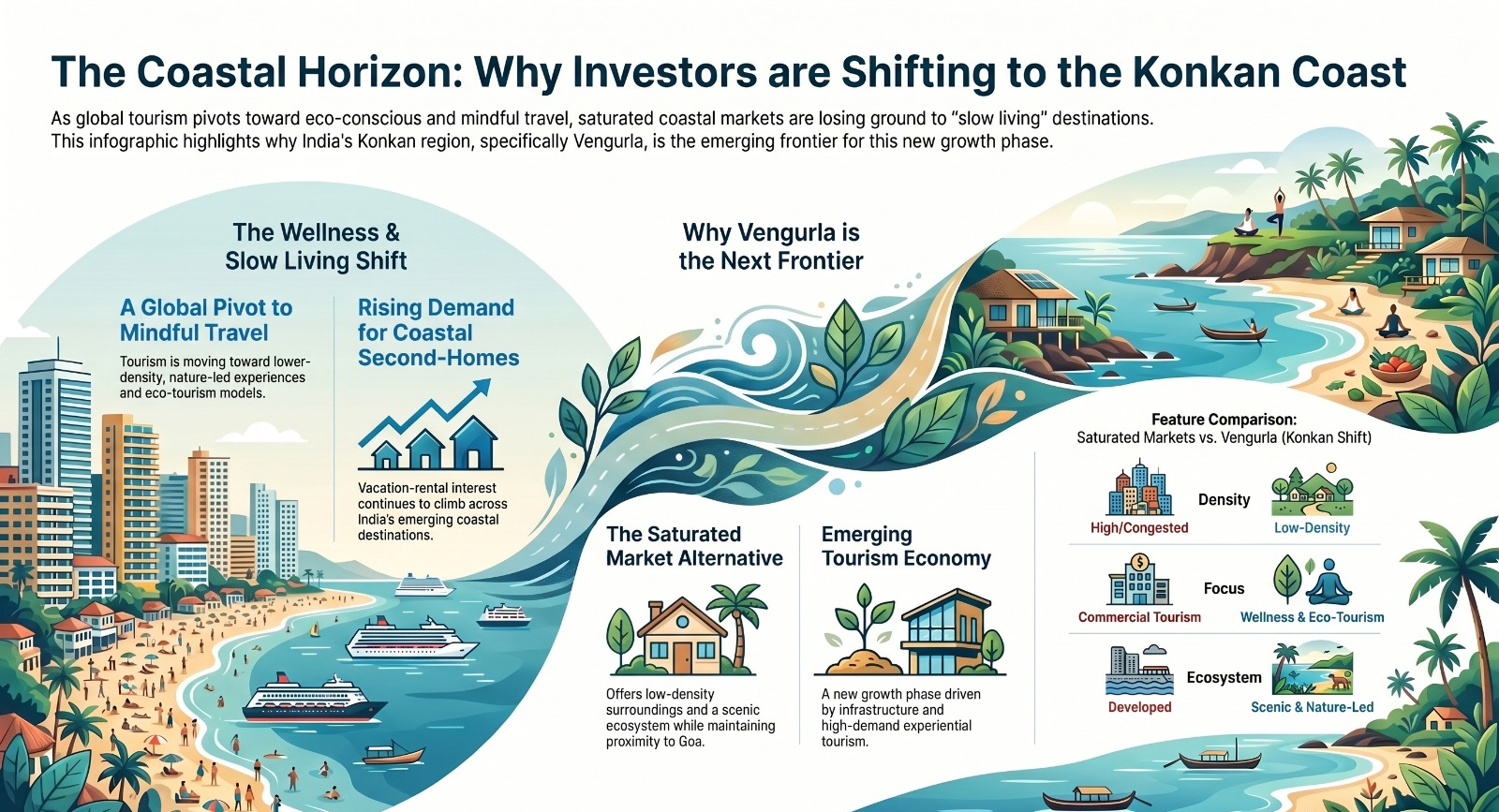
From beach tourism and hospitality growth to luxury villas and second homes, Goa evolved into one of the country’s most recognized lifestyle destinations. But across global tourism markets, a familiar pattern often repeats itself: as destinations mature and become denser, a new generation of travelers and investors begins searching for quieter, lower-density alternatives that still offer strong lifestyle appeal and long-term growth potential.
Today, that conversation is slowly beginning around Vengurla.
Located in Maharashtra’s Sindhudurg district along the Konkan coastline, Vengurla is increasingly gaining attention among tourism observers, second-home buyers, hospitality investors, and strategic land investors due to a combination of infrastructure upgrades, tourism evolution, marine tourism initiatives, and changing travel behavior.
Unlike saturated coastal markets, Vengurla aremains relatively early in its tourism and real estate growth cycle. This is one of the reasons why Vengurla coastal investment discussions are increasingly appearing in infrastructure reports, tourism commentary, hospitality conversations, and emerging coastal development analysis.
The region’s positioning is not built around aggressive commercialization. Instead, its growing relevance comes from a broader transformation taking place across India’s coastal economy.
Major developments such as the Manohar International Airport (MOPA Airport), Mumbai–Goa Highway upgrades, marine tourism initiatives, wellness travel trends, eco-tourism growth, and increasing second-home culture are gradually reshaping the larger Sindhudurg belt.
At the same time, global tourism preferences are evolving toward:
- lower-density destinations,
- nature-led experiences,
- wellness-focused travel,
- slow living,
- eco-luxury hospitality,
- and experiential tourism.
This shift is becoming increasingly important for regions like Vengurla that still retain natural coastal character while simultaneously entering a new infrastructure and tourism growth phase.
For strategic investors, the conversation around Vengurla coastal investment is therefore less about short-term hype and more about understanding how tourism ecosystems evolve over long periods of time.
The Global Shift Away From Overcrowded Coastal Destinations
Across the world, tourism preferences are changing.
After years of rapid urban tourism expansion and over-commercialized beach destinations, travelers are increasingly prioritizing experiences connected to wellness, sustainability, slower lifestyles, and nature-driven environments.
International tourism reports from organizations such as UN Tourism (formerly UNWTO) continue to highlight rising interest in:
- eco-tourism,
- wellness retreats,
- experiential travel,
- boutique stays,
- sustainable hospitality,
- and lower-density coastal destinations.
This transition can already be seen globally in destinations such as:
- Bali’s quieter northern regions,
- Thailand’s boutique island destinations,
- emerging Mediterranean coastal towns,
- and secondary luxury tourism belts in the UAE.
India is also witnessing a similar shift.
As major tourism markets become denser and more commercialized, a section of affluent travelers and second-home buyers is gradually exploring less crowded coastal ecosystems that still provide:
- accessibility,
- natural beauty,
- lifestyle appeal,
- and long-term destination potential.
This is where Vengurla coastal investment conversations begin to gain relevance.
The region offers a different kind of coastal narrative compared to highly commercialized tourism belts. Instead of nightlife-driven tourism density, the appeal lies in:
- cleaner beaches,
- slower coastal living,
- Arabian Sea views,
- Konkan biodiversity,
- wellness-oriented environments,
- and relatively lower-density surroundings.
For hospitality operators and long-term investors, these characteristics often become important during the early stages of destination evolution.
Why Vengurla’s Location Matters Strategically
Vengurla is located in Sindhudurg district in Maharashtra’s Konkan belt, close to the Goa border.
This geographical positioning gives the region strategic importance because it benefits from both:
- Goa’s tourism ecosystem influence
- Maharashtra’s emerging coastal infrastructure development
Historically, regions located near mature tourism markets often experience a “spillover effect.”
This happens when:
- tourist movement expands,
- infrastructure improves,
- hospitality demand increases,
- and investors begin exploring nearby lower-density destinations.
The Konkan coastline has long been known for:
- pristine beaches,
- lush greenery,
- seafood culture,
- biodiversity,
- and scenic coastal geography.
However, limited infrastructure historically slowed large-scale tourism and hospitality expansion.
That equation is now beginning to change.
This is one of the primary reasons why Vengurla coastal investment is increasingly being viewed through a long-term infrastructure and tourism lens rather than only traditional real estate valuation metrics.
The MOPA International Airport Effect
One of the most important infrastructure developments impacting the Goa–Sindhudurg corridor is the opening of Manohar International Airport (MOPA Airport) in North Goa.
The airport has significantly improved accessibility across the larger coastal belt that includes:
- North Goa,
- Sindhudurg,
- Malvan,
- Tarkarli,
- Sawantwadi,
- and Vengurla.
For decades, connectivity remained one of the biggest barriers for coastal development in the Konkan region.
Travel times were long, airport access was limited, and tourism movement remained concentrated around more accessible locations.
MOPA Airport changes this dynamic.
Improved air connectivity has historically influenced:
- tourism growth,
- second-home demand,
- hospitality expansion,
- luxury stay markets,
- and destination visibility.
Many emerging tourism ecosystems globally experienced accelerated growth after airport connectivity improvements.
This is why Vengurla coastal investment discussions increasingly mention the strategic impact of MOPA connectivity.
The airport is not only improving convenience for tourists but also reshaping how investors evaluate the broader Konkan region.
For HNIs, NRIs, business owners, and second-home buyers, accessibility plays a critical role in destination viability.
Better airport infrastructure often increases:
- weekend travel culture,
- premium hospitality demand,
- vacation rental viability,
- and long-term tourism movement.
NH-66 Highway Expansion & Regional Connectivity
Another major growth catalyst is the expansion and modernization of the Mumbai–Goa Highway (NH-66).
Infrastructure improvements across major coastal corridors often act as foundational growth drivers for tourism and hospitality ecosystems.
The Mumbai–Goa Highway expansion is expected to:
- reduce travel friction,
- improve logistics,
- support tourism circulation,
- enhance regional mobility,
- and strengthen connectivity between coastal towns.
Historically, infrastructure has played a major role in transforming tourism-led destinations globally.
Whether in:
- Goa,
- Phuket,
- Bali,
- Dubai’s coastal districts,
- or Mediterranean tourism belts,
improved accessibility frequently became the trigger for broader economic and tourism activity.
For strategic observers studying Vengurla coastal investment, the infrastructure story is therefore extremely important.
Destination growth is rarely created by tourism alone.
Instead, it usually emerges from a combination of:
- connectivity,
- policy support,
- hospitality demand,
- investor confidence,
- and lifestyle trends.
The Konkan coastline is gradually entering that broader transformation phase.
INS Guldar & the Rise of Marine Tourism in Sindhudurg
One of the most unique developments connected to Sindhudurg’s future tourism narrative is the INS Guldar underwater tourism initiative.
Recent tourism and government reports indicate that Sindhudurg is expected to host India’s first underwater museum and artificial reef tourism project around the decommissioned INS Guldar warship.
The project includes:
- underwater tourism,
- artificial coral reef creation,
- scuba tourism,
- marine ecosystem attraction,
- and adventure tourism visibility.
According to official reports, significant tourism funding approvals have already been associated with the initiative.
Globally, marine tourism has helped many coastal destinations build international visibility.
Countries such as:
- Maldives,
- Egypt,
- UAE,
- Thailand,
- and Mexico
have successfully used underwater tourism experiences to strengthen destination branding.
While Sindhudurg’s marine tourism ecosystem is still developing, the strategic importance of such initiatives cannot be ignored.
Marine tourism often creates ripple effects across:
- hospitality,
- transportation,
- tourism branding,
- experiential travel,
- and premium stay demand.
This is another reason why Vengurla coastal investment is increasingly entering conversations around future tourism-driven growth.
The region is no longer being viewed only through traditional coastal tourism metrics.
Instead, broader themes such as:
- blue economy,
- marine tourism,
- adventure travel,
- and experiential coastal ecosystems
are gradually becoming part of the narrative.
The Rise of Luxury Coastal Living in India
India’s luxury lifestyle market is also changing.
A growing number of affluent buyers are increasingly exploring:
- second homes,
- coastal villas,
- wellness retreats,
- boutique stays,
- and managed holiday residences.
Several factors are contributing to this trend:
- hybrid work culture,
- wellness-oriented lifestyles,
- experiential travel demand,
- and increased interest in long-duration leisure stays.
This trend accelerated significantly after the pandemic.
Today, many HNIs and NRIs are looking beyond traditional metro lifestyles and considering destinations that offer:
- cleaner environments,
- slower living,
- coastal access,
- privacy,
- and lifestyle diversification.
This changing behavior is gradually influencing the Vengurla coastal investment landscape.
Unlike highly urbanized tourism belts, Vengurla still retains:
- lower-density surroundings,
- greener environments,
- and a more natural coastal identity.
Globally, some of the most successful luxury tourism destinations today are not necessarily the loudest or most crowded.
Instead, premium travel increasingly revolves around:
- exclusivity,
- tranquility,
- authenticity,
- and nature-connected experiences.
This is why coastal regions with relatively early-stage tourism ecosystems often attract long-term hospitality interest.
Airbnb, Vacation Rentals & Boutique Hospitality Growth
The growth of Airbnb and vacation rental culture has transformed how investors view coastal real estate globally.
Travelers today increasingly seek:
- private villas,
- boutique stays,
- experiential accommodations,
- and long-stay lifestyle properties.
This shift has created new opportunities for:
- hospitality investors,
- villa operators,
- tourism entrepreneurs,
- and second-home owners.
In many coastal destinations globally, vacation rental economies became important catalysts for broader tourism-led real estate demand.
India is also seeing rising interest in:
- managed holiday homes,
- boutique hospitality,
- eco-resorts,
- wellness stays,
- and experiential tourism accommodations.
This larger hospitality transition is one of the reasons why Vengurla coastal investment conversations are becoming more relevant among strategic investors studying emerging tourism corridors.
As tourism ecosystems evolve, hospitality demand frequently expands beyond traditional hotels into:
- villas,
- serviced stays,
- curated experiences,
- and eco-luxury formats.
Destinations that still offer:
- natural beauty,
- lower density,
- coastal accessibility,
- and cultural authenticity
often become attractive for such hospitality experimentation.
Climate, Wellness & Sustainability Advantages
Climate and environmental considerations are increasingly influencing lifestyle decisions globally.
Major Indian metros continue to face:
- rising temperatures,
- pollution,
- traffic density,
- and urban stress.
As a result, coastal regions with greener surroundings and lower-density living environments are gaining more attention among lifestyle-focused buyers.
Vengurla benefits from several natural environmental advantages, including:
- Arabian Sea coastal airflow,
- lush Konkan greenery,
- scenic coastal ecosystems,
- and relatively lower urban density.
This aligns strongly with broader wellness travel and sustainability trends.
Wellness tourism is now considered one of the fastest-growing segments in global hospitality.
Travelers increasingly prioritize:
- mindfulness,
- nature-driven experiences,
- healthier environments,
- and slower lifestyles.
For investors studying Vengurla coastal investment opportunities, these environmental advantages are important because modern destination value is increasingly connected to quality-of-life factors.
The future of coastal real estate is not only about location.
It is also about:
- sustainability,
- wellness,
- climate resilience,
- and long-term livability.
Goa’s Saturation vs Vengurla’s Emerging Growth Phase
Comparisons between Goa and emerging coastal destinations are becoming increasingly common.
However, it is important to understand that Vengurla is not replacing Goa.
Instead, it represents a different stage in the coastal destination lifecycle.
Goa today is:
- globally recognized,
- mature,
- tourism-heavy,
- and commercially established.
Vengurla, on the other hand, is still:
- relatively early-stage,
- lower-density,
- less commercialized,
- and infrastructure-driven.
This difference matters from an investment perspective.
Historically, investors often study destinations during their earlier infrastructure and tourism evolution phases because that is when:
- land availability is larger,
- tourism ecosystems are still developing,
- and hospitality positioning is still evolving.
This is one of the reasons why Vengurla coastal investment discussions are increasingly focusing on long-term transformation potential rather than immediate mass-market commercialization.
The larger Konkan belt still retains:
- natural landscapes,
- lower population density,
- scenic coastal geography,
- and a slower lifestyle identity.
These factors can become increasingly valuable as urban stress and over-commercialization influence traveler behavior.
Why Strategic Investors Study Emerging Coastal Markets Early
Throughout history, infrastructure and tourism have often transformed coastal economies.
Some of the world’s most recognized tourism destinations once existed as relatively quiet coastal regions before:
- airport expansion,
- highway connectivity,
- hospitality investment,
- and tourism branding
changed their economic trajectory.
Strategic investors often study such markets early because destination evolution typically happens over decades, not months.
For investors analyzing Vengurla coastal investment potential, the key conversation is therefore not about short-term speculation.
Instead, the focus is on:
- infrastructure momentum,
- tourism visibility,
- hospitality expansion,
- marine tourism development,
- lifestyle migration trends,
- and long-term coastal demand.
The combination of:
- MOPA Airport,
- NH-66 upgrades,
- marine tourism initiatives,
- eco-tourism trends,
- and rising second-home culture
is gradually bringing more visibility to the Sindhudurg coastline.
This is particularly important because tourism-led economies often create wider ecosystem opportunities across:
- hospitality,
- transportation,
- land development,
- retail,
- and experiential services.
The Future of Coastal Tourism in India
India’s coastal tourism story is still evolving.
Compared to many global tourism markets, large sections of India’s coastline remain underdeveloped from a hospitality and experiential tourism perspective.
Government initiatives around:
- coastal tourism,
- marine tourism,
- port-led development,
- infrastructure expansion,
- and regional tourism branding
are likely to continue shaping emerging coastal destinations over the next decade.
At the same time, tourism itself is changing.
Future growth may increasingly favor destinations that balance:
- accessibility,
- environmental quality,
- lower density,
- authentic experiences,
- and sustainable tourism ecosystems.
This broader transformation is one of the reasons why Vengurla coastal investment conversations are steadily entering mainstream tourism and real estate discussions.
Why Vengurla Is Entering India’s New Coastal Narrative
Vengurla’s growing visibility is not the result of a single project or isolated trend.
Instead, it reflects the intersection of multiple long-term shifts taking place simultaneously across:
- infrastructure,
- tourism,
- hospitality,
- lifestyle migration,
- and coastal investment.
The region today stands at an interesting point in its evolution.
It still retains:
- natural coastal character,
- lower-density surroundings,
- and a relatively early-stage tourism ecosystem.
At the same time, larger structural developments such as:
- MOPA Airport,
- highway upgrades,
- marine tourism projects,
- eco-tourism demand,
- and second-home culture
are gradually increasing regional attention.
For long-term observers, Vengurla coastal investment therefore represents more than a traditional real estate conversation.
It reflects a larger transformation taking place across India’s coastal economy.
As travelers increasingly seek:
- wellness-oriented destinations,
- nature-led luxury,
- experiential travel,
- and lower-density environments,
Emerging coastal regions like Vengurla may continue gaining strategic relevance over the coming years.
The future of India’s coastal tourism narrative may not belong only to already mature destinations.
It may also include quieter coastal ecosystems that are still in the early stages of discovery.
FAQ
1. Why is Vengurla coastal investment gaining attention among long-term investors?
Vengurla coastal investment is gaining visibility because the region is entering an important infrastructure and tourism growth phase. Improved connectivity through MOPA International Airport, Mumbai–Goa Highway upgrades, and increasing tourism movement across the Sindhudurg coastline are reshaping the broader Konkan belt. Investors are also studying the region due to its lower-density coastal environment, hospitality potential, and early-stage destination positioning compared to mature coastal markets.
2. How is MOPA Airport impacting Vengurla coastal investment opportunities?
The opening of Manohar International Airport (MOPA Airport) has significantly improved accessibility across the Goa–Sindhudurg corridor. Better air connectivity often influences tourism growth, second-home demand, hospitality expansion, and destination visibility. Many investors now view Vengurla coastal investment through a long-term infrastructure-led growth perspective due to this improved regional accessibility.
3. What makes Vengurla different from Goa from an investment perspective?
Goa is a mature and globally recognized tourism market, while Vengurla remains in a relatively earlier stage of tourism and infrastructure growth. This difference matters because early-stage coastal destinations often attract investors looking at long-term tourism and hospitality transformation. Vengurla coastal investment discussions are increasingly centered around lower-density living, environmental quality, and emerging tourism visibility rather than commercial saturation.
External Sources:
- Goa Tourism Department
- Konkan Tourism Information
4. Why is marine tourism important for Vengurla coastal investment growth?
Marine tourism can significantly improve destination visibility and experiential tourism demand. The proposed INS Guldar underwater tourism initiative in Sindhudurg includes an underwater museum, artificial coral reef ecosystem, and scuba tourism opportunities. Globally, marine tourism has helped many coastal regions strengthen hospitality ecosystems and tourism branding, which is why it is becoming an important factor in Vengurla coastal investment conversations.
5. Is Vengurla suitable for luxury second homes and vacation properties?
Vengurla is increasingly being viewed as a potential destination for second homes due to its coastal environment, lower-density surroundings, and improving connectivity. Across India, many affluent buyers are exploring destinations that support wellness-oriented lifestyles, slower living, and nature-connected experiences. These broader lifestyle trends are contributing to growing interest in Vengurla coastal investment opportunities linked to second homes and boutique hospitality.
6. How are infrastructure projects influencing Vengurla coastal investment potential?
Infrastructure often acts as a long-term catalyst for tourism and hospitality growth in coastal markets. The expansion of NH-66, improved airport connectivity, and increasing tourism infrastructure across the Konkan region are improving accessibility and regional movement. Investors studying Vengurla coastal investment opportunities are closely watching how these developments may influence tourism ecosystems and hospitality demand over time.
7. Why are lower-density coastal destinations becoming more attractive globally?
Global tourism and lifestyle preferences are increasingly shifting toward destinations that offer wellness, sustainability, slower living, and reduced urban stress. Travelers and second-home buyers are now prioritizing cleaner environments, nature-led experiences, and experiential hospitality. This broader global shift is one of the reasons why Vengurla coastal investment narratives are gaining strategic relevance among hospitality observers and long-term investors.
8. What role does eco-tourism play in the future of Vengurla coastal investment?
Eco-tourism is becoming one of the fastest-growing segments in global travel and hospitality. Coastal regions that preserve natural ecosystems, biodiversity, and environmental quality are increasingly attracting experiential travelers and wellness-focused tourism operators. Vengurla coastal investment discussions are therefore not only connected to real estate, but also to sustainable tourism and nature-led hospitality trends.
9. Can tourism growth increase long-term real estate visibility in Vengurla?
Historically, tourism growth has influenced hospitality demand, infrastructure development, and destination branding across many coastal markets worldwide. As tourism ecosystems expand, regions often experience increased visibility among second-home buyers, hospitality investors, and lifestyle-focused audiences. This is one reason why Vengurla coastal investment is increasingly being discussed through a tourism-led growth framework.
10. Why are strategic investors studying emerging coastal regions like Vengurla early?
Many long-term investors study destinations during their early infrastructure and tourism development stages because this is often when hospitality ecosystems, tourism branding, and lifestyle demand begin evolving. Strategic investors analyzing Vengurla coastal investment opportunities are increasingly focusing on infrastructure momentum, tourism expansion, marine tourism initiatives, and the broader transformation taking place across India’s coastal economy.
Final Thoughts
India’s coastal tourism and investment story is evolving.
As infrastructure improves and tourism preferences shift toward lower-density, experience-driven destinations, regions like Vengurla are gradually entering broader investment and hospitality conversations.
The combination of:
- strategic connectivity,
- marine tourism initiatives,
- wellness travel trends,
- environmental advantages,
- and growing second-home culture
is steadily reshaping how investors and tourism observers evaluate the Sindhudurg coastline.
Importantly, the story of Vengurla coastal investment is not about aggressive commercialization.
It is about understanding how emerging coastal ecosystems evolve over time through:
- infrastructure,
- tourism,
- hospitality,
- and lifestyle transformation.
As India’s tourism landscape continues expanding beyond traditionally saturated destinations, quieter coastal regions with long-term strategic advantages may increasingly become part of the country’s next-generation coastal narrative.
For investors, hospitality operators, second-home buyers, and long-term observers, Vengurla is gradually becoming a destination worth studying more closely.
To explore emerging coastal opportunities, tourism-driven real estate trends, and long-term destination intelligence across India’s evolving coastal markets, visit: https://totlrealty.com/