
Coastal Capital Evolution: Unlocking Luxury Land Investment in the Emerging Vengurla–Sindhudurg Growth Corridor of Maharashtra
India’s Quiet Coastal Investment Shift
India’s western coastline is undergoing a subtle but structurally important transformation. While markets like Goa and Alibaug have already matured into high-value coastal real estate ecosystems, a new set of micro-markets is emerging along the Konkan belt.
Among them, luxury land investment in Vengurla is increasingly being evaluated within institutional real estate circles as an early-stage coastal positioning opportunity supported by infrastructure, tourism policy, and environmental scarcity.
Unlike speculative price-led bubbles, this region is developing through a more traditional economic sequence:
- Government-led infrastructure creation
- Tourism promotion and destination branding
- Hospitality sector entry
- Gradual private real estate absorption
- Second-home demand expansion
- Long-term land value stabilization
Official recognition of Sindhudurg as a tourism district underscores this foundational shift.
significance of luxury land investment in Vengurla lies not in current urbanization, but in its position within an evolving infrastructure-first coastal corridor.
Geographic & Strategic Context: The Konkan Coastal Triangle
Vengurla is located in Sindhudurg district, Maharashtra, close to the Goa border. This positioning creates a rare dual-influence effect from both Maharashtra and Goa tourism ecosystems.
Key Geographic Advantages
- Arabian Sea coastline with long uninterrupted beaches
- Proximity to North Goa’s established tourism economy
- Inclusion in the Mumbai–Goa coastal corridor
- Access to NH-66 (national highway spine)
- Connectivity through Konkan Railway
Structural Importance
Unlike heavily urbanized coastal cities, Vengurla’s surrounding geography remains:
- Low-density
- Environmentally intact
- Tourism-underpenetrated
- Land-availability constrained due to CRZ regulations
This creates the foundational scarcity dynamic that supports luxury land investment in Vengurla over long cycles.
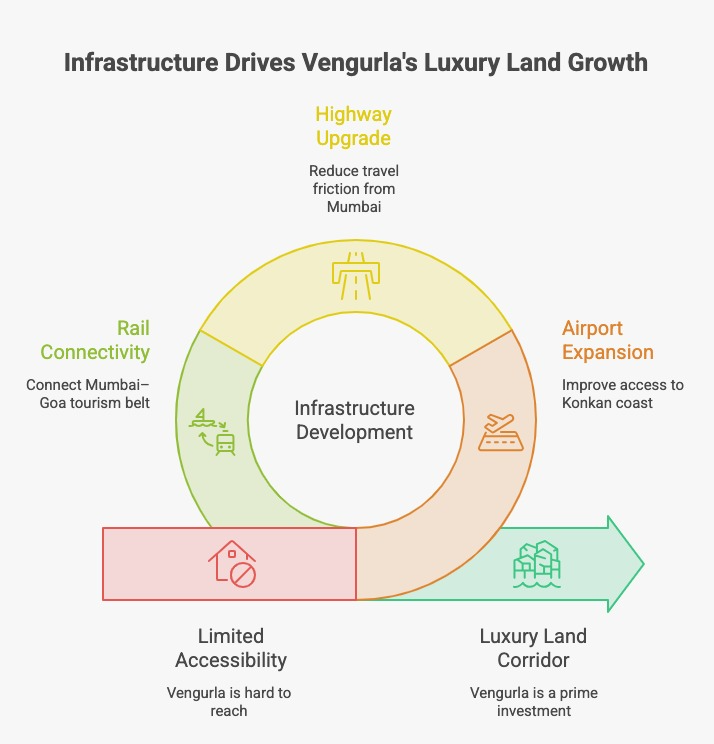
Infrastructure Deep Dive: The Primary Value Driver
Infrastructure is the single most important determinant of land value creation in emerging coastal markets.
Sindhudurg (Chipi) Airport: A Structural Demand Catalyst
The operational Sindhudurg Airport represents a major shift in accessibility dynamics.
Verified Infrastructure Facts:
- Greenfield Airport under the UDAN regional connectivity scheme
- Located in the Sindhudurg district (strategically near the Vengurla region)
- Designed for narrow-body commercial aircraft (A320/B737 category)
- Strengthens air connectivity to Mumbai and other major cities
Economic Significance:
Air connectivity transforms coastal land markets in three key ways:
1. Reduces Access Friction
Travel time compression increases weekend travel frequency.
2. Expands Buyer Pool
HNIs, NRIs, and metro-based professionals can access the region easily.
3. Enables Hospitality Scaling
Hotels and villa projects require reliable air access for occupancy stability.
This structural shift directly influences long-term luxury land investment in Vengurla demand cycles.
NH-66 Highway Corridor: The Mumbai–Goa Economic Spine
The Mumbai–Goa highway expansion is one of India’s most significant coastal infrastructure upgrades.
Key Impacts:
- Reduced travel time between Mumbai, Pune–Konkan, and Goa
- Improved logistics efficiency
- Increased domestic tourism flow
- Enhanced weekend mobility for urban populations
This corridor effectively integrates Vengurla into a larger western coastal economic system, rather than an isolated geography.
Konkan Railway: Structural Mobility Enabler
The Konkan Railway is a critical enabler of regional accessibility.
Strategic Role:
- Connects Mumbai–Ratnagiri–Sindhudurg–Goa
- Supports tourism mobility at scale
- Provides affordable intercity access
- Reduces dependency on road travel
Combined with airport and highway infrastructure, it creates a multi-modal transport system, which is rare in early-stage coastal markets.
Government Policy & Institutional Tourism Strategy
The Maharashtra government has consistently identified Sindhudurg as a key tourism development zone.
Policy Focus Areas:
- Coastal tourism development
- Eco-tourism corridors
- Heritage tourism circuits
- Hospitality investment facilitation
These policies are not symbolic; they are backed by infrastructure allocation and long-term district-level planning.
Institutional Validation: Hospitality Entry Signals
One of the strongest validation signals in real estate markets is entry by global hospitality brands.
The allocation of land for a major Taj Hotels (IHCL) project in the broader Sindhudurg region indicates:
- Long-term tourism confidence
- Institutional destination validation
- Anticipation of demand growth
This type of institutional entry typically precedes broader private-sector real estate interest, reinforcing the narrative behind luxury land investment in Vengurla.
Tourism Economics: The Primary Demand Engine
Tourism is the backbone of all coastal land appreciation cycles.
Key Tourism Segments Emerging in Vengurla:
- Eco-tourism (nature-driven travel)
- Beach tourism (low-density coastal leisure)
- Cultural tourism (Konkan heritage)
- Religious and temple circuits
- Weekend tourism from the Mumbai–Pune–Goa triangle
Structural Advantage:
Unlike Goa, Vengurla remains:
- Less commercialized
- Less saturated
- More environmentally preserved
This creates a differentiated positioning in the western coastal tourism ecosystem.
Second-Home Market Expansion: Behavioral Shift in India
A key macro trend shaping coastal real estate is the rise of second-home ownership.
Key Drivers:
- Remote/hybrid work adoption
- Wealth diversification among HNIs
- Post-pandemic lifestyle decentralization
- Demand for wellness-oriented living environments
These trends directly support long-term interest in luxury land investment in Vengurla.
Land Appreciation Logic: Scarcity + Infrastructure + Regulation
Land appreciation in coastal zones is driven by a combination of:
1. Infrastructure Expansion
Airports, highways, and railways increase accessibility.
2. Demand Growth
Tourism and second-home markets expand buyer base.
3. Regulatory Constraints
Coastal Regulation Zone (CRZ) laws limit supply.
CRZ Impact:
- Restricts construction density near the coastline
- Protects ecological zones
- Reduces available developable land
Economic Outcome:
Limited supply + increasing accessibility = long-term price stability pressure upward
This is a key structural driver of luxury land investment in Vengurla.
Comparative Market Positioning: Konkan vs Goa vs Alibaug
According to leading real estate consultancies:
- CBRE India
- Knight Frank India
Market Lifecycle Positioning:
Market | Stage | Characteristics |
Goa | Mature | High saturation, premium pricing |
Alibaug | Growth | Rapid second-home expansion |
Vengurla | Early-stage | Infrastructure-led emergence |
Interpretation:
Vengurla is still in an early-cycle discovery phase, making it structurally different from established coastal luxury markets.
This reinforces the long-term narrative for luxury land investment in Vengurla.
Environmental & Lifestyle Economics
Vengurla’s environmental profile plays a dual role:
Positive Factors:
- High biodiversity
- Clean coastline
- Low urban density
- Strong eco-tourism potential
Structural Impact:
Environmental regulation ensures:
- Controlled development
- Long-term sustainability
- Premium lifestyle positioning
This aligns with global trends in eco-sensitive luxury destinations.
Risk Framework: Institutional-Level Assessment
A balanced analysis requires acknowledging constraints:
1. Regulatory Constraints
CRZ rules limit development density.
2. Liquidity Risk
Emerging markets have slower resale cycles.
3. Execution Risk
Infrastructure timelines may shift.
4. Demand Cyclicality
Tourism-based economies fluctuate seasonally.
These are critical considerations in any luxury land investment in Vengurla strategy.
Future Outlook (2026–2036): Structural Growth Pathway
Based on current infrastructure and policy direction:
Key Growth Drivers:
- Expansion of Sindhudurg Airport connectivity
- Growth in branded hospitality assets
- Increased second-home adoption
- Spillover demand from Goa
- Improved highway integration
Long-Term Interpretation:
Vengurla is transitioning from a low-density coastal region into a structured secondary tourism and lifestyle investment corridor.
This supports a long-cycle thesis for luxury land investment in Vengurla, particularly for patient capital.
FAQs
1. Why is Vengurla being discussed as an emerging coastal investment destination?
Vengurla is gaining attention due to its position within the Sindhudurg coastal development zone, which is supported by tourism policy, infrastructure expansion, and environmental scarcity.
Key structural drivers include:
- Operational Sindhudurg (Chipi) Airport improving accessibility
- Inclusion in Maharashtra’s tourism development strategy
- Proximity to Goa’s saturated luxury real estate market
- Low-density coastal land availability
From an investment perspective, this places Vengurla in an early-stage coastal development cycle, where infrastructure precedes full real estate absorption.
2. What is the impact of Sindhudurg Airport on land value in Vengurla?
The Sindhudurg Airport is a greenfield airport developed under India’s regional connectivity scheme (UDAN), significantly improving access to the Konkan region.
Key impacts:
- Reduces travel time from metros (Mumbai, Pune)
- Expands weekend tourism demand
- Enhances the feasibility of second homes and luxury villas
- Supports hospitality sector growth
This infrastructure directly strengthens long-term luxury land investment in Vengurla fundamentals.
3. What role does CRZ regulation play in Vengurla land development?
Coastal Regulation Zone (CRZ) rules govern construction along India’s coastline and are strictly applicable in Sindhudurg.
According to regulatory frameworks, coastal land is divided into CRZ categories, restricting development near sensitive zones such as:
- High tide lines
- Mangroves
- Ecologically protected coastal areas
Verified CRZ framework overview:
Investment implication:
- Limits the oversupply of coastal development
- Ensures environmental protection
- Extends long-term appreciation cycles
However, it also increases due diligence requirements for investors.
4. Is Vengurla part of Maharashtra’s official tourism development strategy?
Policy focus areas include:
- Coastal tourism corridors
- Eco-tourism promotion
- Hospitality infrastructure development
- Regional employment generation
This policy framework strengthens institutional confidence in long-term regional development.
5. How does Vengurla compare with Goa and Alibaug in real estate evolution?
Based on industry research from CBRE and Knight Frank:
- Goa: Mature and highly saturated luxury market
- Alibaug: Rapidly growing second-home hub near Mumbai
- Vengurla: Early-stage coastal market with infrastructure-led growth
Key insight:
Vengurla is still in the price discovery and infrastructure formation phase, unlike Goa, which is already fully matured.
6. What is the long-term outlook (2026–2036) for Vengurla real estate?
Long-term growth is expected to be driven by:
- Airport-led connectivity improvements
- Expansion of the NH-66 highway corridor
- Growth of hospitality investments
- Spillover demand from Goa
- Rising second-home ownership trends
Interpretation:
Vengurla is transitioning into a secondary coastal investment corridor, where land appreciation tends to follow infrastructure completion cycles.
7. Is Vengurla suitable for NRI and HNI investment strategies?
Vengurla is increasingly being evaluated by HNIs and NRIs due to:
- Lifestyle-driven second-home demand
- Scarcity of coastal land
- Improved accessibility via airport infrastructure
- Lower entry cost compared to Goa
Key consideration:
It is more suitable for long-term capital appreciation strategies rather than short-term liquidity plays.
8. What are the main risks associated with investing in Vengurla land?
Key risks include:
- CRZ-based regulatory restrictions
- Title verification complexities in coastal land parcels
- Liquidity constraints in early-stage markets
- Infrastructure execution delays
- Seasonal tourism dependency
CRZ regulatory framework reference:
Investment note:
Due diligence and legal verification are essential before any acquisition.
9. What drives land appreciation in coastal regions like Vengurla?
Land appreciation in coastal micro-markets is driven by:
- Infrastructure expansion (airport, highway, railways)
- Tourism growth cycles
- Limited coastal land availability
- Regulatory restrictions limiting supply
Economic principle:
Scarcity + improved accessibility = long-term appreciation pressure upward.
10. Why is institutional interest increasing in the Sindhudurg region?
Institutional interest is visible through:
- Government-backed tourism development programs
- Infrastructure investments like Sindhudurg Airport
- Hospitality sector entry signals (major hotel groups)
- Coastal corridor planning initiatives
Interpretation:
Institutional participation typically signals long-term destination validation, which precedes large-scale real estate absorption.
A Structurally Emerging Coastal Asset Class
Vengurla is not a mature luxury market—it is a transitioning coastal micro-economy shaped by infrastructure, tourism policy, and environmental scarcity.
Key structural pillars include:
- Airport-led accessibility transformation
- Government-backed tourism development
- Institutional hospitality entry signals
- Controlled coastal development environment
In institutional real estate frameworks, luxury land investment in Vengurla represents:
A long-horizon, infrastructure-driven coastal land positioning opportunity within India’s evolving western shoreline economy.