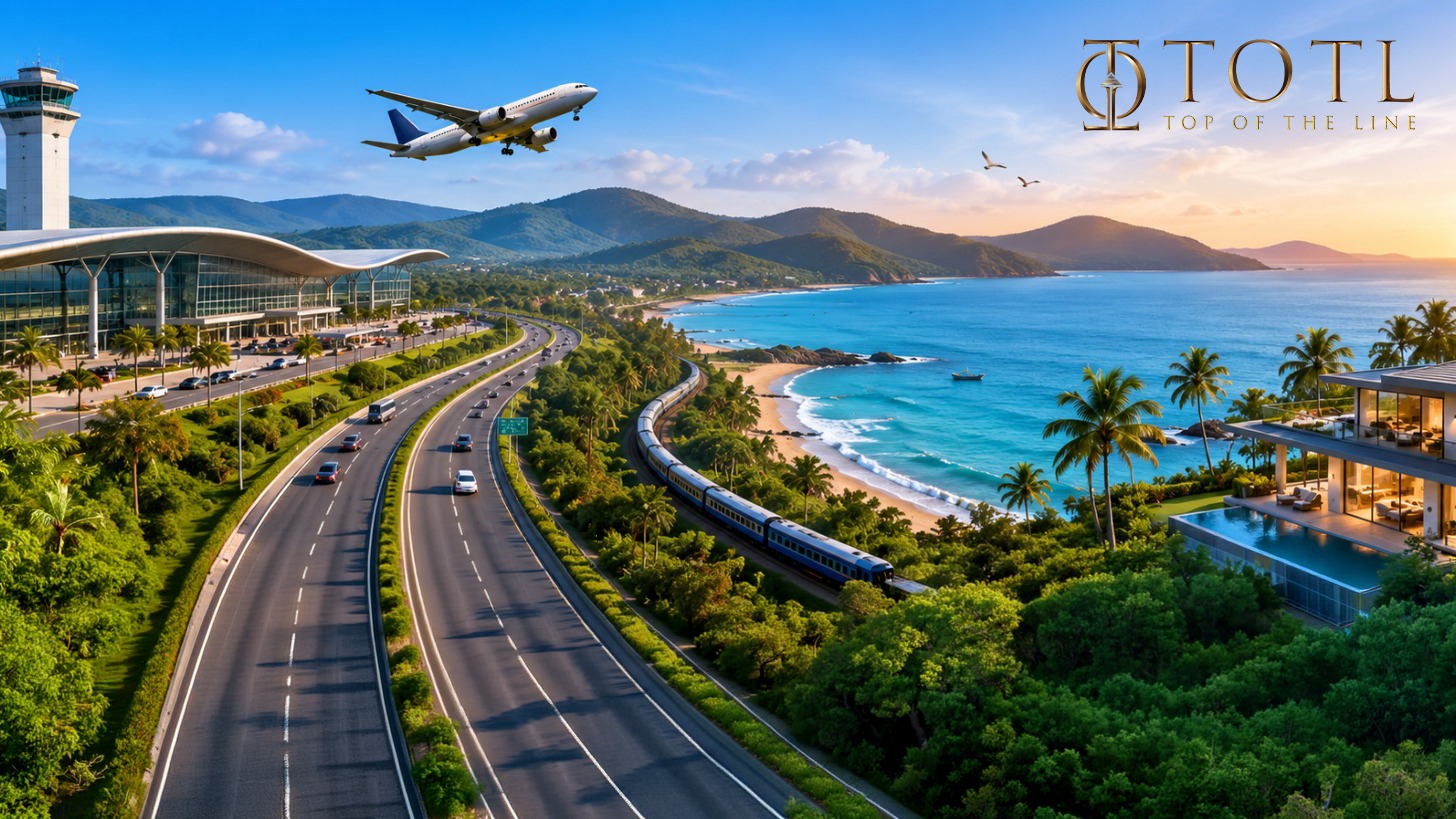
MOPA Airport and the Rise of the Konkan Coastal Growth Corridor: Why the Sindhudurg Investment Corridor Is Emerging on Investor Radar
Infrastructure has historically been one of the most powerful catalysts for economic transformation. Around the world, major airports, highways, ports, and rail corridors have altered regional growth patterns, reshaped investment flows, and transformed previously overlooked destinations into economic hotspots. From the emergence of Dubai around aviation connectivity to the evolution of India’s suburban growth corridors around expressways and metro networks, accessibility often becomes the foundation upon which future development is built.
A similar story is beginning to unfold along India’s western coastline.
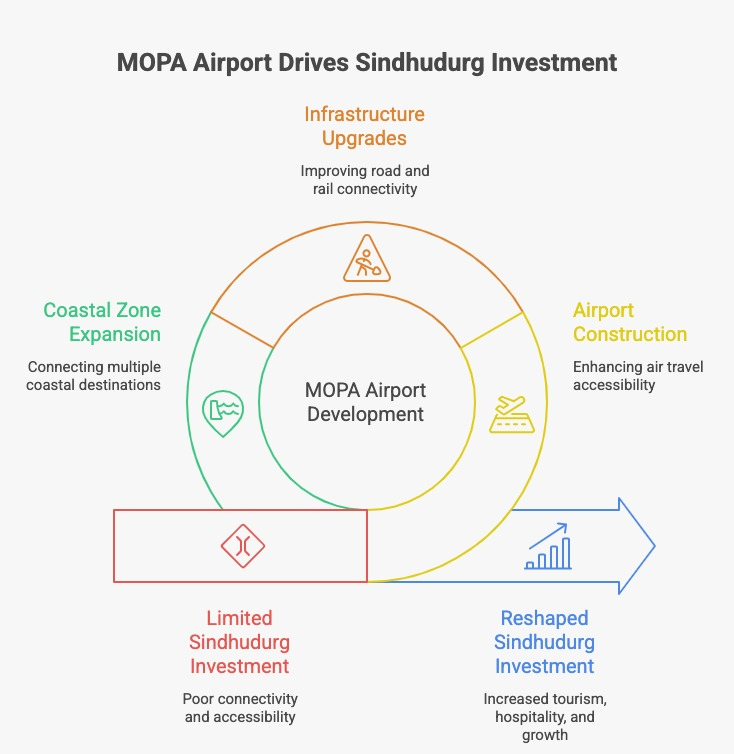
The inauguration of the Manohar International Airport, commonly known as MOPA Airport, has significantly altered travel accessibility across North Goa and the broader Konkan coastline. While the airport was developed primarily to strengthen Goa’s aviation infrastructure, its impact extends far beyond state boundaries. Improved connectivity is influencing tourism patterns, hospitality investments, mobility networks, and real estate discussions across neighboring regions, particularly in the emerging Sindhudurg Investment Corridor.
For decades, Sindhudurg was known primarily for its pristine beaches, marine biodiversity, historic forts, and relatively untouched natural environment. Despite possessing many of the characteristics that attract tourism and lifestyle investments, the district remained largely outside mainstream investor conversations due to limited accessibility and lower infrastructure visibility.
Today, however, several factors are converging simultaneously:
- Expansion of air connectivity through MOPA Airport
- Upgrades to NH-66
- Improvements in Konkan Railway infrastructure
- Rising domestic tourism
- Growing demand for second homes
- Increased hospitality investments
- Expansion of experiential and eco-tourism
Together, these developments are creating a broader coastal growth ecosystem that is bringing new attention to the Sindhudurg Investment Corridor.
This article examines the economic, infrastructure, tourism, and real estate dynamics behind this transformation and explores how changing accessibility is reshaping the geography of coastal development in western India.
Understanding MOPA Airport’s Strategic Importance Beyond Goa
When the Government of Goa approved the development of MOPA Airport, the objective was not simply to build another airport. The larger vision was to create additional aviation capacity, strengthen international connectivity, and support long-term economic growth in the region.
The airport officially commenced operations in January 2023 and has quickly emerged as a significant aviation hub. According to reports from Goa’s aviation authorities, passenger traffic at MOPA crossed approximately 4.7 million passengers during 2024, representing substantial year-on-year growth. This rapid adoption reflects the increasing demand for travel into North Goa and the surrounding regions.
The significance of MOPA extends beyond passenger numbers.
Historically, travelers arriving in Goa through the older airport in South Goa often faced lengthy road journeys to reach destinations in North Goa or the northern coastal belt. MOPA effectively rebalances regional accessibility by positioning a major aviation gateway closer to North Goa and the southern Konkan region.
This shift has important implications because accessibility often determines how quickly tourism, hospitality, and investment ecosystems evolve.
Regions that become easier to reach typically witness:
- Increased tourist arrivals
- Higher hospitality occupancy
- Greater investor interest
- Stronger business activity
- Enhanced regional visibility
These patterns have been observed repeatedly across infrastructure-led growth markets throughout India.
How MOPA Is Redefining Accessibility Across the Konkan Coast
One of the most important concepts in regional development is “travel-time compression.”
In many cases, economic growth is driven less by physical distance and more by the time required to access a destination.
For years, Sindhudurg’s challenge was not a lack of natural attractions or tourism potential. The challenge was accessibility.
Travelers often viewed the region as remote because reaching it involved long road journeys despite relatively short geographic distances from major urban centers.
MOPA changes this equation.
Visitors can now access North Goa through a modern international airport and continue onward by road to destinations across the southern Konkan belt.
This improved connectivity is particularly relevant for travelers arriving from:
- Mumbai
- Delhi
- Bengaluru
- Hyderabad
- Ahmedabad
- Pune
- International destinations in the Middle East
The result is a significant reduction in travel friction.
Instead of being perceived as a distant destination, many locations within the Sindhudurg Investment Corridor are increasingly viewed as accessible coastal alternatives for leisure travel, second-home ownership, and hospitality ventures.
This accessibility shift matters because investor attention often follows improvements in connectivity long before large-scale development occurs.
Historically, many successful tourism-driven real estate markets experienced a similar sequence:
Infrastructure → Accessibility → Tourism Growth → Hospitality Investment → Real Estate Demand
The emerging Sindhudurg Investment Corridor appears to be entering the early stages of this progression.
The Strategic Position of the Sindhudurg Investment Corridor
The term Sindhudurg Investment Corridor is becoming increasingly relevant because the district occupies a unique geographic position.
Situated between Maharashtra’s western coastline and Goa’s tourism ecosystem, Sindhudurg benefits from several overlapping growth drivers.
1. Proximity to Goa’s Tourism Economy
Goa remains one of India’s most recognized tourism destinations.
As visitor numbers continue to grow, travelers increasingly explore nearby destinations offering:
- Less crowded beaches
- Nature-based tourism
- Cultural experiences
- Marine activities
- Wellness retreats
This broader tourism movement benefits neighboring coastal regions.
2. Connectivity Advantages
The combination of MOPA Airport, NH-66 improvements, and Konkan Railway access strengthens regional integration.
Improved mobility allows tourists and investors to explore a larger geographic area during a single trip.
3. Coastal Scarcity
One of the defining characteristics of coastal real estate globally is limited supply.
Unlike urban land, coastlines cannot be replicated.
As tourism expands and infrastructure improves, coastal regions often attract increasing attention due to the scarcity of beachfront and near-coastal land.
The Sindhudurg Investment Corridor benefits from this structural advantage.
Tourism Growth: The Foundation of Long-Term Economic Expansion
Tourism is frequently the first indicator of future real estate activity in coastal regions.
Before hotels are built, before villas are developed, and before investors enter the market, tourism typically establishes demand.
Sindhudurg possesses several tourism assets that have supported its growing visibility.
Beach Tourism
The district is home to numerous coastal destinations that attract visitors seeking relatively less commercialized beach experiences.
Notable destinations include:
- Tarkarli Beach
- Devbagh Beach
- Vengurla Beach
- Shiroda Beach
These locations increasingly attract domestic travelers seeking coastal experiences beyond traditional tourism circuits.
Marine Tourism
Marine tourism has emerged as an important growth segment.
Activities include:
- Scuba diving
- Snorkeling
- Parasailing
- Dolphin safaris
- Boat excursions
The district’s coastal ecosystem supports a variety of tourism experiences that appeal to younger travelers and experiential tourism enthusiasts.
The growing popularity of marine tourism aligns with broader trends in Indian tourism, where travelers increasingly seek experiences rather than conventional sightseeing.
Eco-Tourism and Sustainable Travel
Another important factor contributing to the visibility of the Sindhudurg Investment Corridor is the rise of eco-tourism.
Globally, travelers are increasingly prioritizing:
- Nature-based tourism
- Sustainable destinations
- Wellness travel
- Slow travel experiences
- Environmental conservation
Sindhudurg’s relatively preserved coastline positions it well within these emerging trends.
The district’s appeal is not based solely on infrastructure development. Equally important is its ability to maintain natural assets while benefiting from improved connectivity.
This balance is increasingly valued by both travelers and long-term investors.
Infrastructure Projects Supporting the Sindhudurg Investment Corridor
While MOPA Airport is often viewed as the headline development, it is only one component of a much broader infrastructure transformation.
Several parallel projects are improving connectivity and economic integration across the region.
MOPA Airport Connectivity Roads
The development of dedicated airport access roads and improved highway connections has enhanced regional mobility.
These projects reduce travel times and improve accessibility between the airport and surrounding coastal destinations.
NH-66 Mumbai–Goa Highway Upgrades
Few infrastructure projects are as significant to western India’s coastal economy as the modernization of NH-66.
The highway serves as a critical transportation corridor connecting:
- Mumbai
- Raigad
- Ratnagiri
- Sindhudurg
- Goa
The widening and upgrading of NH-66 is expected to:
- Improve tourism mobility
- Reduce travel times
- Strengthen logistics networks
- Increase regional economic integration
- Support business expansion
For the Sindhudurg Investment Corridor, enhanced road infrastructure represents one of the most important long-term growth drivers.
Konkan Railway Modernization
The Konkan Railway continues to serve as a crucial transportation backbone for the region.
Recent modernization initiatives include:
- Station upgrades
- Enhanced passenger services
- Logistics improvements
- Expanded freight capabilities
The railway plays a vital role in improving connectivity while supporting tourism and economic activity across the Konkan belt.
Why Investors Are Beginning to Monitor the Region
The growing interest in the Sindhudurg Investment Corridor is not being driven by a single event.
Instead, it reflects the convergence of multiple long-term trends:
- Improved aviation access
- Expanding tourism demand
- Better highway infrastructure
- Rising hospitality investments
- Growing interest in lifestyle assets
- Increasing focus on coastal destinations
- Demand for second homes and experiential travel
Investors typically monitor regions where infrastructure improvements precede large-scale market expansion.
Historically, some of India’s most successful growth corridors emerged when transportation infrastructure significantly improved access to previously underexplored destinations.
The next phase of analysis involves understanding how hospitality investments, changing investor behavior, second-home demand, and evolving real estate trends are shaping the future trajectory of the Sindhudurg Investment Corridor.
Hospitality Investments, Real Estate Trends, and the Future of the Sindhudurg Investment Corridor
As infrastructure improves and tourism expands, the next phase of regional transformation often comes through hospitality investment. Across many emerging coastal markets, hotels, resorts, wellness retreats, and tourism-focused developments typically arrive before large-scale residential growth. The same pattern is increasingly visible within the Sindhudurg Investment Corridor.
Understanding this progression is important because hospitality activity often acts as an early indicator of future economic and real estate momentum.
Hospitality Investments Arriving Ahead of Residential Growth
Economic development in tourism-oriented regions often follows a recognizable sequence:
Infrastructure → Tourism → Hospitality → Residential Demand → Capital Formation
The emerging Sindhudurg Investment Corridor appears to be moving through this developmental cycle.
Improved connectivity has made the district more accessible to domestic travelers, weekend tourists, and international visitors arriving through Goa. As visitor movement increases, accommodation demand naturally follows.
Industry reports and tourism observers have noted increasing interest in:
- Boutique resorts
- Eco-resorts
- Wellness retreats
- Luxury homestays
- Experiential tourism properties
- Nature-based accommodation formats
The hospitality sector is particularly important because it introduces organized investment into a destination before residential markets mature.
Unlike speculative activity, hospitality investment is often based on measurable demand indicators such as:
- Tourist arrivals
- Occupancy levels
- Average room rates
- Seasonal demand patterns
- Visitor spending
According to tourism and hospitality industry studies, the broader MOPA influence zone is expected to attract significant hospitality investments over the coming decade, driven by increasing accessibility and tourism expansion.
The significance of this trend for the Sindhudurg Investment Corridor lies in the multiplier effect that hospitality investments create.
Hotels generate demand for:
- Local employment
- Retail businesses
- Transportation services
- Food and beverage establishments
- Tourism infrastructure
- Professional services
These economic linkages often strengthen the foundation for broader regional development.
Understanding the Changing Psychology of Coastal Investors
Investor behavior has evolved significantly over the past decade.
Historically, many investors concentrated primarily on metropolitan residential markets and urban commercial assets. However, post-pandemic shifts have altered preferences across several demographic segments.
Today, investors increasingly evaluate assets through broader lifestyle and diversification perspectives.
Several themes are influencing this shift:
Lifestyle-Led Ownership
Many buyers now seek assets that combine utility with lifestyle value.
This has contributed to growing interest in:
- Coastal homes
- Nature-oriented locations
- Wellness destinations
- Vacation residences
- Flexible-use properties
The Sindhudurg Investment Corridor benefits from these broader lifestyle trends because it offers access to natural environments while gradually improving connectivity.
Remote and Hybrid Work Culture
The expansion of remote and hybrid work models has reduced dependence on traditional urban centers.
Professionals can increasingly spend extended periods in non-metro locations while maintaining business connectivity.
This shift has expanded interest in destinations that offer:
- Quality of life
- Natural surroundings
- Lower density environments
- Improved digital infrastructure
Although still developing, the Sindhudurg Investment Corridor increasingly appears in conversations surrounding lifestyle-oriented living and flexible work environments.
Wealth Preservation Through Real Assets
Many HNIs and NRIs continue to view land and property as long-term stores of value.
Coastal assets often attract attention because of their inherent scarcity.
Unlike many urban developments where supply can expand vertically, coastlines are finite.
As a result, coastal land markets are often evaluated through a scarcity lens rather than purely through conventional supply-demand metrics.
Key Real Estate Trends Shaping the Sindhudurg Investment Corridor
Real estate activity within emerging coastal markets rarely develops uniformly.
Instead, certain asset classes tend to gain traction before others.
Current trends within the Sindhudurg Investment Corridor suggest several areas of growing interest.
Land Banking Activity
Land continues to represent one of the most closely monitored asset classes in emerging coastal regions.
Investors often focus on land because it offers exposure to future infrastructure-led growth without requiring immediate development.
Several factors contribute to growing interest in coastal land:
- Limited supply
- Long-term infrastructure improvements
- Tourism expansion
- Future development potential
However, investors typically evaluate such opportunities based on clear title verification, regulatory compliance, and long-term planning considerations.
Second Home Demand
Second-home demand has become a notable trend across India’s coastal markets.
This demand is being driven by:
- Lifestyle diversification
- Retirement planning
- Family recreation
- Flexible living arrangements
The appeal of second homes is no longer restricted to traditional holiday periods.
Many buyers now seek year-round utility through extended stays and hybrid work arrangements.
As accessibility improves, the Sindhudurg Investment Corridor becomes increasingly relevant within these broader second-home discussions.
Coastal Villa Development
Across many coastal markets, villa developments often emerge before large-scale apartment-driven growth.
Several factors support this trend:
- Privacy preferences
- Low-density living
- Lifestyle positioning
- Tourism-linked demand
Villa-oriented developments are particularly common in destinations where natural surroundings represent a key attraction.
The evolution of this segment within the Sindhudurg Investment Corridor remains closely linked to future tourism growth and infrastructure expansion.
Hospitality-Linked Residential Models
Another emerging trend involves hospitality-supported ownership formats.
These models may include:
- Managed residences
- Vacation homes
- Tourism-linked accommodation
- Flexible-use residential assets
Globally, such formats have become increasingly popular in tourism-driven regions where owners seek a balance between personal use and operational management.
Lessons from Other Infrastructure-Led Coastal Markets
One of the most useful ways to understand the future potential of the Sindhudurg Investment Corridor is to examine how other coastal markets evolved following major infrastructure improvements.
Alibaug
Improved ferry services, road connectivity, and increasing demand from Mumbai residents contributed to Alibaug’s growing visibility.
The region gradually transitioned from a weekend destination to a recognized lifestyle and second-home market.
Kannur
The opening of Kannur International Airport improved accessibility across northern Kerala.
Subsequent years witnessed increased interest in hospitality and tourism-related investments.
Dapoli
Dapoli’s evolution demonstrates how tourism visibility can gradually influence real estate activity.
Infrastructure improvements, combined with growing tourism awareness, increased interest in coastal and lifestyle-oriented assets.
North Goa
North Goa itself provides an example of how sustained infrastructure investment can alter regional economic geography.
Improved road networks, tourism growth, hospitality investments, and aviation connectivity contributed to long-term market expansion.
The Sindhudurg Investment Corridor remains at a much earlier stage of development, but several underlying growth drivers mirror patterns observed in other infrastructure-led destinations.
Opportunities Within the Sindhudurg Investment Corridor
While no market develops in a perfectly linear manner, several opportunities are emerging from the region’s evolving economic landscape.
Tourism Economy Expansion
Increasing visitor movement can support:
- Accommodation demand
- Recreation businesses
- Food and beverage services
- Tourism infrastructure
Hospitality Growth
Growing tourism often creates demand for:
- Resorts
- Boutique hotels
- Wellness retreats
- Experiential tourism offerings
Eco-Tourism
Global interest in sustainable travel continues to rise.
Destinations capable of balancing tourism growth with environmental preservation may benefit from long-term demand trends.
Coastal Real Assets
Scarcity remains one of the defining characteristics of coastal regions.
As infrastructure improves, coastal land and lifestyle-oriented properties often attract increased attention from long-term investors.
Challenges and Considerations Investors Should Monitor
Balanced market intelligence requires evaluating both opportunities and challenges.
Several factors deserve ongoing attention.
Infrastructure Completion Timelines
Large-scale infrastructure projects often experience delays.
The pace of highway completion, connectivity upgrades, and supporting infrastructure development will influence future growth trajectories.
Environmental Sustainability
The long-term appeal of the Sindhudurg Investment Corridor depends significantly on environmental stewardship.
The region’s natural assets—including beaches, marine ecosystems, and biodiversity—form the foundation of its tourism appeal.
Sustainable development practices will therefore remain essential.
Regulatory Compliance
Investors evaluating coastal assets should pay careful attention to:
- Coastal Regulation Zone norms
- Land-use regulations
- Development permissions
- Environmental clearances
Regulatory due diligence remains critical in any coastal market.
Seasonal Tourism Patterns
Tourism demand can fluctuate throughout the year.
Hospitality operators and investors often account for seasonality when evaluating long-term performance expectations.
Economic Indicators That Could Shape the Next Decade
Several measurable indicators may influence the future trajectory of the Sindhudurg Investment Corridor.
Key metrics include:
Aviation Indicators
- MOPA passenger traffic
- New domestic routes
- International connectivity expansion
Tourism Indicators
- Visitor arrivals
- Hotel occupancy
- Tourism spending
Infrastructure Indicators
- NH-66 completion progress
- Railway modernization projects
- Coastal infrastructure investments
Investment Indicators
- Hospitality project announcements
- Tourism-related investments
- Private sector participation
Monitoring these metrics provides a more objective framework for understanding regional growth.
FAQs
1. What is the Sindhudurg Investment Corridor, and why is it gaining attention?
The Sindhudurg Investment Corridor refers to the emerging coastal growth belt across Sindhudurg that is benefiting from improved connectivity, tourism expansion, and infrastructure development. The region is increasingly being monitored by investors due to the impact of MOPA Airport, NH-66 upgrades, and rising hospitality investments.
2. How has MOPA Airport influenced the Sindhudurg Investment Corridor?
The opening of MOPA Airport has significantly improved accessibility to North Goa and nearby coastal regions. Reduced travel times and expanded domestic and international connectivity have increased the visibility of the Sindhudurg Investment Corridor among tourists, businesses, and investors.
3. Why is connectivity important for the growth of the Sindhudurg Investment Corridor?
Infrastructure connectivity often catalyzes economic growth. Improved airport access, highways, and railway networks can stimulate tourism, encourage business activity, and strengthen regional development within the Sindhudurg Investment Corridor.
4. What role does tourism play in the Sindhudurg Investment Corridor?
Tourism acts as a foundation for economic activity by generating demand for hospitality, transportation, retail, and tourism-related services. The growth of beach tourism, marine tourism, and eco-tourism continues to contribute to the evolution of the Sindhudurg Investment Corridor.
5. How are infrastructure projects shaping the future of the Sindhudurg Investment Corridor?
Major projects such as MOPA Airport, NH-66 modernization, and Konkan Railway upgrades are improving regional accessibility and strengthening economic integration. These developments are considered key growth drivers for the Sindhudurg Investment Corridor.
6. Why are hospitality investors showing interest in the Sindhudurg Investment Corridor?
Growing tourist arrivals and improved connectivity have increased interest in hospitality formats such as resorts, boutique hotels, wellness retreats, and eco-tourism projects. These trends are contributing to the broader economic development of the Sindhudurg Investment Corridor.
7. What makes the Sindhudurg Investment Corridor different from other coastal regions?
The Sindhudurg Investment Corridor combines a relatively untouched coastline, improving infrastructure, proximity to Goa, growing tourism demand, and increasing economic activity. This combination creates a unique growth narrative within India’s coastal economy.
8. What economic indicators should investors monitor in the Sindhudurg Investment Corridor?
Key indicators include airport passenger traffic, tourism arrivals, hotel occupancy rates, highway completion progress, hospitality investments, and government infrastructure spending. These metrics provide insights into the long-term trajectory of the Sindhudurg Investment Corridor.
9. What challenges could influence the future of the Sindhudurg Investment Corridor?
Important considerations include infrastructure execution timelines, environmental sustainability, regulatory compliance, and seasonal tourism patterns. Long-term growth within the Sindhudurg Investment Corridor will depend on balancing development with conservation.
10. What is the long-term outlook for the Sindhudurg Investment Corridor?
The long-term outlook for the Sindhudurg Investment Corridor is closely linked to continued infrastructure expansion, tourism growth, hospitality investment, and sustainable regional development. As accessibility improves, the region is increasingly being studied as part of a broader western coastal growth corridor.
The Long-Term Outlook for the Sindhudurg Investment Corridor
The most significant impact of MOPA Airport may not be measured solely in passenger numbers.
Its broader influence lies in altering how accessibility is perceived across the western coastline.
Historically, geography often determined economic opportunity. Today, infrastructure increasingly determines geography.
The Sindhudurg Investment Corridor sits at the intersection of several long-term trends:
✔ Improved aviation connectivity
✔ Highway modernization
✔ Railway upgrades
✔ Tourism expansion
✔ Hospitality investments
✔ Rising demand for experiential travel
✔ Growing interest in coastal living
✔ Expansion of second-home ownership
✔ Eco-tourism growth
✔ Increasing regional visibility
While the district remains in an evolving stage of development, the combination of these factors has placed it on the radar of investors, tourism operators, policymakers, and market observers.
The emergence of the Sindhudurg Investment Corridor illustrates how infrastructure can gradually reshape regional economic geography.
The opening of MOPA Airport has improved accessibility not only for Goa but for a much broader coastal region extending into southern Maharashtra. Combined with highway upgrades, railway improvements, tourism growth, and increasing hospitality activity, these developments are creating new opportunities for economic expansion.
Importantly, the story is not solely about real estate. It is equally about connectivity, tourism, regional development, and the evolving relationship between infrastructure and investment.
As the coming decade unfolds, the success of the Sindhudurg Investment Corridor will likely depend on its ability to balance growth with sustainability, attract investment while preserving natural assets, and leverage improved connectivity to create long-term economic value.
For investors, policymakers, business leaders, and hospitality stakeholders, the region offers a compelling case study of how infrastructure can influence the future trajectory of coastal economies without losing sight of the environmental and cultural assets that make them distinctive.