
Why Invest in Sindhudurg in 2026? How MOPA, NH-66, Tourism & North Goa Are Shaping a New Coastal Investment Corridor
The Indian coastal real estate market is entering a more infrastructure-led phase. Buyers are no longer evaluating second homes and leisure properties only on beaches, views, or lifestyle appeal. Increasingly, they are looking at airport connectivity, highway access, tourism volumes, hospitality investment, destination development and long-term economic potential.
This shift is particularly relevant to the emerging Sindhudurg–North Goa corridor.
For investors asking whether they should invest in Sindhudurg, the most important question is not whether property prices will rise by a predetermined percentage. It is whether the underlying economic ecosystem is becoming strong enough to support sustained real estate demand over the long term.
Several developments make 2026 an important year to study this corridor. Manohar International Airport (MOPA) continues to expand its passenger base and infrastructure. NH-66 remains a critical road connection through the Konkan region. Sindhudurg’s Chipi Airport provides an additional aviation gateway. Goa recorded more than 10.8 million tourist arrivals in 2025, while major hospitality investment is advancing in Sindhudurg, including the Taj/IHCL project at Shiroda–Velaghar.
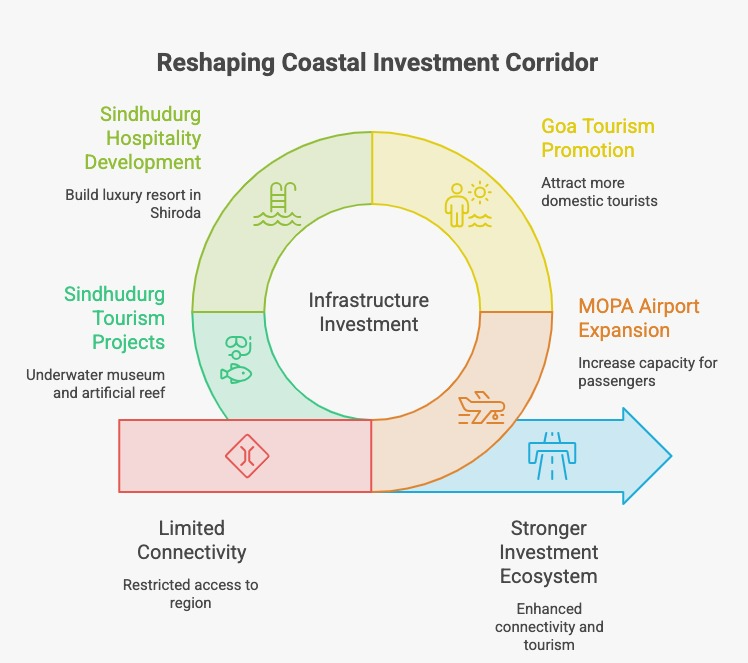
Together, these developments are creating a more connected coastal ecosystem extending from North Goa into southern Sindhudurg.
For those considering whether to invest in Sindhudurg, understanding this broader corridor may therefore be more useful than examining property prices in isolation.
Why Invest in Sindhudurg? Understanding the Emerging Coastal Investment Thesis
The case to invest in Sindhudurg is increasingly connected to the region’s transition from a primarily tourism-oriented destination into a more accessible leisure and lifestyle market.
Sindhudurg already possesses several natural advantages: beaches, marine tourism, forts, forests, cultural attractions and proximity to Goa. Maharashtra Tourism highlights destinations such as Tarkarli and Sindhudurg’s coastal attractions, including scuba diving, water sports and heritage tourism.
What is changing is the supporting infrastructure around those destinations.
A useful way to evaluate the opportunity to invest in Sindhudurg is through five interconnected factors:
Connectivity + Tourism + Hospitality + Demand + Quality Supply
Infrastructure improves accessibility. Better accessibility can support tourism. Growing tourism can attract hospitality investment. Hospitality can strengthen destination visibility and local services. Together, these factors can create a stronger environment for residential and leisure real estate.
This does not mean every property will appreciate equally. For investors looking to invest in Sindhudurg, micro-location, title, zoning, development permissions, road access, construction quality, pricing, and actual market demand remain essential considerations.
The broader investment thesis is therefore about long-term corridor development, rather than short-term speculation.
Sindhudurg Infrastructure Development: The Connectivity Story Behind Real Estate Growth
NH-66: The Road Spine of the Konkan Corridor
One of the most important reasons to invest in Sindhudurg is the district’s position along the NH-66 connectivity network.
NH-66 forms a critical north-south road spine along India’s western coast, connecting Maharashtra, Goa and Karnataka. For Sindhudurg, road accessibility is especially important because many leisure destinations are distributed across a relatively large coastal geography.
Improved road connectivity can influence real estate in several ways:
- easier weekend travel;
- larger catchment areas for second-home buyers;
- better movement of tourists;
- improved access for hospitality businesses;
- stronger connections between towns and tourism destinations;
- greater commercial viability for services and retail.
The National Highways Authority of India publishes project-status information for highway works and related infrastructure.
For someone evaluating whether to invest in Sindhudurg, the key point is that road infrastructure should be viewed as an economic enabler rather than simply a transport facility.
Why Highway Connectivity Matters for Property
A coastal property becomes considerably more practical when the journey from a major urban centre is predictable.
For second-home buyers from Mumbai, Pune or other major cities, this can influence how frequently a property can actually be used.
For investors, improved road access can also expand the potential customer base for hospitality, holiday homes and managed residences.
However, investors should distinguish between announced infrastructure and operational infrastructure. A proposed road should never be treated as though it has already delivered its expected economic benefit.
Chipi Airport: Sindhudurg’s Additional Aviation Gateway
The opportunity to invest in Sindhudurg is also linked to the continued development of Chipi Airport in the Vengurla region.
Chipi provides an aviation gateway directly within Sindhudurg, while MOPA provides a much larger international and domestic airport ecosystem in neighbouring North Goa.
The distinction is important.
MOPA is a large-scale regional aviation engine.
Chipi is a local Sindhudurg connectivity asset.
AAI’s airport data places Sindhudurg Airport within the smaller passenger-throughput category, illustrating that the airport is still operating at a significantly different scale from MOPA.
For those considering whether to invest in Sindhudurg, Chipi’s significance should therefore be assessed in terms of accessibility and future connectivity rather than by comparing its passenger volume with larger metropolitan airports.
MOPA Airport and the Long-Term Transformation of North Goa
If one infrastructure asset deserves particular attention when assessing whether to invest in Sindhudurg, it is MOPA.
Manohar International Airport has rapidly become an important part of Goa’s aviation infrastructure.
According to the Goa Economic Survey 2025–26, from its commencement in January 2023 through January 2026, MOPA handled 14,094,729 domestic and international passengers and facilitated 97,383 aircraft movements, connecting 20 domestic and 12 international destinations.
The same government report states that terminal expansion is underway at a cost of ₹255.69 crore, increasing terminal built-up area from 65,600 sq m to 83,900 sq m. It also records the airport entering Phase III, with capacity increasing beyond its original Phase-I capacity of 4.4 million passengers.
This is significant for anyone considering whether to invest in Sindhudurg because airports influence property markets through accessibility.
MOPA Passenger Momentum
GMR’s traffic data showed MOPA handling approximately 3.82 million passengers during the first nine months of FY2026, representing around 13% year-on-year growth. December 2025 also recorded more than 525,000 passengers at the airport.
The important takeaway is not simply the passenger number.
It is the direction of infrastructure development.
As airport connectivity expands, locations that were previously considered relatively distant from major tourism gateways can become more accessible to domestic and international travellers.
That can potentially benefit:
- luxury villas;
- second homes;
- hospitality projects;
- serviced residences;
- vacation rentals;
- restaurants and experiences;
- tourism-oriented businesses.
For investors looking to invest in Sindhudurg, MOPA effectively expands the geographical lens beyond the Goa state boundary.
MOPA as an Economic Infrastructure Asset
MOPA’s influence is also extending beyond passenger aviation.
Goa’s infrastructure ecosystem around the airport is developing alongside tourism and logistics activity. The state’s economic planning increasingly treats the airport as part of a broader connectivity and economic-development network.
This is why investors should consider MOPA not simply as an airport but as a potential regional economic multiplier.
North Goa’s Evolving Real Estate Investment Ecosystem
The opportunity to invest in Sindhudurg cannot be fully understood without looking at North Goa.
North Goa already has a mature luxury property ecosystem built around tourism, hospitality, restaurants, beaches and second-home demand.
The region has established premium markets such as:
- Assagao;
- Anjuna;
- Vagator;
- Morjim;
- Siolim;
- Mandrem;
- Pernem.
For someone looking to invest in Sindhudurg, this established North Goa market is relevant because it demonstrates the strength of the wider coastal lifestyle economy.
At the same time, the North Goa market has become more selective.
Recent market reporting has highlighted a period of price moderation in some villa segments as supply and buyer preferences evolve.
That is an important lesson for investors.
A growing destination does not mean every property automatically becomes a strong investment.
Asset quality, location, legal clarity, pricing, and demand remain important.
Tourism Growth: The Demand Engine Behind Coastal Real Estate
One of the strongest reasons to invest in Sindhudurg is the tourism ecosystem developing across the broader coastal corridor.
Goa recorded 10,802,410 tourist arrivals in 2025, consisting of:
- 10,284,608 domestic tourists
- 517,802 foreign tourists
This was an increase from approximately 10.41 million arrivals in 2024.
Goa Tourism in Numbers
Year | Total Tourist Arrivals |
2021 | 3.33 million |
2022 | 7.19 million |
2023 | 8.63 million |
2024 | 10.41 million |
2025 | 10.80 million |
Source: Government of Goa tourism data.
For investors considering whether to invest in Sindhudurg, this matters because tourism creates the underlying demand ecosystem for leisure real estate.
The relationship can be expressed simply:
Tourism → Accommodation → Hospitality → Employment & Services → Lifestyle Demand → Real Estate
Tourism growth does not guarantee property appreciation, but it provides an economic foundation upon which real estate markets can develop.
International Tourism Is Also Relevant
Goa recorded 1,784 international flights in 2025, carrying approximately 235,798 foreign tourists, according to the state’s tourism data. MOPA accounted for a substantial portion of these scheduled international flights.
This matters for HNIs and NRIs considering coastal property.
International connectivity makes the broader region more accessible to overseas buyers and their families.
For people looking to invest in Sindhudurg, MOPA therefore represents an opportunity to access a larger tourism and aviation ecosystem without relying exclusively on Chipi Airport.
Hospitality Expansion Is Changing Sindhudurg’s Investment Narrative
The most important 2026 hospitality development for those considering whether to invest in Sindhudurg is the advancement of the Taj/IHCL project at Shiroda–Velaghar.
On 18 August 2026, a tripartite agreement was signed between Indian Hotels Company Limited (IHCL), Maharashtra Tourism Development Corporation (MTDC), and the local landholders’ representative body for the proposed Taj hotel project at Shiroda–Velaghar.
The development is significant because institutional hospitality investment can contribute to destination visibility, visitor spending and local economic activity.
IHCL has previously described its Shiroda project as a luxury resort spread across 138 acres, with 150 rooms including 46 villas, alongside restaurants, wellness facilities and other resort infrastructure.
Why Does Branded Hospitality Matter?
For those evaluating whether to invest in Sindhudurg, the importance of a major hospitality project goes beyond the hotel itself.
A successful destination ecosystem generally requires several layers:
Accommodation
↓
Restaurants
↓
Experiences
↓
Transport
↓
Local services
↓
Tourism employment
↓
Visitor spending
↓
Real estate demand
IHCL’s wider expansion strategy also provides context. In Q1 FY2027, IHCL reported reaching a portfolio of 645 hotels with a pipeline of 263 hotels, while specifically identifying Sindhudurg among emerging markets where the company was expanding.
The 2026 agreement at Shiroda should nevertheless be described accurately as a major development milestone, not as an already operational hotel.
For investors looking to invest in Sindhudurg, that distinction is important because credible investment research must separate announcements, agreements, construction and completed infrastructure.
Government-Led Tourism Initiatives Could Broaden Sindhudurg’s Appeal
Another factor supporting the long-term case to invest in Sindhudurg is tourism diversification.
The Ministry of Tourism has approved ₹46.91 crore for the INS-Guldar Underwater Museum, Artificial Reef and Submarine Tourism project in Sindhudurg under its tourism-development framework.
This is significant because Sindhudurg’s tourism proposition is not limited to beaches.
The district has the potential to combine:
- coastal tourism;
- scuba diving;
- water sports;
- heritage;
- forts;
- marine experiences;
- culinary tourism;
- wellness;
- nature-based tourism.
Maharashtra Tourism highlights Tarkarli and other Sindhudurg destinations for their beaches, marine activities, Sindhudurg Fort and water-based experiences.
For people evaluating whether to invest in Sindhudurg, diversified tourism is important because destinations with multiple visitor motivations can potentially create broader and more resilient demand than markets dependent on a single attraction.
What Is Driving Real Estate Demand Across the Corridor?
The decision to invest in Sindhudurg is increasingly relevant to several distinct buyer categories.
HNI Buyers
HNIs often evaluate luxury coastal real estate through a combination of lifestyle and asset considerations.
Key factors include:
- privacy;
- architecture;
- location;
- hospitality access;
- beach proximity;
- wellness;
- family use;
- legacy value;
- professional management.
For this segment, the strongest opportunity may lie in distinctive villas, private estates and premium managed residences rather than standard residential inventory.
NRI Buyers
NRIs can be attracted by the combination of:
- international aviation;
- second-home utility;
- family lifestyle;
- tourism;
- professional property management.
For an NRI considering whether to invest in Sindhudurg, due diligence becomes especially important because ownership, taxation, FEMA requirements, land-use rules and property-management arrangements need to be evaluated carefully.
Second-Home Buyers
Second-home buyers often want their property to serve two purposes:
A home for personal use + an asset when they are away.
This creates demand for properties with practical access, reliable services and professionally managed operations.
Long-Term Investors
Long-term investors may focus more heavily on:
- infrastructure;
- tourism growth;
- land scarcity;
- market maturity;
- development quality;
- future liquidity.
For these investors, the decision to invest in Sindhudurg should be based on a multi-year view rather than short-term price movements.
Real Estate Market Trends: What Current Data Suggests
The North Goa market provides useful evidence about how coastal real estate can evolve.
Liases Foras’ 2026 research shows North Goa dominating Goa’s villa-project supply, with 80 of 127 identified villa projects located in North Goa. The report also records substantial 2025 activity in premium villa categories.
Its May 2026 research projects 1.6x price growth for North Goa over five years. This is an industry projection, not a guaranteed return, and should be treated accordingly.
For anyone considering whether to invest in Sindhudurg, this is useful as a market-development reference rather than a direct forecast for Sindhudurg.
It illustrates how established tourism markets can develop differentiated premium property segments.
The more important lesson is that real estate growth tends to become increasingly selective as a market matures.
Investors should therefore examine:
- location;
- access;
- legal status;
- construction quality;
- developer track record;
- actual rental demand;
- competing supply;
- resale liquidity;
- operating costs.
This approach is particularly important when considering emerging destinations.
Where Could Long-Term Property Appreciation Potential Come From?
The strongest argument to invest in Sindhudurg is not a promise of a particular return.
Instead, long-term appreciation potential can be analysed through five structural factors.
1. Connectivity Premium
Better road and air access can make previously less accessible locations more practical for buyers and visitors.
2. Tourism Premium
Increasing visitor volumes can support accommodation, hospitality, food, experiences and related services.
3. Hospitality Premium
Major hotel investments can strengthen destination branding and potentially attract additional investment.
4. Scarcity Premium
Coastal land is inherently limited, but scarcity only becomes economically meaningful when the land is legally developable and supported by genuine demand.
5. Quality Premium
As buyers become more sophisticated, well-designed, legally clear, well-managed and strategically located assets may command stronger interest.
Therefore, those planning to invest in Sindhudurg should think about location value creation, rather than simply asking what property prices might be five years from now.
Sindhudurg and North Goa: Two Parts of a Broader Coastal Ecosystem
It is more useful for investors to view the two markets as complementary rather than as competing destinations.
Factor | Sindhudurg | North Goa |
Tourism maturity | Emerging | Established |
Airport ecosystem | Chipi + MOPA access | MOPA + Dabolim |
Hospitality | Expanding | Mature |
Luxury real estate | Emerging | Established |
Second-home demand | Developing | Established |
Infrastructure-led opportunity | Significant | Continuing |
Market profile | Emerging coastal corridor | Premium leisure market |
For those considering whether to invest in Sindhudurg, North Goa provides a useful benchmark for understanding how tourism, hospitality and lifestyle real estate can interact.
Sindhudurg’s opportunity is not that it needs to replicate North Goa.
Its opportunity may lie in developing its own premium coastal identity, supported by improved connectivity and tourism infrastructure.
Key Factors to Evaluate Before You Invest in Sindhudurg
Infrastructure and tourism can create opportunity, but property-level due diligence remains essential.
Before deciding to invest in Sindhudurg, investors should examine:
Legal Due Diligence
Verify:
- title;
- ownership chain;
- encumbrances;
- mutation;
- zoning;
- land-use classification;
- development permissions;
- CRZ applicability;
- RERA registration where applicable.
Infrastructure Verification
Classify every major infrastructure claim as:
Announced → Approved → Tendered → Under Construction → Operational
This prevents investors from assigning future infrastructure benefits to today’s property valuation prematurely.
Market Due Diligence
Compare:
- asking prices;
- recent transactions;
- comparable projects;
- rental demand;
- occupancy;
- competing supply;
- resale activity.
Operating Economics
For rental or managed properties, assess:
- management fees;
- maintenance;
- furnishing;
- utilities;
- taxes;
- platform commissions;
- seasonal occupancy;
- repair and replacement costs.
For investors planning to invest in Sindhudurg, the difference between a good location and a good investment ultimately comes down to the relationship between price, quality, demand and future usability.
The Future of the Sindhudurg–North Goa Investment Corridor
The next stage of the corridor will depend on how several developments progress simultaneously.
MOPA
Continued passenger growth and terminal expansion could strengthen North Goa’s role as the region’s principal aviation gateway.
Chipi
Additional connectivity and route development could improve direct access to Sindhudurg.
NH-66
Continued highway connectivity remains important for movement between Mumbai, Konkan, Sindhudurg and Goa.
Shiroda–Velaghar
The 2026 Taj/IHCL agreement provides an important institutional hospitality signal for Sindhudurg.
Tourism Infrastructure
Projects such as the INS-Guldar underwater tourism initiative could diversify visitor experiences.
For investors who want to invest in Sindhudurg, these developments should be monitored as a long-term dashboard rather than treated as immediate guarantees of property appreciation.
5 Key Takeaways for Investors
If you are evaluating whether to invest in Sindhudurg, five conclusions stand out.
- Connectivity is improving.
NH-66, Chipi Airport and MOPA collectively strengthen the region’s accessibility. - Goa provides a powerful tourism demand engine.
The state recorded more than 10.8 million visitors in 2025. - MOPA is scaling rapidly.
Passenger traffic and terminal infrastructure continue to expand. - Sindhudurg is attracting institutional hospitality attention.
The Shiroda–Velaghar Taj/IHCL development is a significant 2026 milestone. - Property selection remains critical.
Infrastructure creates opportunity, but legal clarity, location, pricing, quality and demand ultimately determine individual investment outcomes.
FAQs
1. Is 2026 a good time to invest in Sindhudurg?
Yes, 2026 is an important year to evaluate whether to invest in Sindhudurg, particularly from a long-term infrastructure and tourism perspective. The district is benefiting from improving road and air connectivity, while the wider coastal region is seeing continued tourism and hospitality investment. NH-66 provides an important road connection through the Konkan belt, while Chipi Airport provides direct aviation access to Sindhudurg.
The region is also receiving new tourism infrastructure and institutional hospitality attention. For example, the proposed Taj/IHCL development at Shiroda–Velaghar represents a significant hospitality investment milestone.
However, anyone planning to invest in Sindhudurg should avoid viewing infrastructure development as a guarantee of property appreciation. Location, title, zoning, accessibility, development permissions, pricing, demand, and resale potential should all be evaluated before making an investment decision.
2. How can MOPA Airport influence the decision to invest in Sindhudurg?
Manohar International Airport (MOPA) is important to the broader Sindhudurg investment story because it is creating a larger aviation catchment for North Goa and neighbouring areas of southern Sindhudurg.
According to Goa’s Economic Survey 2025–26, MOPA handled more than 14 million domestic and international passengers between its January 2023 commencement and January 2026, with connectivity to multiple domestic and international destinations. The airport is also undergoing terminal expansion, increasing its built-up area from approximately 65,600 sq m to 83,900 sq m.
For people looking to invest in Sindhudurg, improved accessibility can potentially support second-home demand, hospitality, tourism services and premium residential development. The impact, however, will vary significantly by micro-location and actual travel accessibility.
3. How is NH-66 supporting the case to invest in Sindhudurg?
NH-66 is one of the key transportation corridors supporting the Sindhudurg investment ecosystem. It connects important locations across the Konkan region and provides road connectivity between Maharashtra, Goa and further south.
For real estate, highway connectivity can influence accessibility, tourism movement, weekend travel and the practical usability of second homes. It can also improve the movement of construction materials, hospitality supplies and services.
For investors considering whether to invest in Sindhudurg, the important consideration is not simply the existence of NH-66 but the property’s actual distance and quality of access to the highway and other local roads.
Infrastructure should also be evaluated according to its actual status—whether a project is announced, approved, under construction or operational.
4. How is tourism growth affecting the opportunity to invest in Sindhudurg?
Tourism is one of the most important long-term demand drivers to monitor when evaluating whether to invest in Sindhudurg.
Goa recorded approximately 10.8 million tourist arrivals in 2025, including more than 10.28 million domestic visitors and over 517,000 foreign tourists.
While these figures represent Goa rather than Sindhudurg, they demonstrate the scale of the tourism economy immediately adjacent to the district. Sindhudurg itself offers beaches, marine tourism, heritage attractions, water sports and nature-based experiences.
The potential investment connection is straightforward:
Tourism growth → accommodation demand → hospitality investment → local services → lifestyle demand → real estate demand.
This does not mean that tourism automatically increases every property’s value. Investors should identify locations where tourism accessibility and genuine property demand overlap.
5. Can new hospitality projects strengthen the case to invest in Sindhudurg?
New branded hospitality development can be an important indicator when assessing the long-term potential to invest in Sindhudurg.
In August 2026, a tripartite agreement involving Indian Hotels Company Limited (IHCL), Maharashtra Tourism Development Corporation (MTDC) and the local landholders’ representative body was reported for the proposed Taj project at Shiroda–Velaghar.IHCL has previously described the proposed development as a luxury resort with accommodation, villas, restaurants and wellness facilities.
For investors, branded hospitality can potentially improve destination visibility and contribute to tourism-related economic activity. However, investors should distinguish between a signed agreement, construction progress and an operational hotel when assessing its potential impact.
6. Which locations should investors monitor when they want to invest in Sindhudurg?
Investors researching where to invest in Sindhudurg can monitor locations such as Vengurla, Shiroda–Velaghar, Parule, Malvan and Sawantwadi, while also considering their connectivity to Chipi Airport, NH-66 and the wider MOPA–North Goa ecosystem.
Each micro-market has a different investment profile. Coastal locations may appeal to second-home and leisure buyers, while areas with stronger highway or airport access can have different residential and commercial dynamics.
The key principle is to evaluate micro-location rather than relying on the district name alone.
Before deciding to invest in Sindhudurg, investors should examine:
road accessibility;
distance from airports;
tourism attractions;
surrounding development;
land-use classification;
title clarity;
CRZ applicability;
available infrastructure;
comparable property pricing;
potential resale demand.
7. Is North Goa still relevant when deciding whether to invest in Sindhudurg?
Yes. North Goa provides an important benchmark for understanding the broader Sindhudurg investment ecosystem because it represents a more established tourism and luxury real estate market.
Research from Liases Foras identified 80 villa projects in North Goa out of 127 projects across Goa, demonstrating the concentration of villa development in the northern market. Its research also highlights continued activity in premium villa segments.
For someone looking to invest in Sindhudurg, North Goa demonstrates how tourism, hospitality, airport connectivity and lifestyle demand can support a specialised coastal real estate ecosystem.
However, Sindhudurg should not simply be viewed as a replica of North Goa. Its own tourism assets, infrastructure pipeline, land availability and emerging hospitality ecosystem should be evaluated independently.
8. What should investors check before deciding to invest in Sindhudurg?
Anyone planning to invest in Sindhudurg should conduct property-level due diligence in addition to studying the region’s growth story.
First, verify the property’s title, ownership history, encumbrances, zoning and land-use classification. Investors should also establish whether CRZ regulations or other environmental and development restrictions apply.
Second, verify project approvals and RERA applicability where relevant. Third, assess actual connectivity rather than relying only on future infrastructure announcements.
For rental-oriented properties, investors should calculate the economics after considering:
maintenance;
property management;
taxes;
furnishing;
utilities;
platform/marketing costs;
seasonal occupancy;
repair and replacement expenses.
Finally, compare the property’s price with relevant local transactions and competing inventory.
The long-term case to invest in Sindhudurg is strongest when regional growth trends are combined with disciplined property-level due diligence. Infrastructure and tourism can create favourable conditions, but neither should be treated as a guaranteed return mechanism.
Why the Sindhudurg–North Goa Corridor Deserves Long-Term Attention
The case to invest in Sindhudurg is becoming increasingly connected to a larger regional story.
North Goa provides an established tourism and lifestyle economy. MOPA is expanding its aviation role. NH-66 continues to serve as a critical coastal road connection. Chipi provides an additional airport gateway for Sindhudurg. Tourism infrastructure is diversifying, while institutional hospitality investment is advancing through developments such as the Shiroda–Velaghar Taj project. (Department of Panchayati Raj, Goa)
Goa’s 10.8 million tourist arrivals in 2025 demonstrate the scale of the demand engine operating on the northern side of the corridor. (ETTravelWorld.com)
For investors evaluating whether to invest in Sindhudurg, the most useful approach is therefore not to predict a guaranteed return.
It is to identify where connectivity, tourism, hospitality, scarcity and asset quality converge.
That is where the long-term investment potential of the Sindhudurg–North Goa corridor deserves the closest attention.