
North Goa Real Estate Investment: 7 Infrastructure Trends Shaping 2026
North Goa has traditionally been associated with beaches, tourism, luxury villas, second homes, and a distinctive lifestyle economy. But the investment story is becoming broader.
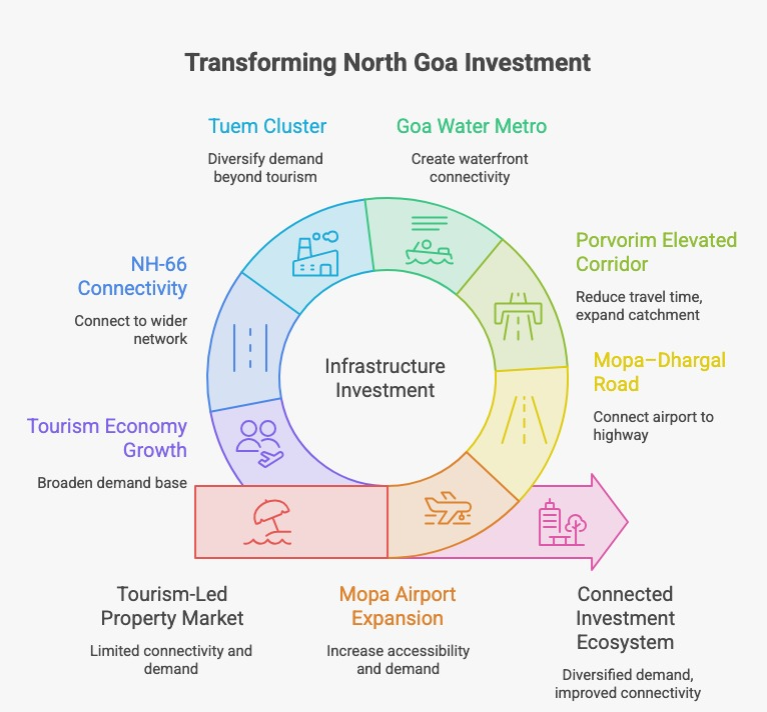
The region is increasingly being shaped by an expanding infrastructure ecosystem that connects aviation, highways, urban mobility, tourism, industrial development and hospitality.
For investors evaluating North Goa real estate investment, this shift matters because infrastructure does more than improve travel times. Over the long term, better connectivity can influence where people stay, where businesses operate, where tourists spend, and where residential and hospitality demand develops.
The transformation is particularly visible around Manohar International Airport at Mopa, NH-66, the Porvorim Elevated Corridor, the Mopa–Dhargal connection and the emerging economic infrastructure around Pernem.
At the same time, Goa’s tourism economy continues to attract substantial visitor volumes. The state’s official tourism data recorded 54.55 lakh tourist arrivals between January and June 2025, including 51.84 lakh domestic and 2.71 lakh international visitors.
For long-term investors, therefore, the more important question is not simply whether property prices will rise. It is whether North Goa is developing the underlying economic and connectivity conditions that can support sustained real estate demand.
That is where the North Goa real estate investment story becomes particularly interesting in 2026.
Why North Goa Real Estate Investment Is Becoming an Infrastructure Story
Real estate markets are rarely shaped by one factor.
Location, infrastructure, employment, tourism, accessibility, supply, land characteristics and buyer preferences interact with one another. When several of these factors improve simultaneously, a location can develop a stronger and more diversified demand base.
North Goa is increasingly experiencing this type of infrastructure-led transition.
The arrival of Manohar International Airport at Mopa has strengthened aviation connectivity in the northern part of Goa. Highway improvements are enhancing road movement. The Porvorim Elevated Corridor is designed to improve movement along a critical section of NH-66. Meanwhile, proposed water-based mobility and industrial infrastructure around Pernem could add new dimensions to the regional economy.
For North Goa real estate investment, this creates an important distinction.
The opportunity is not simply about buying property close to a single project. It is about understanding how multiple infrastructure investments interact.
A new airport can improve accessibility.
Better highways can expand the practical catchment area.
Industrial infrastructure can create employment and business activity.
Tourism growth can increase demand for hotels, villas, serviced residences and short-stay accommodation.
Together, these factors can potentially create a broader real estate ecosystem.
That is why investors should increasingly evaluate North Goa through an infrastructure-plus-economy lens, rather than viewing it only as a leisure destination.
Mopa Airport Is Strengthening North Goa’s Connectivity Advantage
Few infrastructure developments are as important to the North Goa investment narrative as Manohar International Airport.
The airport has already moved beyond the early stage of being simply a new aviation facility. According to Goa’s Economic Survey 2025–26, the terminal expansion at Mopa is being undertaken at a cost of ₹255.69 crore, with the built-up terminal area expected to increase from 65,600 sq m to 83,900 sq m.
The same Economic Survey states that from its inception on January 5, 2023, through January 2026, the airport had handled 14,094,729 domestic and international passengers and facilitated 97,383 aircraft movements, connecting 20 domestic and 12 international destinations.
The airport also entered its Phase III stage. Its Phase I capacity was 4.4 million passengers, the stated current capacity was 7.8 million, while its ultimate planned capacity is 35 million passengers annually.
For investors, these numbers are relevant because airport infrastructure can influence real estate in several ways.
First, accessibility becomes stronger.
Second, the geographical area considered convenient for second-home buyers, tourists, entrepreneurs and hospitality operators can expand.
Third, improved air connectivity can support higher-frequency travel rather than limiting Goa primarily to occasional holiday visits.
This does not mean every property near Mopa will automatically outperform. Real estate outcomes remain dependent on pricing, location, land characteristics, legal status, infrastructure quality and demand.
But for North Goa real estate investment, Mopa creates an important long-term connectivity foundation.
The airport’s evolution also strengthens the investment relevance of areas that sit within the broader Mopa–Pernem–North Goa ecosystem.
NH-66, Mopa–Dhargal and Porvorim Are Reshaping Regional Mobility
Air connectivity works best when it is supported by efficient surface connectivity.
North Goa’s road infrastructure is therefore another major component of the North Goa real estate investment story.
The Mopa–Dhargal six-lane access-controlled road has created a direct high-capacity connection between the airport and the national highway network. The project has been positioned as an important component of improving access to Mopa and strengthening movement through the northern corridor.
Further south, the Porvorim Elevated Corridor has become another major mobility intervention.
The six-lane elevated corridor stretches approximately 5.15 km and was constructed at a reported cost of ₹641 crore. The project was inaugurated on September 9, 2026.
According to Financial Express, the project is expected to substantially improve movement between Mapusa and Panaji, with peak-hour travel time potentially falling from around 40 minutes to approximately 10 minutes.
From a real estate perspective, improved mobility can influence investment decisions in subtle ways.
A location that previously required longer travel can become more practical for regular use.
A second-home buyer may find a wider selection of locations viable.
Hospitality operators can potentially serve a broader visitor catchment.
Businesses can access markets and workforce more efficiently.
This is particularly relevant for investors who are thinking beyond immediate rental income and considering the long-term positioning of land and property.
The larger infrastructure story is therefore not one road or one corridor. It is the cumulative effect of aviation and road connectivity creating a more integrated North Goa mobility network.
Goa Water Metro Could Add a New Layer of Future Connectivity
Another potentially significant development is Goa’s proposed Water Metro and inland water transport network.
As of September 2026, the feasibility study had been completed and the Detailed Project Report was under preparation.
According to ET Infra, the proposed network covers nine routes and approximately 111 km of waterways. The government has stated that the final project cost and funding structure will only be determined after the DPR is completed.
This distinction is important for investors.
The Water Metro should currently be viewed as a proposed future infrastructure layer, rather than as an operational network.
Nevertheless, the concept is significant because it represents an attempt to diversify mobility beyond roads.
If implemented as planned, water-based transportation could potentially influence tourism movement, urban mobility, travel patterns and accessibility to selected waterfront locations.
For North Goa real estate investment, the important lesson is not to price future infrastructure into a property as though it is already operational.
Instead, investors should track milestones such as DPR approval, funding, route finalisation, construction and commissioning.
Infrastructure certainty should always increase before investors assign greater weight to a future project.
Pernem Is Developing Into a Broader Economic Growth Corridor
Pernem is particularly important because its story extends beyond tourism.
The area benefits from its proximity to Mopa Airport, highway connectivity and emerging industrial infrastructure.
One of the most significant developments is the Electronic Manufacturing Cluster at Tuem, being developed under the Greenfield Electronics Manufacturing Cluster Scheme of the Ministry of Electronics and Information Technology.
According to the Government of Goa’s Department of Information Technology, the project covers approximately 5,97,125 sq m and has an approved project cost of ₹161.32 crore. Twenty-two companies have already been allotted plots, with projected investment of approximately ₹1,350 crore and projected employment of 3,800 people.
This is important for North Goa real estate investment because employment-generating infrastructure can create a different form of property demand from tourism.
Tourism generates seasonal and visitor-oriented demand.
Industrial and technology infrastructure can create more permanent economic activity.
As companies establish operations, demand can emerge for housing, rental accommodation, services, logistics, food, retail and supporting businesses.
That does not mean every surrounding parcel will benefit equally. Investors still need to evaluate accessibility, zoning, development potential, title, infrastructure availability and pricing.
But the emergence of employment-oriented infrastructure adds depth to the North Goa investment thesis.
Instead of relying entirely on tourism, selected parts of the region could increasingly participate in a broader economic ecosystem.
Tourism Growth Is Expanding the Demand Base
Tourism remains one of the strongest structural pillars of Goa’s economy.
According to the Goa Tourism Department, the state welcomed 54.55 lakh tourists during January–June 2025, including 51.84 lakh domestic visitors and 2.71 lakh international visitors.
The official tourism narrative is also becoming more diversified.
Goa is increasingly promoting experiences beyond conventional beach tourism, including heritage, wellness, sports, culture, hinterland experiences and regenerative tourism.
The Department of Tourism’s 2025 tourism communication highlighted this broader positioning and international connectivity.
For property investors, diversification matters.
A destination that attracts visitors for only one reason can have a narrower demand profile.
A destination offering beaches, heritage, food, wellness, sports, cultural experiences and hinterland tourism can potentially create demand across a wider range of seasons and visitor segments.
This can support different forms of real estate demand, including:
- Boutique hospitality
- Luxury villas
- Serviced residences
- Second homes
- Long-stay accommodation
- Rental properties
- Retail and lifestyle businesses
- Hospitality-linked land
The North Goa real estate investment opportunity therefore sits at the intersection of tourism and infrastructure.
Connectivity brings people in.
Tourism gives them reasons to stay.
Infrastructure determines how easily they move.
Real estate provides the physical platform for accommodation, living, hospitality and business activity.
From Tourism to Real Estate: How Infrastructure Creates Property Demand
The relationship between infrastructure and property demand is rarely immediate or linear.
A highway does not automatically make every nearby property valuable.
An airport does not automatically create demand for every parcel.
Instead, infrastructure tends to influence real estate through several intermediate stages.
Connectivity
Improved roads and airports reduce travel friction.
Accessibility
Locations become easier to reach from airports, business centres, tourism destinations and urban areas.
Economic activity
Improved access can encourage hospitality, retail, services, logistics and businesses.
Employment and footfall
Economic activity creates more regular movement of people.
Accommodation demand
Visitors, employees, entrepreneurs and second-home users can create different forms of housing and hospitality demand.
Real estate demand
Over time, locations that combine accessibility, economic activity and liveability can become more attractive to property buyers.
This is the core logic behind infrastructure-led North Goa real estate investment.
The key is to identify where multiple drivers overlap.
For example, an investor may examine whether a particular micro-market has:
- Proximity to major road corridors
- Practical access to Mopa Airport
- Established tourism demand
- Hospitality infrastructure
- Social infrastructure
- Employment opportunities
- Development potential
- Legal and planning clarity
- Appropriate land or property pricing
The strongest investment thesis is generally created where several of these factors converge rather than where only one future project is being announced.
Which North Goa Micro-Markets Offer the Strongest Long-Term Signals?
Investors should avoid treating North Goa as one uniform real estate market.
Different micro-markets have different demand drivers.
Mopa–Pernem
This corridor is particularly relevant for investors tracking airport-led development, hospitality and emerging economic activity.
Mopa Airport provides the connectivity anchor, while Pernem’s infrastructure expansion creates additional economic potential.
Morjim–Mandrem–Ashwem belt
This region remains strongly associated with tourism, lifestyle, hospitality and second-home demand.
Its investment story is more closely linked to tourism, experiential travel and premium lifestyle demand.
Arpora–Anjuna–Assagao
These markets have established tourism and lifestyle ecosystems and can appeal to buyers seeking hospitality, second homes and premium residential assets.
Mapusa–Porvorim
This belt has a different investment character, with stronger links to established residential demand, commercial activity and movement toward Panaji.
The completion of the Porvorim Elevated Corridor adds another important infrastructure consideration to this broader mobility network.
The important point for North Goa real estate investment is that investors should match the property type with the underlying demand driver.
A hospitality-oriented location may not have the same investment logic as an employment-oriented corridor.
A lifestyle market may not behave like a conventional residential market.
A land parcel near future infrastructure may have a different risk profile from an already developed residential property.
Micro-market selection is therefore more important than simply choosing “North Goa.”
How Investors Should Evaluate North Goa Property in 2026
Infrastructure can improve the investment potential of a location, but due diligence remains essential.
The first question should be what exactly is being purchased?
For land buyers, title, land classification, access, development permissions and planning restrictions should be examined carefully.
For coastal properties, environmental and coastal regulations are particularly important.
The Government of Goa’s NRI property guidance recommends checking applicable coastal regulation requirements before purchasing property.
Investors should also understand the applicable Coastal Regulation Zone framework and verify whether proposed construction or development requires specific approvals.
The second consideration is infrastructure certainty.
There is a meaningful difference between:
- Announced
- Approved
- Under construction
- Completed
- Operational
A disciplined investor should assign different weight to each stage.
The third consideration is actual accessibility.
Do not rely solely on a map radius.
A property may appear close to an airport or highway but still have limited practical access because of local roads, terrain, junctions or development restrictions.
The fourth consideration is demand depth.
Ask who is expected to use the property.
Is the demand primarily from tourists?
Second-home buyers?
Local residents?
Professionals?
Hospitality operators?
Businesses?
A diversified demand base can provide a stronger long-term foundation.
The fifth consideration is pricing discipline.
Infrastructure creates potential. It does not remove the importance of entry valuation.
Investors should compare asking prices with comparable properties, land characteristics, development potential and actual market conditions.
For investors considering tourism-linked accommodation, regulatory compliance is also important. Goa’s Tourism Department requires tourism service providers such as homestays and B&B establishments to comply with registration and applicable licensing requirements.
Is 2026 a Strong Entry Window for North Goa Real Estate Investment?
The most useful way to view 2026 is not as a year of guaranteed appreciation, but as a period of infrastructure transition.
Several important components are moving simultaneously.
Mopa Airport is expanding.
NH-66 connectivity continues to evolve.
The Porvorim Elevated Corridor is now operational.
Pernem is developing industrial infrastructure.
Goa is exploring new water-based mobility.
Tourism continues to attract substantial visitor volumes.
Hospitality and lifestyle demand remain important parts of the regional economy.
For long-term investors, this combination deserves attention.
The opportunity is particularly relevant for those willing to take a five-to-ten-year view rather than looking only for short-term price movements.
The central investment question should therefore be:
Which locations are positioned to benefit from multiple layers of infrastructure, economic activity, tourism and improving accessibility?
That is a more useful question than simply asking where property prices are currently lowest.
The Road Ahead
North Goa’s next phase is likely to be defined by the interaction of infrastructure and economic activity.
Mopa strengthens the aviation gateway.
NH-66 improves regional road movement.
Porvorim strengthens the connection between northern and central Goa.
Pernem adds an emerging industrial and employment dimension.
Tourism continues to diversify beyond beaches.
Potential water-based mobility could add another layer in the future.
For North Goa real estate investment, these developments create a broader investment framework built around connectivity, accessibility, tourism, employment and long-term land-use potential.
The strongest opportunities are unlikely to come from simply following announcements.
They will come from identifying locations where infrastructure is translating into actual accessibility, economic activity and sustained demand.
Looking at North Goa Through an Investor Lens
For investors, HNIs, NRIs, business owners and land buyers, North Goa increasingly deserves to be evaluated as a developing regional ecosystem rather than simply a holiday destination.
That requires a disciplined approach: study the infrastructure pipeline, understand the micro-market, verify the legal and planning position, assess actual connectivity and evaluate the property against long-term demand.
TOTL Realty approaches this process from a brokerage and investment-advisory perspective, helping investors evaluate premium real estate opportunities through the lens of location, infrastructure, connectivity and long-term market potential.
For those exploring North Goa real estate investment, the objective should not be to chase a short-term trend, but to identify quality assets positioned within the region’s evolving infrastructure and economic landscape.
The next phase of North Goa’s real estate story may ultimately be shaped not by one project, but by how airports, highways, tourism, employment and lifestyle infrastructure come together.
And for long-term investors, that intersection is where the most interesting opportunities deserve closer attention.
FAQs
1. Is North Goa real estate investment a good option for long-term investors?
North Goa real estate investment can be an attractive long-term consideration for investors who evaluate property based on infrastructure, connectivity, tourism, economic activity and location fundamentals rather than short-term price movements.
North Goa is undergoing an infrastructure transition supported by developments such as Manohar International Airport at Mopa, NH-66 connectivity improvements, the Porvorim Elevated Corridor and emerging economic infrastructure around Pernem. These developments can improve accessibility and potentially strengthen the region’s long-term residential, hospitality and commercial ecosystem.
However, no real estate investment should be viewed as having guaranteed appreciation. Investors should assess the property’s exact location, title, development permissions, access, surrounding infrastructure, supply and entry valuation.
The Government of Goa’s Economic Survey 2025–26 provides useful official data on the state’s infrastructure and economic development.
2. How is Mopa Airport influencing North Goa real estate investment?
Mopa Airport is one of the most important infrastructure factors supporting the North Goa real estate investment narrative.
According to Goa’s Economic Survey 2025–26, Manohar International Airport recorded more than 14 million cumulative passengers between January 2023 and January 2026, with connections to domestic and international destinations. The airport is also undergoing terminal expansion, while its ultimate planned capacity is significantly higher than its current operating capacity.
Improved air connectivity can make North Goa more accessible to domestic and international tourists, second-home buyers, entrepreneurs, hospitality operators and business travellers.
For investors, the key consideration is not simply distance from Mopa Airport. The more important question is whether a property sits within a location that combines airport accessibility with road connectivity, tourism demand, social infrastructure and future economic activity.
Investors can refer to the official Goa Economic Survey 2025–26 for the latest government-reported airport data.
3. Which infrastructure projects are important for North Goa real estate investment in 2026?
Several infrastructure developments are relevant when evaluating North Goa real estate investment in 2026.
Key projects and initiatives include:
Manohar International Airport at Mopa
Mopa–Dhargal six-lane access-controlled road
NH-66 connectivity improvements
Porvorim Elevated Corridor
Proposed Goa Water Metro
Tuem Electronic Manufacturing Cluster
Supporting infrastructure and economic development around Pernem
These projects influence different parts of the investment ecosystem.
Airports improve regional accessibility, highways improve road movement, elevated corridors can reduce travel friction, industrial clusters can create employment and business activity, while proposed water transport could eventually diversify mobility.
The Department of Information Technology, Government of Goa provides information on the Tuem Electronic Manufacturing Cluster, while the Goa Tourism Department provides information on tourism-related development.
4. How does tourism growth support North Goa real estate investment?
Tourism is a major demand driver behind North Goa real estate investment because visitor activity creates demand for accommodation, hospitality, food and beverage, retail, experiences and supporting services.
Goa Tourism reported 54.55 lakh tourist arrivals during January–June 2025, including approximately 51.84 lakh domestic and 2.71 lakh international visitors.
Goa is also increasingly promoting tourism beyond traditional beach holidays, including heritage, wellness, culture, sports, hinterland experiences and other experiential segments.
This diversification can create opportunities for different property formats, including luxury villas, serviced residences, boutique hospitality, second homes and other tourism-oriented assets.
However, investors should distinguish between tourism demand and guaranteed property returns. The performance of an individual property depends on its location, positioning, management, regulatory compliance, competition and operating model.
The latest official visitor information can be followed through the Goa Tourism Department.
5. Is Pernem an emerging area for North Goa real estate investment?
Pernem is increasingly relevant to North Goa real estate investment because several growth drivers converge around the region.
Its proximity to Mopa Airport gives it an important connectivity advantage, while road infrastructure and emerging economic developments add another dimension to its growth profile.
The Electronic Manufacturing Cluster at Tuem is particularly significant. According to the Government of Goa’s Department of Information Technology, the project covers approximately 5,97,125 sq m, has an approved project cost of ₹161.32 crore, and has projected investment of around ₹1,350 crore with projected employment of approximately 3,800 people.
Employment-generating infrastructure can create demand that extends beyond tourism, potentially supporting housing, services, retail and commercial activity.
For investors, however, Pernem should not be evaluated as one uniform market. Individual locations should be assessed based on connectivity, land use, infrastructure availability, development potential and legal status.
6. What should investors check before making a North Goa real estate investment?
Before making a North Goa real estate investment, investors should conduct comprehensive property and location due diligence.
Important factors include:
Clear and marketable title
Land classification and permitted use
Development and construction permissions
Road access and right of way
Actual distance from major infrastructure
Applicable environmental and coastal regulations
Existing and planned infrastructure
Comparable property pricing
Local supply and demand
Developer or seller documentation, where applicable
Coastal properties require particular attention because applicable Coastal Regulation Zone (CRZ) rules can affect development and construction.
The Government of Goa’s NRI property guidance specifically highlights the importance of checking applicable coastal regulations before purchasing property.
Investors can review the Government of Goa’s property guidance and relevant information from the state’s Environment Department before proceeding with a transaction.
Professional legal and technical due diligence should also be undertaken before committing capital.
7. Can the Goa Water Metro influence future North Goa real estate investment?
The proposed Goa Water Metro could become an additional factor in the long-term North Goa real estate investment landscape, although investors should currently treat it as a future infrastructure proposal rather than an operational network.
As reported by ET Infra, the feasibility study has been completed and the Detailed Project Report is under preparation. The proposed network covers approximately 111 km of waterways across nine routes.
If implemented, water-based public transportation could potentially improve connectivity between selected waterfront locations and diversify Goa’s transportation ecosystem.
However, the final routes, project cost, funding structure, construction schedule and operational timeline should be monitored as the DPR progresses.
For investors, the appropriate strategy is to track infrastructure milestones rather than price future infrastructure into a property prematurely.
The latest reported project status can be followed through ET Infra’s Goa Water Metro update.
8. Is 2026 a good time to consider North Goa real estate investment?
For investors with a long-term horizon, 2026 can be an important year to study North Goa real estate investment because several infrastructure and economic developments are progressing simultaneously.
Mopa Airport is expanding its capacity and connectivity. The Mopa–Dhargal road has strengthened airport access. The Porvorim Elevated Corridor has added another major mobility improvement. Pernem is developing new economic infrastructure, while tourism continues to generate substantial visitor activity.
The opportunity, however, should be approached selectively rather than as a blanket expectation that all North Goa properties will appreciate.
Investors should focus on micro-market quality, infrastructure certainty, accessibility, land or property fundamentals, legal clarity, demand depth and entry valuation.
The strongest long-term opportunities may emerge where multiple drivers overlap: good connectivity, established or emerging tourism demand, economic activity, quality infrastructure and appropriate property fundamentals.
For a broader understanding of Goa’s economic environment and infrastructure pipeline, investors can refer to the Government of Goa Economic Survey 2025–26.