
Vengurla Beach: The Clean, Quiet Konkan Coastline India Is Beginning to Notice
India’s coastal tourism story is entering a new phase.
For decades, Goa dominated conversations around beach tourism, second homes, hospitality investments, and coastal lifestyle migration. But as many popular coastal markets continue to experience rising congestion, commercialization, traffic pressure, and environmental strain, travelers and investors are beginning to look elsewhere.
Increasingly, attention is shifting toward quieter coastal destinations that still retain ecological integrity, lower-density living, and long-term sustainability potential.
Among these emerging coastal regions, Vengurla Beach in Maharashtra’s Sindhudurg district is beginning to stand out.
Located along the Konkan Coast near the Goa border, Vengurla Beach represents a very different coastal narrative from India’s heavily commercialized beach destinations. The region is known for its cleaner shoreline conditions, relatively untouched landscapes, tropical greenery, slower pace of life, and growing eco-tourism appeal.
According to Maharashtra Tourism, Vengurla Beach is recognized for its scenic coastline, peaceful atmosphere, and coastal beauty that remains comparatively preserved from excessive urban tourism pressure.
But the growing interest around Vengurla Beach is not only about tourism.
The region is gradually attracting attention from:
- Nature-conscious travelers
- Hospitality entrepreneurs
- NRIs exploring coastal second homes
- Sustainable tourism advocates
- Boutique hospitality developers
- Long-term lifestyle investors
- Remote-working professionals seeking quieter environments
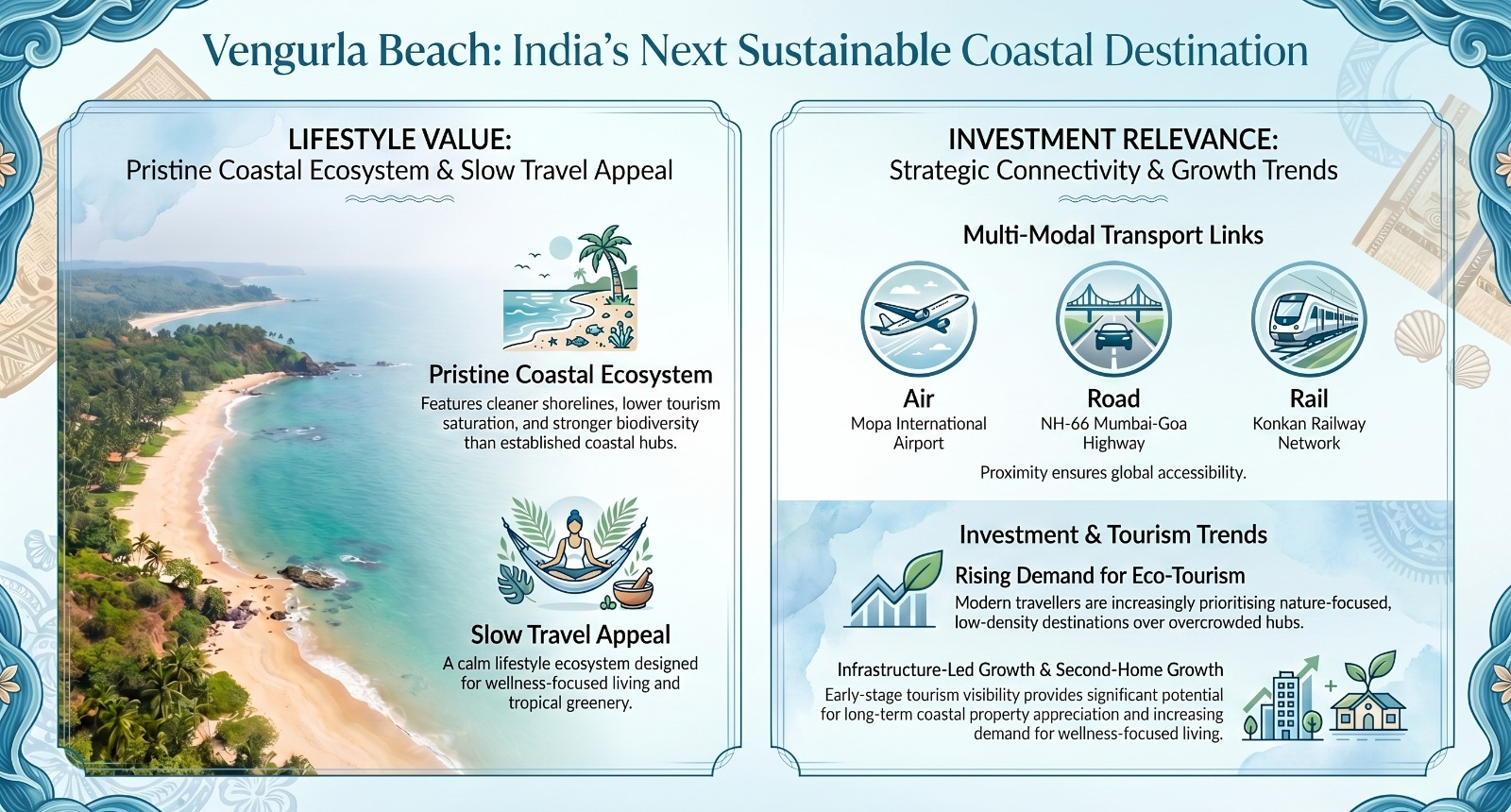
At the same time, major infrastructure developments including the expansion of NH-66, operationalization of Sindhudurg Airport, and the emergence of Goa’s Mopa International Airport are reshaping accessibility across the Konkan region.
For investors and policymakers, Vengurla Beach now represents an important question:
Can India develop coastal destinations more responsibly while preserving ecological and cultural value?
The answer may significantly shape the future of India’s western coastline.
Understanding the Historical and Geographical Importance of Vengurla Beach
Vengurla Beach is not simply an emerging tourism destination. Its coastal identity has been shaped over centuries through maritime trade, fishing economies, agriculture, and strategic coastal geography.
Historically, Vengurla functioned as an important maritime settlement along the Konkan belt. Historical accounts referenced by Tour My India indicate Dutch traders once operated in the region during the 17th century because of its strategic coastal location.
Like much of the Konkan Coast, the area evolved through:
- Maritime commerce
- Cashew and coconut trade
- Fishing-based livelihoods
- Portuguese and Dutch coastal influence
- Agricultural settlement patterns
Geographically, Vengurla Beach lies within Maharashtra’s Sindhudurg district, one of the most ecologically rich coastal regions along India’s western shoreline.
The coastline is characterized by:
- Arabian Sea-facing beaches
- Laterite cliffs
- Coconut plantations
- Cashew orchards
- Mangrove ecosystems
- Rocky marine outcrops
- Estuarine biodiversity
According to Maharashtra Tourism – Sindhudurg District, the Sindhudurg coastline stretches across approximately 120 kilometers and remains one of Maharashtra’s most naturally diverse coastal regions.
This geographical composition is one of the biggest reasons why Vengurla Beach is now attracting sustainable tourism interest.
Unlike highly urbanized coastal destinations, Vengurla still benefits from:
- Lower construction density
- Reduced industrial pressure
- Cleaner natural landscapes
- Better visual openness
- Less tourism saturation
For investors studying long-term coastal markets, these environmental characteristics increasingly matter because ecological preservation itself is becoming a value driver.
How Connectivity Is Transforming Vengurla Beach
One of the biggest reasons Vengurla Beach is beginning to gain visibility is infrastructure connectivity.
Historically, several Konkan destinations remained relatively inaccessible despite strong tourism potential. However, over the past decade, major transportation upgrades have started changing the economic and tourism dynamics of the region.
Airport Connectivity
The operationalization of Sindhudurg Airport (Chipi Airport) has significantly improved regional accessibility.
Additionally, the opening of Manohar International Airport (Mopa Airport) in North Goa is expected to accelerate tourism spillover toward southern Maharashtra’s coastal belt.
This dual-airport advantage is important because improved aviation access often acts as a catalyst for:
- Tourism growth
- Hospitality investment
- Premium villa demand
- Weekend tourism
- Coastal second-home development
Vengurla Beach is now positioned within driving distance of both airports, making it more accessible for domestic travelers, NRIs, and high-income urban buyers.
NH-66 and Konkan Highway Expansion
The expansion and modernization of NH-66 is another major growth driver.
According to National Highways Authority of India, the Mumbai-Goa highway corridor is undergoing extensive upgrades aimed at improving freight movement and reducing travel time.
Better highway infrastructure has broader implications for:
- Tourism mobility
- Hospitality logistics
- Real estate accessibility
- Weekend travel demand
- Regional economic integration
Historically, infrastructure improvements have played a major role in transforming India’s coastal destinations from local tourism zones into broader lifestyle and investment ecosystems.
Konkan Railway Connectivity
The Konkan Railway remains one of India’s most strategically important coastal transportation corridors.
It connects Vengurla Beach and nearby regions to:
- Mumbai
- Pune
- Goa
- Karnataka
- Kerala
The railway has long supported tourism and migration across the Konkan belt, but with rising domestic tourism demand, its relevance is increasing further.
For second-home buyers and long-stay travelers, multi-modal accessibility strengthens the long-term viability of coastal regions like Vengurla.
Why Vengurla Beach Stands Out Environmentally
One of the strongest differentiators for Vengurla Beach is its environmental positioning.
Across India, several coastal tourism destinations are increasingly struggling with:
- Waste management pressure
- Shoreline overcrowding
- Water pollution
- Unregulated construction
- Ecological degradation
Vengurla Beach, however, still retains a relatively cleaner and lower-density coastal environment.
According to Maharashtra Tourism, the beach is known for its calm atmosphere, scenic beauty, and peaceful coastline.
This environmental advantage matters not only for tourism but also for long-term economic sustainability.
Coastal Biodiversity and Marine Ecology
The Sindhudurg coastal ecosystem supports significant biodiversity.
The region includes:
- Mangrove ecosystems
- Marine habitats
- Tropical vegetation
- Fish breeding zones
- Coastal bird populations
- Rocky marine formations
These ecosystems play a critical role in:
- Marine biodiversity preservation
- Shoreline stabilization
- Carbon sequestration
- Climate resilience
Environmental preservation is increasingly becoming economically important because global tourism trends show rising preference for cleaner and more nature-oriented destinations.
Olive Ridley Turtle Conservation Awareness
The Konkan coastline periodically supports marine turtle activity, including Olive Ridley sea turtles.
According to Sea Turtles of India, Olive Ridley turtles are considered vulnerable and are protected under India’s Wildlife Protection Act.
Coastal regions that preserve marine ecosystems often gain stronger positioning within eco-tourism and conservation-focused tourism markets.
However, tourism expansion without environmental regulation can threaten:
- Marine biodiversity
- Turtle nesting activity
- Mangrove ecosystems
- Coastal water quality
This is why responsible tourism planning is becoming critical for destinations like Vengurla Beach.
The Rise of Quiet Tourism and Why Travelers Are Choosing Vengurla Beach
Tourism preferences are changing globally.
Post-pandemic travel trends increasingly show demand for:
- Lower-density destinations
- Wellness tourism
- Nature retreats
- Slow travel
- Digital detox experiences
- Sustainable tourism
This shift strongly benefits destinations like Vengurla Beach.
Unlike heavily commercialized tourism hubs, Vengurla offers:
- Reduced crowd density
- Less nightlife pressure
- Cleaner beaches
- More natural surroundings
- Lower visual pollution
- A calmer lifestyle atmosphere
This changing traveler behavior is important from an investment perspective because tourism demand itself is evolving.
Goa Spillover Tourism
As Goa continues experiencing tourism saturation in several pockets, nearby coastal destinations are beginning to benefit from spillover interest.
Travelers increasingly explore regions beyond traditional tourism circuits in search of:
- Better privacy
- Less congestion
- Nature-oriented experiences
- Lower-density stays
Vengurla Beach benefits strategically because it is close enough to Goa for accessibility while still maintaining a distinct coastal identity.
This positioning could become increasingly valuable over the next decade.
Emerging Tourist Demographics
The traveler profile visiting regions like Vengurla Beach is also evolving.
Emerging segments include:
- Remote-working professionals
- Wellness travelers
- Boutique luxury travelers
- Eco-tourism enthusiasts
- Entrepreneurs seeking slower living environments
- Retirees exploring coastal migration
- NRIs seeking quieter second homes
This is important because high-value tourism markets increasingly prioritize experience quality over mass-scale tourism density.
Lifestyle Appeal: What Makes Vengurla Beach Different
One of the biggest attractions of Vengurla Beach is lifestyle quality.
Many Indian coastal markets have become increasingly urbanized and commercially dense. Vengurla, in contrast, still offers a more grounded coastal experience.
The region combines:
- Sea-facing landscapes
- Tropical greenery
- Fishing village culture
- Coastal calmness
- Scenic sunsets
- Lower-density living
Nearby attractions include:
- Shiroda Beach
- Sagareshwar Beach
- Redi Ganpati Temple
- Vetoba Temple
- Cashew plantations
- Mangrove belts
According to Maharashtra Tourism – Sindhudurg, the region also supports multiple water-based activities including:
- Boating
- Scuba diving
- Water sports
- Beach tourism
- Nature exploration
However, the real long-term appeal of Vengurla Beach may lie less in commercial tourism and more in sustainable coastal living.
Why Investors Are Beginning to Study the Vengurla Region
India’s coastal real estate landscape is gradually evolving.
For years, mature markets such as Goa and Alibaug dominated second-home demand. But rising prices, increasing density, and limited land availability in saturated markets are encouraging investors to explore emerging coastal regions.
Vengurla Beach is beginning to attract interest because it combines:
- Improving infrastructure
- Tourism growth potential
- Lower-density living
- Ecological value
- Emerging hospitality demand
- Relatively lower entry pricing compared to mature coastal markets
Importantly, the region is still in an early-stage growth cycle.
Historically, early infrastructure-led coastal markets often experience stronger long-term transformation once:
- Tourism visibility increases
- Accessibility improves
- Hospitality ecosystems expand
- Lifestyle migration accelerates
The Rise of Second Homes Along the Konkan Coast
Across India, second-home demand is expanding beyond traditional hill stations and metro outskirts.
According to multiple hospitality and lifestyle trend studies, affluent urban buyers increasingly seek:
- Wellness-focused living
- Nature-connected environments
- Remote-working flexibility
- Long-stay leisure homes
- Coastal retirement destinations
The Konkan Coast aligns strongly with these trends.
For NRIs and HNIs, destinations like Vengurla Beach offer:
- Lower-density environments
- Cleaner natural settings
- Long-term lifestyle appeal
- Future tourism potential
- Access to both Maharashtra and Goa ecosystems
Boutique Hospitality Opportunities
One of the strongest opportunities around Vengurla Beach may emerge through low-density hospitality development rather than large-scale mass tourism infrastructure.
Potential hospitality segments include:
- Eco-resorts
- Boutique villas
- Wellness retreats
- Nature-focused stays
- Managed coastal residences
- Sustainable hospitality projects
Globally, premium tourism markets are increasingly moving toward:
- Experience-driven hospitality
- Sustainable architecture
- Wellness-oriented tourism
- Smaller luxury ecosystems
This trend could strongly benefit the Konkan Coast over the coming decade.
The Economic Impact of Tourism on Vengurla Beach
Tourism growth creates both opportunities and responsibilities.
Traditionally, the Vengurla region depended heavily on:
- Fishing
- Cashew farming
- Coconut cultivation
- Agriculture
- Local trade
However, tourism expansion is gradually diversifying the regional economy.
Emerging tourism-driven sectors include:
- Hospitality services
- Homestays
- Local transport
- Food businesses
- Adventure tourism
- Water sports operations
For local communities, responsible tourism can improve:
- Employment generation
- Income diversification
- Small-business opportunities
- Regional infrastructure development
However, unmanaged tourism growth can also create risks.
Research published on SSRN Coastal Tourism Studies highlights that rapid tourism expansion in coastal regions can contribute to:
- Ecological pressure
- Land inflation
- Coastal privatization
- Community displacement
- Waste management stress
This is why sustainable tourism planning becomes essential.
Why Sustainability Will Determine Vengurla Beach’s Future
The future value of Vengurla Beach depends heavily on how responsibly the region develops.
Its competitive advantage today comes from:
- Ecological integrity
- Lower-density development
- Cleaner shoreline conditions
- Natural coastal character
If overdevelopment occurs without regulation, these advantages could weaken rapidly.
This is a critical lesson already visible across several over-commercialized coastal markets globally.
The Importance of Responsible Coastal Development
Sustainable coastal development increasingly requires:
- CRZ compliance
- Controlled construction density
- Waste management systems
- Renewable energy integration
- Rainwater harvesting
- Mangrove conservation
- Marine ecosystem protection
For policymakers and investors alike, sustainability is no longer only an environmental concern.
It is becoming an economic necessity.
Destinations that preserve ecological quality often maintain:
- Higher tourism longevity
- Better lifestyle appeal
- Stronger premium positioning
- Greater long-term resilience
Climate and Coastal Risk Awareness
Like all coastal regions, Vengurla Beach also faces long-term climate considerations.
These include:
- Coastal erosion
- Sea-level rise
- Monsoon intensity
- Marine ecosystem disruption
Responsible planning and scientific coastal management will therefore play an important role in determining the region’s long-term sustainability.
The Future of Vengurla Beach
Vengurla Beach now sits at an important transition point.
It remains:
- Relatively undiscovered
- Ecologically strong
- Less saturated
- Infrastructure-supported
- Tourism-ready yet still calm
At the same time, broader macro trends are increasingly favoring destinations like Vengurla.
These include:
- Eco-tourism growth
- Wellness migration
- Sustainable luxury travel
- Remote-work lifestyles
- Second-home demand
- Experience-driven tourism
For investors, entrepreneurs, and policymakers, the region represents a rare opportunity to study coastal development before full-scale commercialization occurs.
The larger question is not whether Vengurla Beach will grow.
The real question is whether it can grow intelligently.
Because the destinations that preserve ecological identity while enabling sustainable economic development are likely to become the most valuable coastal regions of the future.
FAQ
1. Why is Vengurla Beach becoming popular among travelers and investors?
Vengurla Beach is gaining attention because it offers something many coastal destinations in India are beginning to lose — cleaner surroundings, lower crowd density, and a more peaceful coastal environment. Located in Maharashtra’s Sindhudurg district along the Konkan Coast, Vengurla Beach is increasingly attracting eco-tourists, second-home buyers, hospitality entrepreneurs, and long-term investors looking for emerging coastal destinations with sustainable growth potential.
The region also benefits from improved infrastructure such as NH-66 upgrades and proximity to both Sindhudurg Airport and Goa’s Mopa International Airport, which are improving tourism accessibility and long-term regional connectivity.
2. Where is Vengurla Beach located and how can travelers reach it?
Vengurla Beach is located in the Sindhudurg district of Maharashtra near the Goa border along India’s Konkan Coast. The beach is well connected through road, rail, and airport infrastructure.
Travelers can access Vengurla Beach through:
- NH-66 Mumbai-Goa Highway
- Konkan Railway stations such as Kudal and Sawantwadi
- Sindhudurg Airport (Chipi)
- Manohar International Airport (Mopa Airport) in Goa
The improving connectivity is one of the major reasons tourism and second-home interest around Vengurla Beach are gradually increasing.
3. Is Vengurla Beach cleaner than many other coastal destinations in India?
Vengurla Beach is widely recognized for its relatively cleaner and less commercialized environment compared to many heavily crowded beach destinations across India. Because tourism density remains lower, the beach still retains scenic natural beauty, cleaner shorelines, and lower visual pollution.
Government tourism portals frequently describe Vengurla Beach as peaceful, scenic, and naturally preserved. However, environmental experts also emphasize that maintaining this cleanliness will require sustainable tourism planning, waste management systems, and regulated coastal development in the future.
4. Does Vengurla Beach have Blue Flag certification?
As of 2026, Vengurla Beach does not officially hold Blue Flag certification. However, the beach possesses several characteristics associated with environmentally strong coastal destinations, including cleaner shoreline conditions, lower-density tourism, and strong natural ecosystems.
If local authorities continue investing in:
- waste management,
- water quality monitoring,
- coastal conservation,
- sustainable tourism infrastructure,
- and environmental education,
Vengurla Beach could strengthen its long-term positioning as a premium sustainable tourism destination along the Konkan Coast.
5. What makes Vengurla Beach environmentally important?
Vengurla Beach lies within one of Maharashtra’s ecologically significant coastal regions. The surrounding Sindhudurg coastline includes:
- mangrove ecosystems,
- marine biodiversity,
- tropical vegetation,
- estuarine systems,
- fish breeding zones,
- and coastal wildlife habitats.
The Konkan coastal ecosystem also periodically supports marine turtle activity, including Olive Ridley turtles, which are protected under Indian wildlife laws.
These ecological assets are important not only from a conservation perspective but also for the future of sustainable tourism and coastal resilience.
6. Why are investors beginning to study the Vengurla Beach region?
Investors are increasingly studying the Vengurla Beach region because it combines multiple long-term growth drivers:
- improving infrastructure,
- tourism expansion,
- lower-density coastal living,
- increasing second-home demand,
- and emerging hospitality potential.
Compared to more saturated coastal markets, Vengurla Beach still remains relatively early-stage in terms of tourism and real estate evolution. Historically, infrastructure-led coastal regions often experience stronger long-term transformation once accessibility and tourism visibility improve.
The region is particularly attracting interest from:
- NRIs,
- HNIs,
- hospitality entrepreneurs,
- eco-tourism developers,
- and lifestyle-focused investors.
7. Is Vengurla Beach suitable for sustainable tourism and eco-tourism?
Yes, Vengurla Beach has strong potential for sustainable tourism and eco-tourism because of its natural landscape, biodiversity, lower tourism saturation, and scenic coastal environment.
Potential eco-tourism opportunities around Vengurla Beach include:
- mangrove tours,
- birdwatching,
- wellness retreats,
- cycling tourism,
- scuba diving,
- kayaking,
- agro-tourism,
- and low-density coastal hospitality.
Globally, tourism demand is increasingly shifting toward quieter and nature-oriented destinations, which positions Vengurla Beach favorably within future tourism trends.
8. How is infrastructure development impacting the future of Vengurla Beach?
Infrastructure development is playing a major role in transforming the long-term outlook for Vengurla Beach.
Key infrastructure drivers include:
- NH-66 highway expansion,
- Sindhudurg Airport,
- Mopa International Airport,
- improved Konkan Railway accessibility,
- and rising digital tourism visibility.
Improved infrastructure generally increases:
- tourism movement,
- hospitality activity,
- lifestyle migration,
- second-home demand,
- and regional economic growth.
However, experts also emphasize that infrastructure growth around Vengurla Beach should remain environmentally balanced to avoid the problems seen in over-commercialized coastal destinations.
9. What are the biggest risks facing Vengurla Beach in the future?
Like many emerging coastal destinations, Vengurla Beach faces several long-term environmental and planning challenges.
These include:
- overdevelopment,
- coastal erosion,
- climate change risks,
- waste management pressure,
- ecological degradation,
- and unregulated construction activity.
Research studies on coastal tourism in Maharashtra highlight that rapid tourism growth without sustainability planning can negatively affect both ecosystems and local communities.
The future success of Vengurla Beach will likely depend on balancing tourism growth with environmental preservation and responsible coastal governance.
10. Why could Vengurla Beach become one of India’s important future coastal destinations?
Vengurla Beach is increasingly being viewed as a future-ready coastal destination because it aligns with several major global and Indian lifestyle trends:
- sustainable tourism,
- wellness travel,
- eco-conscious living,
- remote work lifestyles,
- nature-based hospitality,
- and low-density coastal development.
Unlike highly saturated tourism destinations, Vengurla Beach still retains ecological integrity and long-term planning potential. As travelers and investors increasingly prioritize cleaner environments and experience-driven destinations, quieter coastal regions like Vengurla Beach may become significantly more valuable over the next decade.
Vengurla Beach is quietly becoming one of the most interesting emerging coastal destinations along India’s western shoreline.
Its appeal lies not in mass tourism or aggressive commercialization, but in something increasingly rare:
balance.
Balance between:
- tourism and ecology,
- infrastructure and nature,
- investment and sustainability,
- lifestyle and preservation.
As infrastructure connectivity improves and tourism visibility rises, Vengurla Beach may increasingly attract travelers, entrepreneurs, second-home buyers, and long-term investors seeking calmer and more environmentally aligned coastal ecosystems.
But the region’s true long-term value will likely depend on preserving the very qualities that make it different today.
Because in the future of coastal tourism, the cleanest and quietest destinations may ultimately become the most important ones.