
The Coastal Curiosity Cycle: Why Emerging Coastal Destinations Often Become Tomorrow’s Most Watched Real Estate Markets
The Rise of Destination-Led Investing
For decades, real estate investment decisions were largely driven by urbanization, employment centers, and population growth. Investors followed cities because cities created jobs, attracted talent, and generated demand. However, a noticeable shift is emerging across global property markets. Increasingly, investors are not just tracking cities—they are tracking destinations.
From Bali and Phuket to Goa and Alibaug, some of the most closely watched real estate markets today were once relatively overlooked coastal regions. Their transformation did not happen overnight. Long before they became premium lifestyle and investment locations, they entered a stage best described as the “curiosity phase”—a period when infrastructure, tourism, hospitality, and changing lifestyle preferences began attracting attention before large-scale property demand became evident.
This phenomenon is becoming increasingly relevant as emerging coastal destinations gain visibility among investors, policymakers, business leaders, and high-net-worth individuals seeking long-term opportunities. These locations often benefit from a combination of natural appeal, improved connectivity, tourism growth, and economic diversification that gradually reshape local demand dynamics.
According to the United Nations World Tourism Organization, tourism remains one of the most powerful economic drivers for destination development, contributing significantly to employment generation, infrastructure investments, and regional economic growth. As tourism expands, it often creates the foundation upon which broader real estate demand eventually develops.
Understanding how emerging coastal destinations evolve can provide valuable insight into the relationship between infrastructure, economic development, and real estate interest. More importantly, it helps explain why investor curiosity frequently appears years before a destination reaches mainstream recognition.
Understanding the Coastal Curiosity Cycle
Every successful coastal market appears unique on the surface, but a closer examination reveals a remarkably consistent pattern.
Whether examining the evolution of Goa, Alibaug, Bali, Phuket, or Portugal’s Algarve region, a similar sequence of events often unfolds:
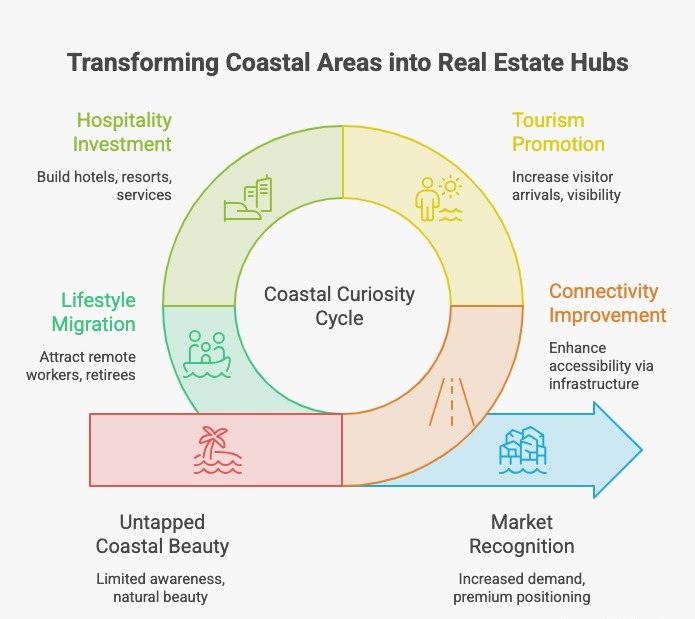
Curiosity → Infrastructure → Tourism Growth → Hospitality Investment → Lifestyle Migration → Residential Demand → Market Maturity
This sequence can be described as the Coastal Curiosity Cycle.
Unlike mature urban markets where demand is already established, emerging coastal destinations generate interest through future potential rather than present transaction volumes. Investors begin paying attention because they recognize signals that suggest a destination may be entering a new phase of growth.
Why Curiosity Appears Before Demand
One of the most misunderstood aspects of destination development is the timing of interest.
By the time property demand becomes visible through rising prices and increasing transaction activity, much of the initial curiosity has already occurred.
Early indicators often include:
- New airport announcements
- Highway expansion projects
- Increased tourism arrivals
- Hospitality brand entries
- Government infrastructure spending
- Improved digital visibility
- Media attention
These factors create awareness long before they translate into measurable real estate demand.
For investors, curiosity often begins when a destination’s future narrative becomes more compelling than its present reality.
The Attention Economy of Real Estate
Modern real estate markets increasingly operate within an attention economy.
Before capital flows into a location, attention typically arrives first.
Social media creators, travel influencers, tourism campaigns, hospitality brands, and infrastructure announcements collectively increase destination visibility. As awareness grows, so does investor interest.
This phenomenon is particularly evident in emerging coastal destinations, where perception frequently precedes market expansion.
Research in tourism economics consistently shows that destination branding significantly influences visitation patterns and investment sentiment.
How Destinations Create Value Before Transactions Increase
A destination does not need to experience rapid transaction growth to become more valuable.
In many cases, value creation begins through:
- Improved accessibility
- Better tourism infrastructure
- Economic diversification
- Enhanced destination branding
- Lifestyle migration
These changes strengthen the destination’s long-term attractiveness, creating conditions that may support future demand.
For this reason, emerging coastal destinations are often studied not only through current market performance but also through indicators of future transformation.
The Psychology Behind Investor Interest in Emerging Coastal Destinations
Real estate decisions are rarely driven by numbers alone.
Psychology plays a critical role, particularly in destinations where future potential is still developing.
The growing interest in emerging coastal destinations reflects a combination of economic logic and behavioral factors.
Scarcity Creates Attention
Unlike urban expansion corridors, coastlines are finite.
Additional beachfront land cannot be manufactured.
This natural scarcity contributes to long-term investor interest because supply remains inherently limited.
Many of the world’s most valuable residential markets—from Monaco and Miami to parts of Goa and the French Riviera—derive part of their appeal from geographical constraints.
Investors understand that scarce assets often attract premium demand over time.
The Search for Future Growth Stories
Historically, some of the strongest wealth creation opportunities have emerged before destinations became widely recognized.
As a result, investors often search for locations that exhibit characteristics similar to previously successful markets.
Common indicators include:
- Tourism growth
- Infrastructure investments
- Increasing hospitality activity
- Growing media visibility
- Lifestyle migration
This search for future growth stories explains why emerging coastal destinations increasingly attract attention from sophisticated investors.
Lifestyle Aspirations Are Influencing Investment Decisions
A major shift is occurring globally.
Property ownership is no longer viewed solely through the lens of financial returns.
Increasingly, buyers seek assets that provide:
- Lifestyle benefits
- Wellness opportunities
- Family experiences
- Nature connectivity
- Flexible usage
Coastal destinations often align naturally with these aspirations.
The Global Wellness Institute estimates that the wellness economy continues to expand globally, influencing residential preferences and destination choices.
The Rise of Experience-Based Asset Ownership
Younger affluent buyers, entrepreneurs, NRIs, and family offices are increasingly prioritizing experiences over traditional status symbols.
This trend has elevated demand for locations that offer:
- Scenic environments
- Lower-density living
- Outdoor recreation
- Cultural authenticity
- Quality-of-life advantages
Many emerging coastal destinations possess these characteristics naturally, making them attractive to individuals seeking a balance between lifestyle and long-term asset ownership.
Infrastructure: The First Trigger of Coastal Market Transformation
If curiosity is the spark, infrastructure is often the catalyst.
Few factors influence destination evolution more consistently than improved connectivity.
Across global coastal markets, infrastructure development repeatedly emerges as the earliest and most reliable indicator of future transformation.
The Airport Effect
Airports have historically played a crucial role in reshaping coastal destinations.
Improved air connectivity:
- Reduces travel time
- Expands tourism catchment areas
- Increases business travel
- Supports hospitality growth
- Encourages investment activity
The impact of airport infrastructure can be observed across numerous international destinations.
Case Study: Bali
Bali’s transformation into a globally recognized tourism and residential destination was heavily supported by the development and expansion of Ngurah Rai International Airport.
Improved accessibility accelerated visitor growth, hospitality investment, and broader economic activity.
Case Study: Phuket
Phuket experienced similar growth patterns following airport expansion and tourism infrastructure development.
The destination evolved from a regional tourism market into one of Southeast Asia’s most established hospitality and residential locations.
India’s Emerging Airport-Led Growth Corridors
India is increasingly witnessing similar trends.
The operationalization of Manohar International Airport (Mopa Airport) in Goa has significantly enhanced connectivity to North Goa and surrounding coastal regions.
Improved accessibility has strengthened tourism potential, increased investor attention, and supported broader regional development.
Highways and Regional Connectivity
While airports attract national and international visitors, highways influence regional accessibility.
Reduced travel times can fundamentally alter destination economics.
Examples include:
- Mumbai–Goa Highway upgrades
- East Coast Road corridor in Chennai
- Konkan connectivity improvements
These projects make coastal regions more accessible for tourists, businesses, and long-term residents.
According to the Ministry of Road Transport and Highways, improved road infrastructure remains a key driver of regional economic integration and tourism development.
Ports, Maritime Corridors and Coastal Economic Activity
Infrastructure-led growth extends beyond tourism.
India’s Sagarmala Programme seeks to promote port-led development, logistics efficiency, industrial growth, and coastal economic development.
This is particularly important because sustainable demand in emerging coastal destinations increasingly depends on diversified economic activity rather than tourism alone.
Port infrastructure can generate:
- Employment
- Trade activity
- Logistics investment
- Industrial growth
- Ancillary services
These factors strengthen local economies and contribute to broader demand creation.
Why Infrastructure Matters More Than Popularity
A destination may be popular without being economically transformative.
Conversely, a destination may be relatively unknown while possessing strong infrastructure fundamentals.
History repeatedly demonstrates that infrastructure frequently precedes recognition.
Airports create access.
Roads create mobility.
Ports create economic activity.
Together, they establish the foundation upon which tourism, hospitality, migration, and eventually real estate demand can grow.
For this reason, infrastructure remains one of the most important variables when analyzing the future potential of emerging coastal destinations.
Tourism-Led Development: The Foundation of Coastal Demand
While infrastructure creates access, tourism creates visibility.
Across the world, some of the most successful coastal real estate markets began their journey as tourism destinations rather than property markets. Before investors started evaluating land values, rental yields, or capital appreciation potential, travelers were already discovering these locations for their natural beauty, culture, climate, and lifestyle experiences.
This is one of the most important lessons from destination development: tourism often acts as the first economic engine that introduces a location to the wider world.
For many emerging coastal destinations, tourism serves as the catalyst that gradually attracts hospitality operators, businesses, entrepreneurs, investors, and eventually long-term residents.
According to the United Nations World Tourism Organization (UN Tourism), tourism remains one of the world’s largest economic sectors, supporting employment, infrastructure investment, local businesses, and regional development.
Why Tourism Often Arrives Before Real Estate Growth
Tourism lowers the barrier to destination discovery.
People are far more likely to visit a location as tourists before considering it as a place to invest, retire, relocate, or purchase a second home.
The typical progression looks like this:
Tourist → Repeat Visitor → Long-Stay Visitor → Second-Home Buyer → Investor
This progression has been observed in destinations ranging from Bali and Phuket to Goa and Alibaug.
A destination that attracts repeat visitors often creates familiarity. Familiarity builds trust. Trust eventually supports investment decisions.
This explains why tourism data is often one of the earliest indicators studied when evaluating emerging coastal destinations.
The Visitor-to-Resident Conversion Cycle
One of the most fascinating aspects of coastal destination development is how tourism gradually transforms into residential demand.
A visitor who spends a few days in a destination may initially be attracted by:
- Beaches
- Weather
- Natural landscapes
- Hospitality experiences
- Local culture
However, repeat exposure often reveals deeper advantages:
- Lower-density living
- Better quality of life
- Community experiences
- Wellness opportunities
- Remote work feasibility
Over time, a percentage of visitors begin considering longer stays, second homes, or permanent relocation.
This conversion process has become increasingly important in a post-pandemic world where flexibility and lifestyle have become major decision-making factors.
Tourism Creates Economic Multipliers
Tourism’s influence extends far beyond visitor numbers.
When tourism expands, it creates demand across multiple sectors:
- Hotels
- Restaurants
- Transportation
- Retail
- Entertainment
- Wellness services
- Local entrepreneurship
The World Travel & Tourism Council estimates that tourism contributes significantly to employment and economic activity globally, creating extensive multiplier effects across local economies.
For emerging coastal destinations, these multiplier effects are especially important because they create jobs and income streams that support long-term residential demand.
The Role of Destination Branding
Tourism growth today is increasingly influenced by destination branding.
A destination’s image can shape investor perceptions years before significant real estate activity emerges.
Modern destination branding is influenced by:
- Tourism campaigns
- Social media visibility
- Influencer content
- Travel publications
- Hospitality brands
- Government promotion initiatives
The destinations that successfully combine natural appeal with strong branding often experience greater visibility among both travelers and investors.
This attention becomes a valuable asset in itself.
India’s Coastal Tourism Opportunity
India’s tourism potential remains substantial.
According to the Ministry of Tourism, domestic tourism continues to be a major driver of economic activity across multiple regions.
With more than 7,500 kilometers of coastline and growing demand for experiential travel, many emerging coastal destinations are increasingly benefiting from domestic tourism growth.
As travel patterns evolve, destinations that combine accessibility, sustainability, culture, and lifestyle experiences may attract increasing attention over the coming decade.
The Hospitality Signal: What Hotels Reveal About Future Markets
If tourism introduces a destination to visitors, hospitality investment often provides one of the strongest signals of future confidence.
In many cases, hotel operators, resort developers, and hospitality investors move into a destination long before residential developers scale their activities.
This is why hospitality investment is frequently viewed as a leading indicator of destination maturity.
Why Hospitality Investors Often Move First
Hospitality operators evaluate destinations using rigorous demand analysis.
Before investing, they typically assess:
- Tourism growth
- Accessibility
- Visitor demographics
- Spending patterns
- Infrastructure quality
- Long-term destination potential
When hotel brands choose to enter a destination, they are effectively expressing confidence in future visitor demand.
For investors studying emerging coastal destinations, hospitality activity often serves as an early validation mechanism.
Hotels as Economic Anchors
Hotels do more than accommodate visitors.
They help create:
- Employment
- Local supply chains
- Retail demand
- Food and beverage ecosystems
- Event activity
- Destination visibility
Large hospitality investments often attract additional businesses and supporting services, accelerating local economic development.
This pattern has been observed repeatedly across coastal destinations worldwide.
Hospitality and Residential Demand: The Hidden Connection
A growing hospitality ecosystem can influence residential demand in several ways.
First, it increases destination familiarity.
Second, it improves service infrastructure.
Third, it enhances the overall visitor experience.
Over time, these factors may encourage repeat visitors to explore longer-term ownership opportunities.
This relationship helps explain why many successful coastal markets first experienced hospitality growth before significant residential expansion.
Global Examples
Bali
International hospitality investment played a major role in transforming Bali from a tourism destination into a globally recognized lifestyle and residential market.
Phuket
Resort development accelerated tourism growth, which later contributed to increasing residential demand.
Algarve
Portugal’s Algarve region experienced substantial tourism-driven growth supported by hospitality expansion, eventually becoming one of Europe’s most sought-after lifestyle destinations.
These examples illustrate how hospitality often acts as a bridge between tourism and real estate demand.
Hospitality Trends in India
India’s hospitality sector continues to attract significant investment.
According to industry reports from leading real estate consultancies, branded hospitality expansion is increasingly targeting leisure and coastal markets due to rising domestic travel demand.
As hospitality footprints expand, many emerging coastal destinations may benefit from improved visibility and broader economic activity.
How Lifestyle Migration Is Reshaping Coastal Real Estate
Perhaps the most important structural shift influencing emerging coastal destinations today is lifestyle migration.
Historically, coastal regions were primarily associated with tourism and seasonal visitation.
Today, they are increasingly becoming places where people choose to live, work, retire, and spend extended periods of time.
This transformation is changing the way investors evaluate coastal markets.
The Rise of Location Flexibility
The widespread adoption of digital technologies and hybrid work models has reduced dependence on traditional urban centers.
Many professionals can now work remotely while maintaining access to national and international opportunities.
As a result, location decisions are increasingly influenced by lifestyle preferences rather than workplace proximity.
This trend has created new opportunities for emerging coastal destinations that offer:
- Quality natural environments
- Better work-life balance
- Lower-density living
- Recreational opportunities
- Improved connectivity
Wellness Is Becoming a Residential Priority
The Global Wellness Institute estimates that the global wellness economy continues to expand significantly, influencing consumer preferences across multiple sectors.
Increasingly, people are prioritizing:
- Physical wellbeing
- Mental wellness
- Outdoor living
- Nature connectivity
- Environmental quality
Coastal environments naturally align with many of these preferences.
This makes emerging coastal destinations attractive not only as tourism locations but also as long-term lifestyle destinations.
Retirement Migration and Long-Stay Living
Demographic changes are also contributing to coastal demand.
Many retirees increasingly seek locations that provide:
- Pleasant climates
- Healthcare accessibility
- Community environments
- Lifestyle amenities
Globally, retirement migration has become an important component of coastal market growth.
As populations age and life expectancy increases, destinations that offer quality-of-life advantages may continue attracting long-term residents.
Why Families Are Looking Beyond Cities
Urban centers remain important economic hubs.
However, many families are increasingly evaluating factors such as:
- Air quality
- Access to nature
- Community experiences
- Wellness opportunities
- Lifestyle quality
These preferences are influencing residential decisions in ways that support the growth of emerging coastal destinations.
The New Definition of Coastal Demand
Coastal demand is no longer driven exclusively by tourism.
Today it increasingly reflects a combination of:
- Lifestyle migration
- Remote work flexibility
- Wellness priorities
- Retirement planning
- Second-home ownership
- Long-stay living
This broader demand base may prove more resilient than traditional tourism-led demand alone.
As a result, investors, policymakers, and researchers are paying closer attention to the demographic and behavioral shifts shaping the future of emerging coastal destinations.
NRI, HNI and Family Office Investment Behaviour in Coastal Markets
While tourism creates visibility and infrastructure improves accessibility, the next stage in the evolution of many emerging coastal destinations is often marked by the arrival of affluent investors.
Historically, High-Net-Worth Individuals (HNIs), Non-Resident Indians (NRIs), Ultra-HNIs, and family offices tend to identify destination trends earlier than the broader market. Their investment decisions are frequently influenced not only by immediate returns but also by long-term wealth preservation, lifestyle value, scarcity, and generational planning.
This behavior has played a significant role in shaping some of the world’s most recognized coastal property markets.
Why Affluent Investors Often Enter Before Mainstream Buyers
Institutional investors typically wait for evidence.
Affluent investors often invest based on conviction.
When evaluating emerging coastal destinations, they frequently focus on long-term structural trends rather than short-term market cycles.
These trends include:
- Infrastructure expansion
- Tourism growth
- Economic diversification
- Lifestyle migration
- Scarcity of developable coastal land
By entering markets during the early stages of destination development, affluent investors position themselves ahead of broader demand cycles.
This pattern has been observed in destinations such as:
- Goa
- Alibaug
- Bali
- Phuket
- Algarve
- Costa del Sol
In each case, early investors often arrived before large-scale institutional participation.
Coastal Assets and the Concept of Scarcity
One reason coastal real estate attracts affluent investors is scarcity.
Unlike urban developments that can expand outward through new corridors, coastlines are finite.
The amount of accessible, legally developable, environmentally compliant coastal land is naturally limited.
This scarcity creates three important investment characteristics:
1. Limited Supply
Additional coastline cannot be created.
2. Lifestyle Utility
The asset can provide personal enjoyment alongside ownership.
3. Long-Term Relevance
Demand for coastal environments has remained consistent across generations.
For many HNIs and NRIs, these factors make emerging coastal destinations particularly attractive from a wealth preservation perspective.
The Rise of Second-Home Investment
The global second-home market has undergone significant transformation over the past decade.
Historically, second homes were viewed primarily as vacation properties.
Today, they are increasingly being considered:
- Lifestyle assets
- Flexible residences
- Long-stay homes
- Retirement options
- Legacy assets
According to the Knight Frank Wealth Report, affluent buyers globally continue to allocate capital toward lifestyle-oriented real assets, including coastal and resort-linked properties.
This trend is contributing to growing interest in emerging coastal destinations where quality-of-life factors align with long-term ownership goals.
NRI Investment Patterns Are Evolving
NRIs have historically played a significant role in India’s property market.
However, investment motivations are evolving.
Beyond traditional metropolitan markets, NRIs are increasingly exploring destinations that offer:
- Lifestyle advantages
- Family usage potential
- Retirement flexibility
- Future relocation opportunities
- Long-term wealth diversification
India’s improving infrastructure and expanding coastal tourism ecosystem are creating new areas of interest for global Indian investors.
According to the Reserve Bank of India, remittance inflows continue to place India among the world’s largest recipients of international remittances.
As wealth creation among overseas Indians grows, interest in diversified real estate ownership is expected to remain strong.
Family Offices Are Thinking Generationally
Perhaps the most influential investors in destination development are family offices.
Unlike traditional investors focused on shorter holding periods, family offices often evaluate opportunities through a multi-generational lens.
Their priorities typically include:
- Capital preservation
- Legacy creation
- Portfolio diversification
- Tangible asset ownership
- Long-term appreciation potential
Because of these priorities, emerging coastal destinations frequently align with family office investment strategies.
A destination that may require 10–15 years to fully mature can still be attractive if it demonstrates strong long-term fundamentals.
The Blue Economy: An Emerging Growth Driver Beyond Tourism
Tourism often receives the most attention when discussing coastal development.
However, some of the most significant long-term growth opportunities may come from a broader economic framework known as the Blue Economy.
For investors seeking to understand the future of emerging coastal destinations, the Blue Economy represents one of the most important structural trends of the coming decade.
What Is the Blue Economy?
The World Bank defines the Blue Economy as the sustainable use of ocean resources for economic growth, livelihoods, employment, and ecosystem health.
The concept extends far beyond tourism.
It includes:
- Fisheries
- Maritime trade
- Port infrastructure
- Coastal logistics
- Marine tourism
- Renewable energy
- Aquaculture
- Ocean technology
For coastal regions, this creates economic diversification that supports long-term demand.
India’s Growing Focus on the Blue Economy
India is increasingly positioning the Blue Economy as a strategic growth pillar.
NITI Aayog has highlighted the significant potential of India’s coastal regions in supporting economic development, employment creation, and sustainable growth.
India’s advantages include:
- More than 7,500 km of coastline
- Strategic maritime trade routes
- Major and minor ports
- Expanding coastal infrastructure
- Strong tourism potential
These factors create opportunities that extend beyond traditional tourism-driven growth.
Why Economic Diversification Matters
One challenge faced by many tourism-dependent destinations is seasonality.
Markets reliant on tourism alone may experience fluctuations in activity and demand.
A diversified coastal economy creates greater resilience.
When coastal regions benefit from:
- Trade
- Logistics
- Marine industries
- Fisheries
- Tourism
- Services
they develop multiple economic engines.
This diversified foundation often supports more sustainable growth trajectories for emerging coastal destinations.
Port-Led Development and Regional Transformation
Infrastructure programs such as India’s Sagarmala initiative demonstrate how coastal regions can become major economic corridors.
The Sagarmala Programme aims to enhance port connectivity, logistics efficiency, and coastal industrial development.
Historically, port-led development has played an important role in transforming numerous coastal economies worldwide.
For investors, this highlights an important point:
The future of coastal regions is increasingly linked to broader economic activity rather than tourism alone.
Sustainability and Coastal Growth
The Blue Economy is also closely tied to sustainability.
Future coastal growth will increasingly depend on:
- Responsible resource management
- Climate resilience
- Environmental protection
- Sustainable tourism
- Conservation initiatives
As environmental awareness grows, destinations that balance development with ecological stewardship may become increasingly attractive to residents, investors, and policymakers alike.
Lessons from Coastal Markets That Successfully Matured
Although every destination evolves differently, successful coastal markets often share remarkably similar development patterns.
Studying these examples provides valuable insight into how emerging coastal destinations progress from relative obscurity to national or international recognition.
Case Study 1: Goa – India’s Most Recognized Coastal Evolution Story
Early Stage
Several decades ago, Goa was primarily viewed as a tourism destination.
Property demand remained relatively limited outside local markets.
Key Growth Triggers
- Airport connectivity
- Tourism expansion
- Hospitality investments
- National visibility
- Lifestyle migration
Long-Term Outcome
Today Goa attracts:
- Domestic investors
- NRIs
- Entrepreneurs
- Second-home buyers
- Hospitality operators
The destination demonstrates how tourism, infrastructure, and lifestyle demand can collectively reshape a coastal market.
Case Study 2: Alibaug – The Weekend Destination That Became a Lifestyle Market
Early Stage
Alibaug initially gained attention as a weekend retreat for Mumbai residents.
Key Growth Triggers
- Ferry connectivity
- Road improvements
- Celebrity adoption
- Lifestyle appeal
Long-Term Outcome
The destination evolved into one of India’s most recognized coastal lifestyle markets.
The lesson is clear:
Accessibility can transform perception.
Case Study 3: East Coast Road, Chennai
Early Stage
The East Coast Road corridor was primarily associated with leisure travel.
Key Growth Triggers
- Road infrastructure upgrades
- Urban expansion
- Residential development
Long-Term Outcome
The corridor gradually evolved into an important residential and lifestyle destination.
This example demonstrates how transportation infrastructure can redefine coastal geography.
Case Study 4: Bali – A Global Example of Destination Transformation
Early Stage
Bali was known primarily as a tourism destination.
Key Growth Triggers
- Airport expansion
- International tourism
- Hospitality investments
- Digital nomad migration
Long-Term Outcome
Bali has become one of the world’s most recognized lifestyle and residential destinations.
Its evolution illustrates how tourism visibility can eventually support broader residential demand.
Common Patterns Across Successful Coastal Markets
Despite geographic differences, successful coastal destinations frequently share similar characteristics.
Growth Trigger | Long-Term Impact |
Airport Development | Increased Accessibility |
Highway Connectivity | Regional Integration |
Tourism Growth | Destination Visibility |
Hospitality Investment | Market Confidence |
Lifestyle Migration | Residential Demand |
Economic Diversification | Sustainable Growth |
Environmental Quality | Long-Term Appeal |
Strong Branding | Global Recognition |
These recurring patterns provide a useful framework for evaluating emerging coastal destinations around the world.
Destination Maturity and the Real Estate Appreciation Curve
One of the most overlooked concepts in real estate investing is destination maturity.
Not all destinations are at the same stage of development.
Understanding where a market sits within its lifecycle can provide valuable context when evaluating future potential.
The Five Stages of Destination Evolution
Stage 1: Discovery
- Limited awareness
- Minimal infrastructure
- Low transaction activity
Stage 2: Curiosity
- Growing attention
- Infrastructure announcements
- Early tourism growth
Stage 3: Development
- Hospitality expansion
- Improved connectivity
- Increasing investment activity
Stage 4: Recognition
- National visibility
- Strong tourism performance
- Expanding residential demand
Stage 5: Maturity
- Established reputation
- Higher valuations
- Institutional participation
Where Does Most Appreciation Historically Occur?
Historically, the largest percentage growth often occurs between:
Curiosity Stage → Recognition Stage
This period typically includes:
- Infrastructure delivery
- Tourism acceleration
- Increased destination awareness
- Hospitality expansion
- Growing investor participation
Once a destination reaches full maturity, growth may continue, but appreciation often becomes more incremental.
This is one reason investors, analysts, and policymakers closely monitor emerging coastal destinations during their early stages of evolution.
Why Destination Maturity Matters
Understanding maturity helps answer critical questions:
- Is growth infrastructure-led or demand-led?
- Is tourism established or emerging?
- Has hospitality investment arrived?
- Is economic diversification occurring?
- Are migration patterns changing?
The answers often reveal more about a destination’s future trajectory than current property prices alone.
For this reason, destination maturity has become an increasingly important framework for evaluating long-term opportunities in emerging coastal destinations.
Emerging Trends Shaping Coastal Destinations in 2026 and Beyond
The next decade is expected to redefine how people interact with coastal regions. While tourism and infrastructure will continue to influence growth, the future of emerging coastal destinations will increasingly be shaped by sustainability, technology, wellness, demographic shifts, and changing ownership models.
For investors, policymakers, and business leaders, understanding these trends is essential because tomorrow’s most successful destinations may look very different from those that dominated the last two decades.
Managed Second Homes Are Becoming Mainstream
Traditionally, second-home ownership came with operational challenges.
Owners often faced concerns related to:
- Maintenance
- Security
- Property management
- Seasonal occupancy
- Upkeep during periods of absence
Today, managed ownership models are becoming increasingly popular across global leisure markets.
Professional management services allow owners to maintain their properties efficiently while improving convenience and usability.
This trend is particularly relevant for emerging coastal destinations, where many buyers are seeking flexible ownership solutions rather than permanent residency.
As ownership models evolve, convenience is becoming as important as location.
Wellness and Longevity Communities Are Reshaping Demand
Health and wellness are no longer niche lifestyle preferences.
They are becoming central components of residential decision-making.
According to the Global Wellness Institute, the global wellness economy continues to expand as consumers prioritize physical health, mental wellbeing, preventive healthcare, and quality-of-life factors.
As a result, many emerging coastal destinations are increasingly being viewed through a wellness lens.
Factors driving this shift include:
- Access to nature
- Outdoor recreation
- Cleaner environments
- Lower population density
- Slower-paced lifestyles
The growing popularity of wellness-oriented living may significantly influence future residential preferences.
Climate-Conscious Development Is Becoming Essential
Climate resilience is rapidly moving from a sustainability discussion to an investment consideration.
Investors, governments, developers, and financial institutions increasingly recognize that long-term value creation depends on environmental stewardship.
Future coastal development strategies are expected to focus on:
- Resilient infrastructure
- Responsible land use
- Coastal ecosystem protection
- Sustainable tourism
- Climate adaptation measures
The World Bank continues to emphasize climate resilience as a critical component of sustainable coastal development.
For emerging coastal destinations, sustainability may become one of the defining factors separating long-term success from short-term growth.
The Rise of Digital Nomads and Location-Independent Professionals
One of the most significant post-pandemic shifts has been the growing acceptance of remote and hybrid work.
Professionals are increasingly evaluating where they want to live rather than where they are required to live.
This has created opportunities for destinations that offer:
- Reliable connectivity
- Quality lifestyle environments
- Recreation opportunities
- Community experiences
- Accessibility
The World Economic Forum has highlighted how digital transformation continues to influence work patterns and geographic flexibility.
As workplace flexibility expands, many emerging coastal destinations may benefit from growing demand among professionals seeking a different balance between work and lifestyle.
Experience-Led Real Estate Is Replacing Traditional Ownership Models
Historically, real estate decisions were heavily influenced by physical attributes such as location, size, and accessibility.
Today, experience has become a major value driver.
Modern buyers increasingly evaluate:
- Lifestyle quality
- Community experiences
- Wellness opportunities
- Cultural authenticity
- Environmental quality
This shift is transforming how destinations compete for attention.
The future of emerging coastal destinations may depend not only on infrastructure and tourism but also on their ability to deliver meaningful experiences that encourage repeat visitation, longer stays, and eventual ownership.
Risks and Considerations Investors Should Evaluate
While the opportunities associated with emerging coastal destinations are significant, responsible investing requires a balanced understanding of potential risks.
Successful destination development depends on multiple variables working together over long periods of time.
Investors should therefore evaluate both opportunities and challenges.
Environmental Risks
Coastal environments are dynamic by nature.
Potential considerations include:
- Coastal erosion
- Sea-level rise
- Flood risks
- Extreme weather events
- Ecological sensitivity
Environmental due diligence has become increasingly important when evaluating coastal markets.
Investors should consider local environmental regulations, conservation measures, and climate resilience strategies.
Infrastructure Execution Risk
Infrastructure announcements often generate attention.
However, not every announced project progresses according to initial timelines.
Investors should assess:
- Project implementation status
- Funding availability
- Government approvals
- Construction progress
- Connectivity timelines
Understanding execution risk helps create more realistic expectations regarding destination evolution.
Regulatory Considerations
Coastal regions frequently operate under specialized planning and environmental regulations.
In India, Coastal Regulation Zone (CRZ) guidelines play an important role in managing coastal development.
Understanding regulatory frameworks is essential for assessing long-term sustainability and compliance.
Tourism Dependency
Tourism remains a powerful growth engine.
However, destinations that rely exclusively on tourism may experience cyclical fluctuations.
This is why economic diversification has become increasingly important.
Markets supported by multiple sectors such as:
- Tourism
- Logistics
- Marine industries
- Services
- Hospitality
- Trade
often demonstrate greater resilience over time.
Oversupply and Market Saturation
Rapid development can occasionally outpace demand.
Investors should monitor:
- Supply pipelines
- Hospitality inventory
- Infrastructure capacity
- Long-term demographic trends
Balanced growth generally supports healthier market evolution than excessive short-term expansion.
Key Takeaways: What Creates Long-Term Curiosity Around Coastal Destinations?
The evolution of emerging coastal destinations is rarely driven by a single factor.
Instead, it is typically the result of multiple forces working together over time.
1. Infrastructure Creates Access
Airports, highways, ports, and transportation networks reduce barriers and connect destinations to broader markets.
2. Tourism Creates Visibility
Visitors introduce destinations to the wider world and establish the foundation for broader economic activity.
3. Hospitality Creates Confidence
Hotels and resorts often serve as early indicators of long-term destination potential.
4. Lifestyle Migration Creates Demand
Remote work, wellness priorities, and changing lifestyle preferences are expanding residential demand beyond traditional urban centers.
5. Economic Diversification Creates Stability
Tourism alone is rarely sufficient. Sustainable growth often depends on multiple economic drivers.
6. The Blue Economy Creates Opportunity
Marine industries, logistics, tourism, fisheries, and coastal services contribute to long-term economic resilience.
7. Sustainability Creates Longevity
Environmental stewardship increasingly influences destination attractiveness and investment confidence.
8. Curiosity Often Precedes Recognition
Many successful destinations first attracted attention long before they became mainstream markets.
Why Coastal Curiosity Matters More Than Coastal Popularity
Throughout history, some of the world’s most successful coastal markets have followed a remarkably consistent pattern.
Long before they became recognized destinations, they experienced a period of curiosity.
During this phase, infrastructure improved, tourism expanded, hospitality investment increased, and economic activity diversified. Investors, entrepreneurs, travelers, and policymakers began paying attention—not necessarily because the destination had already matured, but because its future potential was becoming increasingly visible.
This pattern continues to shape emerging coastal destinations around the world.
As global mobility increases, infrastructure networks expand, wellness-driven lifestyles gain importance, and economic activity becomes more decentralized, coastal regions are attracting broader interest than ever before.
For investors, the lesson is not simply about identifying popular locations.
It is about understanding the forces that transform places over time.
Accessibility, tourism, hospitality, migration, sustainability, and economic diversification all contribute to the evolution of destinations. When these factors align, curiosity often emerges first, followed by broader recognition and long-term demand.
Ultimately, the future of emerging coastal destinations will not be determined by popularity alone.
It will be shaped by their ability to create enduring value through infrastructure, economic resilience, environmental responsibility, and quality-of-life advantages that remain relevant for decades to come.
FAQs
1. What are emerging coastal destinations?
Emerging coastal destinations are coastal regions that are gaining attention due to improving infrastructure, tourism growth, economic development, and lifestyle appeal but have not yet reached full market maturity.
2. Why do investors monitor emerging coastal destinations?
Investors often track emerging coastal destinations because infrastructure, tourism, and economic development trends may indicate future growth potential before markets become widely recognized.
3. How does tourism influence real estate demand?
Tourism increases destination visibility, supports local businesses, creates employment, and often introduces visitors to locations that may later attract residential demand.
4. What infrastructure projects have the greatest impact on coastal development?
Airports, highways, ports, rail connectivity, and tourism infrastructure are among the most influential catalysts for destination growth.
5. Why are HNIs and NRIs interested in coastal markets?
Many affluent investors are attracted by scarcity, lifestyle value, wealth preservation opportunities, and the long-term appeal of coastal environments.
6. What role does the Blue Economy play in coastal development?
The Blue Economy supports economic activity through sectors such as marine tourism, fisheries, logistics, maritime trade, renewable energy, and coastal services.
7. How can investors evaluate destination maturity?
Destination maturity can be assessed through indicators such as infrastructure development, tourism growth, hospitality investment, economic diversification, and demographic trends.
8. What risks should be considered before evaluating coastal markets?
Key considerations include environmental factors, regulatory frameworks, infrastructure execution timelines, tourism dependency, and long-term sustainability.